Top posts on Progressive Geographies this week

Posted in Uncategorized | Leave a comment

Neoliberal Dogma? Revisiting Foucault on Social Security, Healthcare, and Autonomy (Pt. II of II)

The second part of a discussion of Foucault and social security, this time on health.

Posted in Uncategorized | Leave a comment

A request for help – some difficult-to-find texts by Michel Foucault

I wonder if anyone reading can help locate copies of these texts by, or about, Foucault. Texts crossed out are ones that I have been sent copies of already.

Michel Foucault, “Photogenic painting”, translated by Pierre A. Walker, Critical texts, Vol 6 No 3, 1989, pp. 1-12; also in Gilles Deleuze and Michel Foucault, Gérald Fromanger: Photogenic Painting/La peinture photogénique, French-English edition, London: Black Dog, 1999, pp. 81-104. Michel Foucault, “Dialogue on power” in Simeon Wade, Chez Foucault, 1978, pp. 4-22. Michel Foucault, “Response to Susan Sontag”, Soho News, 2 March 1982, p. 13. “The power and politics of Michel Foucault”, Inside (Daily Californian), 22 April 1983, pp. 7, 20-22. “A last interview with French philosopher Michel Foucault”, City Paper, 8:3, Jul 27-Aug 2 1984, p. 18. Phillip Horwitz, “Don’t cry for me academia”, Jimmy & Lucy’s House of K, 2 August 1984, pp. 78-80. Michel Foucault, “Le gai savoir”, Mec magazine, 5, June 1988, pp. 32-36 and “Le gai savoir II”, Mec magazine, 6-7, July-Aug 1988, pp. 30-33. (There is an English translation of a revised version of the two parts together in Critical Inquiry, and the French of that version is in Jean Bitoux’s Entretiens sur la question gay. But ideally I would like to see the two original parts.)

I’ve tried multiple ways to get hold of copies, so far with no luck. I am sure there are copies of some of these in the IMEC archive, but at the moment I’m hoping not to have to make another trip there. I know some (but not all) are in Dits et écrits, but they are often translations back into French and I’d like to see the original. The references are correct to the best of my knowledge, but obviously I’ve been unable to check and am reliant on other sources. Any help gratefully received – email me or comment below. At the Foucault Resources page on this site, and especially at the page on Uncollected Notes, Lectures and Interviews, there are some other difficult-to-find pieces that I was able to locate.

Posted in Foucault's Last Decade, Michel Foucault, Publishing | 5 Comments

Antipode’s 5th Institute for the Geographies of Justice – application deadline 31st January

Details of the forthcoming Antipode institute in Johannesburg.

Antipode Editorial Office's avatarAntipodeFoundation.org

Antipode’s 5th Institute for the Geographies of Justice
21st-27th June 2015, Johannesburg, South Africa

‘Occupying Radical Geography’

Antipode’s 5th Institute for the Geographies of Justice (IGJ) will take place in Johannesburg, South Africa from 21st to 27th June 2015.

The 2015 IGJ poses the question ‘how do we occupy radical geography today?’. We pose ‘occupation’ as a meta-theme or framework for praxis as we organize engagements across a wide array of debates and concerns inside/outside radical geography. We pose the question to ask how we might occupy and transform radical geography as an occupation, vocation or critical stance.

As radical-geographic practitioners in various ways, the organizing group in Johannesburg will present a platform for transformations with participants, to enable and renew a set of debates pertinent to ‘occupying radical geography’. In doing so, we pose a number of related questions: How do we define radical/critical geographies? How should we…

View original post 804 more words

Posted in Uncategorized | 1 Comment

The Politics of the UK HE Marking Boycott – Part IV: The Betrayal

Another excellent analysis of the UK higher education pension situation. It is spot on with the claim that the union leadership are creating a situation where they can “present a crushing defeat as a victory”.

Lee Jones's avatarThe Disorder Of Things

The farce of UCU’s “resistance” to universities’ attack on employees’ pensions is now reaching its inevitable climax (see Part I, Part II and Part III for background). Readers may recall that the crisis has been provoked by the employers’ association, UUK, seeking to impose dramatic cuts on the basis of a supposed massive deficit in the USS pension scheme – a position exposed as spurious by many academic statisticians and UCU’s actuaries. In previous posts, I have been savagely critical of UCU’s response. In summary, I argued:

the UCU leadership is using the membership as a stage army while seeking to mediate between an increasingly angry membership and the employers. It initiated the marking boycott without first consulting its members on what an acceptable negotiating outcome would be, rushed out its proposals in secret and put them to the employers without first seeking members’ approval, and now seeks…

View original post 854 more words

Posted in Uncategorized | Leave a comment

Tim Ingold on the “Life of Lines” – Radio interview and new book

Tim Ingold on the “Life of Lines” – Radio interview and new book

Jeremy Schmidt's avatarJeremy J Schmidt

An interesting BBC Radio interview with Tim Ingold on Lines. Listen here.

The interview anticipates Ingold’s new book, The Life of Lines, which is due out soon. Here is a description from the publisher’s website:

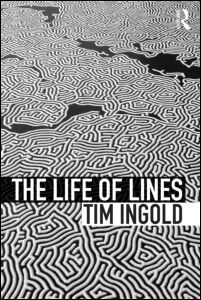
9780415576864“To live, every being must put out a line, and in life these lines tangle with one another. This book is a study of the life of lines. Following on from Tim Ingold’s groundbreaking work Lines: A Brief History, it offers a wholly original series of meditations on life, ground, weather, walking, imagination and what it means to be human. * In the first part, Ingold argues that a world of life is woven from knots, and not built from blocks as commonly thought. He shows how the principle of knotting underwrites both the way things join with one another, in walls, buildings and bodies, and the composition of the ground and the…

View original post 148 more words

Posted in Uncategorized | Leave a comment

CFP: Deleuze and Guattari in the Anthropocene – special issue Deleuze Studies

cfp Deleuze & Guattari in the Anthropocene

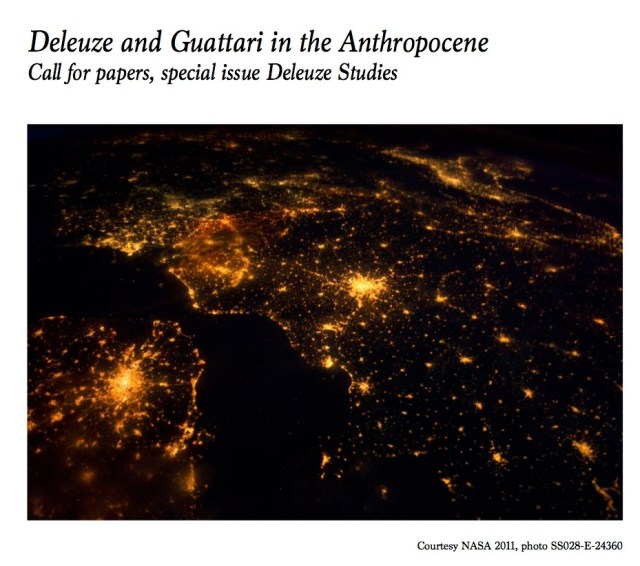
Call for papers, special issue Deleuze Studies – “Deleuze and Guattari in the Anthropocene” – full details in pdf.

This special issue of Deleuze Studies will engage the many philosophical tools provided by Deleuze and Guattari and their interlocutors in order to critically approach our particularly tense moment in earth history. It also asks how this moment could change the ways Deleuze and Guattari are further developed.

We invite considerations of Deleuze, Guattari, or Deleuze-Guattari in relation to the Anthropocene from scholars working in any discipline. Contributions should be 6-8000 words in length and use the journal’s style. Abstracts are due on March 1, 2015. Decisions will be made by the March 15, and final essays due November 1. Articles will then be subject to double-blind peer review and published in 2016.

Please address queries to both editors:

Hannah Stark, School of Humanities, University of Tasmania (Australia) hannah.stark@utas.edu.au

Arun Saldanha, Department of Geography, Environment and Society, University of Minnesota (United States) saldanha@umn.edu

Posted in Felix Guattari, Gilles Deleuze | 2 Comments

Colin Gordon, Foucault, neoliberalism etc. (2015)

Colin Gordon comments on the Foucault and neoliberalism debate. A nuanced, thoughtful and powerful response.

Clare O'Farrell's avatarFoucault News

A Foucault News exclusive.

Colin Gordon, Foucault, neoliberalism etc.

Full PDF of article

 First two pages

The recent online debate triggered by the Ballast interview (translated in Jacobin) with Daniel Zamora will no doubt have helped to publicise Zamora’s book and its forthcoming translation. As publicity for the French and English editions of the book, the interview seems to have been remarkably successful. I noticed the original report in Foucault News partly, I must confess, because it mentioned me and purported to report my views. I have been surprised by the amount of attention the piece has received, which seems to be disproportionate to its merits. The content of the interview, apparently summarising the content of the book, gives the impression that it consists of a mixture of old news and falsification. The old news is that Foucault was not a Marxist or a supporter of any existing model of…

View original post 796 more words

Posted in Uncategorized | 1 Comment

Latour’s obituary for Ulrich Beck

Bruno Latour on Ulrich Beck

doctorzamalek's avatarObject-Oriented Philosophy

And in ArtForum, of all places. You can find it HERE. (Hat tip, Nathan G.)

View original post

Posted in Uncategorized | 1 Comment

‘Maurice Florence’ on Michel Foucault – the missing opening paragraph

One of the things I’ve been doing with the Foucault’s Last Decade project is checking the original publication of texts in several instances, rather than relying on the reprints in Dits et écrits. Sometimes this is because the company Foucault is in can be revealing, or where there were notes or introductions which are removed when it was reprinted. The editors of Dits et écrits sometimes include notes beyond those of Foucault’s, and these are not always marked. So it can be useful to check.

One interesting text which is different in the original to the version in Dits et écrits is the text written by ‘Maurice Florence’, i.e. ‘MF’, which is a thinly-disguised autobiographical work. Foucault co-wrote the text with François Ewald, who was one of the editors of Dits et écrits, along with Daniel Defert. Foucault’s text came from an early version of the introduction to Volume II of the History of Sexuality (for a discussion, see here). In the Dits et écrits version, the opening line is enclosed in brackets, with the note explaining that this was written by Ewald – presumably this alone then, and the rest by Foucault. The version in Essential Works Vol II replicates this format, in a translation by Robert Hurley. There are, though two earlier translations – one by Jackie Urla in History of the Present No 4, and one by Catherine Porter in 1994 for The Cambridge Companion to Michel Foucault. The second edition of The Cambridge Companion does not include this text, with the editor Gary Gutting suggesting that it would be redundant given it is available in Essential Works.

The original publication, in the Dictionnaire des philosophes, begins with this paragraph:
9782130455240FSIl est sans doute encore trop tôt pour apprécier la rupture introduite par Michel Foucault, professeur au Collège de France (chaire d’histoire des systèmes de pensée) depuis 1970, dans un paysage philosophique jusqu’alors dominée par Sartre, et ce que ce dernier désignait comme la philosophie indépassable de notre temps: le marxisme. D’emblée, dès l’Histoire de la folie (1961), Michel Foucault est ailleurs. Il ne s’agit plus de fonder la philosophie sur un nouveau cogito, ni de developer en système des choses jusqu’alors caches aux yeux du monde, mais plutôt d’interroger ce geste énigmatique, peut-être caractéristique des societies occidentales par lequel se trouvent constitutes des discours vrais (donc aussi de la philosophie) avec le pouvoir que l’on sait.

Dictionnaire des philosophes, edited by Denis Huisman, Paris: PUF, Two Volumes, 1984, Vol I, p. 941.

This paragraph is translated in The Cambridge Companion (first edition), but not in Essential Works.
case6.000x9.000.inddIt is doubtless too early to assess the break introduced by Michel Foucault, who has been Professor at the Collège de France (he holds the Chair of the History of Systems of Thought) since 1970, in a philosophic landscape previously dominated by Sartre and by what Sartre called the unsurpassable philosophy of our time, Marxism. From the outset, starting with The History of Madness (1961), Michel Foucault situates himself elsewhere. It is no longer a question of basing philosophy on a new cogito, or of developing a system of things previously hidden from the eyes of the world, but rather of interrogating the enigmatic gesture – a gesture that may be characteristic of Western society – through which true discourses (thus also those of philosophy) are constituted, with their familiar power.

Maurice Florence, “Foucault, Michel, 1926 – “, in Gary Gutting (ed.), The Cambridge Companion to Foucault, Cambridge: Cambridge University Press, 1994, p. 314.

As a paragraph by Ewald, there is clearly a reason for its excision, though it could have been marked in the same way as the sentence by him that was included. Yet equally, Foucault approved the text for the Dictionnaire; it is part of an integral work; and this is an interesting way of positioning his work. Other texts included – such as discussions following lectures, or roundtables – have words from others alongside Foucault’s.

The Cambridge Companion first edition is, of course, out of print, as it has been replaced by the second edition. The Dictionnaire des philosophes is in print, and there is a 2009 edition – I’m not sure if the Foucault text in that is still the one by ‘Maurice Florence’. [Update: The full French text is available here.] Given the historical interest of this presentation, it seemed worthwhile to make this paragraph, in French and English, available again.

(This post is part of the Foucault Resources part of this site, which also includes bibliographies, links to audio and video recordings, some textual comparisons, a few brief translations, and some other pieces.)

Posted in Foucault's Last Decade, Michel Foucault, Publishing | 2 Comments