 critical-theory.com rounds up ‘88 Critical Theory Books That Came Out in 2014‘
Some of these will also be on my end of year list, which I hope to post soon. But plenty more ideas here for things I’ve not yet read…
critical-theory.com rounds up ‘88 Critical Theory Books That Came Out in 2014‘
Some of these will also be on my end of year list, which I hope to post soon. But plenty more ideas here for things I’ve not yet read…
New reviews – including one of Deborah Cowen’s new book – and articles from Antipode. The Christian Parenti piece is open access, as are all the reviews.
Thus far in December we’ve published three new papers, three reviews, and an Antipode lecture.
Papers
The Elusive Inclusive: Black Food Geographies and Racialized Food Spaces by Margaret Marietta Ramírez
Abstract: North American food scholars, activists and policymakers often consider how to make a community food project more inclusive to “vulnerable populations” to increase participation in local food efforts. Drawing from qualitative research conducted with two community food organizations in Seattle, Washington, I argue that inclusive efforts are not addressing the power asymmetries present in organizations and within communities. Engaging with black geographies literature, I reveal how a black food justice organization grapples with violent histories of slavery and dispossession rooted in a black farming imaginary, and works to re-envision this imaginary to one of power and transformation. The spatial imaginaries and spaces of each food organization acknowledge racial histories differentially, informing their activism. Black geographies possess knowledge and spatial…
View original post 826 more words
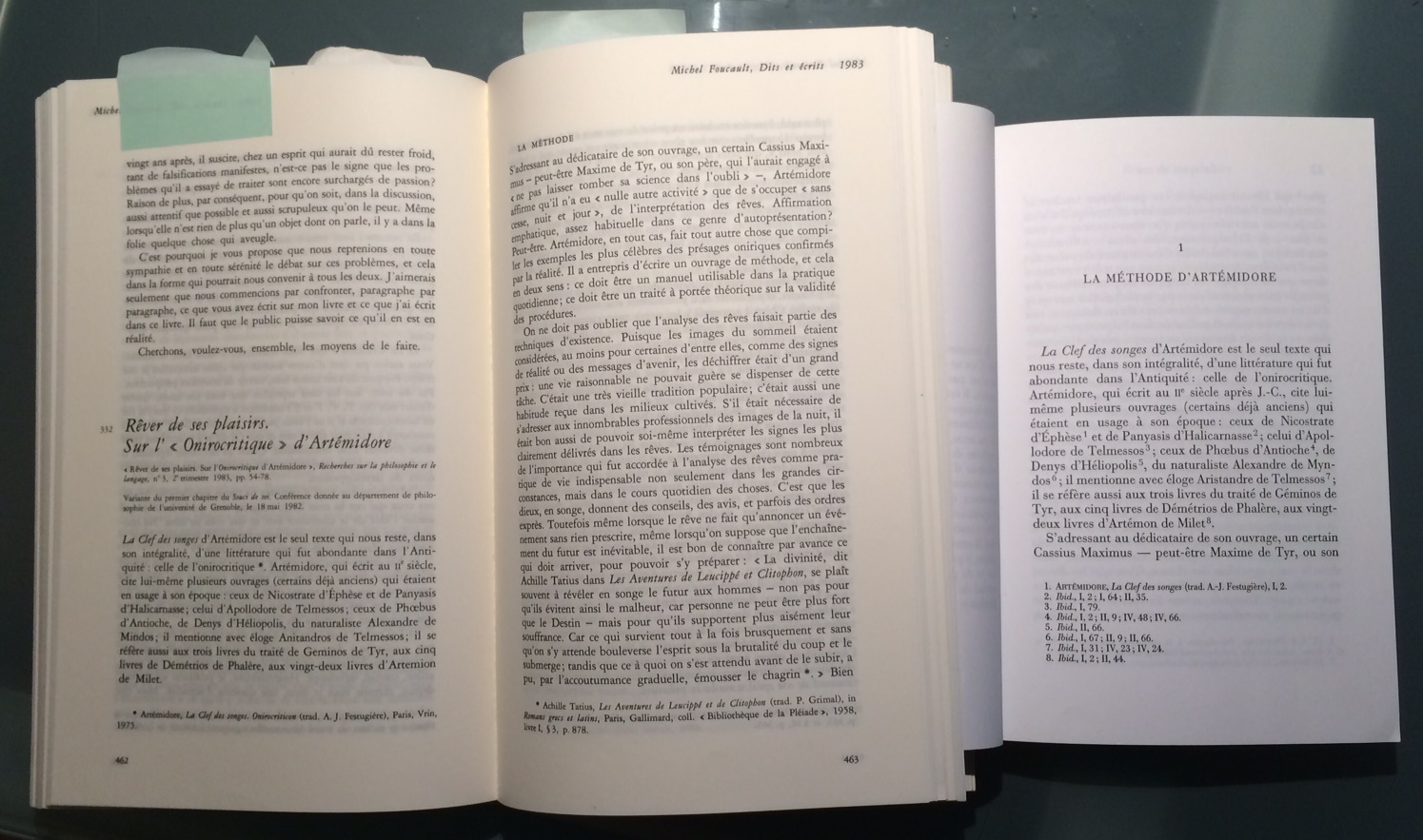
As a kind of appendix to my comparison of the three different introductions to the History of Sexuality volume II, I thought I would share my working notes on the two different versions of the first chapter of History of Sexuality volume III – the only other part which was published before the books. They can be found as a page on this site.
Developing from his 1981 Collège de France lectures, Foucault gave this material as a lecture in Grenoble on 18 May 1982. It would have been a long lecture if all the published text was delivered. It appeared in 1983 as“Rêver de ses plaisirs. Sur l’«Onirocritique» d’Artémidore” in Recherches sur la philosophie et la langage (No 3, pp. 54-78). If anyone can provide me with a copy of this original it would be much appreciated – it appears to be a house publication from Grenoble, and no UK libraries seem to have a copy. It is reprinted in Dits et écrits as text 332. [Update: I do now have a copy.]
This was an early version of the three sections of Chapter I of Le souci de soi/The Care of the Self. There are changes of various kinds between the 1983 version and the final 1984 one in the book. Most are minor. The most important is right at the end – two short paragraphs in the book replace a longer one in the lecture/article. At the end I discuss the cut passage, what replaced it, and speculate on why it didn’t work in the book, with the 1984 arrangement of material between the volumes.
 In 1981 Foucault was profiled in Time magazine – Otto Friedrich with Sandra Burton, “France’s Philosopher of Power”, Time, November 16 1981, pp. 58-9. I’d seen a few references to this piece before, such as in Mark Kelly’s guide to the first volume of the History of Sexuality, so made an effort to find a copy. It took a little while, not least because the pagination is different in the various editions of Time – I’ve seen it referenced to pp. 92-4 and 147-8. Inter-library loan requests led to replies the pages were wrong and therefore it didn’t exist. I did eventually get a copy, only to discover there is a version freely available online here. An interesting piece, much familiar, but a few little things of historical interest.
A useful, thoughtful and judicious discussion of this question by Mitchell Dean.
Mitchell Dean, Michel Foucault’s ‘apology’ for neoliberalism. Lecture delivered at the British Library on the 30th anniversary of the death of Michel Foucault, June 25, 2014, Journal of Political Power, Volume 7, Issue 3, 2014, pages 433-442
Abstract
This lecture evaluates the claim made by one of his closest followers, François Ewald, that Foucault offered an apology for neoliberalism, particularly of the American school represented by Gary Becker. It draws on exchanges between Ewald and Becker in 2012 and 2013 at the University of Chicago shortly before the latter’s death. It places Foucault in relation to the then emergent Second Left in France, the critique of the welfare state, and, more broadly, the late-twentieth-century social-democratic take-up of neoliberal thought. It indicates three limitations of his thought: the problem of state ‘veridiction’; the question of inequality; and the concept of the economy. It also indicates how these might…
View original post 9 more words
Radio Benjamin is reviewed by David Beer in Berfrois. Here’s the opening two paragraphs:

Writing at sometime around 1930 or 1931, Walter Benjamin (p.364) suggested that the voice on the radio is a like a visitor in the home, as such it is “assessed just as quickly and sharply” as any other houseguest. Unfortunately, as far as we are aware, there are no existing audio tapes with which to assess our sympathies for Walter Benjamin’s radio voice. Yet the newly translated collection of the scripts from his various radio broadcasts, gathered in the recently published volume Radio Benjamin, provides us with some insights into what he might have sounded like.
There is an undoubtable audio texture to these printed passages, the grain of his voice and the style of his speech find their way into the prose. But this selection of his radio outputs does more than simply allow us to listen to his imagined voice; these pieces also reveal something of his writing, his working practices and the emergence and formation of some of his key ideas. Far from being an unwelcome and maybe even annoying distraction from his work, as Benjamin himself would have us believe, it would seem, that these broadcasts became an important part of the development of his thinking and writing (as has been briefly suggested by Gilloch, 2002: 170 and Brodersen, 1996: 193).
 At Critical Legal Thinking, Flavio Michele Ceci discusses ‘Homo Sacer: The Last Act’ – the recent publication of Giorgio Agamben’s L’uso dei Corpi — forthcoming in English translation as The Use (or Usage?) of Bodies.
Here’s the first paragraph:
Giorgio Agamben has abandoned Homo sacer. By his own admission in the foreword to his book, and having so acknowledged in the first lecture of his 2014 seminar at the European Graduate School, his latest L’uso dei Corpi—forthcoming in English translation as The Usage of Bodies—will be the last chapter of his 20-year-long research. Abandoned, he said and wrote, because every demanding philosophical effort cannot be pushed to an end, it cannot be concluded.
In these words, there is already a sort of declaration, a signal from the place he belongs and toward the place he currently occupies in western philosophy. Homo sacer ends with a book gathering his writings and ideas over a span of 20 years, reworking the texture of a lifetime’s thought by recollecting its latest inheritance, but mostly — and more importantly — advancing something on the future.
A schema of the whole Homo Sacer series can be found here.
 This is good news – Geographica Helvetica will be open access for both new work and all the archives from 1st January 2015. I’ve been on the board of this journal for the past few years and it’s published some interesting and important work. In it’s own words it “publishes contributions in all fields of geography as well as in related neighbouring disciplines. It is a multi-lingual journal, accepting articles in the three Swiss languages, German, French and Italian, as well as in English. It invites theoretical as well as empirical contributions”. It’s now part of an important shift in publishing patterns – an established and reputable journal moving to open access.
Philip Conway has put together a call for papers for a session or sessions on ‘Rethinking possibilism for an Anthropocenic geopolitics’ for the 2015 RGS-IBG conference. RGS-IBG Conference on ‘Geographies of the Anthropocene’, 1st – 4th September 2015, University of Exeter – full details here.
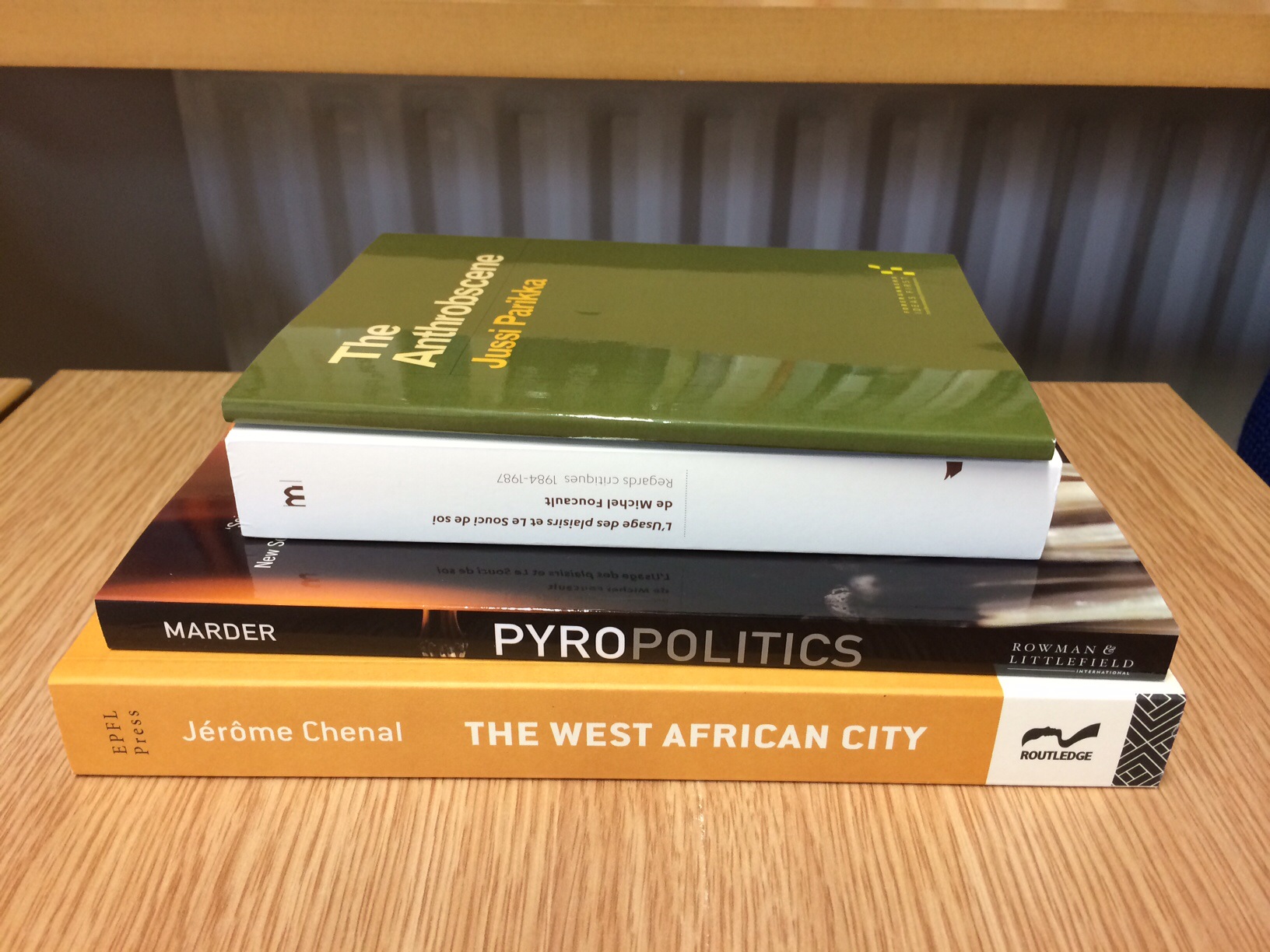
Jussi Parikka’s The Anthrobscene; a collection of contemporary reviews and discussions of the second and third volumes of Foucault’s History of Sexuality; Michael Marder’s Pyropolitics and Jérôme Chenal’s The West African City.