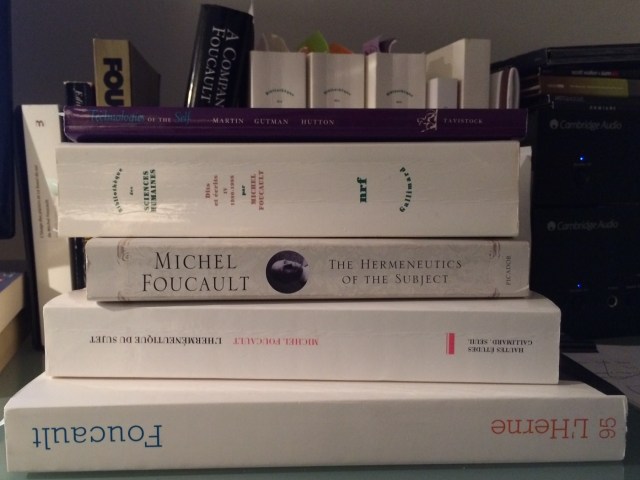
I have now a complete draft of Chapter Eight, but this has partly been achieved by moving discussion of the final two volumes of the History of Sexuality into the next chapter. The main thing I’ve accomplished is typing up my notes on The Hermeneutic of the Subject and reorganizing these into a couple of sections. I also went through the various interviews and short publications of the 1980-1982 period, including the three interviews conducted at Louvain, collected in Wrong-Doing, Truth-Telling.
There are some very interesting pieces from this period, including the interview and lectures in the Technologies of the Self volume, which came from a visit Foucault made to the University of Vermont in 1982. The book was not published until 1988, after Foucault’s death. As the editors note, Foucault did not edit the texts himself, and so they were transcribed (I don’t think the recordings are available). But he authorized their publication, because they appear, translated into French, in Dits et écrits. Indeed, they are the last three texts in that volume, out of only a handful there that appeared after his death. Perhaps giving these texts the same kind of treatment that the 1980 Dartmouth lectures recently received – L’origine de l’herméneutique de soi: Conférences prononcées à Dartmouth College, 1980 (Vrin 2013) would be in welcome. That volume is due to appear in English with University of Chicago Press in 2015. While most of its components have been available in English for some time (as I discuss here), there is much value in the editorial apparatus. That the Vermont texts did appear in Dits et écrits, though, will presumably rule out a similar treatment. It’s worth noting that the Dits et écrits translations include editorial notes that do not appear in the English original; the seminar transcripts in Essential Works: Ethics are amended, the lecture in Power is not. These notes do provide some helpful bibliographic orientations, but linking these seminars to Paris lectures might be worthwhile.
In reading the short pieces from this time I was also struck by two issues of dating. One is that the famous ‘The Subject and Power’ afterword to the Dreyfus and Rabinow book wasn’t all written at the same time – the first half is clearly from the early 1980s, but the second is probably from the late 1970s. Arnold Davidson has pointed this out before, and it’s also mentioned by Colin Koopman in his Genealogy as Critique. Though not mentioned in the reprint in Essential Works: Power, the first part ‘Why Study Power’ was written in English by Foucault; the second part ‘How is Power Exercised?’ (and subsequent subdivisions) was translated by Leslie Sawyer for the Dreyfus and Rabinow book (see the note in the original, p. 208). [Update 24.12.14 – the original French of the second part is in the Berkeley archive as text 1.14; the French edition of the Dreyfus and Rabinow text Michel Foucault : Un parcours philosophiques says there are ‘deux essais’ included.] All this would lend support to the idea of different datings. I did find one other clue – in the Technologies of the Self volume a note in the editors’ introduction (p. 8 n. 3) suggests that the first part was the text from his contribution to an October 1981 conference at University of South California. From a contemporary report, this would make sense –
A few of the cognoscenti complained afterwards that Foucault had directed his remarks to the great unwashed. And, in fact, Foucault did opt for a less esoteric paper when he learned the size of the crowd he was to address – a sort of outline of what he sees as the trajectory of his own theoretical and political project over the last 15 years or so. Be that as it may, the talk had the virtue of relative clarity, free of the maddening jargon that had characterized a few of the earlier talks (p. 195).
(Incidentally, the version in Essential Works: Power promotes some subsections in the second half to the level of sections – the original is in two sections, with four subsections/questions in the second half. The French version in Dits et écrits numbers these questions.)
The other was the various versions of the introduction to the second volume of the History of Sexuality, which I analyse in detail here. That throws up some really interesting issues. I also worked through the differences between “Rêver de ses plaisirs” – an article first published in 1983, based on a 1982 lecture, and reprinted in Dits et écrits text 332 – and the first chapter of the third volume, but the differences are minimal (which is itself revealing) aside from right at the end. My working notes on this are here.
I also spent a bit of time ordering the list of Foucault’s audio and video recordings on this site, and listened to a few of the ones from the early 1980s. It’s interesting listening to the lecture and reading the French transcription in the Collège de France volumes at the same time – while I found nothing to disagree with the editorial work, there is quite a lot of smoothing of style and grammar. A slavish rendition would be awful to read, but it does add something of a distance from the spoken word, and again makes these appear as more polished texts – as ‘books’ – than they really are. This reinforces some of the thoughts I made in response to some recent discussion of Foucault’s relation to neoliberalism – something of a distraction and also retreading material I thought I had finished with. There are some lively exchanges in the comments on the post.
So, a complete draft of Chapter Eight is now in place. Chapter Nine will begin with the discussion of the actually published volumes II and III, and related pieces, and then move to the two final lecture courses in Paris. That’s a lot to cover in a single chapter, and the book is already well over contracted word length. Editing, cutting and perhaps renegotiation will come later.
You can read more about the Foucault’s Last Decade project, along with links to previous updates, here.


 I expect many readers will know Patrick Crogan‘s Gameplay mode: war, simulation and technoculture (Minnesota, 2011). He has now uploaded what I think is a draft of Drones and global technicity: automation and (dis)individuation at academia. Here’s the extended abstract: