Foucault – uncollected notes, lectures and interviews, a list on Progressive Geographies

I’ve made a list of uncollected notes, lectures and interviews by Michel Foucault. Many of these have been posted on this site before, but this is an attempt at collecting details and links in one place. There are a couple of scans of hard to find material.

The four-volume Dits et écrits collects almost all the short pieces published in any language in Foucault’s lifetime.  For an English bibliography of translations of pieces in Dits et écrits, see Richard Lynch’s work (available at www.michel-foucault.com and updated in A Companion to Foucault). I’ve not repeated any of that information, nor listed his major works or the lecture courses.

The list is of pieces which didn’t make it into Dits et écrits, but which are available in some form. With a couple of exceptions where I can link to an online version or to correct a reference I’ve not included things in Jacques Lagrange’s ‘Complément bibliographique’ in Dits et écrits (Vol IV, 829-38).

On Foucault’s collaborative projects, see the list here; for audio and video recordings here.

Corrections and additions very welcome.

Posted in Foucault's Last Decade, Michel Foucault, Publishing | Leave a comment

Top posts this week on Progressive Geographies

Posted in Uncategorized | Leave a comment

The other Henri Lefebvre – excerpt from The Missing Pieces in Berfrois

0-unites-perdues-mini

Although it appears in at least one bibliography of the better-known Henri Lefebvre, Les unités perdues, translated as The Missing Pieces, is actually by a different author, born in 1959. It’s an interesting book on abandoned, lost, destroyed, forgotten and unfinished works, and a short excerpt is available on the Berfrois website.

Update September 2026: unfortunately, though perhaps fittingly, the excerpt has disappeared with the demise of Berfrois. I briefly write about the confusion of this Henri Lefebvre with the more famous Marxist in one of my ‘Sunday History‘ pieces.

Posted in Henri Lefebvre | 1 Comment

Verso ebook sale – 90% off until January 1st 2015

Feature-iPad-Critique-max_462-9da38d42b284284552f86df1abd95ec8Verso have an ebook sale – 90% off until January 1st 2015.

I picked up nine for less than £15 – books by Eric Hazan, Danny Dorling, Slavoj Zizek, Shlomo Sand, Walter Benjamin, Stanley Aronowitz, Keller Easterling, Arundhati Roy and Marcus Rediker.


Posted in Uncategorized | 2 Comments

Foucault’s preparatory notes to Les mots et les choses (The Order of Things)

icp031This isn’t recent news, but I hadn’t seen this before. Foucault’s preparatory notes to Les mots et les choses (The Order of Things) are available online at La bibliothèque de Foucault : Guide des papiers de travail de Michel Foucault.

The page reproduced left and here is on Kant’s ‘Des différentes races humaines’ from 1775. Thanks to Benoît Dillet, whose excellent review of the L’Herne volume on Michel Foucault alerted me to this resource.

Les mots et les choses isn’t within the time period I’m working on for the current book, But if it were, this would be an invaluable resource.

Perhaps material from the later years will become available in time for a second edition…

Posted in Foucault's Last Decade, Michel Foucault, Publishing | 2 Comments

Foucault on Parrhesia – translation of a 1982 lecture forthcoming in Critical Inquiry

PREVIEW (1)A lecture by Foucault in 1982 at Université de Grenoble, on “Parrēsia” was first published in French in 2012 in the journal Anabases. Another lecture from this same trip, “Rêver de ses plaisirs”, was published in 1983, and is a variant of the first chapter of Le souci de soi/The Use of Pleasures. I outline and discuss the differences here.

The French version of the “Parrēsia” article will be available online in October 2015. A translation by Graham Burchell is forthcoming in Critical Inquiry in early 2015 [update: now available here]. For the moment, that journal has just posted the first two paragraphs:

Thank you very much for inviting me. I am here, as you know, as a supplicant. What I mean is that, until four or five years ago, my field, at any rate the domain of my work, had scarcely anything to do with ancient philosophy; and then, following a number of zigzags, detours, or steps back in time, I began to say to myself that, after all, it was very interesting.  So I come to ancient philosophy as part of the work I am doing.  One day, when I was asking him some questions, telling him about my problems, Henri Joly was kind enough to say that you might agree to discuss my work with me, in its present imperfect state.  It is some material, some references to texts, some indications; what I am going to sketch out to you is therefore incomplete, and, if you were willing, it would be very good of you, first, to call out if you can’t hear me, stop me if you do not understand or if it’s not clear, and then anyway, at the end, tell me what you think.

So, to start with, this is how I came to be asking myself this set of questions.  What I had been studying for really quite a long time was the question of the obligation to tell the truth:  what is this ethical structure internal to truth-telling, this bond that, beyond necessities having to do with the structure or reference of discourse, means that at a given moment someone is obliged to tell the truth?  And I tried to pose this question, or rather I encountered this question of the obligation to tell the truth, of, if you like, the ethical foundation of truth-telling, with regard to truth-telling about oneself.  In actual fact it seems to me that I encountered it several times.  First of all in medical and psychiatric practice since, from a given moment, which is moreover quite precise and can be pinpointed at the beginning of the nineteenth century, we see the obligation to tell the truth about oneself becoming part of the great ritual of psychiatry.  Obviously we come across this problem of truth-telling about oneself in judicial practice and more especially in penal practice.  And, finally, I came across it for the third time with regard to, let’s say, problems of sexuality and more precisely of concupiscence and the flesh in Christianity.

 

Posted in Conferences, Michel Foucault, Publishing | 2 Comments

Adam Kuper on Anthropologists and Anthropology, forty years on

9780415736343Adam Kuper has an interesting piece on his book Anthropologists and Anthropology, forty years on and in an updated new edition (with a reversed title). It’s a survey of British Anthropology as a discipline – almost an anthropology of anthropology. Kuper taught me briefly as an undergraduate, when I took a survey social science course at Brunel (or ‘dead white men with beards’ as it was known). After Darwin, Marx, Weber, Freud, Kuper taught Durkheim.

Posted in Uncategorized | 1 Comment

The Lancet on IMF reforms and the West African Ebola crisis

Screenshot 2014-12-23 14.36.05

Writing today in the journal Lancet Global Health, researchers from Cambridge University’s Department of Sociology examine the links between the International Monetary Fund (IMF) and the Ebola outbreak in West Africa.

According to the authors, joined by colleagues from Oxford University and the London School of Hygiene and Tropical Medicine, IMF programs over the years have imposed heavy constraints on the development of effective health systems of Guinea, Liberia and Sierra Leone – the cradle of the Ebola outbreak that has killed more than 6,800 since March this year.

The researchers say that economic policy reforms advocated by the IMF have undermined the capacity of health systems in these three nations – systems already fragile from legacies of conflict and state failure – to cope with infectious disease outbreaks and other such emergencies. – See more here.

A long reading list on Ebola, which I updated regularly between October and November 2014, is available on this site.

Posted in Ebola, Politics | Leave a comment

Foucault and Iran (and Ernst Bloch) – an August 1979 interview newly available in French

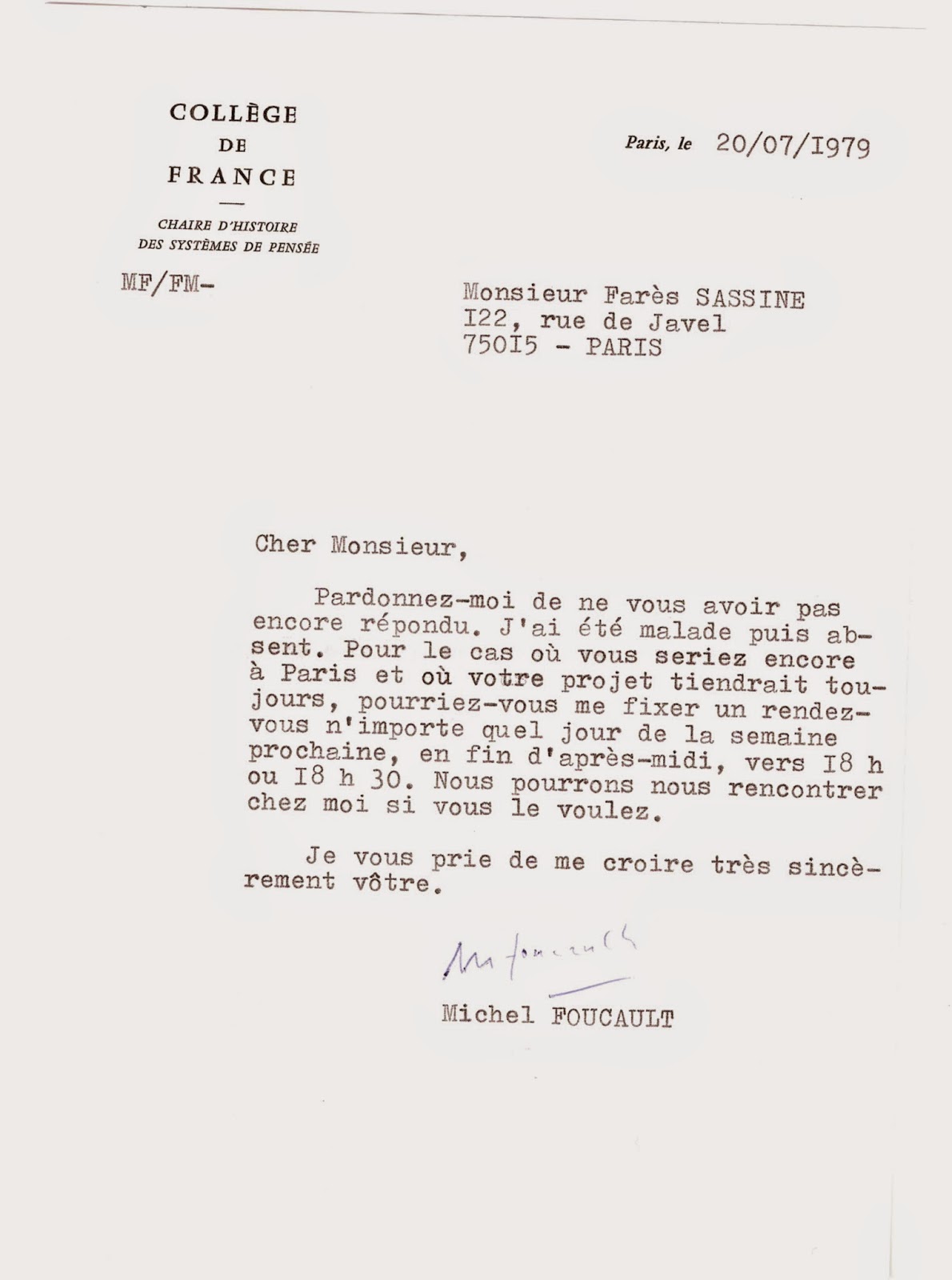
Thanks to a reader who wishes to remain anonymous for sending me these details of an interview with Foucault about Iran conducted in August 1979, which was first published in French in 2013.

PHOTO 3 N3DI’ve stumbled upon an interview with Foucault from this era that has up until recently remained completely uncommented by Foucault scholarship, unreferenced even in Afary-Anderson [Foucault and the Iranian Revolution – SE]. I have no doubt that you will find it interesting. The interview was conducted in August ’79 with Farès Sassine from the Paris paper An-Nahar al-`Arabi wa‘d-Duwali, in which extracts were published in ’79. translated into Arabic from the French. The original article, in Arabic, can be found here. It wasn’t until last year, however, that a full transcription of the interview in French was published in the somewhat obscure Revue Rodéo (no. 2) with an accompanying piece by Farès Sassine himself. This, also, alas, has been impossible for me to track down, but luckily, just this August, 35 years after the interview, Mr. Sassine posted the transcript on his blog along with some editorial remarks.

LETTRE 2I’ve found the interview to be very informative, and at least very pertinent to several contemporary discussions around the notion of political spirituality (which actually was inspired by Bloch’s Principle of Hope!), Foucault’s relationship the nouvelles philosophes, and perhaps (thereby) also a correction to the ongoing reframing of Foucault as a neoliberal in leftist clothing. It’s also a very pleasant read, seeing a very amicable atmosphere between the two, and a very welcoming Foucault, despite sickness and fatigue.

entretien JPEGThe whole interview in French can be read here.

This interview is significant for multiple reasons, not least because it postdates the other texts on this topic – I think the last one, before this, was ‘Inutile de se soulever [Is it useless to revolt]?’ published in Le monde on 11-12 May 1979. As well as the initial mention of Ernst Bloch, it also discusses some of his contemporaries and their work, and it’s also the only place I know where Foucault mentions Edward Said.

I’m very grateful for the details and the message, which is posted with permission. The images come from Farès Sassine’s commentary – clicking on each will take you to the page with the larger image.

Posted in Edward Said, Michel Foucault, Politics | Tagged | 6 Comments

Foucault and Simeon Wade – and the elusive ‘Chez Foucault’ publication

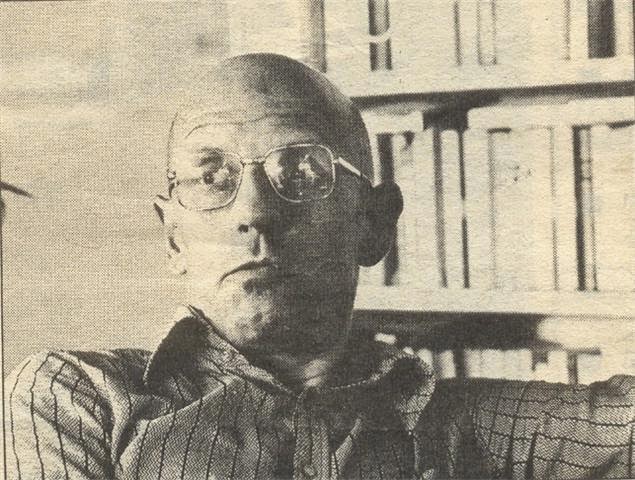
Last week I posted about Time magazine’s profile of Foucault from 1981. The piece included this photograph:

Michel, Simeon and Michael

James Miller‘s biography of Foucault says that this picture was of Simeon Wade, and Wade’s friend ‘Michael’ (The Passion of Michel Foucault, pp. 437-8 n. 1). Who is Simeon Wade? Well he’s an interesting figure in Foucault’s California story, because he was the author of an unpublished “121 page typescript”, ‘Foucault in California’, which recounts Foucault’s 1975 LSD trip in Death Valley. Miller discusses this in Chapter 8 of his book. I’m somewhat sceptical about this story and what has been made of it. I discuss it briefly in a 2005 piece that was a kind of prelude to the work I am now doing in much more detail – I am not sure if that particular discussion will make it into the book.

[Update 2017: Wade is interviewed by Heather Dundas in Boom California – see also my comments here]

But Wade is also interesting for another reason: he interviewed Foucault in 1976 in a piece which was first published in 1978 in a publication he edited – Chez Foucault, Los Angeles: Circabook, 1978, pp. 4-22. This text is translated into French for Dits et écrits (online here). My practice with texts originally published in English, and for which the Dits et écrits version is already once removed, is to try to find the original. This is often challenging, but in this case, it’s proved impossible. Dits et écrits describes the publication this way – “The Circabook is a sort of campus polycopié” – a handout or pamphlet, a mimeograph. I’ve been told by a reliable source that it was effectively a fanzine. I can find no library that has a copy.

So, has anyone ever seen this in the original? I’ve been unable to find contact details for Wade. Any information gratefully received.

Update: 21 Feb 2015 – I now have a scanned copy of this rare document, which can be downloaded here.

Posted in Foucault's Last Decade, Michel Foucault | 16 Comments