Joshua Hagen reviews The Birth of Territory in Geographical Review

gere12034A nice review of The Birth of Territory in Geographical Review, by Joshua Hagen (requires subscription).

Here’s the concluding paragraph:

Elden is to be commended for his keen analysis that tackles rather complex issues of meaning and translation while remaining eminently readable. I also credit Elden for undertaking such an ambitious project when the incentive structures in modern academia increasingly tilt toward producing the minimal publishable unit. Upon first perusing the book, I immediately thought of Clarence Glacken’s Traces on the Rhodian Shore, an impression that was only reinforced as I read through the chapters. I was a bit frustrated the book lacked a full bibliography. The main chapters seemed to average around 250 notes, so looking up full citations was laborious. I will refrain from the rather lazy criticism that this or that should have been included in a book that covers so much ground, but I would have liked a bit more explanation about what criteria governed
the selection of source materials. Perhaps my most significant complaint would be that I do not think the title fits the book very well. The story Elden tells is less about the birth of territory than the changing relations between place and power. Elden explicitly acknowledges as much throughout the book. I believe what Elden has actually produced is much more than the birth of territory. With apologies to Glacken, I think the book would be better titled Place and Power in Western Thought from Ancient Times to the End of the Seventeenth Century. These small points do not diminish a truly impressive piece of scholarship.


Posted in Territory, The Birth of Territory | 2 Comments

Some links on the situation in Gaza – and Verso’s The Case for Sanctions Against Israel free to download

The desperate situation on Gaza continues… some things worth reading, as something of a balance to the mainstream media

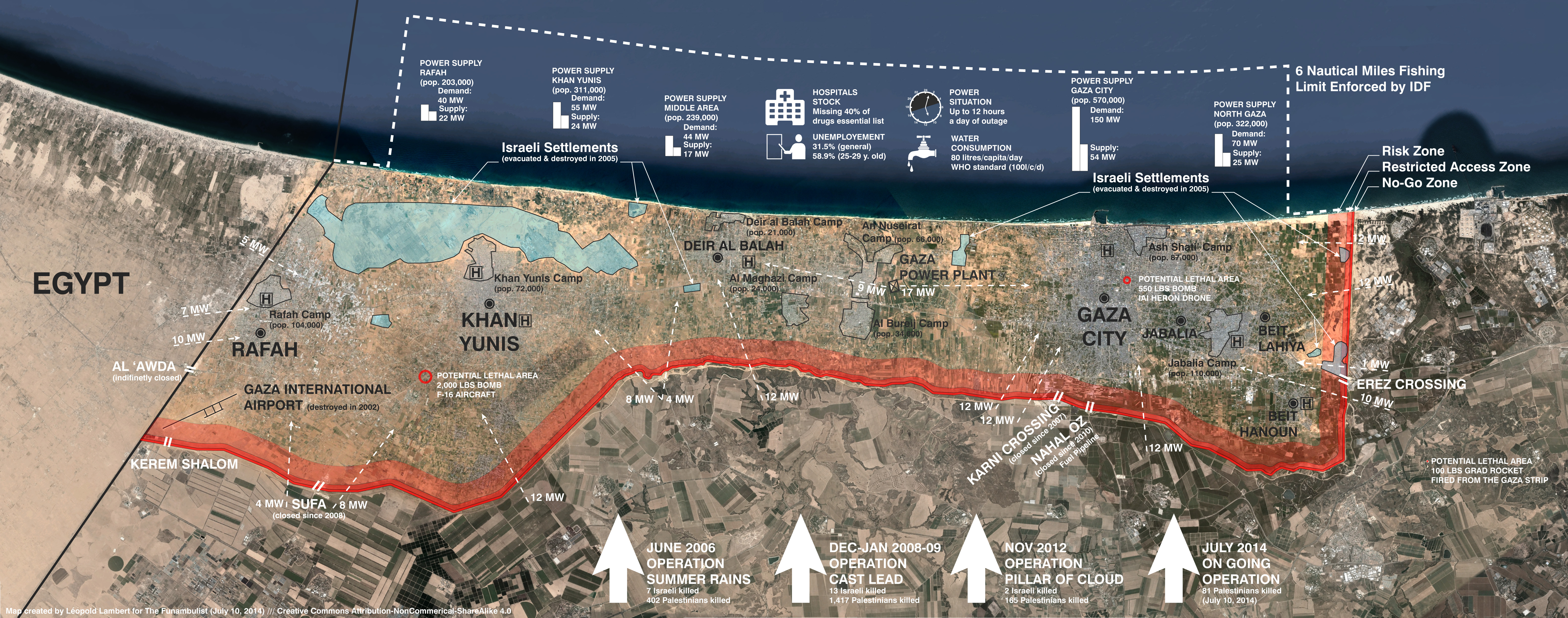
The Funambulist has had some excellent analysis, in word and image by Léopold Lambert  – clicking the map below takes to you a high-quality image. [Plus a new post on 30/7/2014]

Map Gaza

Derek Gregory’s blog Geographical Imaginations has had several good posts recently – Corpographies and Footnotes to Gaza 101, among them…

Juan Cole’s Informed Comment is a continually useful source of perspectives, on this and much else

Craig Jones’s War, Law, Space blog had some important pieces towards the beginning of this war, including a link to a work in progress entitled  ‘Frames of law: Targeting advice and operational law in the Israeli Defense Force

Critical Legal Thinking has had some good pieces too

Finally, The Case for Sanctions Against Israel – Verso’s collection of essays is now available as a free e-book

[Update: ‘Isolating Gaza‘ at the Stanford University Press blog is also very good]

Posted in Politics, Territory | 2 Comments

Seyla Benhabib reviews Richard J. Bernstein, Violence at NDPR

Seyla Benhabib reviews Richard J. Bernstein, Violence at NDPR

Posted in Uncategorized | 1 Comment

Ed Cohen on The Productive Body and La société punitive in the LARB

Ed Cohen reviews Francois Guéry and Didier Deleule’s The Productive Body and Foucault’s La société punitive in the Los Angeles Review of Books.

Posted in Michel Foucault, Politics | Leave a comment

Top ten posts on Progressive Geographies this week

Special Issue on Ranciere

What is neoliberalism?

Foucault’s Last Decade – Update 12

Bruno Latour – Some advantages of the notion of “Critical Zone” for Geopolitics

Guattari, Felix 2012 Schizoanalytic Cartographies, reviewed by Thomas Jellis

Foucault’s Last Decade

Peter Sloterdijk, You Must Change Your Life reviewed by Eduardo Mendieta

Geographies of peace

Books received – Foucault Lexicon, Lefebvre on Architecture, etc.

Articles and Chapters

Posted in Books, Bruno Latour, Eduardo Mendieta, Felix Guattari, Foucault's Last Decade, Michel Foucault, Peter Sloterdijk, Politics, Territory | 2 Comments

Bruno Latour – Some advantages of the notion of “Critical Zone” for Geopolitics

An intriguing short piece by Bruno Latour – ‘Some advantages of the notion of “Critical Zone” for Geopolitics’ – available to download from his website.

Abstract: The relatively new concept of “critical zones”, much like that of the “Anthropocene”, signals an interesting twist in the ways to approach life-sustaining systems on Earth and thus a new way to understand the prefix “geo” in geopolitics. Some advantages of the notion for political sciences are listed.

Posted in Bruno Latour, Politics, Territory | 1 Comment

Atlases of disease

Atlas of Epidemic Britain: A Twentieth Century Picture reviewed by Tom Koch at the Society and Space open site.

Posted in Uncategorized | Leave a comment

Books received – Foucault Lexicon, Lefebvre on Architecture, etc.

books received 25 July 2014Henri Lefebvre’s Toward an Architecture of Enjoyment; Alberto Manguel’s The Library at Night; Janet Ruane’s Essentials of Research Methods; Bernard Pivot, Ecrire, Lire et en Parler (which contains the French version of a Foucault interview that is not in Dits et Écrits); the new issues of Theory, Culture & Society and Society and Space; and my author copy of The Cambridge Foucault Lexicon.


Posted in Books, Henri Lefebvre, Michel Foucault, Society and Space, Theory, Culture and Society | 1 Comment

Open access report on Drone Strikes in Afghanistan

ImageA new report published finds that despite Afghanistan being the most heavily drone-bombed country in the world, the reporting of air strikes is far less comprehensive than in other theatres.

Commissioned by Remote Control, a project hosted by Oxford Research Group, The Bureau of Investigative Journalism’s report Drones in Afghanistan: A scoping study assesses the feasibility of using open-source materials to track drone strikes in Afghanistan, modelled on its existing databases of drone strikes in Pakistan, Yemen and Somalia.

The report found that drones are playing an increasingly important role in Afghan air campaigns in recent years (in 2011 drones fired 5% of all missiles fired in air strikes, by 2012 this had risen to 18%). It also found that an increased reliance on drones after the US drawdown this year is expected for counterterrorism operations in the country.  Drones now account for a third of all civilian deaths in Afghan air strikes but little is known about the details of these strikes.

The research concludes that media reports would not be sufficient as a primary source to develop a full record of drone strikes, but instead would require networks of local contacts to compile additional data, along with urging the military forces involved to release their own data. Despite these challenges, the report stressed the vital importance of developing a database of strikes in Afghanistan.

Read the report here.

Posted in Politics | Leave a comment

Foucault’s Last Decade – Update 12

Update 12 After what has felt like a long break from working on this book, I’ve begun writing again. Some of this was during a recent trip to Ghana.

The first part of Chapter Six looks at the collaborative projects Foucault was involved with through his Collège de France seminars and his involvement with CERFI in the 1970s. I discuss four projects. The first was work conducted at CERFI, also involving Deleuze and Guattari, on into urban infrastructure and related themes, which led to the book Les équipements du pouvoir by Lion Murard and François Fourquet. The second is the collective work Les machines à guérir (aux origines de l’hôpital moderne) published in 1976 and then reissued in 1979. The third is a study Foucault edited entitled Politiques de l’habitat (1800-1850) from 1977. The fourth is a study of the ‘green spaces’ of Paris. These projects are important, I think, for moving Foucault’s interests beyond institutions to the wider society, and for beginning his thinking on questions of governmental practice. I’ve written about these projects before, using the archive of his papers at IMEC, and so it was mainly a question of reorganizing material into the form for this book. We tend to have a vision of Foucault largely as a solitary individual author, but that is at least partly due to the lack of translation of his collaborative works and writings by his colleagues.

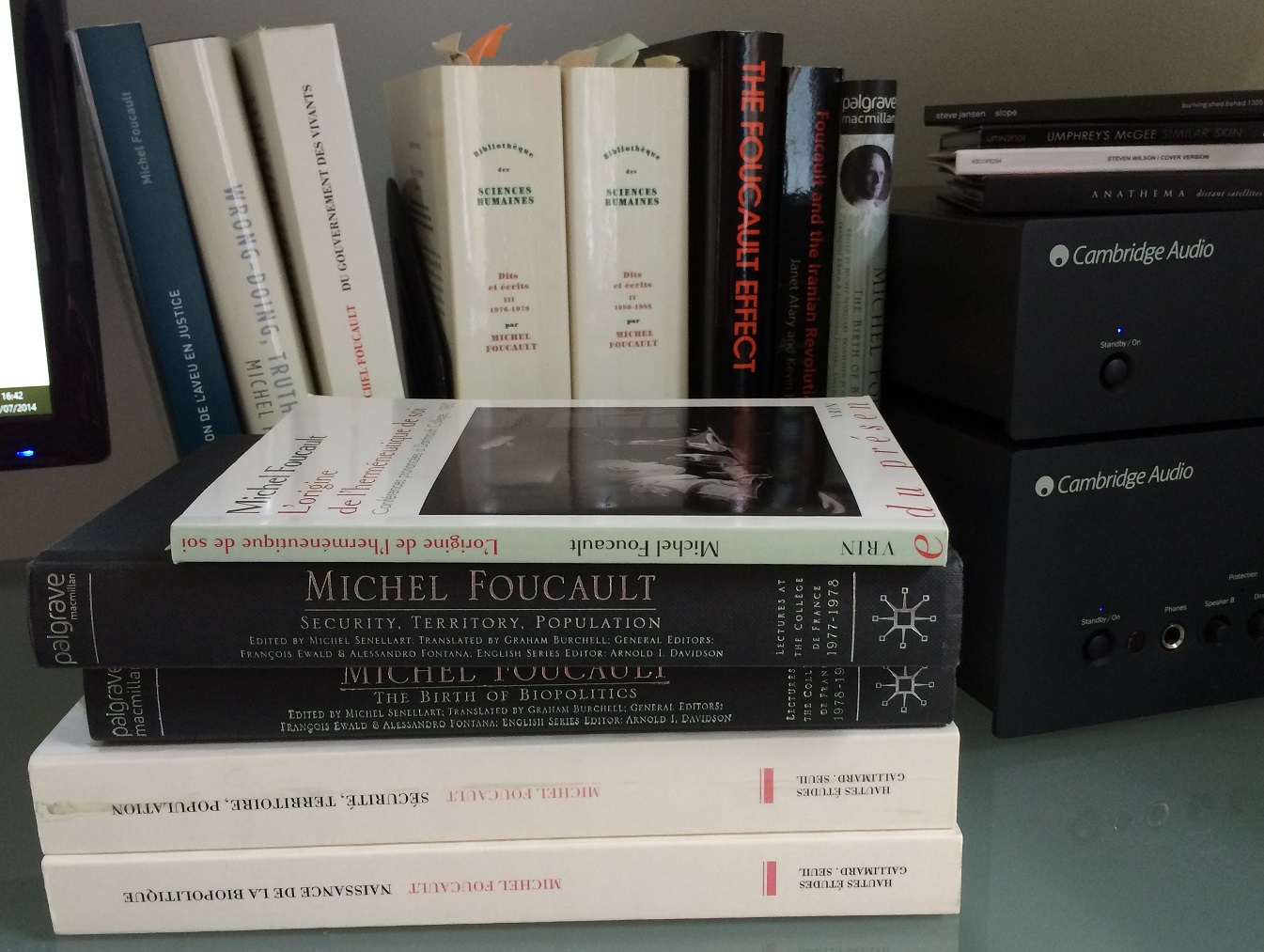
The second part of this chapter discusses the two ‘governmentality’ courses – 1978’s Security, Territory, Population and 1979’s The Birth of Biopolitics. I’ve written about these courses, especially the first, before because of the direct relation of Foucault’s concerns to my previous work on the history of territory. I have no wish to repeat that argument again in this book. Instead I’ve concentrated on the discussion of the Christian pastoral in the first course, and the emergence of homo oeconomicus in the second. There is an extensive literature on these courses already, but I hope I’ve said something worthwhile about them: principally because I try to find the continuity of concerns and the links to other material, rather than see them as a completely discrete project. The pastorate is particularly important to the account I am giving, especially as it provides the basis for the third course on governmentality, Du gouvernement des vivants – forthcoming in translation as On the Government of the Living.

There were lots of other pieces that needed to be weaved into this story – Foucault gave a sequence of lectures and interviews in Japan in 1978 immediately after the first course, only some of which are in English and all of which are fascinating; there are the discussions with historians in L’impossible prison; the ‘What is Critique?’ lecture at the Société française de philosophie from May 1978, but only published in 1990 and hence not in Dits et écrits; and the Tanner lectures at Stanford, ‘Omnes et Singulatim’ from October 1979. I still need to decide how to treat the journalism on Iran.

The next chapter will discuss Du gouvernement des vivants (1980) and 1981’s Subjectivité et vérité alongside the newly translated 1981 Louvain lectures Wrong Doing, Truth Telling and other material from that time, along with the US lectures of 1980-81, now mostly collected in L’origine de l’herméneutique de soi (see here and here).

You can read more about the Foucault’s Last Decade project, along with links to previous updates, here.

Posted in Books, Felix Guattari, Foucault's Last Decade, Gilles Deleuze, Michel Foucault, Writing | 3 Comments