Special Issue on Ranciere

Special issue of Space and Polity on the work of Jacques Ranciere

Mark Purcell's avatarPath to the Possible

sp_special_issue

Just out: a new special issue of Space & Polity on the thought of Jacques Ranciere and how it might be useful for political action today. I edited the special issue, which includes articles by:

Erik Swyngedouw:
Where is the political? Insurgent mobilisations and the incipient “return of the political”

Mark Davidson and Kurt Iveson:
Occupations, mediations, subjectifications: fabricating politics

Paul Hanson:
Cleveland’s Hough riots of 1966: ghettoisation and egalitarian (re)inscription

Mark Purcell:
Rancière and revolution

Kate Booth and Stewart Williams:
A more-than-human political moment (and other natural catastrophes)

You can find more information, and abstracts, here.

My article, which argues that we need to augment Ranciere with Deleuze and Guattari’s political thought, is available free to the first 50 people who ask for it, which you can do here.

View original post

Posted in Uncategorized | 1 Comment

Geographies of peace

Geographies of Peace collection from IB Tauris.

Derek Gregory's avatargeographical imaginations

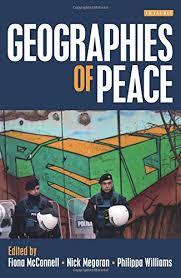
News today from I.B. Tauris of a new collection edited by Fiona McConnell, Nick Megoran and Philippa Williams, Geographies of peace:

Geographies of peaceFrom handshakes on the White House lawn to Picasso’s iconic dove of peace, the images and stereotypes of peace are powerful, widespread and easily recognizable. Yet if we try to offer a concise definition of peace it is altogether a more complicated exercise. Not only is peace an emotive and value-laden concept, it is also abstract, ambiguous and seemingly inextricably tied to its antithesis: war. And it is war and violence that have been so compellingly studied within critical geography in recent years. This volume offers an attempt to redress that balance, and to think more expansively and critically about what peace means and what geographies of peace may entail. The editors begin with an examination of critical approaches to peace in other disciplines and a…

View original post 434 more words

Posted in Uncategorized | 1 Comment

What is neoliberalism?

Some thoughts on neoliberalism by Jeremy Crampton, quoting Robin James, via New APPS. Also a call for an interesting session at the next AAG.

Jeremy's avatarOpen Geography

robinjames (@doctaj) on neoliberalism:

I want to hone in on one tiny aspect of neoliberalism’s epistemology. As Foucault explains in Birth of Biopolitics, “the essential epistemological transformation of these neoliberal analyses is their claim to change what constituted in fact the object, or domain of objects, the general field of reference of economic analysis” (222). This “field of reference” is whatever phenomena we observe to measure and model “the market.” Instead of analyzing the means of production, making them the object of economic analysis, neoliberalism analyzes the choices capitalists make: “it adopts the task of analyzing a form of human behavior and the internal rationality of this human behavior” (223; emphasis mine). (The important missing assumption here is that for neoliberals, we’re all capitalists, entrepreneurs of ourself, owners of the human capital that resides in our bodies, our social status, etc.) [3] Economic analysis, neoliberalism’s epistemontological foundation, is the attribution…

View original post 196 more words

Posted in Uncategorized | 2 Comments

Guattari, Felix 2012 Schizoanalytic Cartographies, reviewed by Thomas Jellis

Thomas Jellis reviews Felix Guattari’s book Schizoanalytic cartographies at the Society and Space open site.

Posted in Uncategorized | 2 Comments

Peter Sloterdijk, You Must Change Your Life reviewed by Eduardo Mendieta

Sloterdijk-YouMustChangeYourLife3Peter Sloterdijk, You Must Change Your Life reviewed by Eduardo Mendieta at NDPR.

Posted in Eduardo Mendieta, Peter Sloterdijk | 4 Comments

Robert T. Tally Jr. – Fredric Jameson: The Project of Dialectical Criticism
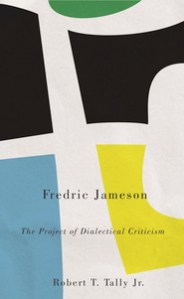
Untitled-2Fredric Jameson: The Project of Dialectical Criticism by Robert Tally, newly published in the Marxism and Culture Series at Pluto Press:

Fredric Jameson is the most important Marxist critic in the world today. While consistently operating at the cutting edge of literary and cultural studies, Jameson has remained committed to seemingly old-fashioned philosophical discourses, most notably dialectical criticism and utopian thought.  In Fredric Jameson: The Project of Dialectical Criticism, Robert Tally surveys Jameson’s entire oeuvre, from his early studies of Sartre and formal criticism through his engagements with postmodernism and globalisation to his recent readings of Hegel, Marx and the valences of the dialectic.  The book is both a comprehensive critical guide to Jameson’s theoretical project and itself a convincing argument for the power of dialectical criticism to understand the world today.

“One doesn’t endorse one’s self, but I can say that Tally’s thorough and insightful review of my work will make it possible for readers to connect up parts they may have missed and to grasp the coherence of a long list of books and essays which might at first seem to wander across a variety of very different topics and interests. I’m most grateful to have available such a useful introduction to that work.”

Fredric Jameson

Posted in Fredric Jameson | 1 Comment

New book reviews – migration, protest, enclosure, economies, and frontiers

Five new book reviews on the Antipode Foundation site.

Antipode Editorial Office's avatarAntipodeFoundation.org

For July we’ve added five new book reviews to our open access repository

Andrew Burridge (University of Exeter) on Olivier Clochard and Migreurop’s Atlas of Migration in Europe: A Critical Geography of Migration Policies;

Andrew Davies (University of Liverpool) on Anna Feigenbaum, Fabian Frenzel and Patrick McCurdy’s Protest Camps;

Derek Hall (Wilfrid Laurier University) on Peter Linebaugh’s Stop, Thief! The Commons, Enclosures, and Resistance;

Ethan Miller (University of Western Sydney) on Vishwas Satgar’s The Solidarity Economy Alternative: Emerging Theory and Practice; and

Mori Ram (Ben Gurion University) on Asher Kaufman’s Contested Frontiers in the Syria-Lebanon-Israel Region: Cartography, Sovereignty, and Conflict.

migreurop bookThere have been a number of essays on AntipodeFoundation.org recently on migration, including Jill Williams’ intervention on the limits to some recent strategies of protest against US immigration policy , ‘The Spatial Paradoxes of “Radical” Activism’, and Sarah Launius reply (see also Olivia Mena’s intervention on borders and

View original post 274 more words

Posted in Uncategorized | Leave a comment

A brief genealogy of governmentality studies: the Foucault effect and its developments. An interview with Colin Gordon (2013)

A very interesting interview with Colin Gordon on Foucault and governmentality.

Clare O'Farrell's avatarFoucault News

A brief genealogy of governmentality studies: the Foucault effect and its developments. An interview with Colin Gordon by Fabiana Jardim, Educação e Pesquisa, vol.39 no.4 São Paulo Oct./Dec. 2013

http://dx.doi.org/10.1590/S1517-97022013000400016
Full text available from this link

ABSTRACT
This interview approaches the intellectual context within the areas of philosophy and social sciences, in the 1970s United Kingdom, and also looks back to Colin Gordon’s work as a translator and editor of Michel Foucault’s researches on power and politics into English. Finally, it attempts to assess the developments of this strange notion of governmentality within the English-Speaking intellectual world and its relations to present times. The interview has taken place during Colin Gordon’s visit to Brazil for the “International Seminar Max Weber and Michel Foucault: possible convergences” (May, 2013). It aims to revisit the context in which the governmentality studies have appeared as a specific field of interest and research, in…

View original post 145 more words

Posted in Uncategorized | Leave a comment

Foucault’s legacy: an interview with Frédéric Gros

FoucaultFoucault’s legacy: an interview with Frédéric Gros at the Verso blog, a translation of an interview originally in Le Monde.

Posted in Michel Foucault | 1 Comment

Top ten posts on Progressive Geographies last week


Posted in Uncategorized | 1 Comment