A Mini-Interview: Mercedes Bunz explains meson press

An interview about the new publisher Meson Press, with whom I am working on the Kostas Axelos translation.

jussiparikka's avatarMachinology

meson press first book, Rethinking Gamification (PDF), was just released in Lüneburg. Part of the Hybrid Publishing Lab at the Leuphana University, the press focuses on digital culture and network media with the aim to “challenge contemporary theories and advance key debates in the humanities today.” I was interested in inviting one of the representatives of the press, Mercedes Bunz, to share in the style of some earlier mini-interviews I have conducted what she sees as the stakes in coming up with a multiple-format publishing house that focuses on theory.

Most of scholars are increasingly frustrated with the dinosauric habits of big academic publishers, but how to establish alternatives in the academic world that is challenged both by the necessity of new formats and by the only slowly changing recognition systems of the academic world?

The burning questions in publishing seem to be about the changing media ecology…

View original post 714 more words

Posted in Uncategorized | Leave a comment

Searching for the sublime: Tuan’s Romantic Geography reviewed

A review of Yi-Fu Tuan’s new book at the Society and Space open site.

Posted in Uncategorized | Leave a comment

Review essay on Terror and Territory (in Portuguese)

Thanks to Paulo Jorge Vieira for alerting me to this new review essay of my 2009 book Terror and Territory in the Brazilian journal Geografares by Márcio José Mendonça.

Posted in Politics, Territory, Terror and Territory | 2 Comments

Ice Law project website launched

usfws-5164532851_056174e81e_bA couple of weeks ago I said a little about The IBRU Workshop on International Law, State Sovereignty, and the Ice-Land-Water Interface that I attended back in Durham.

The plan is that all participants to the workshop write a short summary of how their work contributes to the project, and I think these will all be posted online as the next stage in this work. For the moment, I’ll simply post the audio recording of my comments to one of the sessions. Much of this will be familiar to people who know my work on territory – both the historical, political and conceptual work on this topic – but that was really the point: a brief primer for people from a range of disciplines including anthropology and international law.

The project now has a website with lots of detail about the work and the first two reflections, from Klaus Dodds and Kate Coddington, have been posted. More will appear over the next few weeks.

Posted in Boundaries, Conferences, Politics, Territory | Leave a comment

Judith Butler reviews Jacques Derrida, The Death Penalty Volume I

In the London Review of Books, Judith Butler reviews Jacques Derrida, The Death Penalty Volume I.

Posted in Jacques Derrida, Judith Butler | 1 Comment

Deborah Cowen – The Deadly Life of Logistics

Deborah Cowen’s new book – out in September.

Posted in Uncategorized | 1 Comment

IBRU Relaunched as Centre for Borders Research

Phil Steinberg on the change of IBRU’s name to Durham University’s Centre for Borders Research.

philsteinberg's avatar

On its 25th anniversary, IBRU, formerly the Durham University’s International Boundaries Research Unit, has been relaunched as Durham University’s Centre for Borders Research. Although past and current clients of IBRU’s consulting and training services likely will see little difference (asiIBRU-new-webde from our new logo), the name change signals IBRU’s ongoing commitment to building bridges between applied work at the intersection of political geography and international law with cutting edge research that connects this applied work with inquiries into the changing nature of borders, territory, sovereignty, citizenship, and the political organisation of space.
View original post

Posted in Uncategorized | 2 Comments

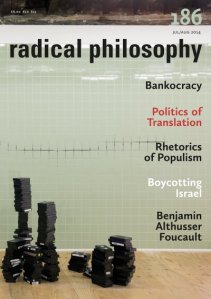
New issue of Radical Philosophy, including discussion of the politics of translation

186cover_webA new issue of Radical Philosophy is out, including a very interesting discussion of the politics of translation. The specific case is Hegel, and the new Terry Pinkard translation of the Phenomenology of Spirit, but the issues raised go beyond this text and author. Also includes pieces on boycotting Israel, Ernesto Laclau’s posthumous book, Esther Leslie’s review of the new Walter Benjamin biography, and a review of the Hannah Arendt film.

Posted in Ernesto Laclau, Georg Wilhelm Friedrich Hegel, Hannah Arendt, Politics, Publishing | 1 Comment

Foucault’s major works to appear in a Pléiade edition

Foucault’s major works – his sole-authored books, plus some articles – will appear in a two-volume collection in 2015 as a prestigious Pléiade edition. Thanks to Colin Gordon for alerting me to the news. Frédéric Gros is interviewed about this here (in French). Among other things the interview says that the final Collège de France course, Théories et institutions pénales (1971-1972), is due out in 2015, and that, in common with other volumes, the Pléiade volumes will be a critical edition.

Posted in Michel Foucault | 1 Comment

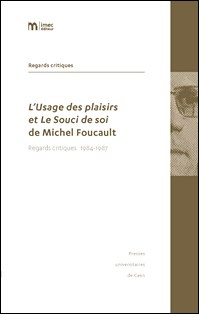
L’Usage des plaisirs et Le Souci de soi de Michel Foucault. Regards critiques 1984-1987 (2014)

The latest in a useful series of contemporary reviews of Foucault’s books.

Clare O'Farrell's avatarFoucault News

MF_HSL’Usage des plaisirs et Le Souci de soi de Michel Foucault. Regards critiques 1984-1987
coédition PUC – IMEC, Juillet 2014
Dossier coordonné par Luca Paltrinieri.

Textes choisis et présentés par Philippe Artières, Jean-François Bert, Sandra Boehringer, Philippe Chevallier, Frédéric Gros, Luca Paltrinieri, Judith Revel.

Collection Regards critiques.

Avec L’Usage des plaisirs et Le Souci de soi, Michel Foucault reprend, après huit ans de silence, le fil interrompu d’une histoire de la sexualité. Entre-temps, toutefois, le projet a changé profondément : il ne s’agit plus seulement d’étudier les concepts et les normes qui règlent la sexualité, mais aussi les formes et les modalités du rapport à soi par lesquelles les individus se constituent et se reconnaissent comme sujets. La première réception des deux ouvrages témoigne ainsi d’un double étonnement : la découverte d’un nouveau registre de la pensée foucaldienne qui se tisse autour de la subjectivation et l’inexistence, dans les sociétés anciennes…

View original post 12 more words

Posted in Uncategorized | Leave a comment