Bradley Garrett in The Times Higher on protection for researchers

“Place-hacker Bradley Garrett: research at the edge of the law” in The Times Higher. It’s good to see some people like Danny Dorling publicly supporting him, especially given the weak statement from Royal Holloway, University of London, where he did the PhD research. Here’s the first paragraph:

man_standing_on_city_crane_at_nigh_450

In 2008, I began a four-year doctoral research project with urban explorers in London. Urban explorers are groups of people interested in sneaking into, and often photographing, off-limits architecture, trespassing into abandoned buildings, infrastructure systems and under-construction skyscrapers. Given the nature of what they do, conducting research with them was always going to require a level of deep participation; passive “observers” are swiftly identified, censured and disregarded in this community. I chose to undertake ethnographic work in the tradition of the Chicago School of Sociology. What followed over the next few years was, by any stretch of the imagination, an incredible series of events that concluded two weeks ago with a qualified victory for me and eight of my project participants after beating a charge of “conspiracy to commit criminal damage”, which carries with it a 10-year maximum jail sentence. Elated as we were to be out of the dock, this was a victory with sombre caveats for me as a researcher.

Posted in urban/urbanisation | Leave a comment

Cryptologic geographies

An interesting piece from Jeremy Crampton looking at what he calls ‘cryptologic geographies’…

Jeremy's avatarOpen Geography

In 2011, a 29-year-old grad student at the University of Münster in Germany made some coding alterations to OpenSSL, the secure sockets layer used on half a million websites around the world, including banks, financial institutions and even Silicon Valley companies such as Yahoo, Tumblr, and Pinterest.

Unfortunately the code contained a security flaw. At one hour before midnight on New Year’s Eve 2011, a British computer consultant approved the new code and submitted it into the release stream, failing to notice the bug. The vulnerable code went into wide release in March 2012 as OpenSSL Version 1.0.1.

So began the “Heartbleed” vulnerability. For two years until it was noticed in April 2014 any attacker could exploit the vulnerability to obtain the “crown jewels” of the server itself, that is, the master key or password that would unlock all the accounts and enable access to everything coming or going from the server…

View original post 813 more words

Posted in Uncategorized | Leave a comment

The work of editing – adding references to translations

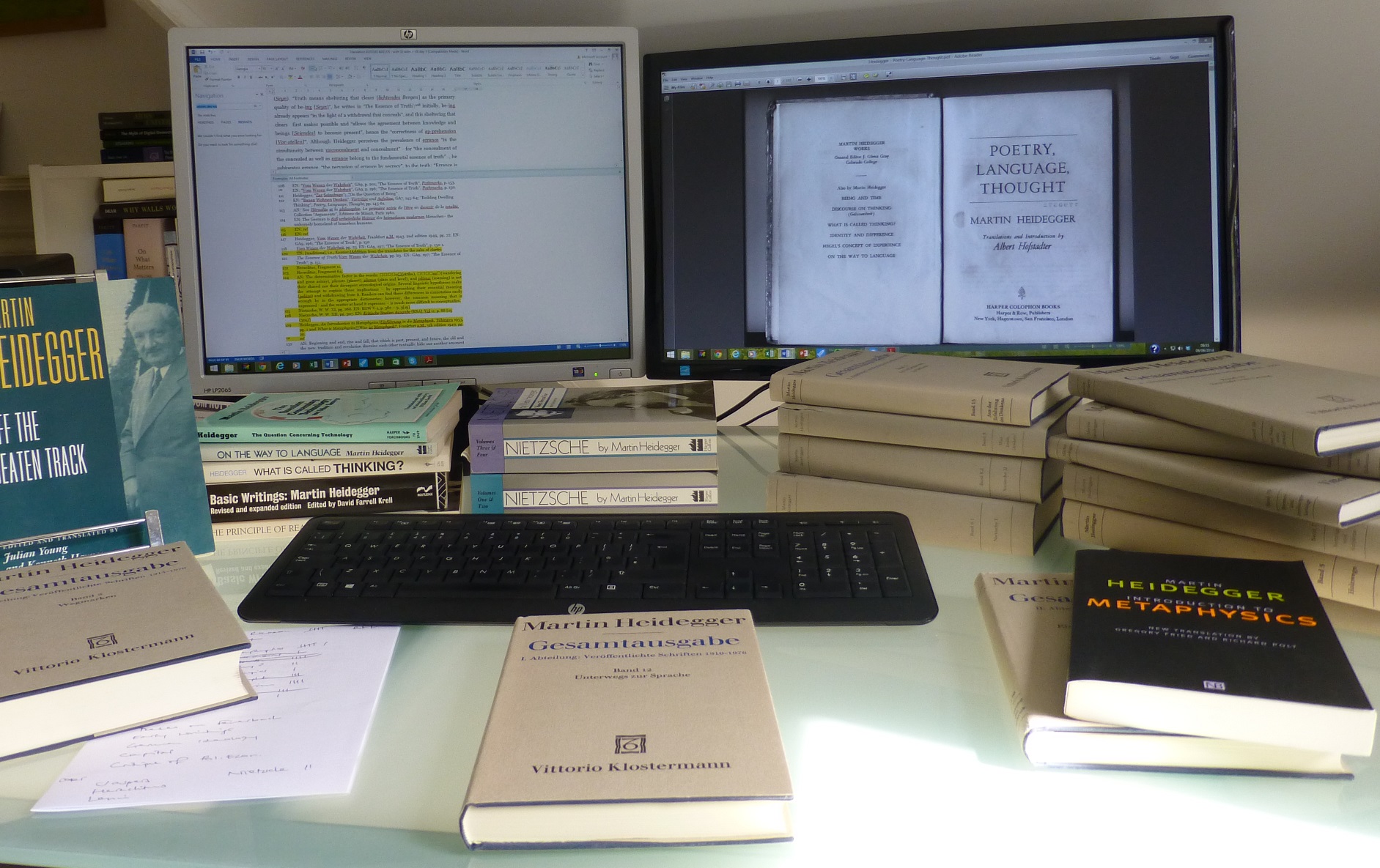
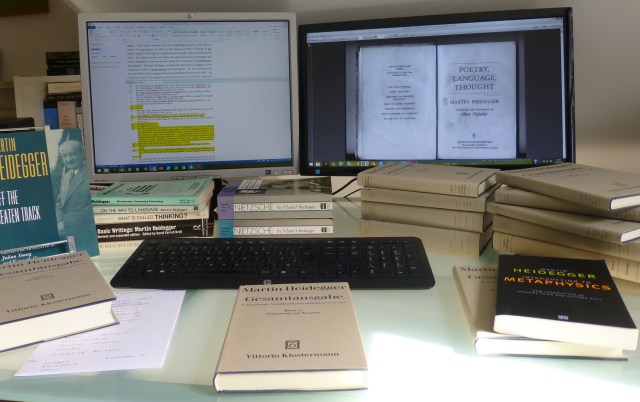
deskOver the past few weeks, around other things, I’ve been editing a translation of a book for a new press. I’ll post details of the book when the website is available. A lot of the work has been checking the translation to the original, and making alterations in keeping with other translations of this thinker, but also, more importantly, those he is in dialogue with. When all this is done I’ll be writing an introduction. Another part of the role though is important, undervalued and enormously time-consuming. This is the task of updating the references and providing indications of English language versions. This was a book published in the 1960s, based on lectures from the 1950s. One of the key interlocutors was Heidegger. The references to Heidegger are to old editions of his texts. Some are to early editions of collections like Holzwege (Off the Beaten Path) and Vorträge und Aufsätze. Others are to originally separately published texts – the ‘Letter on Humanism’, ‘What is Metaphysics?’, ‘The Essence of Truth’ etc. – that were later gathered into the collection Wegmarken (Pathmarks), or other pieces that ended up in other volumes.

The easiest option, of course, would be to simply keep the original references, perhaps translating the title – that’s what the translator did. The second option would be to indicate the bibliographic details of the English translation of the relevant text but not the specific page number. The third, which is the one I am taking – and did for all the Lefebvre texts I edited or co-edited – is to provide full references. But there is a necessary step in between. Few research libraries continue to shelve the earlier editions of the texts – older ones are put in the store, or worse, if they stock the Gesamtausgabe (collected edition). I only have a few Heidegger texts in German other than this edition. So before I can find the English passage in question, I need to find the German in the Gesamtausgabe. With a very few this is relatively easy – the new editions of Holzwege and Vorträge und Aufsätze have marginal pagination which refers to the old, though these are not always consistent with the references I have. With others there is either no indication of a page at all – all-too-frequent – or the pagination is to a different edition. So quite a lot of hunting around – few Heidegger books have indexes. The internet and digital editions of some texts makes this a little easier, but not that much. The old pirate site of digital editions of the Gesamtausgabe has been closed. It doesn’t help that in more than a few instances the page number in the source text is wrong – the worst and most time-consuming error was p. 56 when it should have been pp. 5-6. With ‘What is Metaphysics?’ the Introduction, main text, and Afterword are provided in sequential order in the standalone text, referenced without distinction,but in chronological order of writing in Wegmarken and Pathmarks – main text, Afterword, Introduction.

Once I’ve located the German in the modern edition, then I find the English translation. Almost all of the texts referenced do exist in an English translation, and I do have most of these. But while some books are translated entire – Holzwege (Off the Beaten Path) and Wegmarken (Pathmarks), for instance – others have their contents scattered through multiple collections – Vorträge und Aufsätze ends up in five or six different English books (a new translation of this is overdue). The English Nietzsche does not include all of the German, but adds a related essay. In long essays with no or few section divisions, finding a specific passage can take a while.

So the majority of the notes in this translation have three references – the original; a modern German version; and a modern English version. That won’t solve things for everyone as there are multiple English translations of some key essays, but I’ve referenced what I think is the best or most recent. But it is a lot more helpful to readers than the alternatives. Once I’m done with the Heidegger, I need to turn to the references to Marx, Hegel, Nietzsche, Jaspers, Heraclitus and Lenin…


Posted in Books, Martin Heidegger, Publishing, Writing | 7 Comments

Volume 32, Issue 3 now out

New issue of Society and Space out.

Posted in Uncategorized | 1 Comment

Foucault’s Lectures on the Punitive Society XIII (concluding here)

Barry Stocker’s reading of this course concludes.

Barry Stocker's avatarStockerblog

Lecture of March 28th, 1973

The last lecture. Coming soon, summaries of the lectures in Subjectivité et Vérité: Cours au Collège de France. 1980-1981, published a few weeks ago.

Foucault refers to the role of the prison, as the dominant form of the punishment of criminality, having a history of 150 years. It has been a failure from the beginning in that criminals and recidivists did not decline in number, while the coherence of delinquents as a group increased. The architecture of the prison is discussed in relation to the development of the state. The prison has a particular kind of space, in a star shape. The centre of the star is an observation tower which is the place of constant and universal surveillance of prisoners. The arms of the start shaped prison contain the life and work of the prisoners, pushed towards complete regularity and order.

The architectural…

View original post 933 more words

Posted in Uncategorized | 2 Comments

Foucault’s Lectures on the Punitive Society XII (should be XI)

Barry Stocker’s reading of Foucault continues.

Barry Stocker's avatarStockerblog

Lecture of March 14th 1973

In my last post on Foucault I referred to my mistake in dates and orders of the lectures I am summarising. I have had to correct my own correction and have finally worked out the problem. I wrote notes for today’s post a few days ago but forget them when posting again and put later notes in there. Everything is now corrected in previous notes, so just remember that this should been XI in this series, and XI should be XII. That is swap this post with the last post in your imagination, and remember that references to the previous lecture, refer to material I covered in post X .

Foucault begins by saying that when he referred in the previous lecture to accumulated wealth, he was misleading in suggesting that that the wealth was in the form of goods ready to consume, or elements…

View original post 957 more words

Posted in Uncategorized | Leave a comment

Books received – Verso (3 of 3)

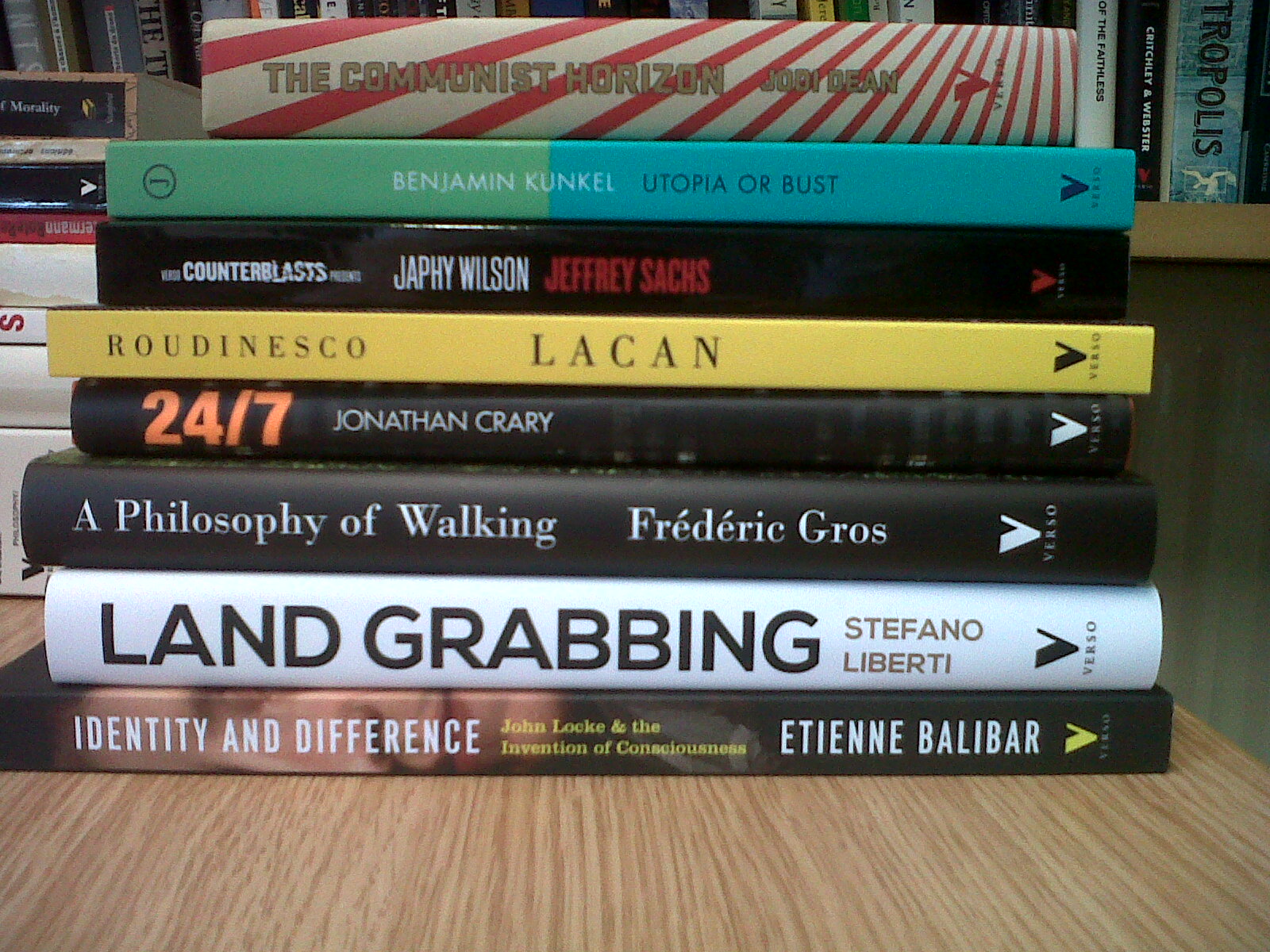
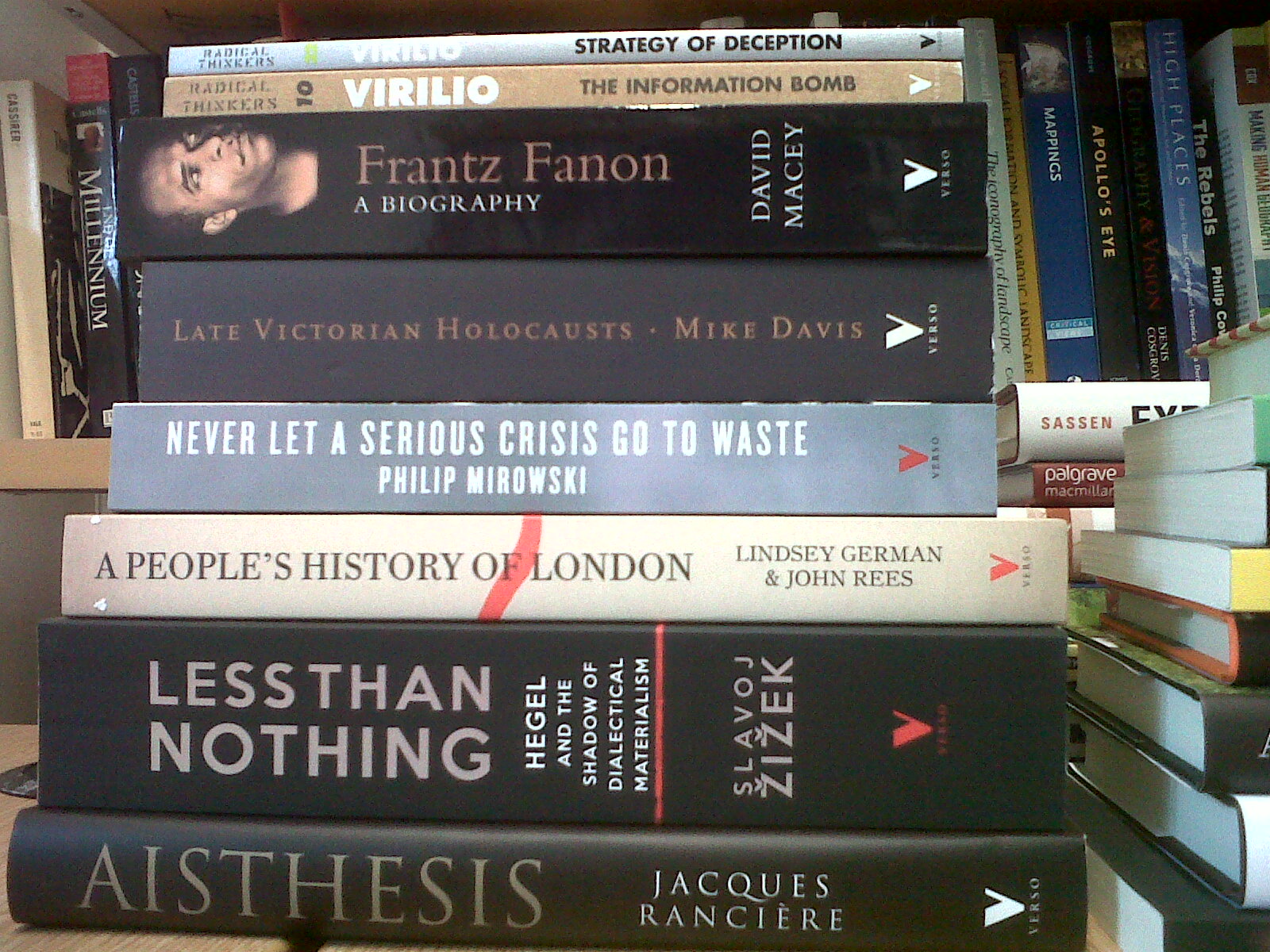
Some of these I’ve read already due to Verso’s excellent e-book bundling. I wish more publishers would do this.

Verso 1 Verso 2


Posted in Books, Etienne Balibar, Frantz Fanon, Jacques Rancière, Slavoj Zizek | 4 Comments

Books received – Nietzsche, Heidegger, Foucault, Lefebvre etc. (2 of 3)

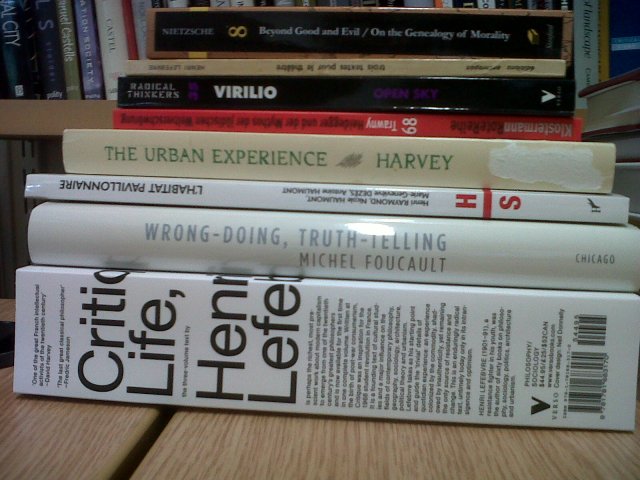
The new translation of Nietzsche’s Beyond Good and Evil and On the Genealogy of Morality; Lefebvre’s Trois textes pour le theâtre; Virilio’s Open Sky; Trawny’s Heidegger und der Mythos der jüdischen Weltverschwörung; Harvey’s The Urban Experience; the new edition of a collection Lefebvre wrote the preface to – L’habitat pavillonaire, the translation of Foucault’s 1981 Louvain lectures, Wrong-Doing, Truth-Telling; and the one-volume edition of Lefebvre’s Critique of Everyday Life. Some of these were pre-ordered in recompense for review work; a couple bought new; the rest picked up second-hand.

Lefebvre etc

Posted in David Harvey, Friedrich Nietzsche, Henri Lefebvre, Michel Foucault, Paul Virilio, Politics | 1 Comment

Books received – territory, borders, architecture, government (1 of 3)

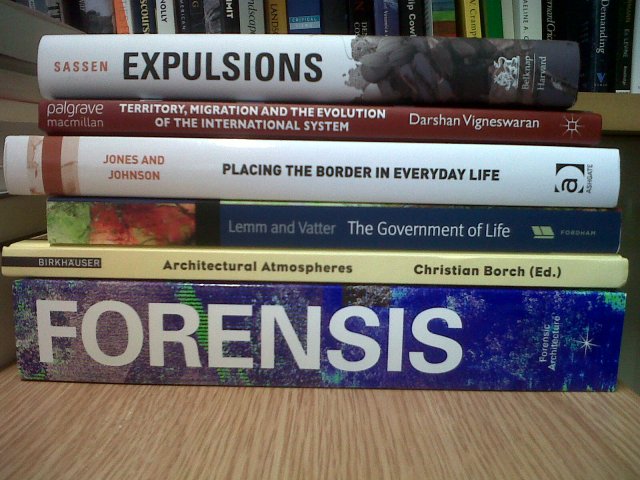
Working through the post… Saskia Sassen’s Expulsions and Darshan Vigneswaran’s Territory, Migration and the Evolution of the International System – both to review; Jones and Johnston’s Placing the Border in Everyday Life – which I endorsed; and Lemm and Vatter’s The Government of Life: Foucault, Biopolitics and Neoliberalism, Christian Borch’s Architectural Atmospheres collection; and the Forensic Architecture collection Forensis sent by publishers or editors.

Territory etc

Posted in Books, Eyal Weizman, Politics, Saskia Sassen, Territory | 1 Comment

Gerry Kearns reviews The Birth of Territory – and a minor note on ‘land’

12 The Birth of TerritoryGerry Kearns has written a review of The Birth of Territory for Society and Space. My sincere thanks to Gerry, and Veronica della Dora, who commissioned the review. The review is available open access, so I won’t quote from it here. It’s a detailed, lengthy and very generous review. Likening it to studies by Clarence Glacken, David N. Livingstone and Derek Gregory is a considerable honour. I won’t pick up on lots of small issues of nuance and complexity in the review, but will clarify one thing that I think is important.

The point is not about land itself, but about understanding territory as land. If we understand territory as land, then I think it is hard to trace the specificity of territory. Territory is much more than land, as I try to show. But territory is obviously related to land, and that I do try to discuss in depth, as Gerry notes. For me then, the two conceptual markers for the inquiry are not ‘land and power’ (as Gerry suggests) but ‘power and place’. I know that these are complicated terms, and I have no wish to reduce those complexities, but we are fortunate in having excellent historical studies of both concepts – by Edward Casey and Michael Mann. I was therefore able to situate my inquiry alongside studies such as those. I think there are clearly related terms to power and place in Greek and Latin thought – I don’t believe there are with territory. With land, I’m less sure – it’s a much more complicated concept than we give it credit for, I think we too quickly collapse it into rent and to my knowledge there is no study comparable to Casey or Mann that interrogates it in depth. (I will go back to the Keith Tribe book noted by Gerry, which I don’t reference in the study.) I’d like to see more work on land – and we also need more on terrain, as Gerry notes. I’m considering doing work on both at some point.

I’m very grateful to Gerry for the review (as I was to Tom Conley yesterday) – authors need other authors to take the time to engage with their work, to point out problems, highlight ambiguities, and point to future directions for work. At their best – as Gerry does at the end – they indicate how books might be used, rather than just read.

Posted in Clarence J. Glacken, David N. Livingstone, Derek Gregory, Society and Space, The Birth of Territory | 3 Comments