
 A nice round-up of some recent books – Derrida, Laclau, Lefebvre, Damlé, Flusser, etc. -at critical-theory.com
A nice round-up of some recent books – Derrida, Laclau, Lefebvre, Damlé, Flusser, etc. -at critical-theory.com
Back in the UK – this was what was awaiting me at work. The two big boxes are from the Verso sale; the rest I’m not yet sure.

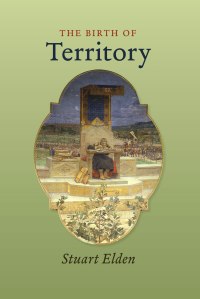 Tom Conley reviews The Birth of Territory in Imago Mundi (subscription required). It’s a thoughtful, generous and engaged review.
Here’s the first paragraph:
Readers of Imago Mundi will appreciate this book for what it does along the fringes the history of cartography. In his intellectual history of what (on the back cover) he calls ‘emergence of the concept of territory in western political thought’, Stuart Elden discusses, both copiously and elegantly, writings from Homer to Rousseau bearing witness to how place and power can be understood. From the Iliad to the Social Contract, territory, he concludes, is best defined in terms of political technology, the latter a lens through which the term resembles a mosaic of modes of measure and control. Territory acquires currency when, in its formative phases, the nation-state implements technologies of measure. Res extensa becomes, as it were, coextensive with the power that a nation exerts upon what it sets under its jurisdiction…
A few bits from later on:
The stunning virtue of The Birth of Territory is found in its sweep and intellectual panache… The close readings of an astounding number of texts attest to the complexity of a term that Elden shows bearing a dazzling history… Elden has provided an exhaustively comprehensive gloss of what in the wake of his book we can now call the territorial canon.
Aside from the generosity, I really like some of the phrases here – “a mosaic of modes of measure and control” and the “territorial canon”. There are some suggestions for where future work might go, which are good, but perhaps most interesting is the critique in the concluding paragraph, suggesting something that would break with much modern scholarly convention, but harks back to some earlier ways of referencing and linking:
The Birth of Territory might have been better arranged, however, were its material organised cartographically. Rather than a cumbrous mass of 2,750 footnotes covering 146 pages, readers would have found a gazetteer-like list of works consulted more useful, especially if coordinated with references in the text itself. Such a system would allow the reader better to see how the politics of Elden’s view of territory in this rich study is born of its capacious matrix of primary and secondary material.
My thanks to Tom for this engagement with the work.

Warning: if you are planning on seeing this production of Macbeth, I’d suggest not reading further. There are spoilers about the production I would not have wanted to know beforehand.
The staging of Macbeth at the Park Avenue Armory was perhaps the best thing about this production, though that is not intended to damn the acting. The Armory is a vast space, the old home of the Seventh Regiment. From the outside it appears like a mock-castle; inside there are lots of ornate rooms, paintings and crafted ceilings. On entry into the Armory audience members were given a wristband with their clan identity – in my case, Ross – and told to be in a designated room fifteen minutes before the scheduled 8pm start. It soon became apparent this was largely as a means of organizing seating. At a little before the appointed hour we were called, clan-by-clan through bells and shouts, to troop through the cavernous drill hall to the racked benches. The seats were arranged in steep rows two sides of a large muddy area, flanked by monolithic semi-circles on both sides and a small raised stage with an expanse of candles at one. To reach this, the audience had to walk along a long pathway, through a heath landscape, dimly lit by torch-bearing attendants. All very evocative, which would have been much better if people had resisted the need to continue using their phones or engaging in banal conversations. This was the first night of the production – apparently still called previews, with a formal opening in a week’s time. It took a long time to get everyone seated, and the production did not begin until thirty minutes after the schedule. The setup put some people right in the action; others a long way from it – more akin to a sports stadium or arena show than a theatre. The hall went black, the witches appeared to be levitating between the monoliths, and as soon as their opening speech was done, rain fell and the battle commenced. There were several minutes of fight choreography with only a few words spoken – right into the action and a clear sense of Macbeth as a man of military action.
There were several highlights in the production, including Branagh’s delivery – largely speaking in natural conversational tones, but occasionally putting emphasis on words in ways I’d not heard before, usually successfully, but occasionally jarring. At times his words were a little indistinct – this is a vast space to fill with a voice. Alex Kingston was a very strong Lady Macbeth, with the sexual appeal of the Macbeths as a couple readily apparent. Jimmy Yuill’s Banquo was played as something of a father figure, and from the distance I was from the stage, appeared a little similar in appearance to Duncan, played by John Shrapnel. The kilts and tartan costumes were perhaps a bit too traditional, though given what has been written about the development of tartan, at the same time anachronistic. The supernatural was done well – the daggers were real, illuminated by lights and then disappearing into darkness; the appearance of Banquo as a ghost convincingly staged; and the vision of the line of kings from the witches’ cauldron enacted in a way I’d not seen done before.
It was interesting seeing this the same day as the cinema screening of King Lear with Simon Russell Beale in the title role, as part of National Theatre Live. I’m going to see that version of Lear in London later this month, so will probably say more about it then. But two things struck me about seeing the two productions together. One was that Emma Freud introduced the cinema version with a description of Beale as ‘the finest classical actor of his generation’. I’m not going to judge on the validity of the description of Beale. But the question of age is interesting – appearances can be deceiving, as Beale is actually one month younger than Branagh. Beale here is playing a old man’s role – at 53 he is surprisingly young to be taking it on. Branagh is playing a role, and playing it in such a physical way, for which he might appear to be rather old. It would not have worked to have reversed the roles in these productions. Nonetheless, while Branagh playing Lear at some future point seems almost inevitable, Beale, perhaps surprisingly, has expressed a wish to take on Macbeth again, a part he played almost ten years ago. They would doubtless be very different visions of the roles.
The second contrast comes from the production style. Despite seeing Lear on screen, this is very much a stage-production, with all the techniques of set and sound design that the National can provide. Macbeth, however, was cinematic in breadth and intent, perhaps reflecting the recent career of Branagh, who has directed the Hollywood films Thor and Jack Ryan: Shadow Recruit, and co-directed this production with Rob Ashford. This production was run without interval, quickly cutting from scene to scene, often with the audience turning their heads like spectators at a tennis match as something happened in their peripheral vision. In this, and much else, it made use of the performance space to great effect. The marching army of Malcolm and the English, disguised by boughs from Burnham Wood, appeared from the other end of the hall, lit by torches, taking the same route the audience had just over two hours before. We did not leave the same way – a slow progression round the back of the stage, past sound and light desks and the scaffolding of the set, out into Lexington Avenue. A slow unveiling of a production that took us a very long way from New York City.
[Update: Thanks to dmfant for this link to a New York Times review, which also has a few good photographs.]
A nice piece on the process of finishing a book – in this case, Stories of Stone for University of Minnesota Press – which discusses funding, collaboration and the process of writing.
Barry Stocker’s reading continues…
Lecture of March 7th 1973
Foucault continues a discussion from the last lecture of the lawyer Guy-Jean-Baptiste Target, he refers to there in connection with the dehumanised account of peasant rebels against the regime of the French Revolution. Foucault goes on to say that Target defines a difference between classes in moral terms, so that one is characterised by virtues and the other by vices. The morally bad class is like a stranger within the social body. Foucault suggests a convergence with the (Anglo-American) Quaker view (discussed in earlier lectures) according to which the state is a necessity for absorbing evil with an order of goodness. In both cases the state is necessary to correct the moral delinquency of the lower class, which is the class of the economically poor as well as the morally deficient.
Foucault goes onto discuss the role of fear in organising penalty in the nineteenth…
View original post 639 more words
Some interesting advice from IR theorist Nicholas Onuf.
Nicholas Onuf recently gave an interview over at e-IR. Several people of our acquaintance shared the tail-end of that, in which he is prompted to dispense career advice. Although opinions are indeed like assholes, these are good enough to elevate far above the gutter.
 Original image by Stéphanie Saramago
1. Preparing at length for classes does not make you a better teacher. Insofar as it dampens spontaneity, students will think you are boring; this will undercut the self-confidence you thought your lengthy preparations had purchased for you. And, of course, it steals valuable time from your scholarship.
2. Writing is a craft; writing well takes most of us a great deal of work. The usual practice is to think of a problem or issue, formulate a project, do ‘research,’ and then write it up. Bad idea. Keep writing at every stage, even if, in the end, you throw…
View original post 719 more words
I missed the formal opening a few days ago, but on the way to the opening plenary of LeftForum today, I made a detour to the newly named Miles Davis Way – the block between West End Avenue and Riverside Drive on W 77th Street.
This was mentioned at LeftForum yesterday, a major study and publication on The Growth of Mass Incarceration in the United States: Exploring Causes and Consequences. The paper copy is for sale; but it is also available to download as a pdf or read online.
After decades of stability from the 1920s to the early 1970s, the rate of imprisonment in the United States more than quadrupled during the last four decades. The U.S. penal population of 2.2 million adults is by far the largest in the world. Just under one-quarter of the world’s prisoners are held in American prisons. The U.S. rate of incarceration, with nearly 1 out of every 100 adults in prison or jail, is 5 to 10 times higher than the rates in Western Europe and other democracies. The U.S. prison population is largely drawn from the most disadvantaged part of the nation’s population: mostly men under age 40, disproportionately minority, and poorly educated. Prisoners often carry additional deficits of drug and alcohol addictions, mental and physical illnesses, and lack of work preparation or experience. The growth of incarceration in the United States during four decades has prompted numerous critiques and a growing body of scientific knowledge about what prompted the rise and what its consequences have been for the people imprisoned, their families and communities, and for U.S. society.
The Growth of Incarceration in the United States examines research and analysis of the dramatic rise of incarceration rates and its affects. This study makes the case that the United States has gone far past the point where the numbers of people in prison can be justified by social benefits and has reached a level where these high rates of incarceration themselves constitute a source of injustice and social harm.
The Growth of Incarceration in the United States recommends changes in sentencing policy, prison policy, and social policy to reduce the nation’s reliance on incarceration. The report also identifies important research questions that must be answered to provide a firmer basis for policy. The study assesses the evidence and its implications for public policy to inform an extensive and thoughtful public debate about and reconsideration of policies.


