Top ten posts on Progressive Geographies this week

Some links on the situation in Gaza – and Verso’s The Case for Sanctions Against Israel free to download

What is neoliberalism?

Articles and Chapters

Peter Hall (1932-2014)

Judith Butler 2012 Parting Ways: Jewishness and the Critique of Zionism reviewed by Lisa Bhungalia

Bruno Latour – Some advantages of the notion of “Critical Zone” for Geopolitics

Seyla Benhabib reviews Richard J. Bernstein, Violence at NDPR

Special Issue on Ranciere

Joshua Hagen reviews The Birth of Territory in Geographical Review

How powerful is your passport? – infographic

Posted in Uncategorized | Leave a comment

Heidegger’s Black Notebooks: Philosophy, Politics, Anti-Semitism

Heidegger’s Black Notebooks: Philosophy, Politics, Anti-Semitism, Emory University, September 5-6, 2014

Speakers:
Peter Trawny (Bergische Universität Gesamthochschule Wuppertal)
Bettina Bergo (Université de Montréal)
Robert Bernasconi (Pennsylvania State University)
Martin Gessmann (Hochschule für Gestaltung, Offenbach am Main)
Sander Gilman (Emory University)
Peter E. Gordon (Harvard University)
Eduardo Mendieta (Stony Brook University)
Richard Polt (Xavier University)
Tom Rockmore (Duquesne University)

Conference is free and open to the public.

Please join us for a conference devoted to Heidegger’s recently published Black Notebooks. These notebooks contain Heidegger’s private political ruminations from the years 1931-1944, dealing directly with his conception of National Socialism and politics more broadly. They also evince a strain of anti-Semitism, not only in passing remarks, but as incorporated into his philosophical/political thinking as well. And while the Black Notebooks are undoubtedly crucial for an assessment of Heidegger’s relation to politics, National Socialism, and anti-Semitism, they likewise provide an opportunity to reflect more broadly on topics such as the relation of philosophy to politics, the role of the intellectual in society, the problem of modernity, and the tension between the public and the private, to name only a few. The Emory conference features the editor of the notebooks, Peter Trawny, along with an interdisciplinary group of scholars to address the content of these notebooks from a variety of perspectives and contexts.

The conference will be held at the Emory Conference Center. Rooms can be reserved at the Emory Conference Center Hotel, (404) 712-6000, emoryconferencecenter.com Discounted room rates may apply.

For further details or questions, please contact the conference organizer, Andrew J. Mitchell, at andrew.j.mitchell@emory.edu

This conference is made possible by the generous support of the Center for Faculty Development and Excellence, the Hightower Fund, the departments of Philosophy, Comparative Literature, German Studies, and French and Italian, the Institute of Liberal Arts, and the Tam Institute for Jewish Studies.

Update: Flyer here

Posted in Conferences, Eduardo Mendieta, Martin Heidegger | 3 Comments

The Birth of Territory reviewed in Croatian International Relations Review

s18485782The Birth of Territory has been reviewed in Croatian International Relations Review by Daniel Šaric (open access). Here’s the first paragraph:

Stuart Elden’s new book The Birth of Territory is a magisterial and in parts almost encyclopedic work. The book covers a diverse and broad ground, starting from political theory and international relations through geography and law to theology and history. The book’s basic presupposition is to present a genealogy of the concept of territory as we understand it today. Elden asserts that the concept of territory is taken for granted today. That is the case in political practice as well as in political theory and the social sciences more generally where territory has been under-examined. Thus, the author “seeks to offer an account of the emergence of the concept of territory in Western political thought. It does so primarily through a contextualized reading of the texts of that tradition with one key question: what is the relation between place and power?” (ibid: 10). He answers this question through a mesmerizing account divided in three parts spanning nine chapters and a coda which are supported by more than 2,700 endnotes. The book won the 2013 Association of American Geographers Meridian Book Award for “outstanding scholarly work in Geography”.

Posted in Politics, Territory, The Birth of Territory | 1 Comment

Rob Kitchin’s updated website

Fully updated at kitchin.org

Posted in Uncategorized | Leave a comment

Judith Butler 2012 Parting Ways: Jewishness and the Critique of Zionism reviewed by Lisa Bhungalia

Lisa Bhungalia reviews Judith Butler’s Parting Ways at the Society and Space open site.

Posted in Uncategorized | 1 Comment

Peter Hall (1932-2014)

Urbanist and geographer Peter Hall died two days ago. There is an obituary in The Guardian and one at Building Design.

Posted in urban/urbanisation | 1 Comment

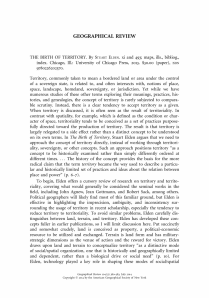
Joshua Hagen reviews The Birth of Territory in Geographical Review

gere12034A nice review of The Birth of Territory in Geographical Review, by Joshua Hagen (requires subscription).

Here’s the concluding paragraph:

Elden is to be commended for his keen analysis that tackles rather complex issues of meaning and translation while remaining eminently readable. I also credit Elden for undertaking such an ambitious project when the incentive structures in modern academia increasingly tilt toward producing the minimal publishable unit. Upon first perusing the book, I immediately thought of Clarence Glacken’s Traces on the Rhodian Shore, an impression that was only reinforced as I read through the chapters. I was a bit frustrated the book lacked a full bibliography. The main chapters seemed to average around 250 notes, so looking up full citations was laborious. I will refrain from the rather lazy criticism that this or that should have been included in a book that covers so much ground, but I would have liked a bit more explanation about what criteria governed
the selection of source materials. Perhaps my most significant complaint would be that I do not think the title fits the book very well. The story Elden tells is less about the birth of territory than the changing relations between place and power. Elden explicitly acknowledges as much throughout the book. I believe what Elden has actually produced is much more than the birth of territory. With apologies to Glacken, I think the book would be better titled Place and Power in Western Thought from Ancient Times to the End of the Seventeenth Century. These small points do not diminish a truly impressive piece of scholarship.


Posted in Territory, The Birth of Territory | 2 Comments

Some links on the situation in Gaza – and Verso’s The Case for Sanctions Against Israel free to download

The desperate situation on Gaza continues… some things worth reading, as something of a balance to the mainstream media

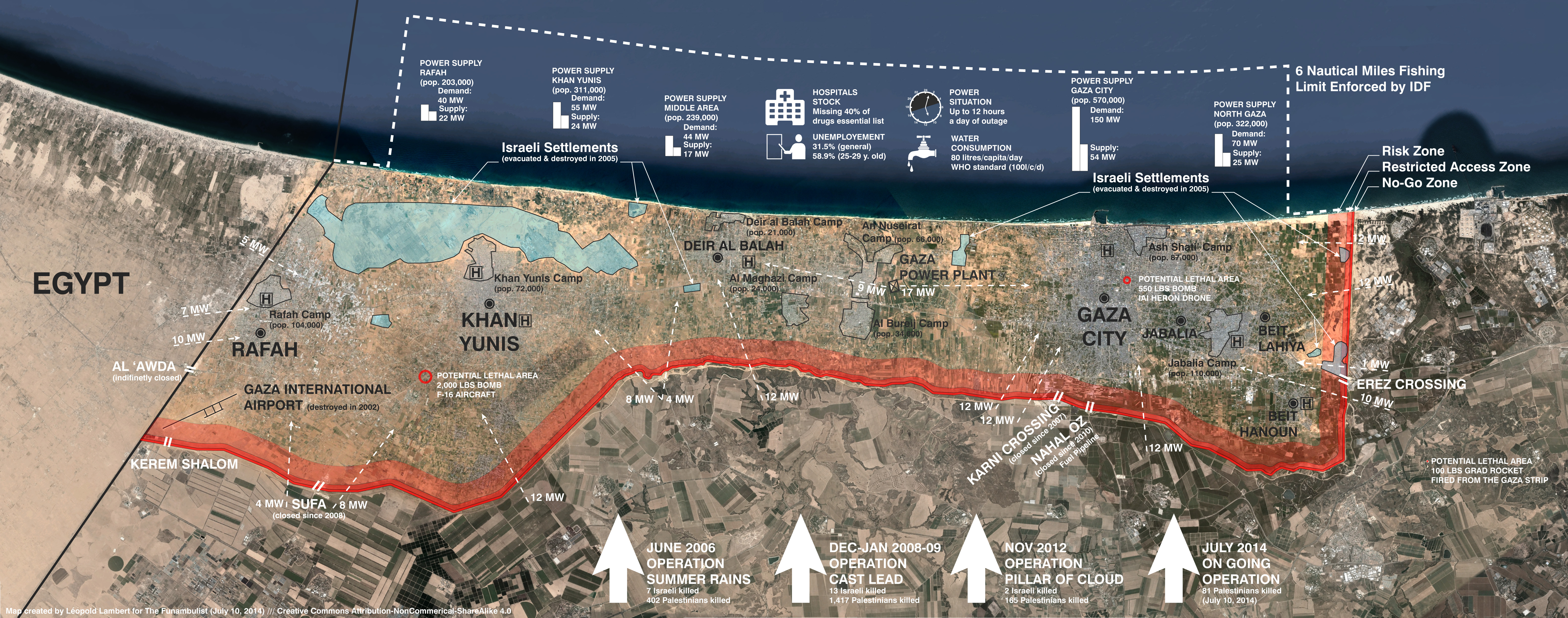
The Funambulist has had some excellent analysis, in word and image by Léopold Lambert  – clicking the map below takes to you a high-quality image. [Plus a new post on 30/7/2014]

Map Gaza

Derek Gregory’s blog Geographical Imaginations has had several good posts recently – Corpographies and Footnotes to Gaza 101, among them…

Juan Cole’s Informed Comment is a continually useful source of perspectives, on this and much else

Craig Jones’s War, Law, Space blog had some important pieces towards the beginning of this war, including a link to a work in progress entitled  ‘Frames of law: Targeting advice and operational law in the Israeli Defense Force‘

Critical Legal Thinking has had some good pieces too

Finally, The Case for Sanctions Against Israel – Verso’s collection of essays is now available as a free e-book

[Update: ‘Isolating Gaza‘ at the Stanford University Press blog is also very good]

Posted in Politics, Territory | 2 Comments

Seyla Benhabib reviews Richard J. Bernstein, Violence at NDPR

Seyla Benhabib reviews Richard J. Bernstein, Violence at NDPR

Posted in Uncategorized | 1 Comment

Ed Cohen on The Productive Body and La société punitive in the LARB

Ed Cohen reviews Francois Guéry and Didier Deleule’s The Productive Body and Foucault’s La société punitive in the Los Angeles Review of Books.

Posted in Michel Foucault, Politics | Leave a comment