Rob Kitchin – Writing for impact: how to craft papers that will be cited

An interesting piece by Rob Kitchin about writing and publishing.

For the past few years I’ve co-taught a professional development course for doctoral students on completing a thesis, getting a job, and publishing.  The course draws liberally on a book I co-wrote with the late Duncan Fuller entitled, The Academics’ Guide to Publishing.  One thing we did not really cover in the book was how to write and place pieces that have impact, rather providing more general advice about getting through the peer review process.

The general careers advice mantra of academia is now ‘publish or perish’.  Often what is published and its utility and value can be somewhat overlooked — if a piece got published it is assumed it must have some inherent value.  And yet a common observation is that most journal articles seem to be barely read, let alone cited.

Both authors and editors want to publish material that is both read and cited, so what is required to produce work that editors are delighted to accept and readers find so useful that they want to cite in their own work?

continue reading here

Posted in Publishing, Writing | Leave a comment

Discussion forum on Henri Lefebvre ‘Dissolving city, planetary metamorphosis’ – paper and intro open access, and four online commentaries

Four commentaries on a short piece by Lefebvre that appeared in the last issue Society and Space – all open access. As well as Lefebvre’s piece, there is the introduction by David Wachsmuth and Neil Brenner, and commentaries by Anne Vogelpohl, Stefan Kipfer, Ross Exo Adams and Stuart Elden.

Posted in Uncategorized | Leave a comment

What is Space: a Post-Disciplinary Workshop at Warwick on the Return of an Old Debate – 17 June 2014

Now with date (!) and link to poster.

stuartelden's avatarProgressive Geographies

Please contact Marijn Nieuwenhuis with any inquiries. The workshop is on 17 June 2014. Poster here.

What is Space: a Post-Disciplinary Workshop on the Return of an Old Debate

The eternal silence of these infinite spaces frightens me (Pascal, Thoughts, 1964)

Space is the everywhere of modern thought. It is the flesh that flatters the bones of theory. It is an all-purpose nostrum to be applied whenever things look sticky. (Crang and Thrift, Thinking Space, 2000)

The question of space has in both the humanities and the social sciences recently regained prominence on academic agendas. The so-called ‘spatial turn’, initially set in motion by geographers, has allowed historians, philosophers, sociologists, anthropologists, artists and others to return to the long abandoned, albeit fundamental, question of what space is. This reengagement has resulted in a gradual, ongoing questioning and re-opening of the great debates that earlier characterised the European Renaissance. Contemporary…

View original post 247 more words

Posted in Uncategorized | Leave a comment

How Capitalism Survives – Eleventh Annual Historical Materialism London Conference 6-9 November 2014

How Capitalism Survives
Eleventh Annual Historical Materialism London Conference
6-9 November 2014
Vernon Square, Central London*

This year marks the first of a series of centennial commemorations and anniversaries, starting with that of the first worldwide inter-imperialist conflict. Centuries of colonialism and imperialism served as a preparatory phase for the catastrophe. Indeed, while the main parties of the Second International trampled the revolutionary socialist tradition in trench-mud, the First World War destroyed the illusion that imperialist violence could be wreaked on the colonies while leaving Europe untouched. If capital came into the world ‘dripping from head to toe, from every pore, with blood and dirt’, Marx’s analysis of ‘primitive accumulation’ has certainly not been confined to a pre-history of capital. 

And yet, contrary to all expectations, despite these tremors and shocks, despite the terrifying glances into the abyss of destruction, capitalism has survived. Not only has capital muddled through; it has mutated, adapted and, by some criteria, emerged stronger than before. At the same time, however, new contradictions and crises have appeared, expanding the spaces of critique to the ecological and the ideological terrains and opening up new possibilities of revolutionary breakthrough.

In recent years, the crisis and the movements emerging in response have re-opened an opportunity to envision, and fight for, substantive alternatives. But these movements have remained fragmented and have faced increasing state repression and imperialist aggression. And the on-going crisis is now raising the stakes. It is clear that this crisis is indeed global, leading to deepening austerity in the North and undermining the conditions for sustained growth in the South. If, in the North, the ‘war on terror’ manifests itself in intensified state racism and Islamophobia, the crisis is also intensifying and bringing to the surface underlying international rivalries. The winds of war from the South are reaching Europe once again. But from the South, movements worldwide also bear witness to countless examples of struggle and resistance. 

At this year’s conference, we want to explore capital’s capacity to survive in order to explore, first and foremost, how it can be overcome. We are interested in investigating contemporary geographical reconfigurations of accumulation and interrogating theories of imperialism, hegemonic succession, and capital’s tendencies towards increasing inter-state rivalries. On the other hand, we want to delve into theories and practices of class struggles, social movements and resistance which create possible alternatives to neoliberalism, crisis and war by constantly challenging the smooth reproduction of capitalism in its gendered, social, economic, political, racial, ecological, cultural and ideological dimensions. In doing so, we also want to enrich our understanding of a Marxian analysis of ‘core’ and ‘periphery’ with an analysis of current developments of Marxism in the South in general and in the BRICS economies in particular. We also hope to continue the theme on Race and Capital inaugurated last year.

We welcome abstract proposals of 200 words on these themes or any others, in all disciplines, from all continents and from all perspectives within Marxism. The deadline for proposals is 15th May 2014. 

Please register your abstracts here: http://www.historicalmaterialism.org/conferences/annual11/submit

Separate calls go out for the following streams: Marxism and Feminism, and Ecology and Climate Change. 

* Please note that this year the conference will not be taking place at the main SOAS buildings at Thornhaugh Square.

Posted in Conferences | Leave a comment

What is Space: a Post-Disciplinary Workshop at Warwick on the Return of an Old Debate – 17 June 2014

Please contact Marijn Nieuwenhuis with any inquiries. The workshop is on 17 June 2014. Poster here.

What is Space: a Post-Disciplinary Workshop on the Return of an Old Debate

The eternal silence of these infinite spaces frightens me (Pascal, Thoughts, 1964)

Space is the everywhere of modern thought. It is the flesh that flatters the bones of theory. It is an all-purpose nostrum to be applied whenever things look sticky. (Crang and Thrift, Thinking Space, 2000)

The question of space has in both the humanities and the social sciences recently regained prominence on academic agendas. The so-called ‘spatial turn’, initially set in motion by geographers, has allowed historians, philosophers, sociologists, anthropologists, artists and others to return to the long abandoned, albeit fundamental, question of what space is. This reengagement has resulted in a gradual, ongoing questioning and re-opening of the great debates that earlier characterised the European Renaissance. Contemporary discussions and writings about space have led to a multiplication of literal and metaphorical spatial references ranging from ‘location’, ‘terrain’, ‘site’, ‘region’ among countless others. This intellectual enrichment means however also that the question of space has become an increasingly messy, ambiguous and sometimes even incongruous affair.

This workshop invites junior and senior academics from across the University to explain and demonstrate how they conceptualise space in their work. We believe that the problem of space is too important to be left to one discipline. The objective of this one-day workshop is therefore to deterritorialise and transcend the longstanding disciplinary academic divisions and to reengage academics from all departments in an attempt to build bridges over the vast rivers that have come to divide us. The goal is not so much to arrive at a common consensus, nor to find a universally acceptable solution to the fundamental problem that space poses to us, but to openly start questioning and speculating again about the meaning we give to the concept.

We invite abstracts of no more than 300 words for papers of approximately 20 minutes in length, accompanied by a short biographical note. Please email all abstracts and inquiries to the convenor, Dr Marijn Nieuwenhuis. The deadline for the receipt of all abstracts is the 6th of May 2014. We can discuss the possibilities of combining the workshop papers into an edited volume.

This workshop is funded by the Institute of Advanced Study, University of Warwick

Posted in Conferences | 2 Comments

The City as Open Source Pedagogy – Alberto Corsín Jiménez

An online update for a paper in the latest Society and Space (open access for a month).

Posted in Uncategorized | 1 Comment

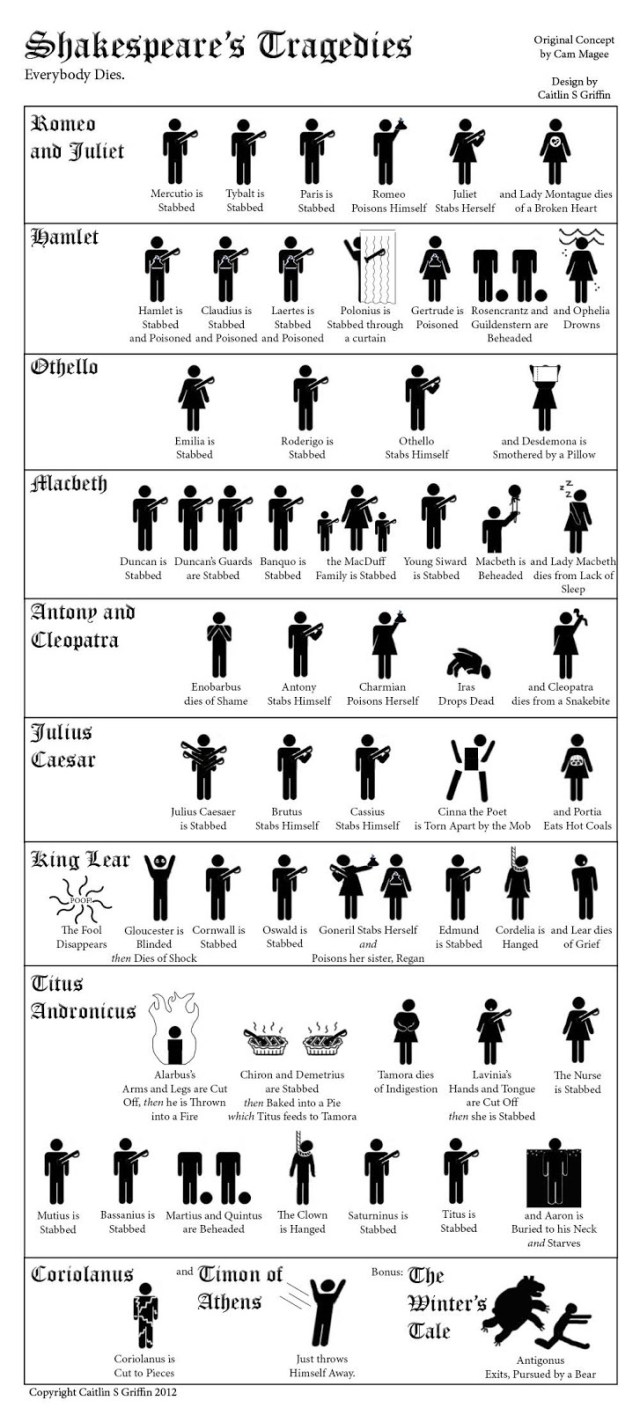
How people die in Shakespeare’s tragedies

Another Shakespeare piece for the birthday. One of the most popular things I’ve ever posted – though I can take none of the credit…

stuartelden's avatarProgressive Geographies

View original post

Posted in Uncategorized | Leave a comment

Ian McKellan, Michael Pennington and Jeffrey Horowitz discuss Shakespeare for his 450th Birthday

Posted in William Shakespeare | Leave a comment

King Lear with Michael Pennington at the Polonsky Shakespeare Center

lear28f-1-webLast night I went to see Michael Pennington in King Lear by the Theatre for a New Audience at the Polonsky Shakespeare Centre in Brooklyn. There are good reviews in The New York Times and NY Daily Times.

As the reviews suggest, this is less high octane than some other recent productions. Some of that is undoubtedly due to the acting, but it is also related to the script. This version uses the Quarto text as its basis, as opposed to the Folio text or the conflated version that is usually the basis for modern editions. That said, some of the cuts made were those of the Folio. There are some crucial differences between these texts. In particular, scenes are cut; speeches and lines are in one or other text; the identity of the invading army changes; and lines are switched between actors.

You can read my paper on “The Geo-politics of King Lear: Territory, Land, Earth” – in Law and Literature (open access). That’s an early version of what I hope will be in the planned Shakespearean Territories book. This production rather underplayed the big ‘geopolitical’ elements of the text – the territorial division (the Quarto omits the crucial line ‘interest of territory, cares of state’), the invading army, internal warring factions – but was good on the more domestic elements, such as the land-inheritance issues at the heart of the Duke of Gloucester/Edgar/Edmund sub-plot. The production was more of a domestic tragedy, with a wider war going on in the background. The behaviour of Lear’s revenue at Goneril’s home almost made you sympathetic for her.

I’m going to see the Sam Mendes/Simon Russell Beale version in London in June. It will be interesting to compare these two productions.

Update: Steve Mentz has a nice piece on this production here, which especially praises the performances of Lear’s daughters.

Posted in Shakespearean Territories, William Shakespeare | 2 Comments

In Memory of Ernesto Laclau

Another tribute to Laclau, from Mark Devenney.

WEEENGLAND's avatarconstellations68

In Memory of Ernesto Laclau

I first met Ernesto Laclau in 1992, in Johannesburg. I was an MA student, studying politics intent on changing the world not merely interpreting it. I struggled though, with party lines, with party discipline, with Marxist theory, and with party hacks who refused even to ask, never mind address, the difficult questions. In the context of apartheid Marxism was the only political discourse which provided both a revolutionary rejection of, and a serious conceptualisation of, the apartheid regime. Knowledge and power fused all too easily in the language of student activists. Those who asked awkward questions were re-educated against residual bourgeois prejudices. In 1989 I read Hegemony and Socialist Strategy. It made sense of my groping attempts to fuse a commitment to the left, with a language and a politics bereft of the politics of certainty, a certainty which rendered so much of the Marxism…

View original post 2,577 more words

Posted in Uncategorized | Leave a comment