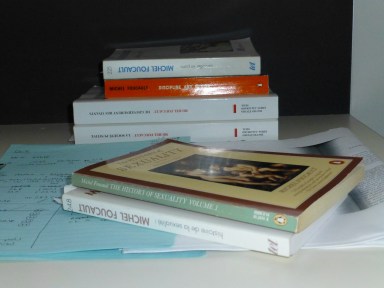
 Over the past couple of weeks I’ve worked through the first volume of the History of Sexuality, in both French and English. There are, to my mind, not nearly as many translational issues with this as with Surveiller et punir/Discipline and Punish, but there are several, and many seriously distort what Foucault is trying to express. The most significant by far, in my view, is the word dispositif being translated as ‘deployment’. Even though this is a very strange choice, I’d pretty much thought you could simply read the text and know when it said ‘deployment’ the word was dispositif. But it’s not that simple. Robert Hurley realises this makes for nonsense in some contexts, so he puts in ‘mechanism’ (though that also sometimes translates other words, sometimes on the same page), ‘apparatus’, ‘layout’, ‘device’, ‘construct’, ‘organization’ (also used for other words) and once just ignores it… ‘The dispositif of sexuality’ is the fourth section of the book, subdivided into four chapters, and is the most extensive by far, absolutely crucial to the overall argument.
Translation issues aside, this should have led to a straight-forward chapter discussing the text, but it is proving to be anything but. Chapter Five needs to accomplish several things. It has to discuss the only part of the original plan of the History of Sexuality Foucault published; situate it in relation to the lecture courses that previewed some of its material – especially the final chapter in ‘Society Must Be Defended’; and in its conclusion provide a summary of what we know from available evidence as to how far Foucault got with his initial schema for the subsequent volumes. Which raises the problem of confession. This is, as I’ve long known, the key question both for my book, and for Foucault’s History of Sexuality. There is, from the available evidence, an extensive discussion of this question (and the medieval period more generally) in the as-yet-unpublished Théories et institutions pénales; which is summarized in The Abnormals; and then alluded to through History of Sexuality volume I. Foucault intended to write the second volume on just this theme. But this book was never published, even though extensive drafts were written—the evidence suggests at least one by 1975 and one in 1978—which were later destroyed. I had originally intended that Chapter Six would be the first of two chapters on confession, treating Foucault’s comments on the topic up to 1976, drawing on all the evidence in early Collège courses and the limited indications in the first volume of the History of Sexuality. I have done quite a lot of work on this previously, in a paper published as ‘The Problem of Confession’, but there was much more to be done given newly available material.
I was finding it very difficult to discuss Volume I without alluding to the other material on confession, so I’ve ended up doing something different: effectively I’ve tried to merge Chapter Five on History of Sexuality I and Chapter Six on confession up to c.1976 together. This has proved quite useful, though it is becoming yet another lengthy chapter. I’m hoping I can find a way to make this work, as the alternative was just proving too tricky. (The plan was the second confession chapter looks at what Foucault did with the concept later, after the work on governmentality, principally in the late 70s and early 80s – most of which is dependent on lectures that have only come out in the past couple of years – and to discuss what we might know of the unpublished fourth volume Les aveux de la chair. I still intend to follow through with that, and will move to begin that next as soon as time allows.)
I still have quite a bit to add into Chapter Five, not least a substantial discussion of the dispositif section. I have extensive notes on that and elsewhere that need to be incorporated, but this continually raises the challenge of not sending chapters beyond their notional word-limits or the bounds of a viable chapter. I’ve been adding things in, edit to fit, cut, summarise and rework… and then realize this has implications for something else. I fix that, and break two or three other things in the process. I am finding myself constrained by chronology in a way that I didn’t expect – this lecture course anticipates this publication, which we can now read in a new light or see in a new context as a result, but unless you’ve outlined the subsequent publication first, this makes little sense. Nor is it easy to treat a book in its proper chronological place in both the received and newly conceived light. Foucault outlined projects with a professed certainty and clarity in print while at the same time, shortly after, or even before, in public and private pronouncements he had already begun their unravelling. The complexity and fascination of the material is what drew me to it, but it is tricky to know how to provide some overall narrative arc to this to make it comprehensive and comprehensible, without over-simplifying or making it too dull.
One of the things I have tried to do with this blog is to talk about the process, rather than just the outcome, of writing. I have done this with work leading up to The Birth of Territory, and with this book on Foucault. My updates have been at uneven intervals – which tells something of a story in itself – and while they’ve tried to convey some of the tricky things I’ve had to balance, resolve or work around, they may well have conveyed a sense of a project moving remorselessly forward. With every major project I’ve been involved with there have been moments when it’s felt stuck, like it’s going in the wrong direction, or progress has been leaden and laboured. At times it feels like this project is going through that stage, or, at least, one of those stages. I know the process of book writing well enough by now to know that it’s unlikely to be the only one. With all previous books, there have been moments or periods when I’ve thought that what I’d done was no good; or where it had all been said before; or that what I was trying to achieve was unachievable (at least by me); or that it was unmanageable within the word, time or logistical constraints set by me or others. The irony of this book is that it is, in large part, the intellectual history of an abandoned project – the first, thematic version of the History of Sexuality – and of an unfinished one – the final, historical version of the History of Sexuality. I may be getting too close to the material and ending up replicating some of its own tensions. But I’ve worked through these kinds of problems before, and over the past few days, especially with the joining of what was previously two chapters together, I feel I am making progress again.
You can read more about the Foucault’s Last Decade project, along with links to previous updates, here.