Creating a writing space – #whereiwrite

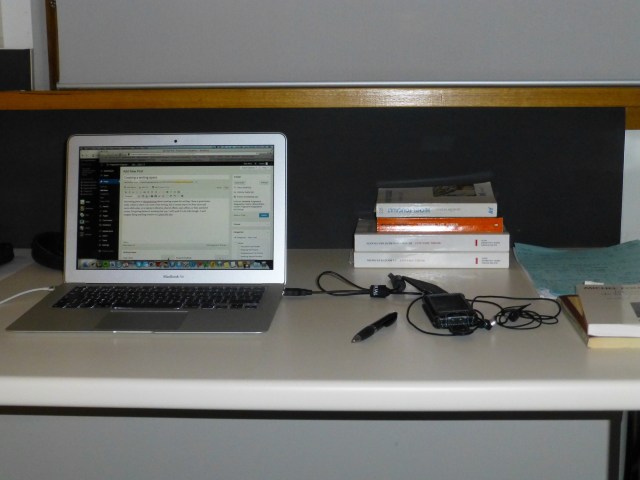
There is an interesting piece at chroniclevitae about creating a space for writing, and continued at #whereiwrite. I have a great home study, which is where I do most of my writing – this is a picture of the last but one home study, and with the old PC, at the moment I completed The Birth of Territory in 2012. Completing the Birth of TerritoryIn recent years I’ve done more and  more while away, on a laptop in libraries, shared offices, open offices, or flats and hotel rooms. The biggest problem I have when doing this is the frustration of knowing I could resolve a reference query with a book that is on the other side of the room on the other side of the world… And I do miss having two monitor screens: I make more notes on paper when using a laptop. This is today, as I’m working on Foucault’s Last Decade: Desk I’m getting better at working this way. I still need it to be fairly tidy though, or at least, as the first picture shows, everything there is needed at that very time.  I can’t imagine doing anything creative in a place like this. Alternatively, you could take your writing on the train, with Amtrak’s writers in residence scheme. Though recently I’ve been doing a lot of writing in this marvellous room in the State Library of Victoria in Melbourne:
LibraryDomeUpdate: David Beer follows up with his own writing spaces here.
 

Posted in Foucault's Last Decade, Publishing, The Birth of Territory, Writing | 3 Comments

Angela Davis to return to UCLA

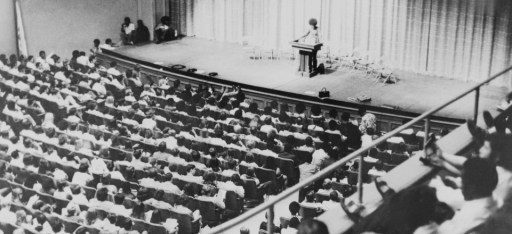
Forty-five years after her one and only lecture at UCLA, Angela Davis returns. Full story (with some discussion of Stuart Hall’s legacy too) here:

Angela Davis Royce Hall_2Fortunately, Professor Davis returns to UCLA as our Regents Professor and Lecturer this spring (2014), where she will teach a graduate seminar in Gender Studies and deliver a public lecture that further advances her profound insights into black radical and feminist sources of ideas of freedom and abolition.

Posted in Stuart Hall | Tagged | Leave a comment

The Pervert’s Guide to Cinema — Slavoj Žižek (Full Film)

A lot of Žižek in one go, but this is the full film – the prequel to the more recent Pervert’s Guide to Ideology.

Biblioklept's avatarBiblioklept

View original post

Posted in Uncategorized | Leave a comment

Eileen Joy interview with The Funambulist – publishing, medieval studies, and much more

This interview was conducted by Léopold Lambert in September 2013, and made available on Archipelago: The Podcast Platform of The Funambulist in January. I’ve just made time to listen. Very interesting insights on publishing, medieval studies and much more.

Every publishing house constructs an editorial line of its own. Sometimes it has to do with the topic, sometimes with a question, sometimes with the authors… In the case of punctum books however, the editorial line is to be found in the failure of the book it publishes to properly take place into a given academic category. The manifesto that lies behind such choice is the topic of the conversation I had with Eileen. The not-so-well-known (at least for me) medieval era meets the scheme of the archipelago dear to this platform, as we imagined together a non-institutionalized university where knowledge is freely shared (punctum’s books are all available in open-access) and disciplines declared obsolete.

Eileen Joy is specialist in Old English literary studies and cultural studies, with interests in poetry and poetics, historiography, ethics, affects, embodiments, queer studies, the politics of friendship, speculative realism, object oriented ontology, and the post/human. She is the Co-Founder and Lead Ingenitor of the BABEL Working Group, the Founder and Co-Editor of “postmedieval: a journal of medieval cultural studies”, Co-Founder and Editor of “O-Zone: A Journal of Object Oriented Studies”, Co-Founder and Director of punctum books: spontaneous acts of scholarly combustion, and Co-Founder and Assoc. Director of punctum records.

Posted in Books, Politics, Publishing, Universities | Tagged , | 1 Comment

Todd May (ed.) Emerging Trends in Continental Philosophy

This looks a potentially interesting collection, though there do seem to be quite a few individual figures treated here.

1844656160

Emerging Trends in Continental Philosophy presents a comprehensive and accessible analysis of the most recent developments in European thought. From feminist thought to environmental philosophy to analytic themes in Continental philosophy to recent discussions of citizenship, Emerging Trends offers an overview of the currents animating contemporary Continental philosophy. The volume focuses on thematic developments rather than individual figures, allowing the reader to follow the threads that weave different thinkers together. Each essay is written by an expert in the area covered, displaying the passion of these experts for the fields they discuss without lapsing into jargon. The volume provides a broad map of the landscape of recent European thought as well as the latest thinking from leading scholars on key themes. This paperback edition includes a new, final chapter bringing the study right up to the present.

Posted in Uncategorized | Leave a comment

Heidegger, Hölderlin’s Hymns “Germania” and “The Rhine” – translation out in September

The long awaited – it’s been forthcoming since the 1990s – translation of Martin Heidegger’s 1934-35 lecture course Hölderlin’s Hymns “Germania” and “The Rhine”, is due out in September 2014. The translators are William McNeill and Julia Ireland, also responsible for the translation of Heidegger’s course on Hölderlin’s Hymn ‘The Ister’. Thanks to Chathan Vemuri for the link.

9780253014214_medMartin Heidegger’s 1934–1935 lectures on Friedrich Hölderlin’s hymns “Germania” and “The Rhine” are considered the most significant among Heidegger’s lectures on Hölderlin. Coming at a crucial time in his career, the text illustrates Heidegger’s turn toward language, art, and poetry while reflecting his despair at his failure to revolutionize the German university and his hope for a more profound revolution through the German language, guided by Hölderlin’s poetry. These lectures are important for understanding Heidegger’s changing relation to politics, his turn toward Nietzsche, his thinking about the German language, and his breakthrough to a new kind of poetic thinking. First published in 1980 as volume 39 of Heidegger’s Complete Works, this graceful and rigorous English-language translation will be widely discussed in continental philosophy and literary theory.

Posted in Martin Heidegger | 1 Comment

Michael Hardt: On Deleuze’s Theory of Control

Interesting relation of my work on territory to Michael Hardt and Gilles Deleuze.

S.C. Hickman's avatarThe Dark Forest: Literature, Philosophy, and Digital Arts

Michael Hardt in an essay on Deleuze’s Postscript for Societies of Control published in Discourse Journal for Theoretical Studies in Media and Culture aligns his notion of Empire contra Foucault’s ‘regimes of biopower’ saying: “I would like to suggest that the social form of this new Empire we are living today is the global society of control” (140). I’ve written on Deleuze’s essay before: here, so will not go back over the details (and one can read it the full essay by Deleuze: here).

Hardt in furthering Deleuze’s initiative sees the change from the Foucauldian  disciplinary society to the society of control as a breakdown in the outside/inside distinctions in conceptions of sovereignty and power over time as manifest in the concept of territory. As he tells it the older forms of sovereignty were always measured in concepts of territory and of the relations of territory to some outside:…

View original post 969 more words

Posted in Uncategorized | 1 Comment

Latour: War & Peace in Time of Ecological Conflicts

Latour’s recent LSE lecture video recording


dmf's avatarANTHEM

LSE lecture:
Although it is still useful to insist on the distinction between science and politics, the scale and importance of ecological mutations make it more and more difficult to use it effectively. The problem is that the alternative requires a redefinition of the two terms “science” and “politics”. The lecture will explore in which way an alternative definition could help us to cope with the geopolitical debates that will become more and more intense in the future.

View original post

Posted in Uncategorized | Leave a comment

Mark Neocleous, War Power, Police Power – sample chapter available

NeocleousMark Neocleous’s book War Power, Police Power has just been published. You can read a sample chapter here.

In this, the first book to deal with the concepts of war power and police power together, Mark Neocleous deals with these questions and many more by using critical theory to radically rethink war power.

Neocleous generates a provocative set of claims about state power and capital accumulation, the role of violence in the making of liberal order, the police wars at the heart of this violence, and the ways in which these processes come to be called ‘peace’. And he takes the reader down some unexpected paths: the ‘war on waste’, debates about effeminacy, the proliferation of resilience and trauma-talk, drones as the culmination of colonial bombing campaigns, and no-fly zones as the perfect accompaniment for drones.

The result is a compelling book that articulates a vision of war/police power beyond the military and the police.

Posted in Mark Neocleous | Leave a comment

(Bad) Evacuation: moving, naming, killing

Pete Adey discusses his new project on Evacuation at the Royal Holloway Geopolitics and Security blog.

Posted in Uncategorized | Leave a comment