Troels Schultz Larsen and Kristian Nagel Delica, Fragmenting Cities: The State, Territorial Stigmatization and Urban Marginality – Edward Elgar, 2025

Troels Schultz Larsen and Kristian Nagel Delica, Fragmenting Cities: The State, Territorial Stigmatization and Urban Marginality – Edward Elgar, 2025

Fragmenting Cities offers a conceptionally innovative and empirically detailed analysis of the surprising acceptance and normalization of state-based stigmatization and discrimination based on place. It does this by drawing on the example of the first state-sanctioned definition of “ghetto”, the controversial “ghetto list” produced by the Danish government.

Troels Schultz Larsen and Kristian Nagel Delica introduce policy schizophrenia as a concept to describe instances where the state simultaneously stigmatizes people from the top while engaging in urban renewal at the bottom, deepening the fragmentation of the city. They develop a meticulously researched neo-Bourdieusian model of the state as nested fields, designed for empirical confrontation and comparative analysis. Through comprehensive socio-historical analysis, this book demonstrates how marked urban and political changes over the past four decades constituted a symbolic revolution, radically upending the fundamentals of not-for-profit housing.

Investigating relationships that have been neglected in contemporary governance research, urban studies, and critical political geography, this book is an essential read for academics, researchers and students of human geography, sociology, urban studies, planning, and governance. Additionally, it is an accessible and innovative resource for policymakers in the field.

Posted in Uncategorized | Leave a comment

Efimia D. Karakantza, Alexandros Velaoras, and Marion Meyer (eds.), Ancient Necropolitics: Maltreating the Living, Abusing the Dead in Greek Antiquity – Brill, January 2025 

Efimia D. Karakantza, Alexandros Velaoras, and Marion Meyer (eds.), Ancient Necropolitics: Maltreating the Living, Abusing the Dead in Greek Antiquity – Brill, January 2025 

This is the first collection of essays approaching aspects of Greek antiquity and its reception through ‘necropolitics’. It discovers traces of necropolitics in the unburied and maltreated corpses of the Homeric epics; it follows the manifestations of necropower in Greek tragedy, historiography, and biography; and it delves into torture, capital punishment, and non-normative burials in the ancient Greek world. It contributes to the debate – much of which is only available in modern Greek – on recent archaeological evidence, notably the iron-bound individuals discovered in the Athenian suburb of Phaleron, and includes a captivating exploration of necropolitics in Yorgos Lanthimos’s Greek-tragedy-inspired cinema.

Posted in Uncategorized | Leave a comment

Open access directories – a resource page on Foucault News

Open access directories – a resource page on Foucault News

Posted in Uncategorized | Leave a comment

Linda Peake, Anindita Datta and Grace Adeniyi-Ogunyankin (eds.), Handbook on Gender and Cities – Edward Elgar, 2024

Linda Peake, Anindita Datta and Grace Adeniyi-Ogunyankin (eds.), Handbook on Gender and Cities – Edward Elgar, 2024

This Handbook is a state-of-the-art exploration of the multidisciplinary field of gender and cities scholarship, providing in-depth assessments of the latest research within key areas of feminist urban academia. Editors Linda Peake, Anindita Datta and Grace Adeniyi-Ogunyankin have brought together over 60 feminist scholars to present cutting-edge insights into this important field of study.

The Handbook on Gender and Cities presents a cross-section of contemporary feminist work, spanning a range of theories and practices associated with urban space. Contributing authors explore key issues including urban policy, planning and politics; the urban economic arena; the urban environment; the urban everyday; feminist imaginaries of urban spaces and places; and feminist and decolonial urban knowledge production. The editors trace numerous crucial themes across the Handbook’s chapters, namely patriarchy, social reproduction, gendered violence, and women’s agency and the arena of the everyday. Whilst the Handbook celebrates the continually developing field of feminist urban studies, it acknowledges the volume of work still to be done and encourages future research to better accept and understand its complex and multiplicitous nature.

This forward-thinking Handbook is a vital resource for students, scholars and researchers in the fields of urban studies, geography, sociology, anthropology, women’s and gender studies and development studies. Its discussion of contemporary issues in urban settings will also appeal to professionals and practitioners working in public policy, urban design and planning.

Posted in Uncategorized | Leave a comment

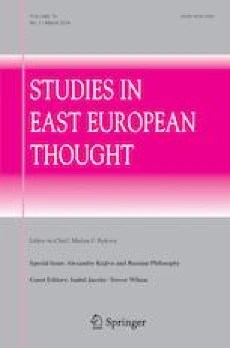
Special issue: Alexandre Kojève and Russian Philosophy – Studies in East European Thought, eds. Isabel Jacobs and Trevor Wilson, March 2024

Special issue: Alexandre Kojève and Russian PhilosophyStudies in East European Thought, eds. Isabel Jacobs and Trevor Wilson, March 2024

Alexandre Kojève and Russian philosophy, Isabel Jacobs & Trevor Wilson

The paradoxical anchoring of Kojève’s philosophizing in the tradition of Russian religious philosophy, Annett Jubara

Alexandre Kojève: revolution and terror, Alexey M. Rutkevich

Thinking in circles: Kojève and Russian Hegelianism, Isabel Jacobs

Stalin with Kant or Hegel? Jeff Love

Alexandre Kojève’s photography: some reflections, Dmitry Tokarev

Religion in Alexandre Kojève’s atheistic philosophy of science, Ivan Sergeevich Kurilovich

Introduction to Alexandre Kojève, “On Creative Freedom and Souls’ Fabrication. Response to Professor N. A. Berdyaev”, Trevor Wilson

On creative freedom and the souls’ fabrication, Alexandre Kojève

Introduction to Alexandre Kojève’s “Moscow, August 1957”, Isabel Jacobs

Moscow: August, 1957, Alexandre Kojève

Review of: Marco Filoni, L’azione politica del filosofo: La vita e il pensiero di Alexandre Kojève, Torino, Bollati Boringhieri editore, 2021, 346 pages, paperback ISBN 978-88-339-3790-8, Kyle Moore

Review of: D. N. Drozdova, O. L. Granovskaia, and A. M. Rutkevich, eds., Perekrestki kul’tur: Aleksandr Koire, Aleksandr Kozhev, Isaiia Berlin [Crossroads of cultures: Alexandre Koyré, Alexandre Kojève, Isaiah Berlin], ROSSPEN, 2021, ISBN 978-5-8243-2425-9, 558 pages, 396 rubles, Sofia Sorokina

Posted in Alexandre Kojève, Uncategorized | Leave a comment

Anthony Burke and Stefanie Fishel, The Ecology Politic: Power, Law, and Earth in the Anthropocene – MIT Press, May 2025

Anthony Burke and Stefanie Fishel, The Ecology Politic: Power, Law, and Earth in the Anthropocene – MIT Press, May 2025

A compelling proposal for new international law and institutions to address the planetary crisis that improves biodiversity protection, supports Indigenous peoples, and prevents catastrophic climate change.

In The Ecology Politic, Anthony Burke and Stefanie Fishel contend that the roots of our planetary crisis lie in the modern state: in its destructive entanglement with capitalism and its colonial legacies of extraction and oppression. This, in turn, has shaped global governance and international law, as they continue to fail to curb global heating, deforestation, and extinction. In a far-reaching critique of the foundational political theory of the modern state—the body politic—the authors insist that nothing less than a radically different model of the polity—an ecology politic—is needed if we are to escape this impasse.

Burke and Fishel argue that the international rule of law enacts a sovereign ban of nature that appropriates nonhuman lives for profit and use while denying them political and legal standing. We fail because we rely on the very institutions, worldviews, and systems that generated the crisis to solve it. The authors reconsider political power, agency, scale, and democracy in the Anthropocene and assert a biospheric ethic that values the entangled planetary structure of matter, energy, and life. Further, they argue for more-than-human beings to be represented in an ecological democracy that flows across borders. In short, they imagine a polity whose fundamental purpose is to protect planetary ecosystems and nurture interlocking systems of social and ecological justice.

Posted in Uncategorized | 1 Comment

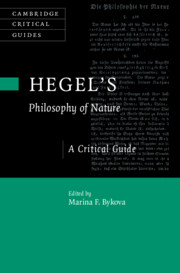
Marina F. Bykova (ed.), Hegel’s Philosophy of Nature: A Critical Guide – Cambridge university Press, December 2024

Marina F. Bykova (ed.), Hegel’s Philosophy of Nature: A Critical Guide – Cambridge university Press, December 2024

Hegel’s Philosophy of Nature constitutes the second part of his mature philosophical system presented in the Encyclopaedia of the Philosophical Sciences, and covers an exceptionally broad spectrum of themes and issues, as Hegel considers the content and structure of how humanity approaches nature and how nature is understood by humanity. The essays in this volume bring together various perspectives on Hegel’s Philosophy of Nature, emphasizing its functional role within the Encyclopaedia and its importance for understanding the complexity of Hegel’s philosophical project. Together they illuminate the core ideas which form Hegel’s philosophical framework in the realm of nature.

  • Offers a systematic reading of the Philosophy of Nature, emphasizing its functional role within Encyclopaedia and its importance for understanding the complexity of Hegel’s philosophical project
  • Brings together fourteen contributors who represent various traditions and a diverse array of interpretive positions
  • Addresses both traditional themes and new, rarely explored topics within Hegel scholarship
Posted in Uncategorized | 1 Comment

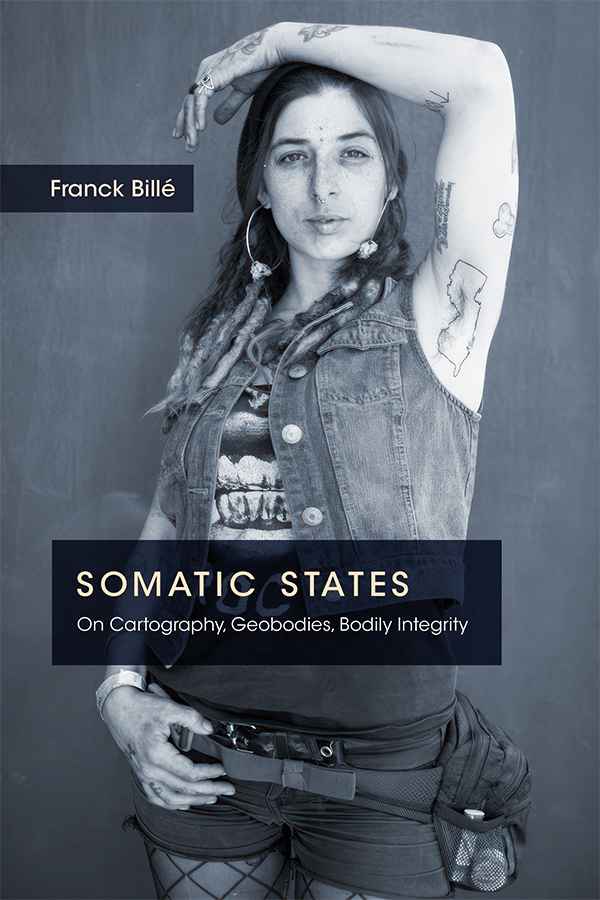
Franck Billé, Somatic States: On Cartography, Geobodies, Bodily Integrity – Duke University Press, April 2025

Franck Billé, Somatic States: On Cartography, Geobodies, Bodily Integrity – Duke University Press, April 2025

In Somatic States, Franck Billé examines the conceptual link between the nation-state and the body, particularly the visceral and affective attachment to the state and the symbolic significance of its borders. Billé argues that corporeal analogies to the nation-state are not simply poetic or allegorical but reflect a genuine association of the individual body with the national outline—an identification greatly facilitated by the emergence of the national map. Billé charts the evolution of cartographic practices and the role that political maps have played in transforming notions of territorial sovereignty. He shows how states routinely and effectively mobilize corporeal narratives, such as framing territorial loss through metaphors of dismemberment and mutilation. Despite the current complexity of geopolitics and neoliberalism, Billé demonstrates that corporeality and bodily metaphors remain viscerally powerful because they offer a seemingly simple way to apprehend the abstract nature of the nation-state.

Update: the introduction is open access here

Posted in Uncategorized | 1 Comment

Gillian Rose articles in Thesis Eleven

Some new articles about Gillian Rose in Thesis Eleven

Michael Lazarus, Economy and state: The politics of citizenship and universality in Gillian Rose, Hannah Arendt and Rosa Luxemburg – open access

J.M. Bernstein, Reification in the age of climate catastrophe: After Gillian Rose’s critique of Marxism – requires subscription

Gregory Marks, Substance is subject is style: On the speculative poetics of Gillian Rose – open access

Tom Bunyard, Tragic landscapes: TJ Clark and Gillian Rose on modernity and the future – requires subscription

Daniel Andrés López, Divine comedy in the work of Gillian Rose – open access

update: Rocío Zambrana, Philosophy in the severe style: Method and value in Rose’s Hegel and Marx – requires subscription


Posted in Gillian Rose, Uncategorized | Leave a comment

Sunday histories – short essays on Progressive Geographies

Updated June 2025: The full list of essays in this series is here.

Over the past several years, my Progressive Geographies blog has become too much of a noticeboard, sharing information about books, talks or shorter pieces by other people that look interesting, and, much less often, a few things about my own work. I’ve shared some research resources – bibliographies, a few textual comparisons, sometimes very short translations – but not written very much for the blog itself, apart from the research updates on my Mapping Indo-European thought in twentieth-century France project.

While I don’t intend to stop sharing links to other people’s work, I am going to try to write a bit more for this site. The first few of what I’m calling ‘Sunday histories’ are these:

  1. Benveniste, Dumézil, Lejeune and the decipherment of Linear B – 5 January 2025
  2. Foucault’s 1972 visit to Cornell University – 12 January 2025 (updated 14 January)
  3. Benveniste and the Linguistic Circle of Prague – 19 January 2025
  4. Marie-Louise Sjoestedt (1900-1940): an important scholar of Celtic languages and mythology – 26 January 2025 (revised and expanded from a 2 May 2023 post)
  5. Thomas Sebeok, Umberto Eco and the Semiotics of Nuclear Waste – 2 February 2025

I didn’t want to commit to doing this until I had a few out there, and ideas for a few more, but I hope to make this a regular thing.

These pieces are intended to be short and accessible, lacking the full scholarly references of something I’d try to publish more formally. They are usually tangential to what I’m working on, perhaps a development of something which would only be a footnote or aside in another text. Sometimes they will be some notes on a topic which might be further developed in the future, or where I’ve reached a dead end. Or they might be a few thoughts on a recent book I’ve just read – not quite a review, but perhaps close to that. 

The title ‘Sunday histories’ comes from the condescending name of ‘Sunday historian’ given to amateurs by professional historians, since these were people whose only time for doing history was outside of the working week. Philippe Ariès called his memoir Un Historien du Dimanche for this reason. My first degree is in Politics and Modern History, and although I’ve had visiting posts in History, I’ve not had a teaching position in a History department. But these short posts are also histoires in the French sense of stories as much as formal histories. At the end of each of these texts I’ve tried to provide a few indications of sources which would provide much more information. 

These pieces are also a bit of a reaction against academic publishing – its slow processes, its costs, and its metrics. These pieces are posted when I’ve finished them, though they might be revised later; they are free to access (I have no plans to turn these into subscription-only); and they are not intended as ‘outputs’ in the tradition sense.

As with the post about Sjoestedt I might revisit some of the earlier occasional pieces on this blog, revise and expand them in a similar format. They are provisional and suggestions are welcome. I’m sure specialists in the areas I discuss will know much more or correct details. I hope there is some interest in them.

I’ll keep a listing of these pieces here.

The next ones are:

6. Vladimir Nabokov, Roman Jakobson, Marc Szeftel and The Song of Igor – 9 February 2025

7. Ernst Kantorowicz and the California Loyalty Oath – 16 February 2025

8. Walter B. Henning, Robert Oppenheimer, Ernst Kantorowicz, the Institute for Advanced Study and the Khwarezmian Dictionary Project – 23 February 2025

9. The Friendship between Hannah Arendt and Alexandre Koyré – 2 March 2025

10. Alexandre Koyré’s Wartime Teaching at the École Libre des Hautes Études and the New School – 9 March 2025

11. Hannah Arendt, David Farrell Krell and the early English translations of Heidegger – 16 March 2025

12. Michel Foucault and Richard Sennett’s 1980 NYU seminar on “Sexuality and Solitude” – some notes on attendance and readings – 23 March 2025

13. The Territory of the Vocabulary and the Vocabulary of Territory: Emile Benveniste – 30 March 2025

14. Who translated Foucault’s The Order of Things? – 6 April 2025

15. Elisabeth Raucq, animal names and approaches to Indo-European vocabulary – 13 April 2025

16. Foucault at Buffalo in 1970 and 1972: The Desire for Knowledge; The Criminal in Literature; and The History of Truth – 20 April 2025

17. Émile Benveniste and the Sogdian Word for ‘Knee’ – 27 April 2025

18. Vladimir Nabokov, Roman Jakobson, and The Song of Igor: other sources for the story of a failed collaboration – 4 May 2025

19. The Murder of Ioan Culianu: Eliade, Anton, Eco, Lincoln and the University of Chicago – 11 May 2025

20. Alexandre Koyré in Cairo – 18 May 2025

21. The Early Edward Said, Michel Foucault and Jonathan Swift – 25 May 2025

22. Roman Jakobson, Franz Boas, and the Paleo-Siberian and Aleutian material at the New York Public Library – 1 June 2025

23. Gillian Rose and the Indo-Europeanists – 8 June 2025

24. Josué V. Harari, the Marquis de Sade, and Michel Foucault’s 1970 lectures in Buffalo – 15 June 2025

25. Henri Lefebvre and the “Liste Otto” of Prohibited Books in Occupied France – 22 June 2025

    Posted in Emile Benveniste, Georges Dumézil, Mapping Indo-European Thought in Twentieth Century France, Michel Foucault, Sunday Histories | 2 Comments