The oldest texts preserved are inscriptions which date back about 5,000 years, though the dating is disputed, and how they should be read presents its own controversies. Most of the earliest texts are on tablets or in stone; with surviving manuscripts on papyrus probably only about 2,500 years old. The languages spoken then, and their forms of representation in pictograms, syllabaries and alphabets, present many challenges of interpretation in our present. If even specialist scholars find these texts difficult, it seems likely future people will find our languages not immediately comprehensible. So, if humans of today want to write something that could be read thousands of years in the future, how should they do this? That was one of the challenges faced in the early nuclear age. Waste created by nuclear technologies would need to be stored securely, but how could those storing it be sure that it would not be disturbed by future humans? What message would warn them away?
One of the linguists tasked with trying to think about this question was Thomas Sebeok, born in Hungary as Sebök Tamás, who became an American citizen during the Second World War. He worked with Roman Jakobson, and through his editorial role with the journal Semiotica connects to the Benveniste story I’m trying to tell. There is some grumpy correspondence between him and Benveniste (and sometimes Julia Kristeva, acting on Benveniste’s part) about a late article delaying the first issue of the journal. It was eventually delivered in instalments and published in two parts, in the first two issues in 1969, which Sebeok said was “a very undesirable precedent”. That is perhaps a story for another time.
For the nuclear challenge, Sebeok authored a short report commissioned by the Bechtel group for the Office of Nuclear Waste Isolation. Written in 1984, “Communication Measures to Bridge Ten Millenia“, was submitted to the United States government department of Energy. It was once a classified report but is now available online. Its summary reads:
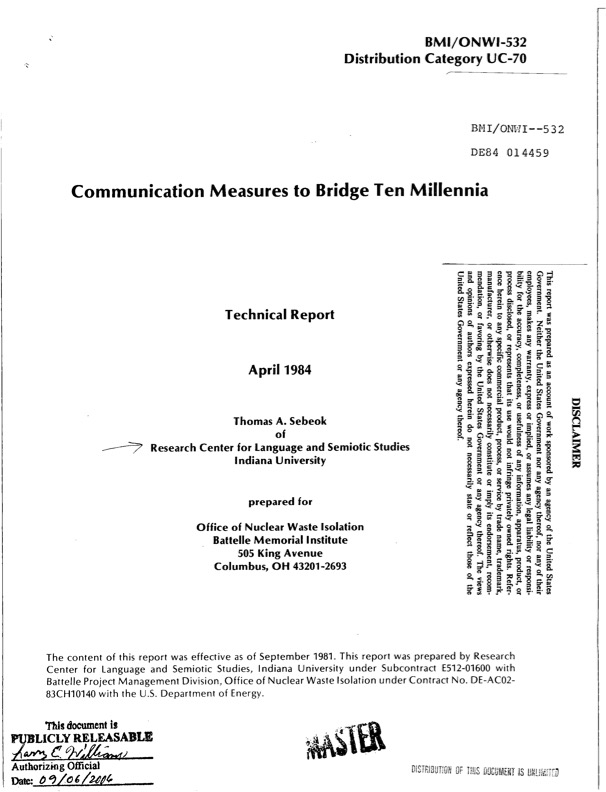
The Department of Energy created the Human Interference Task Force (HITF) in 1980 to investigate the problems connected with the postclosure, final marking of a filled nuclear waste repository. The task of the HITF is to devise a method of warning future generations not to mine or drill at that site unless they are aware of the consequences of their actions. Since the likelihood of human interference should be minimized for 10,000 years, an effective and long-lasting warning system must be designed. This report is a semiotic analysis of the problem, examining it in terms of the science or theory of messages and symbols. Because of the long period of time involved, the report recommends that a relay system of recoding messages be initiated; that the messages contain a mixture of iconic, indexical, and symbolic elements; and that a high degree of redundancy of messages be employed. (source)
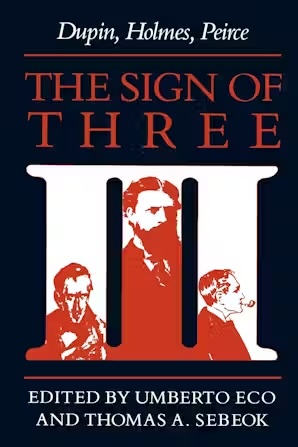
Umberto Eco was on the editorial board of Semiotica and worked closely with Sebeok, both at conferences and in editing The Sign of Three: Dupin, Holmes, Peirce together in 1983. He discusses the nuclear waste project in The Search for a Perfect Language (pp. 176-77). As Eco puts it, ten thousand years in the future is “more than enough time for great empires and flourishing civilisations to perish”.
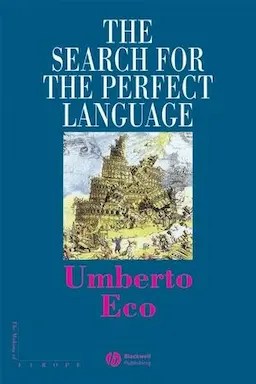
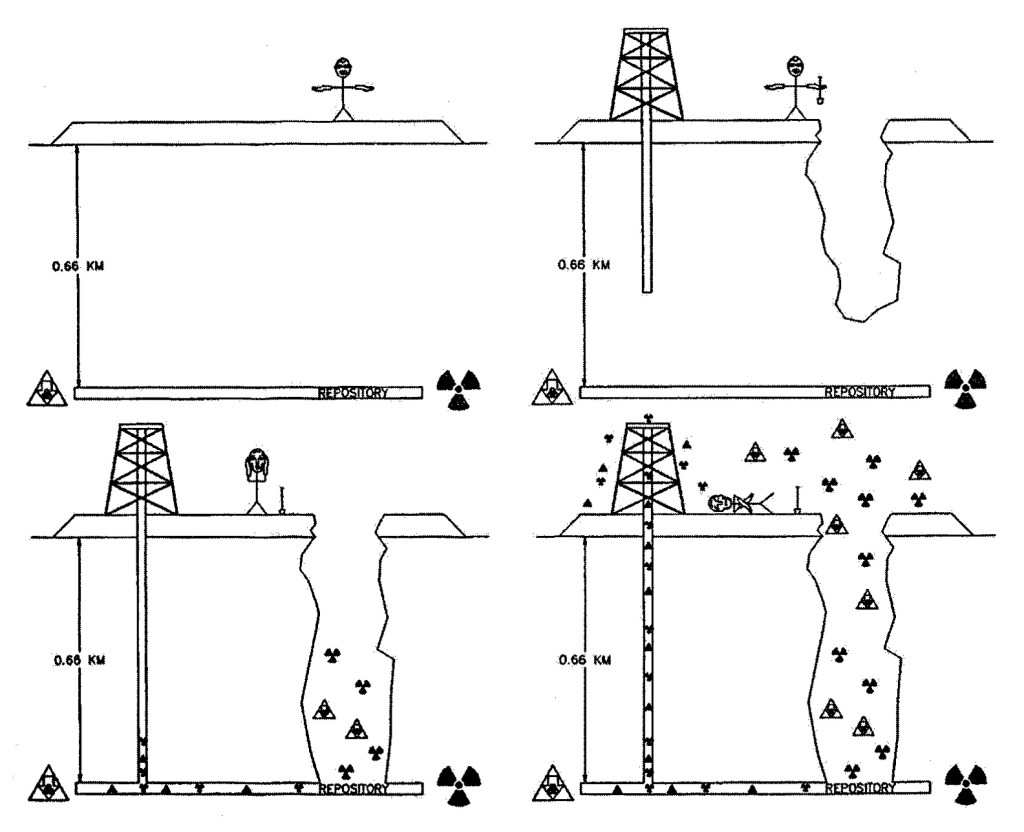
Almost immediately, Sebeok discarded the possibility of any type of verbal communication, of electric signals as needing a constant power supply, of olfactory messages as being of brief duration, and of any sort of ideogram based on convention. Even a pictographic language seemed problematic (p. 176).
The idea of passing on the message between generations was more plausible, but if society broke down could prove problematic. Every known language and sign system could be used together, with the idea that at least one would be at least part-intelligible. But again, “even this solution presupposed a form of cultural continuity (however weak it would be)” (p. 177).
Eco’s account of Sebeok’s additional suggestion is just the sort of story that would appeal to him – it sounds like the premise of one of his novels.
The only remaining solution was to institute a sort of ‘priesthood’ of nuclear scientists, anthropologists, linguists and psychologists supposed to perpetuate itself by co-opting new members. This caste would keep alive the knowledge of the danger, creating myths and legends about it. Even though, in the passage of time, these ‘priests’ would probably lose a precise notion of the peril that they were committed to protect humanity from, there would still survive, even in a future state of barbarism, obscure but efficacious taboos (p. 177).
The idea was to make nuclear storage sites taboo, sites where no one would wish to go. The messages or the scripture warning this would need to be periodically updated to ensure that the instruction remained comprehensible. As Sebeok’s report says:
The legend-and-ritual, as now envisaged, would be tantamount to laying a ‘false trail’, meaning that the uninitiated will be steered away from the hazard site for reasons other than the scientific knowledge of the possibility of radiation and its implications; essentially, the reason would be accumulated superstition to shun a certain area permanently (p. 24).
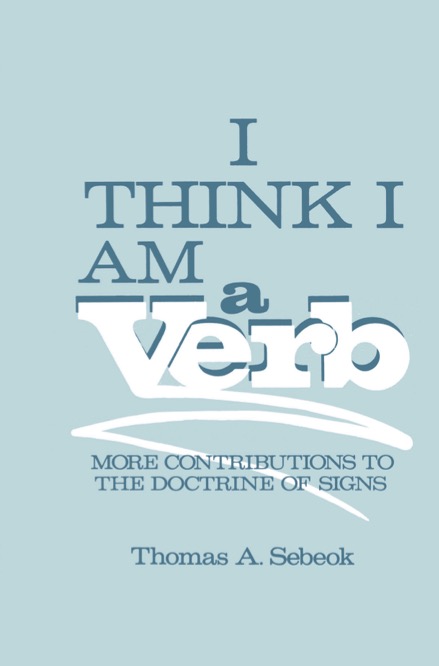
This aspect of Sebeok’s ideas did not find their way into the final report, nor were they taken seriously in subsequent proposals for what remains a problem and will continue to be so for millennia to come. The idea of an “atomic priesthood” – borrowed from the nuclear physicist Alvin M. Weinberg – and a “folkloric relay” were never adopted, and his report was I think relatively unknown during his career. One online article in Slate about the wider problem of warning people away calls his idea “silly”. Was it just an elaborate joke? The report online gives a creation date of 1 April, though the report itself only gives the month. It gives the notional 1st of the month to other reports so this just seems a convention. Sebeok published a version of his report in 1986, in his collection I Think I am a Verb.
This story is hardly unknown – there are a lot of indications online, and Sebeok’s report is fairly widely cited. The ideas have found most purchase in science fiction, as Sebastian Musch has explored (2016), and there is, as you might expect, a project website – https://www.theatomicpriesthoodproject.org – with the indicative dates of 01984 to 9999+.
Sebeok died in 2001, and his report was publicly released on 9 June 2006. Eco’s The Search for a Perfect Language was published in 1993, so he either relied on the chapter or had access to a copy of the report from Sebeok himself. And the early-mid 1980s was when he was writing Foucault’s Pendulum, first published in 1988.
Update February 2026: For a more general discussion of Eco’s work, see Umberto Eco, Philosophers, Mythologists and Linguists
References
The Atomic Priesthood Project, “Reading Room”, https://www.theatomicpriesthoodproject.org/writings
Umberto Eco, The Search for the Perfect Language, trans. James Fentress, Oxford: Blackwell, 1995.
Umberto Eco and Thomas A. Sebeok (eds.), The Sign of Three: Dupin, Holmes, Peirce, Bloomington: Indiana University Press, 1983.
Juliet Lapidos “Atomic Priesthoods, Thorn Landscapes, and Munchian Pictograms”. Slate, November 16, 2009, https://slate.com/technology/2009/11/how-to-communicate-the-dangers-of-nuclear-waste-to-future-civilizations.html
Sebastian Musch: “The Atomic Priesthood and Nuclear Waste Management – Religion, Sci-fi Literature and the End of our Civilization”, Zygon: Journal of Religion and Science 51 (3), 2016, 626-39.
Sebastian Musch: “Hans Jonas, Günther Anders, and the Atomic Priesthood: An Exploration into Ethics, Religion and Technology in the Nuclear Age”, Religions 12 (9), 2021, 741-50, https://doi.org/10.3390/rel12090741
Office of Nuclear Waste Isolation, “Reducing the Likelihood of Future Human Activities That Could Affect Geologic High-Level Waste Repositories”, May 1984, https://www.osti.gov/biblio/6799619
Thomas A. Sebeok, “Communication Measures to Bridge Ten Millenia”, report for Office of Nuclear Waste Isolation, April 1984, https://digital.library.unt.edu/ark:/67531/metadc1199078/ [link broken]; also available here
Thomas A. Sebeok, “Pandora’s Box in Aftertimes”, in I Think I am a Verb: More Contributions to the Doctrine of Signs. New York: Springer, 1986, 149-73.
Archives
Thomas Sebeok papers, collection C264, Indiana University archives, Bloomington, https://archives.iu.edu/catalog/InU-Ar-VAE0871
As far as I’m aware, Umberto Eco’s archives are not yet accessible, but have been acquired by the Italian state and will be loaned to the University of Bologna where Eco taught for 90 years (report here; English story here).
This is the fifth post of an occasional series, where I try to post short essays with some indications of further reading and sources, but which are not as formal as something I’d try to publish more conventionally. They are usually tangential to my main writing focus, a home for spare ideas, asides, dead-ends and possible futures. I hope there is some interest in them. They are provisional and suggestions are welcome. The other posts so far are:
Benveniste, Dumézil, Lejeune and the decipherment of Linear B – 5 January 2025
Foucault’s 1972 visit to Cornell University – 12 January 2025 (updated 14 January)
Benveniste and the Linguistic Circle of Prague – 19 January 2025
Marie-Louise Sjoestedt (1900-1940): an important scholar of Celtic languages and mythology – 26 January 2025
Vladimir Nabokov, Roman Jakobson, Marc Szeftel and The Song of Igor – 9 February 2025
Ernst Kantorowicz and the California Loyalty Oath – 16 February 2025
The full list of ‘Sunday histories’ is here.