Marie-Louise Sjoestedt (1900-1940): an important scholar of Celtic languages and mythology

One of the challenges with my current project on Indo-European thought in France is how male-dominated it is. If you look at a photograph of the professors of the Collège de France in 1967, you can perhaps see why. It wasn’t much better at the Collège de France almost 20 years later (1985).

In fields related to those I’m studying for this project, it’s interesting that the first female professor of the Collège de France was Jacqueline de Romilly (1913-2010), elected to a chair with the title Greece and the Formation of Moral and Political Thought [La Grèce et la formation de la pensée morale et politique] in 1973. I think that the second was Françoise Héritier (1933-2017), who was elected a whole decade later. She succeeded Claude Lévi-Strauss, with a chair in the Comparative Study of African Societies [Étude comparée des sociétés africaines] in 1983. So far, neither of them has featured in the work I’m doing, though both have connections to those people whose careers I am exploring.

Of course, the Collège de France is an elite institution, and there are all kinds of complicated politics in terms of who gets elected. But even looking at other major institutions shows a clear gender imbalance. There are many interesting figures who connect to the story I’m trying to tell, but relatively few women and it can be difficult to find out much information about them.

Of an earlier generation, Marie-Louise Sjoestedt is particularly intriguing. She was born on 20 September 1900. Her father was a Swedish diplomat based in France and her mother was a novelist from Corsica. Her older sister was the artist Yvonne Sjoestedt. She was part of the impressive generation of students taught by Antoine Meillet in the 1920s, alongside Pierre Chantraine, Jerzy Kuryłowicz, Louis Renou, Emile Benveniste and – slightly more distantly – Georges Dumézil. Her husband Michel Jonval, also a linguist with a specialisation in Baltic languages, died young in 1935, just three years after they married. Meillet said this generation was remarkable in that it was clear that many of them would soon be masters themselves.

Photograph taken in Meillet’s office, 5 April 1928. Left to right: Émile Benveniste, René Fohalle, Jerzy Kuryłowicz, Antoine Meillet, Louis Renou, Pierre Chantraine, Marie-Louise Sjoestedt.
The original is in Benveniste’s archives at the Collège de France; and it is reproduced on the cover of Didier Samain and Pierre-Yves Testenoire (eds.), La Linguistique et ses forms historiques d’organisation et de production: Actes du colloque de la Société d’histoire et d’épistémologie des sciences du langage et du laboratoire Histoire des théories linguistiques Paris, 24-26 janvier 2019, Paris: SHESL, 2022.

Sjoestedt died at the age of just 40 by suicide, not long after the French defeat and the arrest of her second husband by the Germans. In a brief biography Renou says that there had been several previous attempts (p. 11). Dumézil acknowledges her death in the second edition of his Mitra-Varuna in a somewhat guarded way: “she was not to survive France’s first misfortunes” (p. xxxvii). 

Sjoestedt was the author of several technical works on the Welsh and Irish languages, including L’aspect verbal et les formations à affixe nasale en celtique, which appeared when she was just 25. It was her primary doctoral thesis, defended in June 1926. Renou says that Meillet was the rapporteur for this thesis; Joseph Vendryes for the secondary thesis on a Middle Irish Saga, ‘The siege of Druim Damhghaire’ (p. 6). Natalie Zemon Davis says Vendryes directed the first thesis, which seems likely. Vendryes worked on Latin and Celtic, and taught alongside Meillet at the École Pratique des Hautes Études (EPHE). In time, Sjoestedt, Benveniste, Dumézil, Chantraine and other Meillet students would teach at the EPHE too. Sjoestedt taught there between 1926 and 1928, in a temporary post, and then Greek at the University of Rennes in Brittany, before a post in Celtic languages was created for her at the EPHE in 1929 (Renou pp. 7-8; see Pierre-Yves Lambert’s entry in the Dictionary of Irish Biography).

Sjoestedt spent a lot of time in Ireland and Wales, and produced a two-volume study of Irish dialects – Phonétique d’un parler irlandais de Kerry (1931) and Description d’un parler irlandais de Kerry (1938) – building on then innovative research on phonology. She also worked on Celtic mythology, especially the legend of Cuchulainn, and her Dieux et héros des Celtes (1940) was intended for a much wider audience. It was translated by her former student Myles Dillon as Gods and Heroes of the Celts after her death

Sjoestedt was one of the editors of Études celtiques, alongside Vendryes. She attended some of Dumézil’s classes on mythology in the 1930s, but he recalls that he was also her student, as she taught him Welsh and Irish. Dumézil said that his aim was to gain the ability to read myths in those languages, not to be able to speak the modern versions. He did, however, later spend some time in Bangor in North Wales. Dumézil references Sjoestedt’s work in Mitra-Varuna, dedicates Jupiter, Mars, Quirinus to her memory, and as noted above, in the preface to the second edition mentions her as one of his students and colleagues lost in the war.

Natalie Zemon Davis, in a valuable essay on “Women and the World of the Annales” situates Sjoestedt in relation to a wider intellectual network. Much of her discussion covers the story outlined above, but is based on a reading of sources in the Annuaire of the EPHE as well:

Joining [Germaine] Rouillard at the Ecole Pratique in 1926 and under like auspices was a young woman whose family was of Swedish origin, Marie-Louise Sjoestedt. She had published her doctoral thesis that year, a technical linguistic study directed by the great Celtic specialist at the Sorbonne, Joseph Vendryes. Vendryes had just taken over the Celtic program at the Ecole Pratique and brought Sjoestedt along as Chargie de conferences to teach both middle and modern Irish. She continued to work as his associate over the years: in 1936, when the Etudes Celtiques were founded (published by Eugénie Droz), Vendryes was the editor and Sjoestedt was the Secretaire de la Rédaction, while writing reviews and articles for the journal. But, a Directeur d’études from 1930 on, she also developed on her own, marrying a fellow linguist who worked on Baltic languages and Latvian myth, discussing linguistic matters with her colleague at the Ecole, Emile Benveniste, and returning often to Ireland for field work in language and folklore. In 1938, she reviewed a new History of Ireland for the Annales. Her important book on the structure of Celtic myths about gods and heroes was under press as the Germans invaded France. She committed suicide in early December 1940 at age forty; her Dieux et héros des Celtes appeared a few weeks later. 

Reviewing the book in the first Annales to appear under the Occupation, [Lucien] Febvre praised Sjoestedt’s ‘remarkable knowledge of the languages, beliefs and customs of the Celtic world’ and regretted that she was gone when so much was still to be expected from her labour.

Natalie Zemon Davis, “Women and the World of the Annales”, History Workshop Journal, 1992, 126-27, see 134-35, n. 34.

A collection of tributes – including ones by Benveniste and Dumézil and a brief biography by Louis Renou – was published in 1941: Marie-Louise Sjoestedt (1900–1940). In Memoriam. Vendryes’s obituary was published in Études Celtiques in 1948. As far as I’m aware, there is no archive of her papers available.

References

Marie-Louise Sjoestedt (1900–1940). In Memoriam, suivi de Essai sur une littérature nationale, la littérature irlandaise contemporaine, Paris: E. Droz, 1941. 

Georges Dumézil, Mitra-Varuna: An Essay on Two Indo-European Representations of Sovereignty, trans. Derek Coltman, ed. Stuart Elden, Chicago: Hau, 2024.

Lucien Febvre, “Histoire des Religions: une nouvelle collection”, Annales d’histoire sociale 3, 1941, 98-99.

Pierre-Yves Lambert, “Sjoestedt (-Jonval), Marie-Louise”, Dictionary of Irish Biographyhttps://www.dib.ie/biography/sjoestedt-jonval-marie-louise-a8102

Seán Ó Lúing, “Marie-Louise Sjoestedt, Celtic Scholar (1900-1940)”, Journal of the Kerry Archaeological and Historical Society 20 (1987), 79-93.

Louis Renou, “Notice biographique”, in Marie-Louise Sjoestedt (1900–1940). In Memoriam, 3-11.

Marie-Louise Sjoestedt, L’Aspect verbal et les formations à affixe nasal en celtique, Paris: Librarie Ancienne Honoré Champion, 1926.

Marie-Louise Sjoestedt, Phonétique d’un parler irlandais de Kerry, Paris: Ernest Leroux, 1931.

Marie-Louise Sjœstedt-Jonval, “Légendes épiques Irlandaises et monnaies gauloises: recherches sur la constitution de la légende de Cuchulainn”, Études Celtiques I, 1936, 1-77.

Marie-Louise Sjoestedt, Description d’un parler irlandais de Kerry, Paris: Honoré Champion, 1938.

Marie-Louise Sjoestedt, Dieux et héros des Celtes, Paris: PUF, 1940; Celtic Gods and Heroes trans. Myles Dillon, New York: Dover, 2000 [1949].

Joseph Vendryes, “Nécrologie: Marie-Louise Sjoestedt”, Études Celtiques 4 (2), 1948, 428-33.

Natalie Zemon Davis, “Women and the World of the Annales“, History Workshop Journal 33, 1992, 121-37.

—-

This is a revised and expanded version of a post from May 2023. It is the fourth post of an occasional series, where I try to post short essays with some indications of further reading and sources, but which are not as formal as something I’d try to publish more conventionally. They are usually tangential to my main writing focus, a home for spare ideas, asides, dead-ends and possible futures. I hope there is some interest in them. They are provisional and suggestions are welcome. The other posts so far are:

Benveniste, Dumézil, Lejeune and the decipherment of Linear B – 5 January 2025

Foucault’s 1972 visit to Cornell University – 12 January 2025 (updated 14 January)

Benveniste and the Linguistic Circle of Prague – 19 January 2025

Thomas Sebeok, Umberto Eco and the Semiotics of Nuclear Waste – 2 February 2025

Vladimir Nabokov, Roman Jakobson, Marc Szeftel and The Song of Igor – 9 February 2025

Ernst Kantorowicz and the California Loyalty Oath – 16 February 2025

The full list of ‘Sunday histories’ is here.
Posted in Antoine Meillet, Emile Benveniste, Georges Dumézil, Sunday Histories | 15 Comments

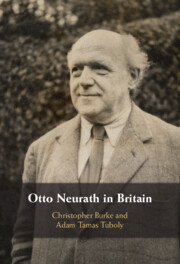
Christopher Burke and Adam Tamas Tuboly, Otto Neurath in Britain – Cambridge University Press, January 2025

Christopher Burke and Adam Tamas Tuboly, Otto Neurath in Britain – Cambridge University Press, January 2025

Otto Neurath (1882–1945) was an Austrian-born philosopher of science, sociologist and political economist, and one of the most multi-faceted and creative thinkers in the Vienna Circle. Forced into exile by fascism, he was part of the intellectual exodus from Central Europe. After an adventurous escape to England and internment as an ‘enemy alien’, he enthusiastically adapted to British culture, working on documentary films and publications for the war effort using the Isotype method of visualization. He treasured the British habit of ‘muddling through’, and debated planning and economics with fellow Central European émigrés, Friedrich Hayek, Karl Mannheim and Karl Popper. Based on new archival research, this book explores a little-known period of Neurath’s rich and fascinating life, weaving together biographical, historical, and philosophical strands that reflect the cross-cultural currents of twentieth-century intellectual history through the lens of Neurath’s contribution.

Posted in Uncategorized | Leave a comment

Tom Arnold-Forster, Walter Lippmann: An Intellectual Biography – Princeton University Press, June 2025

Tom Arnold-Forster, Walter Lippmann: An Intellectual Biography – Princeton University Press, June 2025

Walter Lippmann (1889–1974) was among the most influential and wide-ranging political writers in modern America. As both a journalist and political theorist, he shaped ideas about liberalism and democracy, the nature of public opinion, US power and empire, and the roles of journalists, experts, and citizens. Tom Arnold-Forster provides a bold historical reassessment of Lippmann’s intellectual life, offering fresh perspectives on a career at the intersection of daily news and democratic theory.

This incisive book shows how Lippmann helped define the public debates of American liberalism from the Progressive Era to the Cold War. By exploring his ideas in their historical context, Arnold-Forster challenges the claim that Lippmann was primarily a theorist of expertise and technocracy. Instead, Lippmann emerges as a strikingly political thinker, public-facing and multifarious, who focused on what politics meant and how it worked in modern democracies. Covering subjects from press freedom to urban reform to economic and foreign policy, while tracing the evolution from his early liberal socialism to later conservative liberalism, this book explores Lippmann’s thought as reflecting the protean character of liberal politics and the crises and paradoxes of democracy.

Walter Lippmann: An Intellectual Biography is a richly historical account of a complex political thinker. Lippmann’s ideas played a formative role in the twentieth century and resonate powerfully with our fraught present.

Posted in Uncategorized | 1 Comment

Jakob Norberg, Schopenhauer’s Politics – Cambridge University Press, January 2025 (print and open access)

Jakob Norberg, Schopenhauer’s Politics – Cambridge University Press, January 2025

Arthur Schopenhauer (1788–1860) lived through an era of great political turmoil, but previous assessments of his political thought have portrayed him as a pessimistic observer with no constructive solutions to offer. By assembling and contextualizing Schopenhauer’s dispersed comments on political matters, this book reveals that he developed a distinct conception of politics. In opposition to rising ideological movements such as nationalism or socialism, Schopenhauer denied that politics can ever bring about universal emancipation or fraternal unity. Instead, he viewed politics as a tool for mitigating rather than resolving the conflicts of a fundamentally imperfect world. Jakob Norberg’s fascinating book reconstructs Schopenhauer’s political ideas and shows how they relate to the dominant debates and trends during the period in which he lived. This title is also available as Open Access on Cambridge Core.

Posted in Uncategorized | 1 Comment

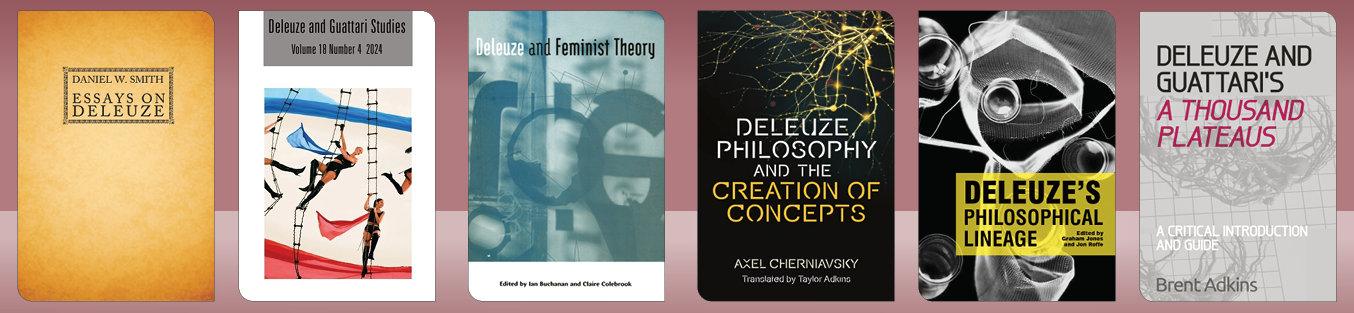
Celebrating 100 years of Gilles Deleuze – Edinburgh University Press

Celebrating 100 years of Gilles Deleuze – Edinburgh University Press

In the centenary year of his birth, we celebrate the impact of Gilles Deleuze, one of the greats of twentieth-century philosophy. 

We kick off on the birthday itself – the 18th of January – with a blog post from Ian Buchanan, editor of both the journal Deleuze and Guattari Studies and the book series Deleuze Connections and Plateaus – New Directions in Deleuze Studies. Look out for more Deleuze-related posts throughout this anniversary year!

Each month we’ll also be making an issue from the Deleuze and Guattari Studies journal free to read! This month, discover Deleuze and Marx

Circle back to find new blogs and free issues each month and scroll down to find out more about our exciting publishing in the field.

Posted in Gilles Deleuze | Leave a comment

Brandon Bloch, Reinventing Protestant Germany: Religious Nationalists and the Contest for Post-Nazi Democracy – Harvard University Press, May 2025

Brandon Bloch, Reinventing Protestant Germany: Religious Nationalists and the Contest for Post-Nazi Democracy – Harvard University Press, May 2025

A revealing account of how German Protestant leaders embraced democratic ideals after WWII, while firmly and consequentially refusing to account for their earlier complicity with Nazism.

Germany’s Protestant churches, longtime strongholds of nationalism and militarism, largely backed the Nazi dictatorship that took power in 1933. For many Protestant leaders, pastors, and activists, national and religious revival were one and the same. Even those who opposed the regime tended toward antidemocratic attitudes. By the 1950s, however, Church leaders in West Germany had repositioned themselves as prominent advocates for constitutional democracy and human rights.

Brandon Bloch reveals how this remarkable ideological shift came to pass, following the cohort of theologians, pastors, and lay intellectuals who spearheaded the postwar transformation of their church. Born around the turn of the twentieth century, these individuals came of age amid the turbulence of the Weimar Republic and were easily swayed to complicity with the Third Reich. They accommodated the state in hopes of protecting the Church’s independence from it, but they also embraced the Nazi regime’s antisemitic and anticommunist platform. After the war, under the pressures of Allied occupation, these Protestant intellectuals and their heirs creatively reimagined their tradition as a fount of democratic and humanitarian values. But while they campaigned for family law reform, conscientious objection to military service, and the protection of basic rights, they also promoted a narrative of Christian anti-Nazi resistance that whitewashed the Church’s complicity in dictatorship and genocide.

Examining the sources and limits of democratic transformation, Reinventing Protestant Germany sheds new light on the development of postwar European politics and the power of national myths.

Posted in Uncategorized | Leave a comment

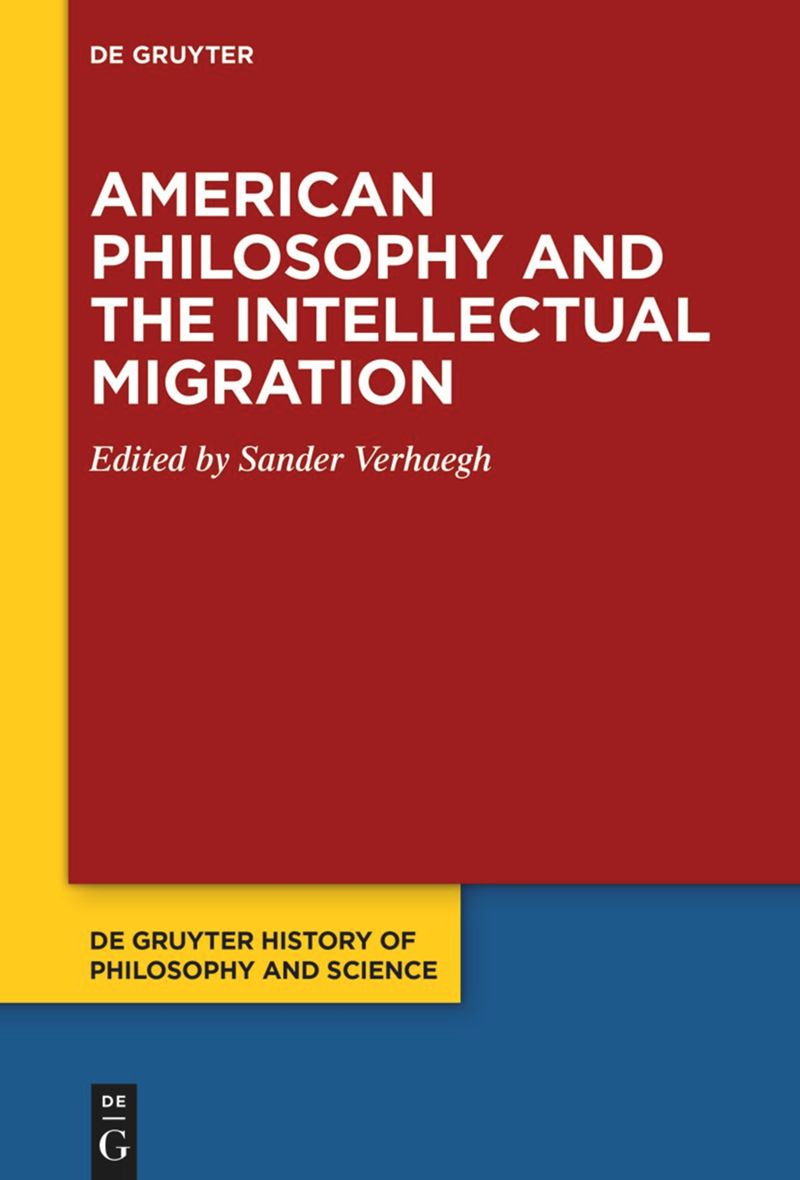
Sander Verhaegh (ed.), American Philosophy and the Intellectual Migration: Pragmatism, Logical Empiricism, Phenomenology, Critical Theory – De Gruyter, 2025 (open access)

Sander Verhaegh (ed.), American Philosophy and the Intellectual Migration: Pragmatism, Logical Empiricism, Phenomenology, Critical Theory – De Gruyter, 2025 (open access)

How did immigrant scholars such as Rudolf Carnap, Max Horkheimer, and Alfred Schütz influence the development of American philosophy? Why was the U.S. community more receptive to logical empiricism than to critical theory or phenomenology? This volume brings together fifteen historians of philosophy to explore the impact of the intellectual migration. 

In the 1930s, the rise of fascism forced dozens of philosophers to flee to the United States. Prominent logical empiricists acquired positions at prestigious U.S. universities. Critical theorists moved their Frankfurt School to Columbia University. And a group of phenomenologists taught at the New School for Social Research. Though many refugee scholars acquired some American following, logical empiricism had the biggest impact on academic philosophy. The exiled empiricists helped the country turn into a bastion of ‘analytic philosophy’ after the war. Phenomenology and critical theory became prominent schools from the 1970s onwards and continue to be influential in American philosophy today. 

This is the first book to investigate to the migration from an integrated perspective, bringing together historians of American philosophy, logical empiricism, phenomenology, and critical theory.

Thanks to dmf for the link.

Posted in Uncategorized | Leave a comment

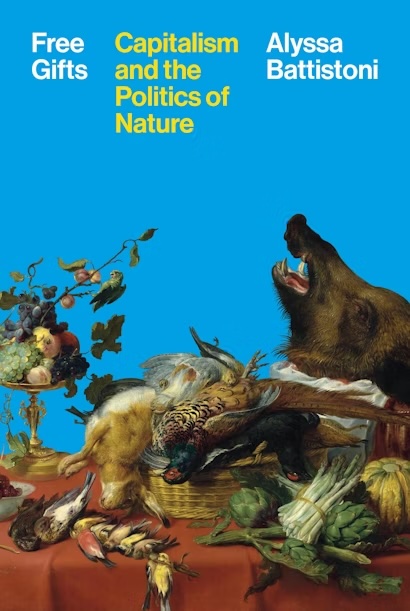
Alyssa Battistoni, Free Gifts: Capitalism and the Politics of Nature – Princeton University Press, August 2025

Alyssa Battistoni, Free Gifts: Capitalism and the Politics of Nature – Princeton University Press, August 2025

Capitalism is typically treated as a force for relentless commodification. Yet it consistently fails to place value on vital aspects of the nonhuman world, whether carbon emissions or entire ecosystems. In Free Gifts, Alyssa Battistoni explores capitalism’s persistent failure to value nature, arguing that the key question is not the moral issue of why some kinds of nature shouldn’t be commodified, but the economic puzzle of why they haven’t been. To understand contemporary ecological problems from biodiversity collapse to climate change, she contends, we have to understand how some things come to have value under capitalism—and how others do not. To help us do so, Battistoni recovers and reinterprets the idea of the free gift of nature used by classical economic thinkers to describe what we gratuitously obtain from the natural world, and builds on Karl Marx’s critique of political economy to show how capitalism fundamentally treats nature as free for the taking. This novel theory of capitalism’s relationship to nature not only helps us understand contemporary ecological breakdown, but also casts capitalism’s own core dynamics in a new light.

Battistoni addresses four different instances of the free gift in political economic thought, each in a specific domain: natural agents in industry, pollution in the environment, reproductive labor in the household, and natural capital in the biosphere. In so doing, she offers new readings of major twentieth-century thinkers, including Friedrich Hayek, Simone de Beauvoir, Garrett Hardin, Silvia Federici, and Ronald Coase. Ultimately, she offers a novel account of freedom for our ecologically troubled present, developing a materialist existentialism to argue that capitalism limits our ability to be responsible for our relationships to the natural world, and imagining how we might live freely while valuing nature’s gifts.

Update August 2025: interview with Jochen Schmon at the Journal of the History of Ideas blog.

Posted in Uncategorized | Leave a comment

Leticia Fernández-Fontecha, Childhood, Pain and Emotion: A Modern British Medical History – Cambridge University Press, April 2025 

Leticia Fernández-Fontecha, Childhood, Pain and Emotion: A Modern British Medical History – Cambridge University Press, April 2025 

Situated between the history of pain, history of childhood and history of emotions, this innovative work explores cultural understandings of children’s pain, from the 1870s to the end of the Second World War. Focusing on British medical discourse, Leticia Fernández-Fontecha examines the relationship between the experience of pain and its social and medical perception, looking at how pain is felt, seen and performed in contexts such as the hospital, the war nursery and the asylum. By means of a comparative study of views in different disciplines – physiology, paediatrics, psychiatry, psychology and psychoanalysis – this work demonstrates the various ways in which the child in pain came to be perceived. This context is vital to understanding current practices and beliefs surrounding childhood pain, and the role that children play in the construction of adult worlds.

Posted in Uncategorized | Leave a comment

Border Temporalities in and Beyond Europe – special issue of Borders in Globalization Review (open access)

Border Temporalities in and Beyond Europe – special issue of Borders in Globalization Review (open access)

Guest editors Johanna Jaschik, Machteld Venken, and Birte Wassenberg bring time into border studies with this new collection, Border Temporalities in and Beyond Europe, featuring 12 research articles. The new issue also includes a portfolio, poetry, policy work, and more! 

Thanks to Adalbert Saurma for the link.

Posted in Boundaries, Territory, Uncategorized | Leave a comment