Benveniste and the Linguistic Circle of Prague

There are some good histories of the Linguistic Circle of Prague, which met in the years before the Second World War, and which included Russian scholars as well as ones from Czechoslovakia. Jindřich Toman’s The Magic of a Common Language is a particularly useful guide. Roman Jakobson, Nikolai Trubetzkoy, René Wellek and Vilém Mathesius were regular attendees to the circle. In 1929, the group founded a journal, Travaux du Cercle Linguistique de Prague

Émile Benveniste presented a paper to the Linguistic Circle of Prague on 8 March 1937. His topic was “Linguistic expression of quantity (grammatical number and numerals)”. It presented some of the material he had first used in his second 1935-36 course at the Collège de France, while he was deputising for Antoine Meillet, whom he would later succeed in 1937 to the chair of Comparative Grammar. He never published the talk, telling Jakobson that the materials were lost when his flat was occupied during the war. (Benveniste spent most of the war either as a prisoner of war or in exile in Switzerland.) He confessed to Jakobson he did not have the courage to return to projects he had completed but never published. He did revisit one incomplete project, saying that he had to reconstitute its data from scratch, but that seems to have been an exception. Jakobson recounts this story both in an unpublished interview (which I’ve seen in the Tzvetan Todorov archives in Paris, but I understand is also in Jakobson’s archive at MIT) and in a note to his edition of Trubetzkoy’s letters to him. Trubetzkoy died in Vienna in 1938 from a heart attack, brought on by Nazi persecution. A volume of the Travaux du Cercle linguistique du Prague was dedicated to Trubetzkoy in 1939, and Benveniste was one of the contributors. His piece then was not the one on quantity, but an analysis of phonology and the distribution of consonants in words. Given Trubetzkoy’s major contribution to linguistics was in phonology, the choice of topic was appropriate, though Benveniste presumably did not know that that Trubetzkoy had told Jakobson he found Benveniste’s writings on phonology “usually not very successful” (10 January 1937).

In this text Benveniste works through examples from Latin, Ancient Greek and modern Persian, before suggesting some connections to the languages of Asia Minor, and from them back to what can be reconstructed of Proto Indo-European, before broadening the analysis in the final pages to languages outside of the Indo-European family. These examples show that even at this early stage of his career he already had an interest in native American languages. (Benveniste would do linguistic fieldwork in the Pacific northwest in the early 1950s.) He closes with the comment that his brief remarks indicate a need for a fuller study, but this is yet another example of one of his possible projects interrupted and then seemingly abandoned due to the war. 

The Travaux du Cercle linguistique series ceased publication with the invasion of Czechoslovakia and the exile of many of the circle’s members. Jakobson fled in March 1939, first to Denmark, then later to Norway, Sweden and the United States. At one point he thought he might move to England, and he was supported by the Society for the Protection of Science and Learning. He recounts that he burned all of his papers in Brno shortly before the Nazi invasion, saving just the letters from Trubetzkoy, which were put in a briefcase, buried and retrieved after the war. It was this correspondence that Jakobson published many years later, in the original Russian with an English apparatus. The book has been translated into French. Jakobson and Benveniste corresponded after the war, and those letters have been published. But the destruction of Benveniste and Jakobson’s pre-war letters, as well as nearly all of Jakobson’s letters to Trubetzkoy, leaves important gaps in the record.
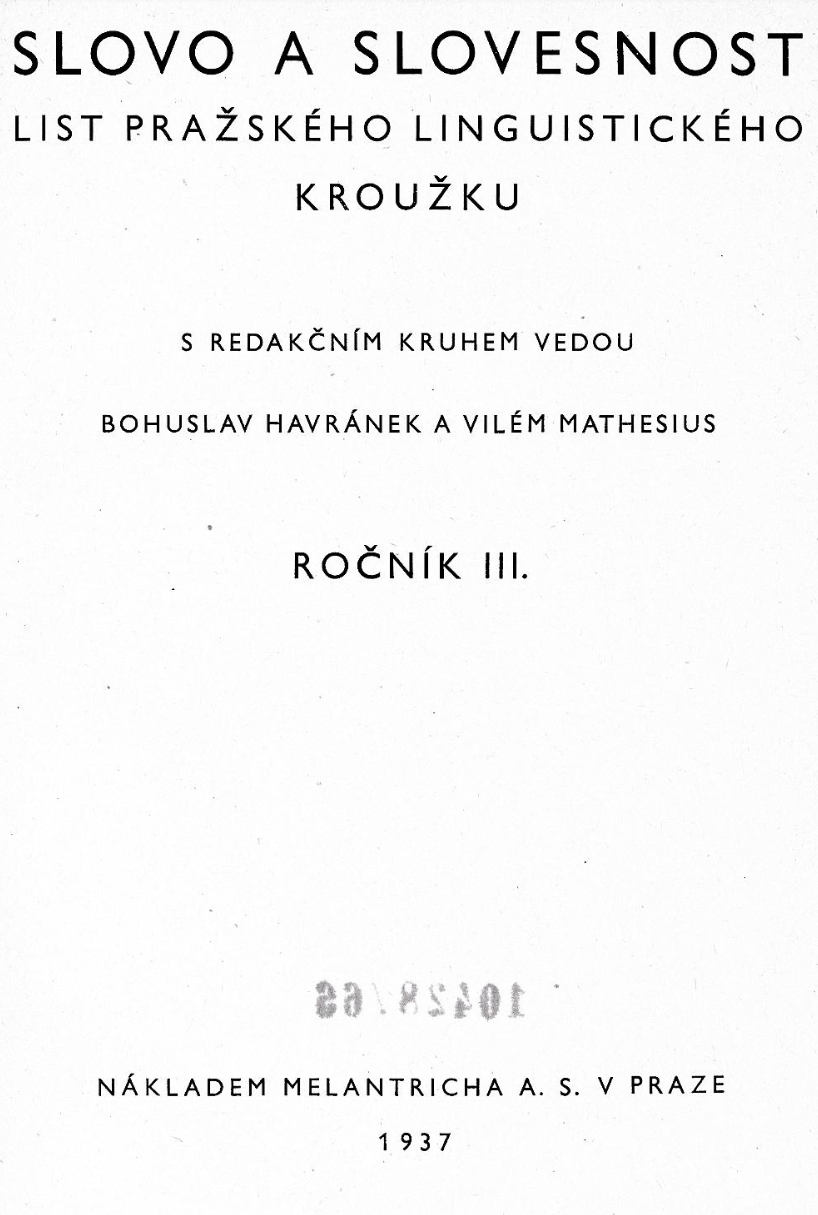
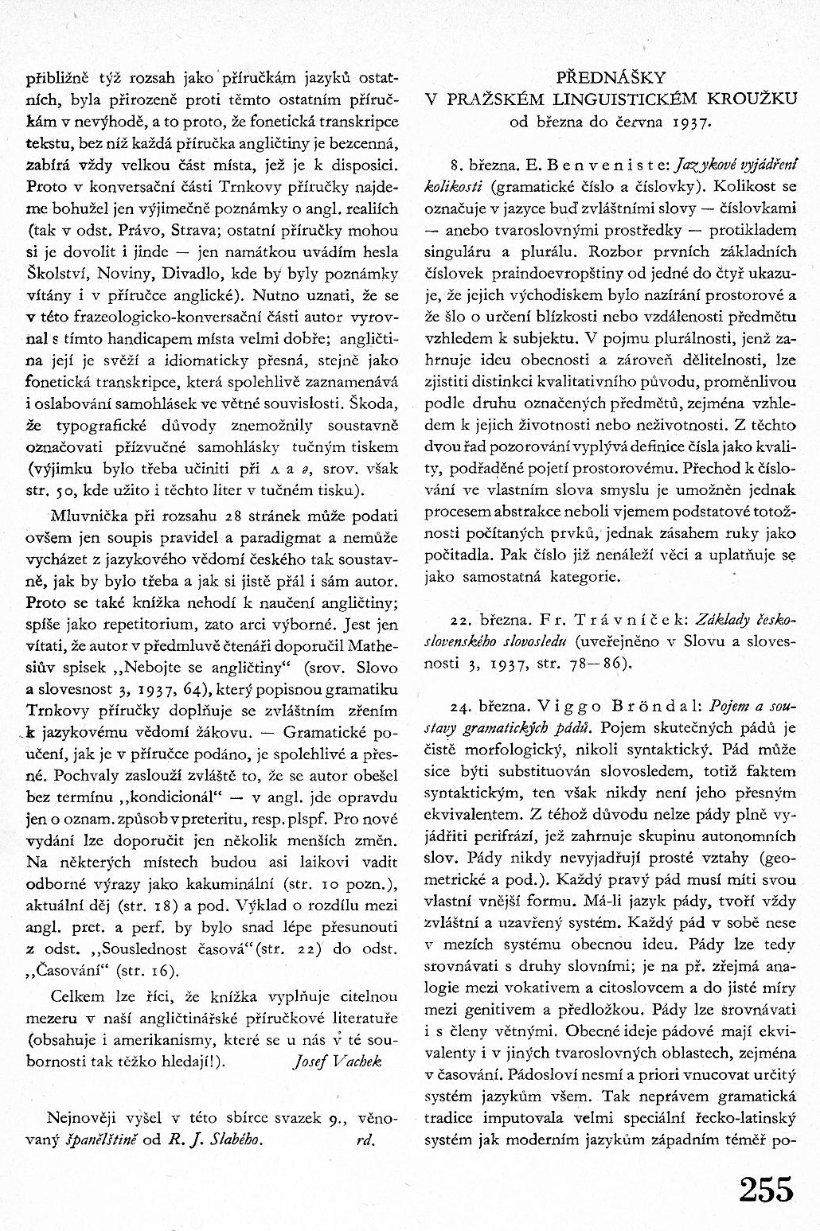
Jakobson’s note to Trubetzkoy’s letter about Benveniste and phonology mentions that a brief Czech summary of Benveniste’s 1937 lecture was published in the Circle’s journal Slovo a slovesnost. I was surprised to find this online. As far as I can tell, this is the only surviving trace of what Benveniste said in Prague, presumably itself a translation of a lost French original:

8. března. E. Benveniste: Jazykové vyjádření kolikosti (gramatické číslo a číslovky). Kolikost se označuje v jazyce buď zvláštními slovy — číslovkami — anebo tvaroslovnými prostředky — protikladem singuláru a plurálu. Rozbor prvních základních číslovek praindoevropštiny od jedné do čtyř ukazuje, že jejich východiskem bylo nazírání prostorové a že šlo o určení blízkosti nebo vzdálenosti předmětu vzhledem k subjektu. V pojmu plurálnosti, jenž zahrnuje ideu obecnosti a zároveň dělitelnosti, lze zjistiti distinkci kvalitativního původu, proměnlivou podle druhu označených předmětů, zejména vzhledem k jejich životnosti nebo neživotnosti. Z těchto dvou řad pozorování vyplývá definice čísla jako kvality, podřaděné pojetí prostorovému. Přechod k číslování ve vlastním slova smyslu je umožněn jednak procesem abstrakce neboli vjemem podstatové totožnosti počítaných prvků, jednak zásahem ruky jako počitadla. Pak číslo již nenáleží věci a uplatňuje se jako samostatná kategorie.

March 8 [1937]. E. Benveniste: Linguistic expression of quantity (grammatical number and numerals). Quantity is indicated in language either by special words – numerals – or by morphological means – the opposition of singular and plural. An analysis of the first basic Proto-Indo-European numerals from one to four shows that their starting point was spatial perception and that it was a matter of determining the proximity or distance of an object relative to the subject. In the concept of plurality, which includes the idea of generality and at the same time divisibility, it is possible to detect a distinction of qualitative origin, variable according to the type of objects indicated, especially with regard to their animacy or inanimacy [životnosti nebo neživotnosti – literally life or non-life or livingness]. From these two series of observations follows the definition of number as a quality, a concept subordinate to that of space. The transition to numbering in its proper sense is made possible both by the process of abstraction, or the perception of the essential identity of the counted elements, and on the other hand by the intervention of the hand as a counter [počitadla – calculator or abacus]. Then the number no longer belongs to the thing and is applied as a separate category. 

[Many thanks to John Raimo for the translation of this text.]

In their apparatus to the Benveniste and Jakobson correspondence, Chloé Laplantine and Pierre-Yves Testenoire note that on the 12 March 1937, Benveniste gave a lecture on the structure of Proto-Indo-European to the Masaryk University in Brno, on Jakobson’s invitation (pp. 140-41). Jakobson wrote a brief report on this lecture for the Lidové noviny newspaper on 16 March: “Prof. Benveniste v Brně”. The text is reprinted in Jakobson’s Selected Writings (Vol IX, Part II, p. 246). The lecture seems to have been mainly for non-specialists, and to have summarised some of Benveniste’s Paris teaching and publications. Jakobson indicates that Benveniste stressed the coherence of his views with those of the Czechoslovak school, talked of the relation of Hittite to Proto-Indo-European, and stressed some of the grammatical functions lacking in the reconstructed language. He also adds that Benveniste, together with the Norwegian Slavic scholar Stang – Christian Schwigaard Stang – visited Brno’s Town Hall and other sites. 

References

Émile Benveniste, “Přednášky v Pražském linguistickém kroužku od března do června 1937”, Slovo a slovesnost III, 1937, 255, http://sas.ujc.cas.cz/archiv.php?lang=en&art=229

Émile Benveniste, “Répartition des consonnes et phonologie du mot”, in Études phonologiques dédiées à la mémoire de M. le Prince N.S. Trubetzkoy, Prague: Jednota Československých Matematiků a Fysiků, 1939, 27-35; reprinted in Benveniste, Langues, Cultures, Religions, eds. Chloé Laplantine and Georges-Jean Pinault, Limoges: Lambert-Lucas, 2015, Ch. 12.

Roman Jakobson (ed.), N.S. Trubetzkoy’s Letters and Notes, The Hague: Mouton, 1975; Correspondance avec Roman Jakobson et Autres Écrits, trans. Patrick Sériot and Margarita Schönenberger, Lausanne: Payot, 1996.

Roman Jakobson, “Prof. Benveniste v Brně”, Selected Writings Vol IX: Uncollected Works, 1916–1943, Part Two, 1934–1943, ed. Jindřich Toman, Berlin: Walter de Gruyter, 2014, 246.

Chloé Laplantine and Pierre-Yves Testenoire (eds.), “La correspondance d’Émile Benveniste et Roman Jakobson (1947-1968)”, Histoire Épistémologie Langage 43 (2), 2021, 139-68, https://journals.openedition.org/hel/1284

Patrick Sériot, Structure and the Whole: East, West and Non-Darwinian Biology in the Origins of Structural Linguistics, trans. Amy Jacobs-Colas, Berlin: Walter de Gruyter, 2014.

Jindřich Toman, The Magic of a Common Language: Jacobson, Mathesius, Trubetzkoy, and the Prague Linguistic Circle, Cambridge, MA: The MIT Press, 1995.

Archives

Fonds Tzvetan Todorov, Bibliothèque nationale de France, NAF 28949, https://archivesetmanuscrits.bnf.fr/ark:/12148/cc104829j

Roman Jakobson papers, Massachusetts Institute of Technology, Department of Distinctive Collections, MC-0072, https://archivesspace.mit.edu/repositories/2/resources/633

—-

This is the third post of an occasional series, where I try to post short essays with some indications of further reading and sources, but which are not as formal as something I’d try to publish more conventionally. They are usually tangential to my main writing focus, a home for spare ideas, asides, dead-ends and possible futures. I hope there is some interest in them. They are provisional and suggestions are welcome. The other posts so far are:

Benveniste, Dumézil, Lejeune and the decipherment of Linear B – 5 January 2025

Foucault’s 1972 visit to Cornell University – 12 January 2025 (updated 14 January)

Marie-Louise Sjoestedt (1900-1940): an important scholar of Celtic languages and mythology – 26 January 2025

Thomas Sebeok, Umberto Eco and the Semiotics of Nuclear Waste – 2 February 2025

Vladimir Nabokov, Roman Jakobson, Marc Szeftel and The Song of Igor – 9 February 2025

Ernst Kantorowicz and the California Loyalty Oath – 16 February 2025

The full list of ‘Sunday histories’ is here.

Posted in Antoine Meillet, Emile Benveniste, Mapping Indo-European Thought in Twentieth Century France, Roman Jakobson, Sunday Histories, Uncategorized | 11 Comments

Ned Richardson-Little, The German Democratic Republic: The Rise and Fall of a Cold War State – Bloomsbury, August 2025

Ned Richardson-Little, The German Democratic Republic: The Rise and Fall of a Cold War State – Bloomsbury, August 2025

This book is a succinct yet comprehensive history of East Germany which provides a differentiated picture of the communist state. It offers a sophisticated analysis of life under dictatorship which candidly confronts the abuses of the East German Communist Party (SED) and the Stasi state security service. Ned Richardson-Little delves into the central contradictions of the GDR as a state meant to overcome the horrors of the Third Reich and create a new utopia, while itself a brutal dictatorship. He also convincingly argues that while the existence of the GDR was a product of the Cold War, it was also entangled in international politics well beyond the rivalry between the United States and the Soviet Union. In this way, the book offers a history of the GDR in a global perspective that illustrates the worldview of those who ruled it, those who rebelled against the strictures of state socialism, and those in between who sought a normal life under dictatorship.

The German Democratic Republic traces the foundation of the GDR from its origins as the Soviet Zone of Occupation after the Second World War through key events such as the 1953 Uprising, the building of the Berlin Wall, the Helsinki Accords and the collapse of state socialism in 1989. Some of the key themes explored include the memory of Nazism and national identity, everyday life under dictatorship, the global politics of the GDR, the diversity of dissent and the competing visions for East Germany’s democratic future.

Posted in Uncategorized | Leave a comment

James Q. Whitman, From Masters of Slaves to Lords of Lands: The Transformation of Ownership in the Western World – Cambridge University Press, November 2024

James Q. Whitman, From Masters of Slaves to Lords of Lands: The Transformation of Ownership in the Western World – Cambridge University Press, November 2024

Today we think of land as the paradigmatic example of property, while in the past, the paradigmatic example was often a slave. In this seminal work, James Q. Whitman asserts that there is no natural form of ownership. Whitman dives deep into the long Western history of this transformation in the legal imagination – the transformation from the ownership of humans and other living creatures to the ownership of land. This change extended over many centuries, coming to fruition only on the threshold of the modern era. It brought with it profound changes, not only in the way we understand ownership but also in the way we understand the state. Its most dramatic consequence arrived in the nineteenth century, with the final disappearance of the lawful private ownership of humans, which had been taken for granted for thousands of years.

Posted in Uncategorized | Leave a comment

Derek Sayer, Postcards from Absurdistan: Prague at the End of History – Princeton University Press, January 2025

Derek Sayer, Postcards from Absurdistan: Prague at the End of History – Princeton University Press, January 2025

Postcards from Absurdistan is a cultural history of Prague from 1938, when the Nazis destroyed Czechoslovakia’s artistically vibrant liberal democracy, to 1989, when the country’s socialist regime collapsed after more than four decades of communist party rule. Derek Sayer shows that Prague’s twentieth century, far from being a story of inexorable progress toward some “end of history,” whether fascist, communist, or democratic, was a tragicomedy of recurring nightmares played out in a land Czech dissidents dubbed Absurdistan. Situated in the eye of the storms that shaped the modern world, Prague holds up an unsettling mirror to the absurdities and dangers of our own times.

In a brilliant narrative, Sayer weaves a vivid montage of the lives of individual Praguers—poets and politicians, architects and athletes, journalists and filmmakers, artists, musicians, and comedians—caught up in the crosscurrents of the turbulent half century following the Nazi invasion. This is the territory of the ideologist, the collaborator, the informer, the apparatchik, the dissident, the outsider, the torturer, and the refugee—not to mention the innocent bystander who is always looking the other way and Václav Havel’s greengrocer whose knowing complicity allows the show to go on. Over and over, Prague exposes modernity’s dreamworlds of progress as confections of kitsch.

In a time when democracy is once again under global assault, Postcards from Absurdistan is an unforgettable portrait of a city that illuminates the predicaments of the modern world.

Posted in Uncategorized | 1 Comment

Krista A. Milne, The Destruction of Medieval Manuscripts in England – Oxford University Press, April 2025 (print and open access)

Krista A. Milne, The Destruction of Medieval Manuscripts in England – Oxford University Press, April 2025

The Dissolution of the Monasteries (1536-40) is widely held as the single most significant event in England’s history of the destruction and loss of medieval manuscripts. Despite this consensus, the ultimate impact of the Dissolution – and of medieval manuscript destruction during the centuries that followed – remains unclear. How did Reformation-era losses compare to those which preceded the Reformation, and to those that followed it? How did the losses caused by sectarian conflicts compare to more quotidian kinds of loss, such as improper storage or deliberate de-acquisition? Which manuscripts were targeted, when were they targeted, and how should one account for the inevitably skewed record?

In The Destruction of Medieval Manuscripts in England, Krista A. Milne asks these questions to better understand literary taste, behavioural patterns, and the circulation of knowledge throughout the medieval period. Milne explores methods drawn from quantitative codicology to explore the most significant moments of manuscript loss in the history of England. The evidence suggests that this destruction was much more limited in its targets, but far more extensive in scope, than is usually acknowledged. Overwhelmingly, throughout the investigation, the manuscripts most at risk were those considered too new to qualify as antique but too old to be au courant. This pattern of destruction, which Milne describes as the principle of ‘age without vintage,’ remains apparent in many different domains today.

Posted in Uncategorized | Leave a comment

We Jung Yi, Worm-Time: Memories of Division in South Korean Aesthetics – Cornell University Press, December 2024

We Jung Yi, Worm-Time: Memories of Division in South Korean Aesthetics – Cornell University Press, December 2024

Worm-Time challenges conventional narratives of the Cold War and its end, presenting an alternative cultural history based on evolving South Korean aesthetics about enduring national division. From novels of dissent during the authoritarian era to films and webtoons in the new millennium, We Jung Yi’s transmedia analyses unearth people’s experiences of “wormification”—traumatic survival, deferred justice, and warped capitalist growth in the wake of the Korean War. 

Whether embodied as refugees, leftists, or broken families, Yi’s wormified protagonists transcend their positions as displaced victims of polarized politics and unequal development. Through metamorphoses into border riders who fly over or crawl through the world’s dividing lines, they reclaim postcolonial memories buried in the pursuit of modernization under US hegemony and cultivate a desire for social transformation. Connecting colonial legacies, Cold War ideologies, and neoliberal economics, Worm-Time dares us to rethink the post-WWII consensus on freedom, peace, and prosperity.

Posted in Boundaries | Leave a comment

Shane Bobrycki, The Crowd in the Early Middle Ages – Princeton University Press, November 2024

Shane Bobrycki, The Crowd in the Early Middle Ages – Princeton University Press, November 2024

By the fifth and sixth centuries, the bread and circuses and triumphal processions of the Roman Empire had given way to a quieter world. And yet, as Shane Bobrycki argues, the influence and importance of the crowd did not disappear in early medieval Europe. In The Crowd in the Early Middle Ages, Bobrycki shows that although demographic change may have dispersed the urban multitudes of Greco-Roman civilization, collective behavior retained its social importance even when crowds were scarce.

Most historians have seen early medieval Europe as a world without crowds. In fact, Bobrycki argues, early medieval European sources are full of crowds—although perhaps not the sort historians have trained themselves to look for. Harvests, markets, festivals, religious rites, and political assemblies were among the gatherings used to regulate resources and demonstrate legitimacy. Indeed, the refusal to assemble and other forms of “slantwise” assembly became a weapon of the powerless. Bobrycki investigates what happened when demographic realities shifted, but culture, religion, and politics remained bound by the past. The history of crowds during the five hundred years between the age of circuses and the age of crusades, Bobrycki shows, tells an important story—one of systemic and scalar change in economic and social life and of reorganization in the world of ideas and norms.

Posted in Uncategorized | Leave a comment

Daniela R. P. Weiner, Teaching a Dark Chapter: History Books and the Holocaust in Italy and the Germanys – Cornell University Press, July 2024

Daniela R. P. Weiner, Teaching a Dark Chapter: History Books and the Holocaust in Italy and the Germanys – Cornell University Press, July 2024

Teaching a Dark Chapter explores how textbook narratives about the Fascist/Nazi past in Italy, East Germany, and West Germany followed relatively calm, undisturbed paths of little change until isolated “flashpoints” catalyzed the educational infrastructure into periods of rapid transformation. Though these flashpoints varied among Italy and the Germanys, they all roughly conformed to a chronological scheme and permanently changed how each “dark past” was represented. 

Historians have often neglected textbooks as sources in their engagement with the reconstruction of postfascist states and the development of postwar memory culture. But as Teaching a Dark Chapter demonstrates, textbooks yield new insights and suggest a new chronology of the changes in postwar memory culture that other sources overlook. Employing a methodological and temporal rethinking of the narratives surrounding the development of European Holocaust memory, Daniela R. P. Weiner reveals how, long before 1968, textbooks in these three countries served as important tools to influence public memory about Nazi/Fascist atrocities. 

As Fascism had been spread through education, then education must play a key role in undoing the damage. Thus, to repair and shape postwar societies, textbooks became an avenue to inculcate youths with desirable democratic and socialist values. Teaching a Dark Chapter weds the historical study of public memory with the educational study of textbooks to ask how and why the textbooks were created, what they said, and how they affected the society around them.

Posted in Uncategorized | Leave a comment

Foucault’s 1972 visit to Cornell University

For his initial trips to the United States, Michel Foucault was often invited by French departments. His visits to SUNY Buffalo in 1970 and 1972, and the first of his multiple visits to the University of California, Berkeley in 1975 were all to French programmes. (He also visited McGill University in Francophone Canada in 1971.) Not only were these programmes with an interest in his work, initially he spoke in French, and when he did speak to an Anglophone audience – such as his 1975 talk to the Semiotext(e) conference in New York – it was with the aid of an interpreter. In time, his ability to speak in English would improve and he would lecture or discuss directly in that language.

Cornell University Sign, photograph by Claude-Étienne Armingaud, CC BY-SA 3.0 via Wikimedia Commons

Foucault also made a visit to Cornell University in 1972, and compared to those other visits to North America, less seems to be known of this. Daniel Defert, in the invaluable ‘Chronologie’ he contributed to Dits et écrits, says that Foucault visited in October 1972: 

At the invitation of the Department of Romance Studies at Cornell University, he gives talks on “Knowledge in Sophocles’ Oedipus the King,” on “Literature and Crime,” and on “The Punitive Society.”

Foucault gave the lecture on Oedipus in multiple places, including in Paris in the course published as Lectures on the Will to Know, which also includes a manuscript on “Oedipal Knowledge”. The manuscript may be a development of the material presented in several visiting lectures, or alternatively their source. In his editorial material to the course, Defert says that there are six or seven versions of this lecture in Foucault’s files, now at the Bibliothèque nationale de France (NAF28730 box 59). It seems likely one of them is the Cornell version.

“The Punitive Society” is the title of a course Foucault would give in Paris in the 1972-73 academic year. That Foucault gave a lecture with this title in Cornell is interesting in part because it precedes the beginning of the Paris course on 3 January 1973 by a few months. The manuscript of the Cornell lecture is in Foucault’s archives, alongside the manuscript of the Paris course (NAF28730 box III, Cours 72-3, folder 8). I don’t know of plans to publish this, but it would have made an interesting addition to the reedition of the course, or would sit well with other material on this theme. I’m unaware of any manuscript of “Literature and Crime”, unless this is a description of the lecture on the Marquis de Sade. Foucault gave a lecture or two on Sade in a few places – beginning with Buffalo in 1970, Montreal in 1971 and Cornell in 1972. The Buffalo version was published in Language, Madness and Desire. Some materials from these lectures are in his archives (NAF28730 box 54, folder 5).

A few further clues come from the archives. Foucault’s personnel file at the Collège de France authorises his absence for this Cornell trip from 9-21 October 1972. A short manuscript with the title “Hatred of Literature”, with a note indicating Cornell in October 1972 is in the BnF archives (NAF28730 box 54, folder 6). I very briefly mention this in The Archaeology of Foucault (p. 208).

Marcelo Hoffman’s fascinating work with Foucault’s FBI files has shown that Foucault required visa ineligibility waivers in order to visit the United States. This was because of his “former membership in the French Communist Party” back in the 1950s. One of those authorisations, Hoffman indicates, and the one for which there are available records, was for the Cornell visit. The application, dated 20 September 1972, reads in part:

The subject wishes to visit the United States in order to accept an offer of the Department of Modern Languages of Cornell University to lecture for a four week period. He plans to arrive at New York via air from Paris on either September 26 or October 1, 1972.

The available FBI file on Foucault, page 5, is a response to this request, suggesting this visit is approved. Unfortunately, there does not seem to be any record of Foucault’s visit in the Cornell University archives, nor in campus newspapers. A request to the archivist there has not turned up any references to be explored.

So, we have the dates of the trip, and some indications of the topics of his lectures, with some of their manuscripts in Paris. But the order and date of the lectures, who invited him, who he met, and other details are, to me, still unknown. I have been unable to locate any correspondence about these visits, recordings or transcripts. We know much more about the Buffalo trips, certainly about his time in California, and – thanks to Hoffman and Heliana de Barros Conde Rodrigues – his visits to Brazil.

References

Heliana de Barros Conde Rodrigues, Michel Foucault au Brésil: Présence, effets, résonances, trans. Anthony David Taïeb, Paris: Harmattan, 2020.

Daniel Defert, “Chronologie”, Dits et écrits, Paris: Gallimard, 1994, Vol I, 13-64; trans. Timothy O’Leary in Christopher Falzon, Timothy O’Leary and Jana Sawicki (eds), A Companion to Foucault, Oxford: Blackwell, 2013, 11–83.

Stuart Elden, The Archaeology of Foucault, Cambridge: Polity, 2023.

Michel Foucault, Leçons sur la volonté de savoir: Cours au Collège de France, 1970-1971, suivi de Le savoir d’Œdipe, ed. Daniel Defert, Paris: Gallimard/Seuil, 2011; Lectures on the Will to Know: Lectures at the Collège de France 1970-71, trans. Graham Burchell, London: Palgrave-Macmillan, 2013.

Michel Foucault, “Conférences sur Sade”, La grande étrangère: À propos de littérature, ed. Philippe Artières, Jean-François Bert, Mathieu Potte-Bonneville and Judith Revel, Paris: Éditions EHESS, 2013, 145-218; “Lectures on Sade”, Language, Madness, Desire: On Literature, trans. Robert Bononno, Minneapolis: University of Minnesota Press, 2015, 93-146.

Marcelo Hoffman, “The FBI File on Foucault”, Viewpoint Magazine, 8 November 2021, https://viewpointmag.com/2021/11/08/the-fbi-file-on-foucault/

Marcelo Hoffman, Foucault in Brazil: Dictatorship, Resistance, and Solidarity, Pittsburgh: University of Pittsburgh Press, 2024.

Archives

Federal Bureau of Investigation, FBI Records, The Vault, Michel Foucault Part 01 of 01, https://vault.fbi.gov/michael-foucault

Fonds Michel Foucault, Bibliothèque nationale de France, NAF 28730

I’m grateful to Marcelo Hoffman for sharing a document from the FBI files, not available elsewhere.

Update 14 January 2025

Many thanks to Brian Rosa for sharing that Foucault stayed at Telluride House (the Cornell Branch of the Telluride Association, CBTA) during his visit to Cornell, and pointing to the following report from its newsletter:

Richard Klein, an assistant professor in the Romance Studies Department (he teaches French literature), is here after four years at Johns Hopkins University. He received his doctorate from and was an undergraduate at Cornell. (He commented with some amusement that during that time he applied to live at Telluride and was rejected.) He has, of course, been to France a number of times – it was there that he wrote his thesis on Baudelaire. In cooperation with Academic Affairs, he led a seminar on a selection of Michel Foucault’s work; this was done prior to Monsieur Foucault’s arrival, in the hope that we would not be totally ignorant of one of the most highly regarded men in France.

Foucault, professor of philosophy at the College de France, was a guest of Telluride for three weeks while he gave lectures for the Romance Studies Department. The author of Words and Things and Madness and Civilization. M. Foucault was perhaps insufficiently aware of our hopes of becoming better acquainted, and in addition had an extremely full academic and social schedule; as a result, some Branchmembers barely caught a glimpse of him.

Marilyn Migiel, “Resident Faculty, Full House Promise Good Year at CB”, Telluride Newsletter 60 (2), November 1972, 3.

Richard Klein has shared one story of Foucault’s visit with me, though not for publication.

Update 10 March 2025:

I’ve spoken to a second archivist at Cornell, but their more extensive search has not turned up any other records of the time, suggesting his visit was not widely publicised.

This is the second post of an occasional series, where I try to post short essays with some indications of further reading and sources, but which are not as formal as something I’d try to publish more conventionally. They are usually tangential to my main writing focus, a home for spare ideas, asides, dead-ends and possible futures. I hope there is some interest in them. They are provisional and suggestions are welcome. The other posts so far are:

Benveniste, Dumézil, Lejeune and the decipherment of Linear B – 5 January 2025

Benveniste and the Linguistic Circle of Prague – 19 January 2025

Marie-Louise Sjoestedt (1900-1940): an important scholar of Celtic languages and mythology – 26 January 2025

Thomas Sebeok, Umberto Eco and the Semiotics of Nuclear Waste – 2 February 2025

Vladimir Nabokov, Roman Jakobson, Marc Szeftel and The Song of Igor – 9 February 2025

Ernst Kantorowicz and the California Loyalty Oath – 16 February 2025

The full list of ‘Sunday histories’ is here.
Posted in Daniel Defert, Foucault: The Birth of Power, Michel Foucault, Sunday Histories, The Archaeology of Foucault | 14 Comments

Aaron Aquilina, The Ontology of Death: The Philosophy of the Death Penalty in Literature – Bloomsbury, November 2024

Aaron Aquilina, The Ontology of Death: The Philosophy of the Death Penalty in Literature – Bloomsbury, November 2024

Through examination of the death penalty in literature, Aaron Aquilina contests Heidegger’s concept of ‘being-towards-death’ and proposes a new understanding of the political and philosophical subject.

Dickens, Nabokov, Hugo, Sophocles and many others explore capital punishment in their works, from Antigone to Invitation to a Beheading. Using these varied case studies, Aquilina demonstrates how they all highlight two aspects of the experience. First, they uncover a particular state of being, or more precisely non-being, that comes with a death sentence, and, second, they reveal how this state exists beyond death row, as sovereignty and alterity are by no means confined to a prison cell.

In contrast to Heidegger’s being-towards-death, which individualizes the subject – only I can die my own death, supposedly – this book argues that, when condemned to death, the self and death collide, putting under erasure the category of subjectivity itself. Be it death row or not, when the supposed futurity of death is brought into the here and now, we encounter what Aquilina calls ‘relational death’. Living on with death severs the subject’s relation to itself, the other and political sociality as a whole, rendering the human less a named and recognizable ‘being’ than an anonymous ‘living corpse’, a human thing.

In a sustained engagement with Blanchot, Levinas, Hegel, Agamben and Derrida, The Ontology of Death articulates a new theory of the subject, beyond political subjectivity defined by sovereignty and beyond the Heideggerian notion of ontological selfhood.

Posted in Uncategorized | Leave a comment