
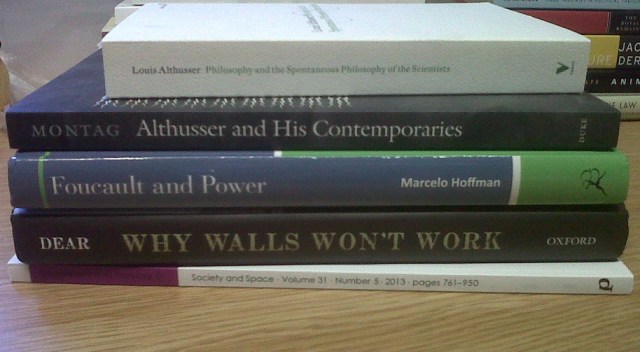
Two books for the Althusser project; Marcelo Hoffman’s Foucault and Power; Michael Dear’s Why Walls Won’t Work; and the latest Society and Space.
Two books for the Althusser project; Marcelo Hoffman’s Foucault and Power; Michael Dear’s Why Walls Won’t Work; and the latest Society and Space.
London, 7th-10th November, ‘Making the World Working Class’ – full details here.
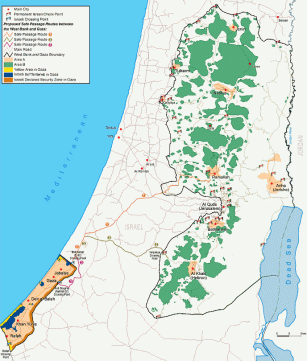 In Feedly this morning, a powerful juxtaposition – Derek Gregory on the West Bank wall, and Juan Cole on Israel’s new settlements in the West Bank. Derek links to a new photo essay by China Miéville presented at the Palestinian Literary Festival and now in Guernica. All worth reading.
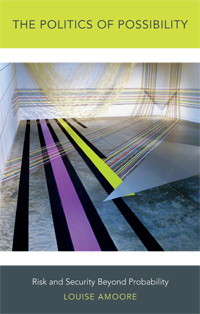 You can read the introduction to Louise Amoore’s The Politics of Possibility here. Duke’s own site says the book is in stock, though online book stores don’t seem to have it yet.
Mark Neocleous on police power and no-fly zones.
Powerful images from National Geographic.
Novelist and academic JM Coetzee’s foreword to University of Cape Town fellow Professor John Higgins’s new book. Thanks to dmfant for the link.
Very interesting piece on the relations between Agamben, Butler and Foucault on the question of place, sovereignty and power. The defence of Foucault against Agamben is particularly useful.
Verena Erlenbusch, The place of sovereignty: Mapping power with Agamben, Butler, and Foucault (2013) Critical Horizons, 14 (1), pp. 44-69.
https://doi.org/10.1179/15685160X13A.0000000003
Abstract
This article addresses the relationship between sovereignty, biopolitics and governmentality in the work of Giorgio Agamben, Judith Butler, and Michel Foucault. By unpacking Foucault’s genealogy of modern governmentality, it responds to a criticism leveled against Foucauldian accounts of power for their alleged abandonment of the traditional model of power in juridico-institutional terms in favor of an understanding of power as purely productive. This claim has most significantly been developed by Agamben in “Homo Sacer: Sovereign Power and Bare Life”. I argue that Judith Butler’s analysis of power, in particular in her essay “Indefinite Detention”, presents a more differentiated account of power that registers the significance of practices of sovereignty and resonates with Foucault’s lectures on “Security, Territory, Population”. © W. S. Maney & Son Ltd 2013.
Author…
View original post 9 more words
 I went to an interesting version of Macbeth in Stratford last night, performed by the Shakespeare Aloud! group, with only six actors. It was heavily cut, with most of the more political discussion scenes missing, but it kept the core of the story intact and was, as a consequence, very fast-paced. Macbeth is a short play in any case, but this was two 40 minute halves with a short interval.
The six actors did a great job, with only the actor playing Macbeth himself taking a single role. There were lots of quick costume changes and different voices. Lots of minor characters were cut. It really jarred only once, when the murder of Lady Macduff was immediately followed by the scene between Malcolm and Macduff. The murderer and Macduff were played by one actor; Malcolm and Lady Macduff by the other. It helped knowing the play so well, and there was quite a bit of whispering in the audience which I took to be ‘who is she/he now?’ questions. Cutting the political parts made it seem rather too much as if Macduff was taking merely personal revenge for the killing of his family, rather than that being only part of the reason for the overthrow of Macbeth. But overall, a really interesting production and I’ll certainly keep an eye out for more by this group – by day they do Shakespeare on demand to tourists at the Shakespeare Birthplace Trust.
Impressive twenty minute presentation via @urbantheorylab


