Michel Foucault: Beyond Good and Evil (1993)

1993 BBC documentary on Foucault.

Clare O'Farrell's avatarFoucault News

Michel Foucault: Beyond Good and Evil, a documentary directed by David Stewart in 1993
42 mins
Broadcast as part of a BBC series called “The Late Show”.

Editor: 15 March 2026. Link above is to the archived page on the Wayback Machine.

Some of this documentary is rather speculative and sensationalised.

Sources of this link: Dangerous Minds
Critical Theory

View original post

Posted in Uncategorized | Leave a comment

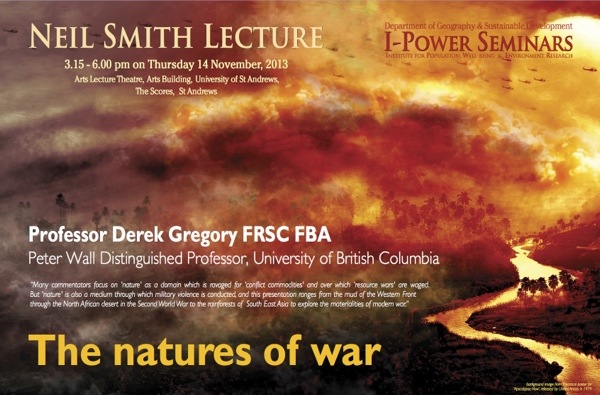
Derek Gregory – The Natures of War

Derek Gregory to give the inaugural Neil Smith lecture at St Andrews on 14 November 2013.

20130921-124524.jpg

Posted in Conferences, Derek Gregory, Neil Smith | Leave a comment

Advice for a newly-minted PhD: write that second book quickly

Interesting advice on book writing from Roland Boer. Six months is unrealistic for a lot of people, and it certainly takes me a lot longer, but I’ve always been well on the way with the next book when one is actually published. And Understanding Henri Lefebvre (my second book) did indeed pick up on unused parts of the PhD (which itself became Mapping the Present).

Posted in Uncategorized | 1 Comment

Background reading on al-Qaida from Pluto Press

Pluto books have a discount of 40% on all books, including these on Al Qaeda.

Posted in Uncategorized | Leave a comment

Theory of the drone 10: Killing at a distance

Another excellent post from Derek Gregory discussing Grégoire Chamayou’s Théorie du drone.

Derek Gregory's avatargeographical imaginations

This is the tenth in a series of extended posts on Grégoire Chamayou‘s Théorie du drone and covers the fifth and final chapter in Part II, Ethos and psyche.

Gulf_war_target_camChamayou begins with a lecture given by German artist and film-maker Harun Farocki in Karlsruhe in 2003 called  ‘Phantom Images‘.  A ‘phantom image’, Farocki explained, is a view that is otherwise inaccessible to a human being – like the ‘bomb’s-eye view’ that became so familiar during the Gulf War (‘a suicidal camera’).  Like so many other ‘technical representations which maintain that they only represent the operative principle of a process’ these are, of course, techno-cultural performances.  They are techno-cultural because they produce a constructed and constrained space – in the Gulf War images that Farocki used to frame his argument, the battle space appears empty of people, a landscape without figures, an odyssey of destruction based on an…

View original post 3,643 more words

Posted in Uncategorized | 1 Comment

“The thingness of books” (From Chrostowska’s Novel Permission)

Nice post on the material nature of books – very appropriate given that I am now, finally, unpacking and organising my home study.

Biblioklept's avatarBiblioklept

The thingness of books, especially of many books kept in a small space, stacked high without rhyme or reason, can become impressive. I worry about being oppressed by the books I own––quite different from being oppressed by the ownership of books. There are days when I am certainly very oppressed by the presence of so many books in such a small space. There is really no more room for me with them around, just as there is no room for more books with me around. Yet I keep introducing new books, and reintroducing books that have either fallen or been misplaced and have now been picked up or found, or those I have lent (both with relief at the extra space and with apprehension at never seen them again) and that have just been returned to me. So now: loads and loads of books everywhere, and the fear that they…

View original post 471 more words

Posted in Uncategorized | Leave a comment

Richard Polt’s The Emergency of Being – now in paperback

Enowing has the good news that Richard Polt’s The Emergency of Being: On Heidegger’s “Contributions to Philosophy” is coming out in paperback, with a new preface. The new preface is also available online. hen this book came out, I reviewed it for Continental Philosophy Review (freely available here), and wrote:

Polt has undoubtedly a difficult task. The difficulties are in part due to the lack of an agreed vocabulary for reading the key terms within Heidegger’s work of the 1930s and beyond, and the relative lack of careful work on Heidegger’s thought of this period, compared to that of the 1920s. This book is a major contribution to that subfield of Heidegger studies. If it lacks the textual fidelity and contextual insights of the work of Theodore Kisiel, it is more philosophically, that is argumentatively, concerned… he argues that ‘‘the Contributions absolve Heidegger of any charges that he was an uncritical supporter of Nazism until the bitter end’’ (178). This is an understandable interpretation, and one with which I would broadly agree, but it tends to see Nazism as rather too much of a unified doctrine of thought.There were debates and disputes within National Socialism—a writer like Heidegger could be critical of key elements, as he was even in 1933–1934, without this meaning that this was a critique from the outside. In that sense, as with others, this interpretation needs to be balanced with those who have worked through the ‘negative’, a task I would suggest is equally in need of the careful argumentation, contextualisation, and interpretative rigour that is on display here.

I’ve not kept up on the secondary Heidegger literature in the past several years, but expect that the book is still an essential introduction to the Contributions, now available in a much better translation.

Posted in Martin Heidegger | 1 Comment

John Agnew review of Stephen Legg (ed.) Spatiality, Sovereignty and Carl Schmitt

John Agnew reviews Stephen Legg (ed.) Spatiality, Sovereignty and Carl Schmitt: Geographies of the Nomos in Progress in Human Geography – here (requires subscription).

Posted in Carl Schmitt, John Agnew | Leave a comment

radio interview on The Birth of Territory

I was briefly interviewed earlier this afternoon on the Moncrieff show on Irish Newstalk radio. You can listen to the recording here – begins at about 22 minutes and goes up to 30 minutes. The interview was about The Birth of Territory but also touched on some more contemporary issues. [Update the interview alone can be accessed here.]

Posted in Territory, The Birth of Territory, Uncategorized | 1 Comment

Five forthcoming papers

Five forthcoming papers in Society and Space now available online (require subscription).

Posted in Uncategorized | Leave a comment