Terricide – RGS-IBG audio available

My talk at the recent RGS-IBG conference is available here. This was part of a session on Geo-social formations: Capitalism and the Earth (details here and here), organised by Arun Saldanha, Kathryn Yusoff and Nigel Clark.

Terricide – Lefebvre, Geopolitics and the Killing of the Earth

In a few places in his four volume study De l’État, Henri Lefebvre briefly discusses the idea of terricide—the killing, destruction or death of the earth. His sources are the poet Jean-Clarence Lambert and, less directly, the philosopher Kostas Axelos. Lefebvre locates the tensions in the international state system, and suggests that while reason of state might be attributed to each of the members, rationality does not characterise the system taken as a whole. His immediate context, writing in the mid 1970s, would seem to be the superpower conflict of the Cold War, but here and elsewhere there are hints that this might be linked to other issues—environmental degradation, modern technology, growth over development, the state mode of production and capitalism more generally.

How might Lefebvre’s spur to consider the potential destruction of the earth help us in rethinking geopolitics? Geopolitics is all-too-often seen as a synonym for global politics, international relations writ large, without much thought given to the globe, much less the world or the earth. But if geopolitics was to return to its etymological roots, as a politics of the earth, it might productively link with discussions of geopower and geophilosophy. This paper brings Lefebvre, Lambert and Axelos into those discussions.
Posted in Conferences, Elizabeth Grosz, Henri Lefebvre, Kostas Axelos, The Space of the World | 2 Comments

Cambridge Foucault Lexicon – forthcoming

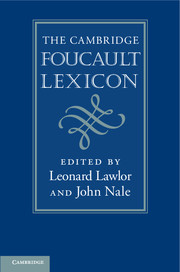
Cambridge FoucaultCambridge University Press have a page up for the forthcoming The Cambridge Foucault Lexicon, edited by Leonard Lawlor and John Nale. I wrote the entry on ‘space’. It looks like this is going to be another expensive, destined for libraries only, hardback – a shame.

Posted in Michel Foucault, My Publications, Publishing | 1 Comment

Koopman, Genealogy as Critique reviewed at NDPR

KoopmanColin Koopman’s important book on Foucault, Genealogy as Critique, is reviewed at NDPR.

Posted in Michel Foucault | Leave a comment

# CINEMA /// Coriolanus and the State of Exception

The Funambulist discusses Coriolanus – Shakespeare’s play and Ralph Fiennes’s recent film.

Léopold Lambert's avatarThe Funambulist

Coriolanus01Still from the film Coriolanus by Ralph Fiennes (2011)

Before being a historical figure, Caius Marcius Coriolanus is a legendary one. He, as an actual person was a Roman general who lived in the fifth century before Christ. What belongs to history and what belongs to the myth about him remains unclear today. The following text will therefore address his (hi)story without the doubts and precautions that a historian would need to systematically indicate when addressing this same story.

Coriolanus’s story is brought to us by the 1608 play written by William Shakespeare. General Caius Marcius earn his name of Coriolanus by his glorious victory against the Volscian city of Corioli. Strengthen by this success, he is encouraged to run for Consul of Rome. Despite an apparent support from both the Senate and the Plebe, he has to face riots from the latter. He finally publicly expresses his…

View original post 636 more words

Posted in Uncategorized | Leave a comment

Ian Hacking on chance as worldview

Understanding Society has an interesting post about Ian Hacking’s work on chance and probability.

Posted in Ian Hacking | Leave a comment

CFP/conference and book pub – The Right to the City in an Era of Austerity (1973-2014)

Call for papers for an interesting sounding conference, and subsequent book on the ‘Right to the City’ and the present era of austerity.

urbanculturalstudies's avatarurbanculturalstudies

The Right to the City in an Era of Austerity (1973-2014): Perspectives on the Past, Present, and Future of Urban Democracy in the United States and Great Britain

An International Conference Organized by the Research Center Monde Anglophone: Politiques et Sociétés (HDEA/Université Paris-Sorbonne) and the Research Group Politiques Américaines (CREA/Université Paris-Ouest Nanterre La Défense)
Paris, France
May 30-31, 2014

If Henri Lefebvre’s idea of “the right to the city” has become fashionable in recent years, this is because it seems to describe something elemental about the current political context in Europe and North America. Indeed, the body of work Lefebvre completed from the late 1960s to the mid 1970s has seen a revival, in part, because it predicted so well the circumstances that now shape the global urban landscape. Writing amidst the social and political upheaval of the late 1960s, Lefebvre fixed his gaze on a dimension of the contestation…

View original post 875 more words

Posted in Uncategorized | Leave a comment

Michel Foucault : la justice et la police (video 1977)

Clare O’Farrell unearths another Foucault interview on video.

Clare O'Farrell's avatarFoucault News

Michel Foucault : la justice et la police (video 1977)

25 avril 1977

Michel FOUCAULT explique, qu’à son avis, la véritable fonction du juge est d’être au service de la police.

Antenne 2

View original post

Posted in Uncategorized | Leave a comment

Gastón Gordillo’s Rubble gets closer

At his Space and Politics blog, Gastón Gordillo has posted the backcover text for his book Rubble: The Afterlife of Destruction – forthcoming with Duke University Press. He also notes that there is a longer summary of the book here. I’ll be interviewing Gastón on the book and his other work for the Society and Space open site in the near future.

At the foot of the Argentine Andes, bulldozers are destroying forests and homes to create soy fields in a geography already strewn with rubble from previous waves of destruction and violence. Based on extensive fieldwork in the region where the Gran Chaco lowlands meet the mountains, this book proposes to examine space through the rubble that is part of its materiality. Rubble seeks to rethink the very idea of “ruins” by asking: Can the spatial, historical, and affective ruptures congealed in the debris scattered all over the world help us look at space differently? The book explores this question by leading the reader on a journey through lost cities from the seventeenth century, derelict train stations, overgrown Jesuit missions and Spanish forts, steamships stranded in forests, mass graves, abandoned towns, razed forests, and bulldozed ruins, as they are entangled with each other and with the towns, cattle ranches, farms, and annual collective events that exist around them. For the rural poor, these palimpsests of debris evoke —rather than dead relics from a distant past— the latent and ongoing presence in the living geographies of the present of the processes of violence that created them. The book shows that this experience is at odds with, and often challenges, the fetishized views of ruins embraced by the regional and scholarly elites. The subaltern experience of the people who live in areas disrupted by agribusiness reveals that the modernist, elite infatuation with ruins is based upon the disregard for the rubble generated by capitalist and imperial forms of destruction. Drawing from anthropology, history, geography, philosophy and the exploration of constellations of debris from multiple eras on the scarred edges of the Gran Chaco, this ethnography brings to light the salience of a spatial, conceptual, and political analysis of rubble.
Posted in Gaston Gordillo, Society and Space | Leave a comment

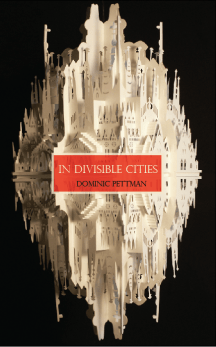
In-divisible cities

Cover-1_Pettman-216x347

To pull cities together, and then push them apart. To feel their bricks crumble in our fingers like honeycomb, before fusing them once more between our palms. To hang the great capitals of the world from the crescent moon, like a nightwatchman’s lamp. To fold them into origami birds that nest in our hats and pockets. To unpack them into radiant flotillas that span the placid oceans.

~Dominic Pettman, In Divisible Cities

The Dead Letter Office of punctum books is excited to announce today the launch of Dominic Pettman‘s phanto-cartographical missive IN DIVISIBLE CITIES, a work of incoherent geography and cartographic origami, which we are releasing in a triptych of formats: as open-access PDF text, as print edition, and as a web-book, beautifully designed by Alli Crandell: indivisiblecities.com.

Posted in Publishing | 1 Comment

Books received

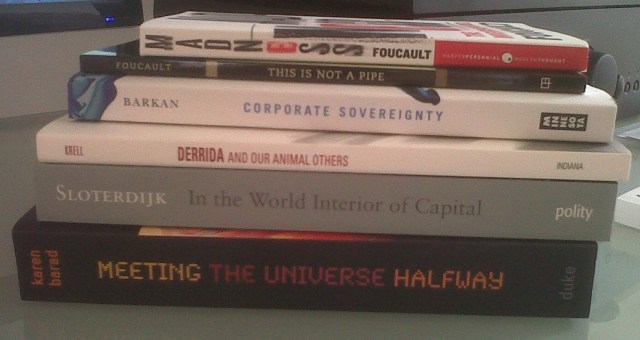
Books received 31 August.jpgTwo reissues of Foucault books, Joshua Barkan’s Corporate Sovereignty, David Farrell Krell’s Derrida and our Animal Others, Sloterdijk’s In the World Interior of Capital, and Karen Barad’s Meeting the Universe Halfway.

Posted in Books, David Farrell Krell, Jacques Derrida, Michel Foucault, Peter Sloterdijk | Leave a comment