
I’m teaching a level 3 option on European Political Theory again this term, for the first time in several years. ‘European’ is used loosely to designate a tradition, rather than all the theorists being European by citizenship. This allows me to include Judith Butler and Achille Mbembe, who engage with that tradition; and Frantz Fanon and Hannah Arendt, who held French and German citizenship, but spent most of their careers outside of Europe.
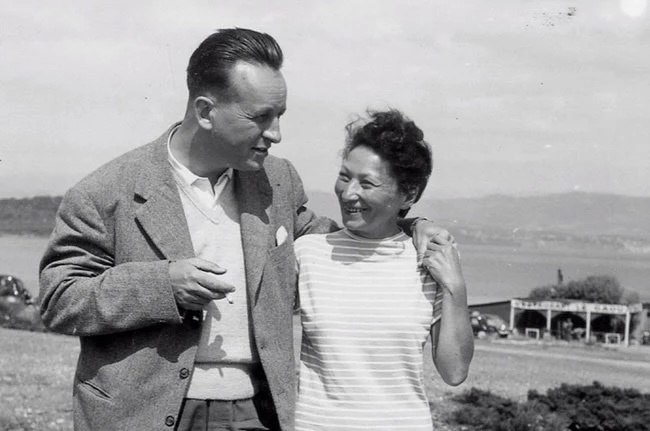
The thinker I struggle with most in the module is Louis Althusser. Should he be taught, and if so, how? Does his murder of his wife mean he should be excluded from the module?
What I do is to continue to teach Althusser, but with warnings and some discussion of the case and her work. I am not sure is the right approach, but other than excluding him entirely I haven’t got a better one. I try to address the reasons for why this might be the wrong choice.
Althusser’s work remains significant, and avoiding him would complicate some of the other lectures. I teach Jean-Paul Sartre in the first week, and Henri Lefebvre later, and one of the themes linking those classes is how to read Marx, or which parts of Marx’s work are most significant. Sartre put a lot of emphasis on the early Marx, which Lefebvre had helped to bring to a French audience in the early 1930s. Althusser wants to exclude the early Marx, seeing it as Hegelian and unscientific. Lefebvre tries to propose a reading of Marx’s career as a whole. There are other themes in the lectures on Sartre and Lefebvre, of course, but Althusser’s position helps with situating their positions in relation to Marx, and introduces the students to a debate. I also discuss Althusser on interpellation and ideology, themes which are later connected to Foucault and Butler, for example.
Althusser was married to Hélène Rytmann, sometimes known as Hélène Legotien after a name she used in the resistance. Confusingly, Rytmann is sometimes spelled as Rytman; Legotien as Légotien. Sometimes her surname is hyphenated with Althusser’s. Legotien was the name she chose to publish with. On 16 November 1980 she was killed in their apartment in the École normale supérieure in Paris. Althusser alerted the school authorities to what he had done. He was institutionalised, initially at the Sainte-Anne hospital, rather than arrested. He never stood trial. French criminal law at the time meant that if the accused was in a state of mental disturbance at the time, no crime was held to have been committed. It was therefore ruled that there should be no trial. It is not that the defence was on the grounds of diminished responsibility or similar, but that because of his mental state a crime did not take place. As the 1810 code says: “There can be no crime, or delict, where the accused was in a state of madness at the time of the action; or when he has been constrained by a force which he had not the power to resist”. This article of the Napoleonic code was not changed until the early 1990s, after Althusser’s death.
In the previous lecture I mention what’s coming the next week, indicating that if anyone wants to miss the class their absence will be understood. I discussed the issues around this case in a bit more detail this year, why he never stood trial for murder, and using recent research to say something more about Legotien.
We have Althusser’s account, written a few years after the event, of what happened. There was an autopsy and a psychiatric evaluation of Althusser. Hélène Legotien was strangled – he claims he was massaging her neck and it was by accident. His mental health was a constant struggle, and he was in and out of institutions for much of his life. He was treated by drugs and underwent psychoanalysis. His time in a German prisoner of war camp is sometimes seen as a factor in this illness. It has also been reported she was thinking of leaving him. There are various secondary accounts including the beginning of Yann Moulier Boutang’s uncompleted biography. Althusser’s own account in his autobiography is obviously one to take with some scepticism, as with much else in that book. John Sturrock writes about the autobiography and biography in the London Review of Books, with a title doubtless chosen by a subeditor, but no less awful for that. Richard Seymour writes about the case, and what Althusser’s autobiography says, and does not say, here.
Seymour also gives some background on Legotien – a Jewish woman, a communist, a resistant, a survivor of childhood sexual abuse, and more. But he ends his piece with the suggestion that it is regrettable that “in the discussion of the murder, Rytman hardly ever appears as a woman with qualities”. Asaf Haider has written about how the horrific events are sometimes used to dismiss Althusser’s thought, often to justify reasons that were raised decades before the murder. William S. Lewis has written a lot more about the murder, about Althusser’s legacy and ways of reading him, and about the overwhelmingly male scholarship on Althusser. Elisabeth Roudinesco, Philosophy in Turbulent Times devotes Chapter 4 to “The Murder Scene”.
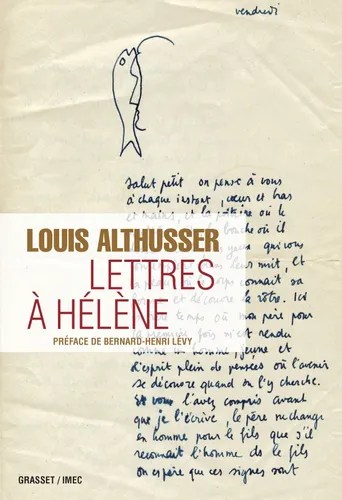
In the teaching this year I was also able to draw on two recent books about the case. One has been translated into English – Killer Althusser: The Banality of Man by Francis Dupuis-Déri. Dupuis-Déri reads the murder as a case of femicide, and claims that Althusser has murdered her in a second sense too, in terms of silencing her and letting his voice dominate. Dupuis-Déri rightly insists that we only have Althusser’s account of what happened. These texts were published posthumously, which is true of all the writings of the last ten years of his life, when he was institutionalised and publicly silent. His letters to her have been published as Lettres à Hélène, though not translated, but not her letters to him, which do still exist. Althusser’s letters to Franca Madonia have also been published. In contrast, Maria Antoinetta Macciocchi’s Lettres de l’intérieur du parti does not include Althusser’s letters on his request, but they are in the original Italian edition and the English translation Letters from Inside the Italian Communist Party to Louis Althusser. (I wrote about Macciocchi in an earlier piece in this series.)
I was more sympathetic to the idea of Dupuis-Déri’s book than I appreciated the book itself. The purpose of questioning the posthumous reception of Althusser’s work and the silencing of Hélène Legotien is important, and I wanted to find out more. But this slight book, based on an article and its postscript, does not do much more than to make that point, relying on existing accounts, particularly Althusser’s own, and trying to hold them to account.
The other recent book, which I think is much better, is Johanna Luyssen, Les Fragments d’Hélène. Luyssen makes the strong point that we need to try to retrieve her voice. It does so first by calling her Hélène, neither the name of her father or her husband. It’s less clear why Legotien, which she chose for herself, should not be preferred. it does more with archival material, as well as using the already-published accounts of her life and death.
Lucie Rondeau du Noyer has also done important work in trying to put the emphasis back on Hélène Legotien, rather than the act of her murder or the writings of her murderer. In English, Rondeau du Noyer’s writing includes a conference paper and a post on the Verso blog. The blog piece is also valuable in listing Legotien’s published works – compiling a bibliography is essential labour which makes possible other engagements. As far as I can tell, nothing of Legotien’s work is available in English translation. (Dupuis-Déri also provides a bibliography, using Rondeau du Noyer’s work.) As well as published work by Legotien, Rondeau du Noyer helped to establish the Hélène Legotien archives at IMEC in Normandy. These archives of French publishers and writers include some materials relating to Foucault, much of the Derrida archive (with copies of the material held at UC Irvine), and Althusser’s own papers. Legotien’s archives were only separately organised and inventoried in 2025. Before that, some of her papers were part of Althusser’s archive. Some documents relating to Legotien’s role in relation to the resistance and her expulsion from the French Communist Party have recently been edited in La Pensée No 424.
I don’t have any strong conclusions here. I’m certainly not trying to convince anyone. As this piece indicates, I struggle with whether I am doing the right thing. My approach is therefore to warn the students of what’s coming; teach with a clear indication of the stakes; try to say what I can about Legotien; and admit I might be wrong to discuss Althusser at all. The students who expressed a view to me seemed to think this approach was appropriate, with some noting that they had been taught Althusser before without this even being mentioned.
References
“Hélène Legotein Rytmann (1950-1952)”, La Pensée 424, 2025, 69-121.
Louis Althusser, L’Avenir dure longtemps suivi de Les Faits, eds. Olivier Corpet and Yann Moulier Boutang, Paris: Éditions Stock/IMEC, 1992, Le Livre du poche, 1994; The Future Lasts a Long Time, trans. Richard Veasey, London: Chatto & Windus, 1993.
Louis Althusser, Lettres à Hélène: 1947-1980, ed. Olivier Corpet, Paris: Grasset, 2011, Le Livre de Poche, 2013.
Louis Althusser, Lettres à Franca (1961-1973), eds. François Matheron and Yann Moulier Boutang, Paris: Stock/IMEC, 1998.
Francis Dupuis-Déri, Killer Althusser: The Banality of Man, trans. Mélissa Bull, Toronto: Between the Lines, 2025.
Asad Haider, “A New Practice of Politics: Althusser and Marxist Philosophy”, Verso blog, 28 March 2018, https://www.versobooks.com/blogs/news/3713-a-new-practice-of-politics-althusser-and-marxist-philosophy
William S. Lewis, “‘But didn’t he kill his wife?’” Verso blog, 29 May 2019, https://www.versobooks.com/blogs/news/4336-but-didn-t-he-kill-his-wife
Johanna Luyssen, Les Fragments d’Hélène, Paris: Juillard, 2025.
Yann Moulier Boutang, Louis Althusser, une biographie I: La Formation du mythe, Paris: Grasset, 1992.
Lucie Rondeau Du Noyer, “Not your average Marxist”, Historical Materialism – Twenty-First Annual Conference, Nov 2024, London, United Kingdom, https://hal.science/hal-05346707
Lucie Rondeau du Noyer, “The Courage of Hélène Legotien”, trans. David Fernbach, Verso Blog, 14 March 2025, https://www.versobooks.com/en-gb/blogs/news/the-courage-of-helene-legotien
Maria Antonietta Macciocchi, Lettere dall’interno del PCI a Louis Althusser, Milano: Feltrinelli, 1969; Lettres de l’intérieur du parti: le Parti communiste, les masses et les forces révolutionnaires pendant la campagne électorale à Naples en mai 1968, Paris: François Maspero, 1970; Letters from Inside the Italian Communist Party to Louis Althusser, trans. Stephen M. Hellman, London: NLB, 1973.
Elisabeth Roudinesco, Philosophy in Turbulent Times: Canguilhem, Sartre, Foucault, Althusser, Deleuze, Derrida, trans. William McCuaig, New York: Columbia University Press, 2019.
Richard Seymour, “The Murder of Hélène Rytman”, Verso blog, 24 July 2017, https://www.versobooks.com/blogs/news/3324-the-murder-of-helene-rytman
John Sturrock, “The Paris Strangler”, London Review of Books, 17 December 1992, https://www.lrb.co.uk/the-paper/v14/n24/john-sturrock/the-paris-strangler
This is the 96th post of a weekly series, posted every Sunday throughout 2025, and so far through 2026. The posts are short essays with indications of further reading and sources. They are not as formal and developed as something I’d try to publish more conventionally, but are hopefully worthwhile as short sketches of histories and ideas. They are usually tangential to my main writing focus, a home for spare parts, asides, dead-ends and possible futures. I hope there is some interest in them. They are provisional and suggestions are welcome. A few, usually shorter, pieces in a similar style have been posted mid-week.
I discuss what I am doing in this series in “Writing the ‘Sunday histories’ – an experiment in sharing short pieces on a blog”, my contribution to the Northern Ireland Legal Quarterly “Reflections on Writing” Series – all pieces are open access.
The full chronological list of ‘Sunday histories’ is here, with a thematic ordering here.
Discover more from Progressive Geographies
Subscribe to get the latest posts sent to your email.


Pingback: Should we teach Louis Althusser? Can we give a voice to Hélène Legotien? | Rashid's Blog: A Place for Inquisitive Souls