The untold story of the academics who became OSS spies, invented modern spycraft, and helped turn the tide of the war
At the start of WWII, the U.S. found itself in desperate need of an intelligence agency. The Office of Strategic Services (OSS), a precursor to today’s CIA, was quickly formed—and, in an effort to fill its ranks with experts, the OSS turned to academia for recruits. Suddenly, literature professors, librarians, and historians were training to perform undercover operations and investigative work—and these surprising spies would go on to profoundly shape both the course of the war and our cultural institutions with their efforts.
In Book and Dagger, Elyse Graham draws on personal histories, letters, and declassified OSS files to tell the story of a small but connected group of humanities scholars turned spies. Among them are Joseph Curtiss, a literature professor who hunted down German spies and turned them into double agents; Sherman Kent, a smart-mouthed history professor who rose to become the head of analysis for all of Europe and Africa; and Adele Kibre, an archivist who was sent to Stockholm to secretly acquire documents for the OSS. These unforgettable characters would ultimately help lay the foundations of modern intelligence and transform American higher education when they returned after the war.
Thrillingly paced and rigorously researched, Book and Dagger is an inspiring and gripping true story about a group of academics who helped beat the Nazis—a tale that reveals the indelible power of the humanities to change the world.
In April 1956, at Gif-sur-Yvette just outside of Paris, the first meeting of the International Colloquium on Mycenaean texts took place. The proceedings of the conference, edited by Michel Lejeune, were published later that year as Études mycéniennes: Actes du Colloque international sur les textes mycéniens (Gif-sur-Yvette, 3-7 avril 1956). Just a few years before, in 1952, Michael Ventris and John Chadwick had deciphered Linear B, a early script which precedes the Greek alphabet, and the texts in Linear B give a first sense of the Greek language, a few hundred years before Homer. Alice Kober did earlier foundational studies of this script, which Ventris and Chadwick used in their work (see for example here, here and here). But Kober died in 1950, at the age of just 43, and did not live to see the publications of Ventris and Chadwick.
In one of his two 1953-54 courses at the Collège de France, Georges Dumézil discussed the work of Ventris and Chadwick, a couple of years before the publication of their Documents in Mycenaean Greek, which was completed in 1955. Given the date, I think Dumézil must have been using“Evidence for Greek Dialect in the Mycenaean Archives”, published in the Journal of Hellenic Studies in 1953. Some slides of the alphabet, possibly used by him in this course, are in his archives in Paris. The importance of this work was acknowledged by Emile Benveniste too, who recognised in a 1968 interview that the Mycenaean texts “draw back the prehistory of Greek by some five hundred years”. He discusses the script in, for example, his 1968-69 Collège de France course published in Last Lectures.
Benveniste and Dumézil both attended the Gif-sur-Yvette conference, along with Ventris and Chadwick, and a range of other French and European academics. The history of the conferences (at the Wayback Machine) says that Pierre Chantraine organised the event with Lejeune. Chantraine had been a student of Antoine Meillet, alongside Benveniste, in the 1920s. There is a photo of them all at the start of the volume. Benveniste takes part in the discussions, but neither he nor Dumézil gave a formal paper.
The participants in the 1956 Gif-sur-Yvette conference, taken from Études mycéniennesKey to the photograph of the participants in the 1956 Gif-sur-Yvette conference, taken from Études mycéniennes (name of the dog not provided)
It was the first of a series of such conferences but the only one attended by Ventris. Five months later he died in a car crash, aged just 34. Documents in Mycenaean Greek was published a few weeks after his death, and Chadwick produced an expanded second edition in 1973. As well as several papers on Mycenaean texts, the conference also set up a working group and passed a series of resolutions outlining plans for collaborative work and setting out an agenda for future study. All these texts are included in the volume Lejeune edited, which is dedicated to Ventris. How much more Ventris would have done had he lived is unclear. Reports suggest that once he had cracked the code, further work on the language did not interest him nearly as much. A technical account of the work of Ventris and Chadwick is found in the opening chapters of Documents in Mycenaean Greek, but a more readable account is Chadwick’s 1958 book The Decipherment of Linear B, which tells the story for a wider audience. There, Chadwick provides an account of Ventris’s work before they started to work together, in which he regularly acknowledges the work of Kober. The Ventris-Chadwick correspondence is in Cambridge, and parts are online, including their initial letters to each other; the Ventris papers are at the Institute of Classical Studies in London and the University of Texas at Austin. Austin also has Kober’s archives.
Ventris’s story has been told, not just by Chadwick, but notably by Andrew Robinson in The Man who Deciphered Linear B, and Kober’s work has been explored by Margalit Fox in The Riddle of the Labyrinth, but I think there is less about the French connection to this story. Although both Benveniste and Dumézil acknowledge the importance of this work, neither seems to have been much involved after this 1956 event. Lejeune, however, was part of the International Committee on the language. Lejeune was also a student of Meillet, and from 1954 had been teaching on Mycenaean. He would publish extensively on the language. Lejeune connects to Benveniste’s story in several ways. He was the nominal second-rank candidate when Benveniste was elected to the Collège de France in 1937, succeeding Meillet; Benveniste and Lejeune were colleagues at the École Pratique des Hautes Études in comparative grammar; and Lejeune worked with Mohammad Djafar Moïnfar in compiling the second volume of Benveniste’s Problèmes de linguistique générale in 1974. In The Decipherment of Linear B Chadwick says that Dumézil’s tribute to Ventris was the most “simple and touching”: “Devant les siècles son œuvre est faite” (p. 139). It suggests that his work is complete for centuries to come, a reputation that would endure well beyond him. But his contribution also points backwards, as Benveniste indicated, opening a view of centuries before.
John Chadwick, The Decipherment of Linear B: The Key to the Ancient Language and Culture of Crete and Mycenae, New York: Vintage, 1958.
Margalit Fox, The Riddle of the Labyrinth: The Quest to Crack an Ancient Code and the Uncovering of a Lost Civilisation, New York: Ecco, 2014.
Alice Kober, “Evidence of Inflection in the “Chariot” Tablets from Knossos”, American Journal of Archaeology 49 (2), 1945, 143-51.
Alice Kober, “Inflection in Linear Class B: I – Declension”, American Journal of Archaeology 50 (2), 1946, 268-76.
Alice Kober, “The Minoan Scripts: Fact and Theory”, American Journal of Archaeology 52 (1), 1948, 82–103.
Michel Lejeune (ed.), Études mycéniennes: Actes du Colloque international sur les textes mycéniens (Gif-sur-Yvette, 3-7 avril 1956), Paris: Centre national de la recherche scientifique, 1956.
Andrew Robinson, The Man who Deciphered Linear B: The Story of Michael Ventris, London: Thames & Hudson, 2002.
Michael Ventris and John Chadwick, “Evidence for Greek Dialect in the Mycenaean Archives”, Journal of Hellenic Studies 73, 1953, 84-103.
Michael Ventris and John Chadwick, Documents in Mycenaen Greek, Cambridge: Cambridge University Press, 1956.
This is the first post of an occasional series, where I try to post short essays with some indications of further reading and sources, but which are not as formal as something I’d try to publish more conventionally. They are usually tangential to my main writing focus, a home for spare ideas, asides, dead-ends and possible futures. I hope there is some interest in them. They are provisional and suggestions are welcome. The other posts so far are:
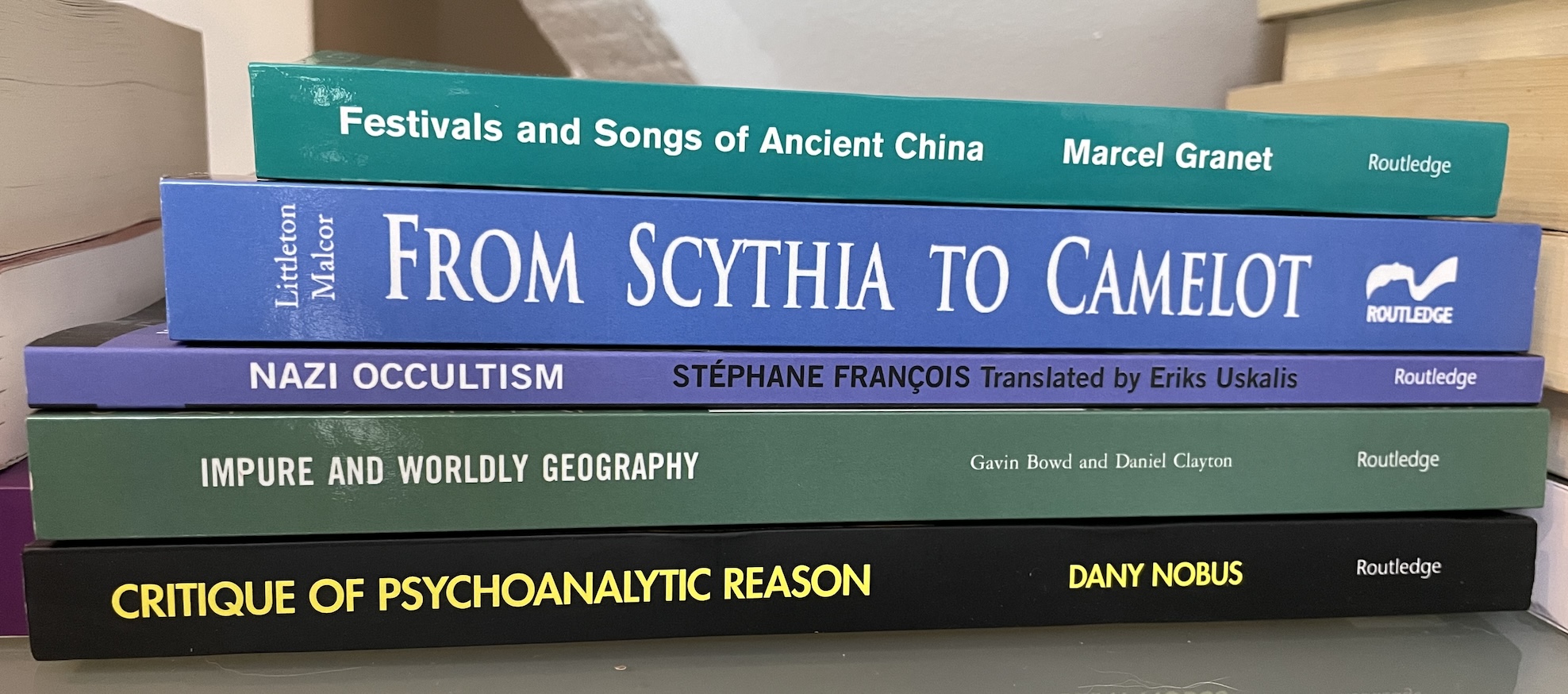
Some books received in recompense for review work…
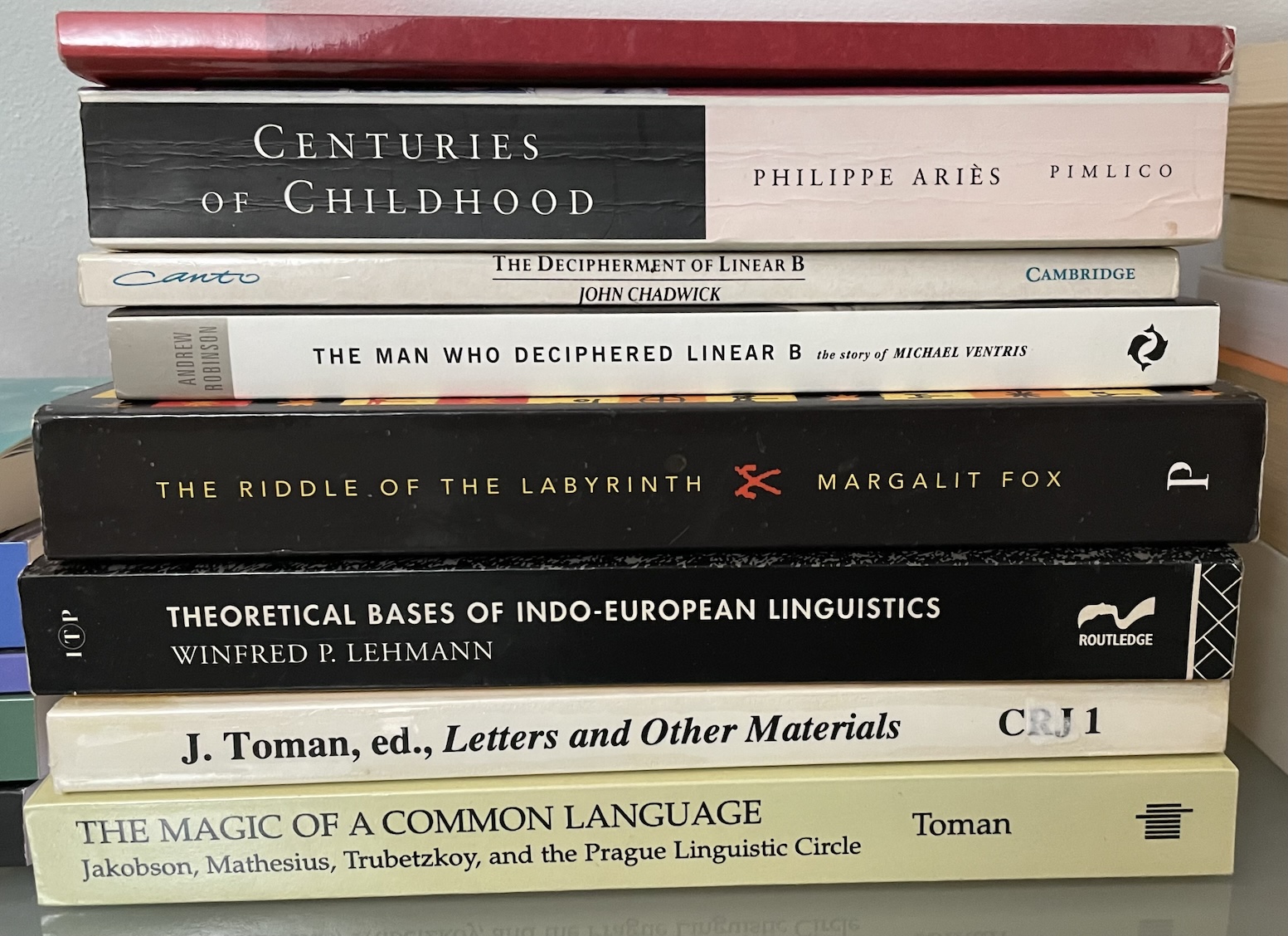
… and some second-hand ones – a couple by Philippe Ariès, some about the decipherment of Linear B, and about the Prague Linguistic Circle. Most of these relate in some way to the Mapping Indo-European thought in twentieth-century France project.
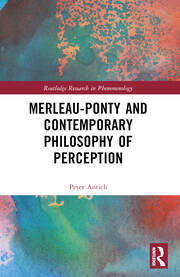
This book draws on Merleau-Ponty’s phenomenology to develop new and promising solutions to contemporary debates about perception. In providing an extension and defense of Merleau-Ponty’s account of perceptual content and of the relation between perception and the world, it demonstrates the value of Merleau-Ponty’s insights for philosophy of perception today.
The author focuses on two main topics: the contents and the nature of perception. In the first half of this book, the author tackles debates about the content of perception, namely, what sorts of properties or features of the world reveal themselves to us in perception and in what modes. Drawing on Merleau-Ponty’s description of perceptual “sense,” the author argues that perception has a unique kind of content, which cannot be adequately described in terms of sensations or concepts. He then shows how this account of perceptual sense can clarify debates about the richness of perceptual content, including whether we can perceive moral properties. In the second half, he turns to the nature of perception. Here he argues that Merleau-Ponty’s account of perceptual intentionality makes available a powerful combination of the core insights of two main contemporary approaches to this question: realism and intentionalism. The author shows how this combination can be developed, defends it from objections, and explains how it is equipped to deal with problems posed by the existence of illusions and hallucinations.
Merleau-Ponty and Contemporary Philosophy of Perception will appeal to scholars and advanced students working on phenomenology and the philosophy of perception.
This bookfocuses on the wars that are normally relegated to the periphery of geo-politics at the heart of Europe’s ‘new’ military history. The military history of the past two centuries of European history has tended to be viewed in the shadow of total war. The impact and aftermath of the French upheaval of 1792-1815, the mid-century struggles for national unification, the World Wars of 1914-18 and 1939-45, and the prospect of mutually assured destruction in the Cold War, were all framed as a totalization of warfare and as a tragic pretext for projects of human rights, collective security, and political integration. But this emphasis on large wars overlooks the impact of the wars waged by minor powers as well as the small wars and counterinsurgencies waged by great powers overseas. The suppression of southern European revolutions in the 1820s, Belgian independence, Cuban struggles against Spanish rule, and the wars of new imperialism ranging from Aceh to Annual, all shaped the strategic and domestic environment in which the Great War happened, and they reverberated on the post-1918 growth of totalitarianism. Equally the post-1945 wars of decolonization militarized the culture and politics in the democratic and authoritarian states of the old continent, in ways which belied the macro-political identities of the Cold War.
A wide-ranging examination of the roots—and possible future—of violence in human societies
Is aggression inevitable among humans? In Regimes of Violence, John Protevi explores how human violence originates and exists in our societies. Taking humans as biocultural (that is, our social practices shape our bodies and minds), he shows how aggression does not arrive from any purely biological predisposition but rather occurs only in social regimes of violence that, by manipulating the ways in which culture can shape our biological inheritance of rage and aggression, condition the forms of violence able to be expressed at any one time.
Offering detailed insights into human aggression throughout history, Protevi’s analysis ranges from evolutionary psychology to affective ideology and finally to an alternate politics of joy. He examines a wide range of seemingly disparate topics, such as cooperation between early nomadic foragers, organized sports, berserkers and blackout rages, the experiences of maroons escaping slavery, the January 6 invasion of the United States Capitol building, and responses to the Covid-19 pandemic. As he entwines the philosophical with the anthropological, he asks readers to consider why humans’ capacity for cooperation and sharing is so persistently overlooked by stories that focus on aggression and warfare.
Regimes of Violence is an important contribution to studies of Deleuze and Guattari, uniquely combining cutting-edge investigations in psychology, history, evolutionary theory, cultural anthropology, and philosophy to examine the “political philosophy of the mind.” Presenting to readers a refreshingly optimistic perspective, Protevi demonstrates that we are not doomed to war and argues that humans can build a world based on antifascism, joy, and mutual empowerment.
An urgent reckoning with digital technology’s fundamentally right-wing legal and economic underpinnings
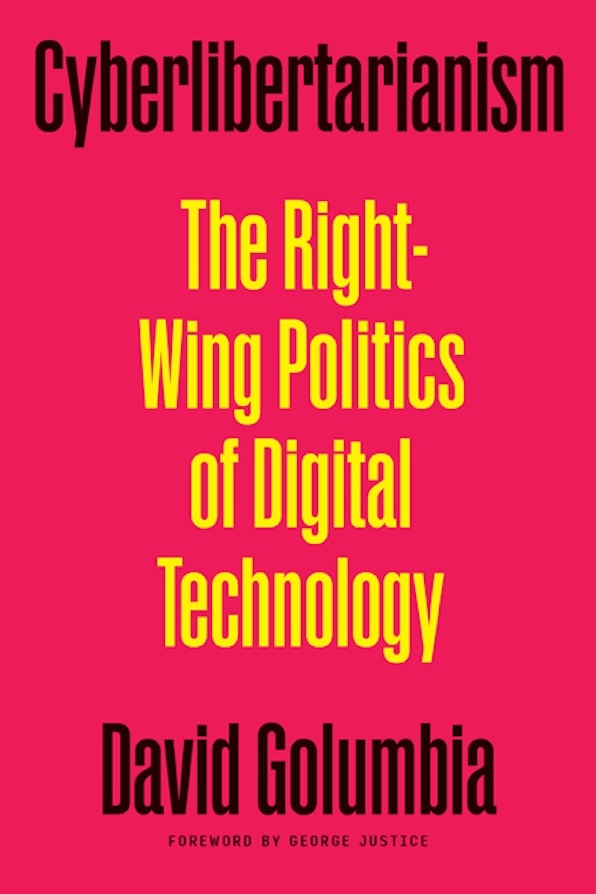
In a timely challenge to the potent political role of digital technology, Cyberlibertarianism argues that right-wing ideology was built into both the technical and social construction of the digital world from the start. Leveraging more than a decade of research, David Golumbia traces how digital evangelism has driven the worldwide shift toward the political right, concealing inequality, xenophobia, dishonesty, and massive corporate concentrations of wealth and power beneath the utopian presumption of digital technology as an inherent social good.
Providing an incisive critique of the push for open access and open-source software and the legal battles over online censorship and net neutrality, Cyberlibertarianism details how the purportedly democratic internet has been employed as an organizing tool for terror and hate groups and political disinformation campaigns. As he unpacks our naively utopian conception of the digital world, Golumbia highlights technology’s role in the advancement of hyperindividualist and antigovernment agendas, demonstrating how Silicon Valley corporations and right-wing economists; antiestablishment figures such as Julian Assange, Elon Musk, Peter Thiel, Edward Snowden, and Mark Zuckerberg; and seemingly positive voices such as John Perry Barlow, Cory Doctorow, the Electronic Freedom Foundation, and Wikipedia all have worked to hamper regulation and weaken legal safeguards against exploitation.
Drawing from a wide range of thought in digital theory, economics, law, and political philosophy as well as detailed research and Golumbia’s own experience as a software developer, Cyberlibertarianism serves as a clarion call to reevaluate the fraught politics of the internet. In the hope of providing a way of working toward a more genuinely democratic and egalitarian future for digital technology, this magisterial work insists that we must first understand the veiled dogmas from which it has been constructed.
Some of these were published in late 2024 but I haven’t seen them yet, or come out in paperback in 2025. Here are the lists of books I liked from previous years – 2013, 2014, 2015, 2016, 2017, 2018, 2019, 2020, 2021, 2022, 2023 and 2024.
At the end of each year I’ve posted a list of academic books I liked. The criteria was that they were published in that year (or late the previous one), and that I read and liked them. Many of the most interesting books I read this year were published years ago; some of the 2024 ones I’ve bought or have been sent remain unread.
Some of those featured are books I reviewed or endorsed, and others are by friends and colleagues. Certain publishers, especially those I review for, feature disproportionately. It’s of course biased by my interests and prejudices. So while there are doubtless many other good books from each of these years, I can at least say I think these ones are worth reading.
Most of these bought on a recent Paris trip, and a couple from online second-hand stores. Spectres of Marx is a new edition, including a debate with Étienne Balibar; Du même à l’autre is the most recent seminar volume, including two 1963 courses on Husserl. The two Foucault books are part of the re-edition of the lecture courses, this time being done in chronological order. Claude Lévi-Strauss, Les plus vastes horizons du monde: Textes et images brésiliens (1935-1942) suivis de cinq films coréalisés avec Dina Dreyfus was edited by Samuel Titan and Carlos Augusto Calil and includes photographs, early texts and film transcripts. The book gives you access to the films themselves too.
Études mycéniennes is the proceedings of an April 1956 conference edited by Michel Lejeune, which both Benveniste and Dumézil attended. Linear B was only deciphered a couple of years before this event. Benveniste takes part in the discussions, but neither he nor Dumézil seems to have given a formal paper, even though both used the language as an example in their teaching. I will say more about this event in a future post since it’s an interesting story. (Update the discussion of the 1956 conference is now here.)