C.L.R. James, interviewed by Stuart Hall, introduction by Phoebe Braithwaite – complete unaired BBC interview from 1976, in The New York Review – requires subscription or free registration to read just this piece
In May 1976, the Jamaican-born cultural theorist Stuart Hall sat down in the BBC’s studios in West London to interview the Trinidadian-born intellectual C.L.R. James. They were being filmed by Mike Dibb, who had produced John Berger’s Ways of Seeing four years earlier, for a planned BBC Two broadcast commemorating James’s seventy-fifth birthday. Hall was forty-four. The conversation was a torch-passing of sorts, from one West Indian intellectual who made his name in Britain to another.
The tape of that interview was lost before it was ever aired. More accurately, it was destroyed—wiped before transmission… A transcript, however, survives in several copies scattered across archives, including James’s papers at Columbia and the C.L.R. James Library in East London… What follows is, to my knowledge, the transcript’s first unabridged publication, drawn from the Columbia copy, lightly edited for clarity and to minimize repetitions.
Stuart Hall and C.L.R. James; illustration by Molly Crabapple
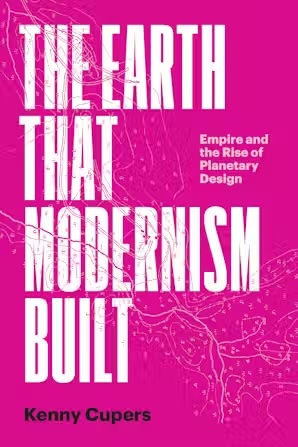
An intellectual history of architectural modernism for an age of rising global inequality and environmental crisis.
The Earth That Modernism Built traces the rise of planetary design to an imperialist discourse about the influence of the earthly environment on humanity. Kenny Cupers argues that to understand how the earth became an object of design, we need to radically shift the terms of analysis. Rather than describing how new design ideas and practices traveled and transformed people and places across the globe, this book interrogates the politics of life and earth underpinning this process. It demonstrates how approaches to modern housing, landscape design, and infrastructure planning are indebted to an understanding of planetary and human ecology fueled by settler colonialism and imperial ambition.
Cupers draws from both canonical and unknown sources and archives in Germany, Namibia, and Poland to situate Wilhelmine and Weimar design projects in an expansive discourse about the relationship between soil, settlement, and race. This reframing reveals connections between colonial officials planning agricultural hinterlands, garden designers proselytizing geopolitical theory, soil researchers turning to folklore, and Bauhaus architects designing modern communities according to functionalist principles. Ultimately, The Earth That Modernism Built shows how the conviction that we can design our way out of environmental crisis is bound to exploitative and divisive ways of inhabiting the earth.
Three of these four publications were completed before last year’s health problems and revisiting them for copy-editing and proofs was a bit strange. The fourth was conceived, written, reviewed and published in a much shorter period of just a few months this year.
The vast majority of what I’ve written in 2024 – and really since mid-2022 – is for the book manuscript under the working title Mapping Indo-European Thought in Twentieth-Century France, on which I’ve been sharing research updates through the year. The articles above all connect to this project, even though none of them use parts of the text. So far, I’ve not excerpted material for separate publication.
A couple of other things are forthcoming, again both completed some time ago, along with a couple of more recent book reviews and a chapter on “Foucault and Structuralism”. I’m hoping that I will complete a first draft of Mapping Indo-European Thought by the end of 2025 – that’s the entire focus again, and talks next year will all present parts of that work.
Longlisted for the 2024 Financial Times Book of the Year. How life and the economy became a black box—a collection of systems no one understands, producing outcomes no one likes.
Passengers get bumped from flights. Phone menus disconnect. Automated financial trades produce market collapse. Of all the challenges in modern life, some of the most vexing come from our relationships with automation: a large system does us wrong, and there’s nothing we can do about it.
The problem, economist Dan Davies shows, is accountability sinks: systems in which decisions are delegated to a complex rule book or set of standard procedures, making it impossible to identify the source of mistakes when they happen. In our increasingly unhuman world—lives dominated by algorithms, artificial intelligence, and large organizations—these accountability sinks produce more than just aggravation. They make life and economy unknowable—a black box for no reason.
In The Unaccountability Machine, Davies lays bare how markets, institutions, and even governments systematically generate outcomes that no one—not even those involved in making them—seems to want. Since the earliest days of the computer age, theorists have foreseen the dangers of complex systems without personal accountability. In response, British business scholar Stafford Beer developed an accountability-first approach to management called “cybernetics,” which might have taken off had his biggest client (the Chilean government) not fallen to a bloody coup in 1973.
With his signature blend of economic and journalistic rigor, Davies examines what’s gone wrong since Beer, including what might have been had the world embraced cybernetics when it had the chance. The Unaccountability Machine is a revelatory and resonant account of how modern life became predisposed to dysfunction.
I’ve shared this before, but was thinking again about Daniel Defert’s memories of Foucault’s working routines in this interview – ‘The Materiality of a Working Life‘ (open access; original French).
No no, weekends didn’t exist! We would go to see art exhibitions on the Saturday afternoon, certainly, but the very notion of the weekend didn’t exist… Especially a public holiday, a Christmas day without writing, that was impossible! Foucault rarely put dates on his writings, but he would have been quite capable of putting “December 25th” on something, that being a day when, as he said, “nothing has happened for several thousand years.”
Interviewed by Alain Brosset and Philippe Chevalier; translated by Colin Gordon.
I’ve shared news of the book before. There is a New Books discussion with Jana Byers now available.
A major study of marine serpent deities, which embodied ancient people’s reverence of water.
Early human relationships with water were expressed through beliefs in serpentine aquatic deities: rainbow-coloured, feathered or horned serpents, giant anacondas and dragons. Representing the powers of water, these beings were bringers of life and sustenance, world creators, ancestors, guardian spirits and law makers. Worshipped and appeased, they embodied people’s respect for water and its vital role in sustaining all living things. Yet today, though we still recognize that ‘water is life’, fresh- and saltwater ecosystems have been critically compromised by human activities. This major study of water beings, and what has happened to them in different cultural and historical contexts, demonstrates how and why some – but not all – societies have moved from worshipping water to wreaking havoc upon it, and asks what we can do to turn the tide.
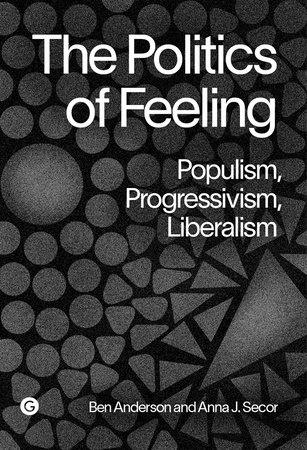
How today’s dominant political forms—right-wing populism, progressivism, and liberalism—offer differentiated responses to shared conditions of uncertainty.
The Politics of Feeling argues that politics has become a matter of political feelings in an age of uncertainty. If the second half of the 20th century saw the defeat and exhaustion of fascism and socialism, what remained of ideological certainty in neoliberal democracies such as the UK and the US ran aground in the wake of the 2008 financial crisis. The Politics of Feeling is diagnostic of how the uncertainties of the post-2008 period have transformed the political arena and made the question of how people feel central to the formation of political affiliations and divisions. We identify three competing political forms in the US and the UK today: right-wing populism, progressivism, and contemporary liberalism. We argue that rather than naming coherent programs of political thought, these popular political forms are operating as arrangements or modes of attachment and political intensity. Each one suggests a different way of remembering the past, imagining the future, and making the present politically meaningful. Each one elevates some affective orientations over others and thereby etches differences of race, class, and gender within its structure. Tracing contemporary articulations of populism, progressivism and liberalism across US and UK contexts, we at once draw out commonalities and underline the way these forms diverge both between and within these societies. The Politics of Feeling is a critique of the living edge of politics: the emergent and shifting clusters of orientations and affects that continually work to differentiate political subjects, to intensify or alienate attachments and allegiances.
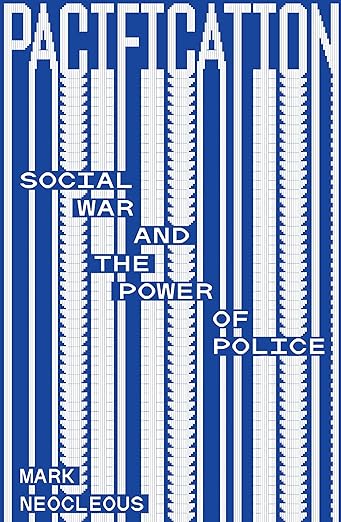
In his new book, critical theorist Mark Neocleous engages in a sustained critique of the theory and practice of pacification. Combining philosophical analysis with historical detail, Neocleous analyses the development of pacification as a key concept through which capitalist modernity has been organised, offering readers the first book that treats pacification as an important concept in the history of state power and capitalism. Neocleous’s approach is fourfold, examining pacification as social warfare carried out through the ideology of peace; as a form of social police carried out through mechanisms of security; as law and order exercised through the permanent wars of class society; and as the myriad practices of power designed to counter insurgency.
Making use of official documents of state, the writings of counterinsurgency thinkers and the ideas perpetuated by practitioners of counterrevolution, the book unravels the complex ways through which pacification generates new forms of social war and new modes of policing that reproduce capitalist order and fabricate obedient subjects.
Through expansive accounts of war and police, and engaging with a range of topics from debt to death, from stasis to civil war, and from the police kettle to the politics of fear, the book offers a provocative analysis of the ways in which state and capital combine to build a pacified social order.