Taking time to dwell with Iain Sinclair

Iain Sinclair lecture – his new book Ghost Milk was published recently.

dmf's avatarANTHEM

Iain Sinclair is a leading writer, filmmaker, poet and psychogeographer, renowned for his walks in the borderlands of cities, derelict sites and urban redevelopments. His solitary walks in Middlesbrough and Hartlepool were the focus of a public talk at mima. Sinclair previously walked the M25 to write London Orbital, and his new book, Ghost Milk, is a road map of post-Olympics landscapes.

View original post

Posted in Uncategorized | 1 Comment

Intervention symposium – ‘Explosive geographies’

An Antipode intervention symposium on the Boston Marathon bombs and the fertilizer factory explosion in Texas.

Antipode Editorial Office's avatarAntipodeFoundation.org

On April 15, 2013, two bombs targeting the Boston Marathon exploded on Boylston St, killing three and initiating the United State’s most visible domestic security operation of the decade. Two days later, a fertilizer plant located in the town of West, Texas exploded spectacularly, killing 14 and levelling a significant part of the town. The Boston bombings and the subsequent manhunt were covered non-stop for weeks, while coverage of the West explosion was comparatively sparse. In a posting to the leftgeog listserv, Raju Das asked geographers what connected the two events and how we might explain the discrepancies in media attention. That initial provocation eventually led to this intervention forum which includes all of the participants who responded to the initial questions and others with unique perspectives on how we can better understand crises, violence, and the representational privileging of some deaths over others.

All of the essays in…

View original post 473 more words

Posted in Uncategorized | Leave a comment

Foucault for Architects

9780415693318Gordana Fontana-Giusti’s Foucault for Architects is now out (via Heterotopian Studies).

From the mid-1960s onwards Michel Foucault has had a significant impact on diverse aspects of culture, knowledge and arts including architecture and its critical discourse. The implications for architecture have been wide-ranging. His archaeological and genealogical approaches to knowledge have transformed architectural history and theory, while his attitude to arts and aesthetics led to a renewed focus on the avant-garde.

Prepared by an architect, this book offers an excellent entry point into the remarkable work of Michel Foucault, and provides a focused introduction suitable for architects, urban designers, and students of architecture.

Foucault’s crucial juxtaposition of space, knowledge and power has unlocked novel spatial possibilities for thinking about design in architecture and urbanism. While the philosopher’s ultimate attention on the issues of body and sexuality has defined our understanding of the possibilities and limits of human condition and its relation to architecture.

The book concentrates on a number of historical and theoretical issues often addressed by Foucault that have been grouped under the themes of archaeology, enclosure, bodies, spatiality and aesthetics in order to examine and demonstrate their relevancy for architectural knowledge, its history and its practice.

Posted in Michel Foucault | 2 Comments

Podcast: Ian Hacking ‘Making up Autism’

Audio recording of Ian Hacking lecture in Leeds from 13 May 2013

Centre for Medical Humanities's avatarCentre for Medical Humanities Blog


A podcast of Professor Ian Hacking’s ‘Making Up Autism’ – Inaugural C. L. Oakley Lecture in Medicine and the Arts, University of Leeds, 13 May 2013 – is now available here.

View original post

Posted in Uncategorized | Leave a comment

Landscape’s Geopolitics reviewed by John Agnew

Agnew on Mangani at the Society and Space open site.

Posted in Uncategorized | Leave a comment

Postdoctoral fellowships at the University of Copenhagen

Posted on behalf of Ben Rosamond – br@ifs.ku.dk:

Three postdoctoral fellowships at the University of Copenhagen ‘EuroChallenge’ Interdisciplinary Research Programme Department of Political Science, Facuty of Law, Faculty of Humanities ‘EuroChallenge’ is a major new interdisciplinary project, financed by the University’s 2016 strategic funding initiative. It addresses key questions about the place of Europe in the context of a rapidly and radically changing global order. The project is a collaborative venture, involving three faculties (Social Science, Law and Humanities), under the directorship of Professor Ben Rosamond of the Department of Political Science and three co-PIs: Professors Mikael Rask Madsen (Law) Hans-Jörg Trenz (Humanities), and Marlene Wind (Political Science). It is organized into three work packages. In this first round of appointments one postdoctoral fellow will be recruited to each work package as follows:

Position 1

3-year Assistant Professorship, Department of Political Science, affiliated to work package 1: ‘The European market space and the new global economy: constructions, paradigms and policies.’

http://www.jobs.ac.uk/job/AGN743/assistant-professorship/

Position 2

3-year postdoctoral fellowship hosted by the iCourts Centre of Excellence in the Faculty of Law, affiliated to work package 2: ‘The European legal-political space in a new global order? The global challenge to European markets, human rights and constitutionalized democracy’

http://www.jobs.ac.uk/job/AGN747/postdoctoral-fellowship/

Position 3

2-year postdoctoral fellowship (with the possibility of up to one year’s extension), hosted by Centre for Modern European Studies in the Faculty of Humanities, affiliated to work package 3: ‘Complex diversity: the social and cultural interpretations of changing European and global order’

http://www.jobs.ac.uk/job/AGN751/postdoctoral-fellowship/

The application deadline for all positions is 24 June 2013.

Posted in Universities | Leave a comment

Spheres Of Action – edited by Alliez and Osborne

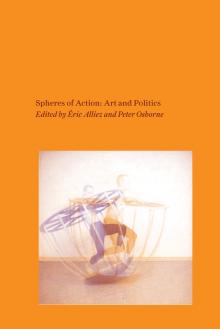
9780262518437Spheres Of Action: Art and Politics, edited by Éric Alliez and Peter Osborne, recently out with MIT Press.

Contemporary art is increasingly part of a wider network of cultural practices, related through a common set of references in cultural theory. Within Europe, relations between national theoretical traditions have become more fluid and dynamic, creating an increasingly transnational—or postnational—space for European cultural and art theory. This book offers a snapshot of recent influential work in contemporary art and political theory in France, Italy, and Germany, in the form of original writings by major representatives of each of the three overlapping national traditions.

In France, debates center on the status and possibilities of the image. Éric Alliez, Georges Didi-Huberman, Elisabeth Lebovici, and Jacques Rancière each adopt a distinctive approach to the making, undoing, and remaking of aesthetic images in contemporary art and their political significance. From Italy, Antonio Negri, Maurizio Lazzarato, Judith Revel, and Franco Berardi each address the “immaterial” situation of contemporary art. From Germany, Peter Sloterdijk, Peter Weibel, and Boris Groys reassess the contemporary legacy of postwar art, demonstrating appropriations of vitalism, structuralism, and deconstruction, respectively.

Posted in Antonio Negri, Peter Sloterdijk | 1 Comment

The Dimensions of Territory – audio of talk at Al Quds Bard Honors College

The audio recording of my talk earlier this month at Al Quds Bard Honors College, “The Dimensions of Territory”, is available here. For people who know my work on territory it doesn’t have much new, but it tries to give an overview of the work I’ve done from Terror and Territory to The Birth of Territory, and to link it briefly to my current work on volume and geopolitics. The introduction is by Nadim Khoury.

Posted in Boundaries, Eyal Weizman, Michel Foucault, Paul Virilio, Peter Sloterdijk, Politics, Stephen Graham, Territory, Terror and Territory, The Birth of Territory, urban/urbanisation | 1 Comment

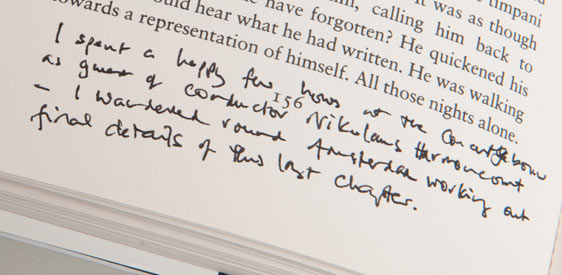
Authors’ annotations to their novels

McEwan

The Guardian has some interesting annotations from authors to their own books.

Posted in Books | Leave a comment

Cara Nine, Global Justice and Territory reviewed

Cara Nine’s Global Justice and Territory is reviewed at NDPR. This book is one of a few recent books by political philosophers looking at questions around territory. After neglect, this is certainly a good thing. However, as I’ve noted before, these debates often proceed without much reference to what political geographers have written about the subject – they take territory itself to be relatively unproblematic, and work through the complexities of particular instances in detail. In other words there are a series of complicated debates about justice, rights, etc. as they pertain to territory – territory becomes something like another object over which there are questions of ownership, use, resources, distribution etc. As I said in the review of earlier books on this topic, the response should not be that political geographers ignore this work, but rather to engage with it, and perhaps in so doing show how their work contributes to these debates.

Posted in My Publications, Politics, Territory | Leave a comment