A very interesting post by Stephen Wolfram about working in the Leibniz archive, with plenty of photographs of his manuscripts (via Leiter Reports).
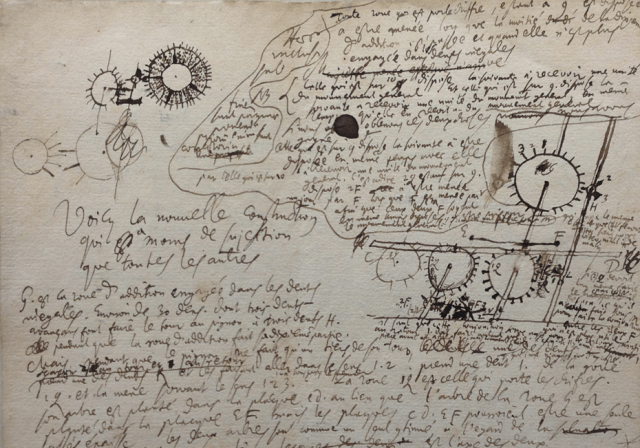
A very interesting post by Stephen Wolfram about working in the Leibniz archive, with plenty of photographs of his manuscripts (via Leiter Reports).
 Alain Badiou’s book On Beckett, translated by Nina Power and Alberto Toscano, available as a free pdf download here.
Thanks to Elliot Jarbe for the link – Ian Hacking recently gave a lecture in Berlin which elaborated on the Pluto theme. Details here. Elliot asks if anyone knows the link to the audio recording – please add as a comment.
 As a break from marking and catching up on journal work and email, I headed up the A1 to Newcastle to hear Ian Hacking speak at the University of Northumbria. I really like his early books The Emergence of Probability and The Taming of Chance, and I’d never seen him speak before. He was speaking about his more recent work, which I know much less well, and was outlining his current project of bringing together a number of papers into a book that seems to be entitled ‘Making Up People’. (He also mentioned another forthcoming book on the philosophy of mathematics).
He gave two examples of the politics of naming in the natural and human sciences – the decision to change the designation of Pluto from planet to dwarf planet; and the decision to remove Asperger’s Syndrome from the Diagnostic and Statistical Manual and instead to classify these symptoms as part of the autism spectrum. While the first simply changes a scientific designation, but not the object so described, the second also changes how people perceive themselves, how they may act and react, and there is a resistance to this from within the community. The talk was somewhat loose, with lots of examples from the BMI to a Foucault anecdote to the history of ideas. I came away thinking that I should read more of Hacking’s recent work, but also interested in the autism material. While I’ve never read the academic literature on this, when I was an undergraduate I spent some time working with special needs children in London, some of whom were labelled as autistic. For people interested in his work, the preparatory reading for the seminar, “Kinds of People: Moving Targets”, Proceedings of the British Academy 151 (2007): 285-318, is available free online here.
Hacking has a really useful website that organises and makes sense of his diverse interests. Like Quentin Skinner, it was inspirational – a clear sense that what I really do, or at least aspire to do, in different projects and with different purposes, is the history of ideas.
A good discussion beginning at Jeremy Crampton’s Open Geography blog on resilience – sparked by papers in Radical Philosophy.
Radical Philosophy has recently been the venue for a short exchange of views on the topic of resilience. Let’s see what was said.
Mark Neocleous led off with a piece on “resisting resilience.” In his view, “resilience is by definition against resistance. Resilience wants acquiescence.” He is, therefore, against resilience. In response, David Chandler, who is editor of a new journal called Resilienceargues that critique is not best served by equating resilience to neoliberalism. And in response to that, Neocleous says that Chandler didn’t engage with his critique and only wants to defend his new journal and that resilience blunts socialist and feminist thought (p. 59).
Not much of this helps us get anywhere. If the agenda is to make something useful from resilience (eg., by critiquing its support for the production of neoliberalism) then we need to use the concept to get at the primary question of ensuring…
View original post 85 more words
Marijn Nieuwenhuis on East Asian territorial and cartographic disputes, at the Antipode site.
 by Marijn Nieuwenhuis, University of Warwick
Introduction
The idea of nationhood rests on the claim of a specific territorial area. The cartographic demarcating of territory automatically exposes, however, the contingent nature of borders. Modern borders are the product of a world system composed of nation states which are not organic unities but socially constructed entities in need of constant affirmation. Nationalism, the modus operandi for that affirmation, often takes a cartographic form. Cartographic nationalism is of all ages but seems in East Asia to have become especially important in post-Mao China.
This short article wishes to offer some insight into the ways in which maps are increasingly being used to arouse nationalist sentiments in East Asia. I do not aspire to explain the reasons for the trend of a rise in nationalism, but instead wish to engage with the manner in which this has become apparent by looking at…
View original post 1,812 more words
Graham Harman has been providing links to some of his papers
“On Interface: Nancy’s Weights and Masses”
“Bruno Latour and the Politics of Nature”
“Badiou’s Relation to Heidegger in Theory of the Subject”
All links via his Object-Orientated Philosophy blog.
65 years since the Nakba, another powerful infographic from Visualizing Palestine.

Craig Jones on Israel’s use of drones.
On the heels of my last post, I now turn to a second geography of drones: how much do drones matter in Israel?
Last Tuesday (April 30) the Israeli Defense Force targeted and killed Hitham Masshal, a twenty-four year old described by the IDF Spokesperson as a “global jihad-affiliated terrorist”. It was the first targeted killing of a Palestinian in 2013. As many Israeli friends have been quick to point out to me over the last week, an Israeli settler was also killed on that day, stabbed while waiting for a bus near the Palestinian town of Nablus. There are a number of differences between these killings, not least the weapons which were used, but I want to use this as an opportunity to reflect on a state-policy that has been publicly acknowledged for over a decade (see here).
Since September 29th 2000, Israel has killed 438 Palestinians using the method of targeted killing…
View original post 1,839 more words


