Bruno Latour – new book

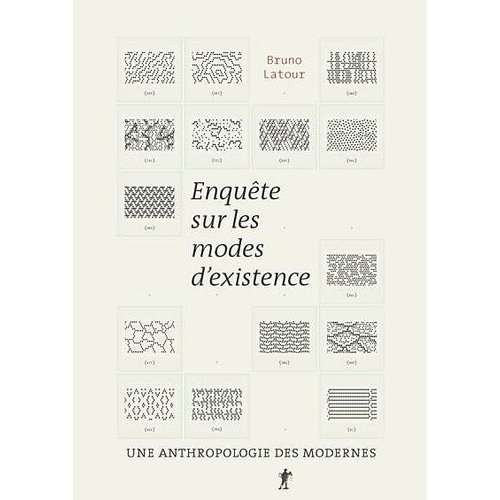
Latour’s new book Enquête sur les modes d’existence is out in French next week, with an English translation following probably next year. Details of these, and much more, at his site.

The result of a twenty five years inquiry, it offers a positive version to the question raised, only negatively, with the publication, in 1991, of ”We have never been modern”: if ”we” have never been modern, then what have ”we” been? From what sort of values should ”we” inherit?  In order to answer this question, a research protocol has been developed that is very different from the actor-network theory. The question is no longer only to define ”associations” and to follow networks in order to redefine the notion of ”society” and ”social” (as in ”Reassembling the Social”) but to follow the different types of connectors that provide those networks with their specific tonalities. Those modes of extension, or modes of existence, account for the many differences between law, science, politics, and so on. This systematic effort for building a new philosophical anthropology offers a completely different view of what the ”Moderns” have been and thus a very different basis for opening a comparative anthropology with the other collectives – at the time when they all have to cope with ecological crisis.  Thanks to a European research council grant (2011-2014) the printed book will be associated with a very original purpose built digital platform allowing for the inquiry summed up in the book to be pursued and modified by interested readers who will act as co-inquirers and co-authors of the final results.  With this major book, readers will finally understand what has led to so many apparently disconnected topics and see how the symmetric anthropology begun forty years ago can come to fruition.
Posted in Bruno Latour | Leave a comment

Schmitt in France – Jean-François Kervégan

Actu Philosophia has a piece on one of France’s main Carl Schmitt commentators, Jean-François Kervégan.

Posted in Carl Schmitt | Tagged | Leave a comment

Graham Harman – Weird Realism: Lovecraft and Philosophy

Graham Harman’s book on Lovecraft, Weird Realism is now out.

As Hölderlin was to Martin Heidegger and Mallarmé to Jacques Derrida, so is H.P. Lovecraft to the Speculative Realist philosophers. Lovecraft was one of the brightest stars of the horror and science fiction magazines, but died in poverty and relative obscurity in the 1930s. In 2005 he was finally elevated from pulp status to the classical literary canon with the release of a Library of America volume dedicated to his work. The impact of Lovecraft on philosophy has been building for more than a decade. Initially championed by shadowy guru Nick Land at Warwick during the 1990s, he was later discovered to be an object of private fascination for all four original members of the twenty-first century Speculative Realist movement. In this book, Graham Harman extracts the basic philosophical concepts underlying the work of Lovecraft, yielding a weird realism capable of freeing continental philosophy from its current soul-crushing impasse. Abandoning pious references by Heidegger to Hölderlin and the Greeks, Harman develops a new philosophical mythology centered in such Lovecraftian figures as Cthulhu, Wilbur Whately, and the rat-like monstrosity Brown Jenkin. The Miskatonic River replaces the Rhine and the Ister, while the Caucasus  of  Hölderlin gives way to the Antarctic mountains of madness of Lovecraft.

William Koch is fast off the mark with a review here.

Posted in Graham Harman, H.P. Lovecraft | Leave a comment

Forensic Architecture – new website

Eyal Weizman’s Forensic Architecture project has a new website here. The Funambulist offers some thoughts here.

Posted in Eyal Weizman | Leave a comment

Gerard Toal provides links to an interview with Robert Kaplan and a new piece by John Agnew.

Posted in Uncategorized | Leave a comment

Some interesting discussion here of book chapters vs. journal articles. Citations should never be the only measure, but not being read is surely a problem for many collections.

Posted in Uncategorized | Leave a comment

David Harvey on Rebel Cities

Interview here – if you know anything about Harvey you should probably skip the intro…

Posted in David Harvey | Leave a comment

Anarchist Geographies – issue details and video abstract

I’ve mentioned Antipode‘s theme issue on Anarchist Geographies before, but they now have a full contents list and a video abstract by one of the editors, Simon Springer.

Posted in Uncategorized | Leave a comment

Gerad Toal on Kaplan – with the text of his short contribution to an earlier discussion of the 2009 article.

Posted in Uncategorized | Leave a comment

Jeffrey Jerome Cohen on writing and nonelectronic notebooks

Some thoughts at In the Middle. A couple of excerpts

Sometimes when I have a lecture or essay to compose I sit at my computer, open a word processing program, and write. The words flow because I’ve done enough thinking in advance that I’m ready to go. More typically, though, I open multiple windows of electronic notes on the e-desktop while surrounding my laptop with a collection of printed outlines and drafts (usually blue with my inked annotations) as well as physical notebook thick with ideas, odd sentences, and even full paragraphs…

Although a technophile, I’ve never found a satisfying electronic platform for capturing thoughts and keeping notes. I’ve tried everything from simple and easily searchable text documents to various programs that look and feel like physical notebooks to workflow software (most recently, this one — but, meh).

As I’ve said before, I increasingly use Evernote as my main notebook. This is on my desktop, laptop, Blackberry and iPad, so I can access things wherever I am. I like the way I can email stuff to this – so I forward a lot of stuff there as a way of filing it; you can clip a webpage directly to it; and I have ‘to do’ lists; lists of books I want; lists of books I’ve ordered so I can make sure I actually get them – especially useful when I order books in recompense for review work that haven’t been published, and I order a lot of books; lists of books I’ve read; things to get from the library; etc. You can set up ‘notebooks’ and drop individual notes into them, or even automate this when you email stuff. I have notebooks for most papers or books I’m working on, and other things. I keep working notes for Society and Space in here, instead of the old paper notebook – as we have a collaborative working practice, I need to keep a note of which co-editors have commented on a new paper, or one back from referees, or something else, and it’s really handy for this. I’m sure there is loads more you can do with it.

I do take notes on paper, but usually type them up fairly soon afterwards. And I have notebooks that I take to conferences, workshops or meetings where typing looks like you are doing something else… But eventually most things find their way into an electronic file. Of course, if Dropbox or Evernote went bust, I might be in trouble…

Posted in Uncategorized | 4 Comments