Antipode‘s 4th Institute for the Geographies of Justice – Durban

This looks a really interesting opportunity for PhD students and early career scholars. Full details here.

Antipode‘s 4th Institute for the Geographies of Justice (IGJ) will take place in Durban, South Africa, May 27th – June 1st 2013 (with a pre-Institute day in Johannesburg for those interested in  interacting with Achille Mbembe and his team at the Johannesburg Workshop on Theory and Criticism).

After Antipode’s first three successful Institutes held in Athens, Georgia, USA (2007), in Manchester, UK (2009), and again in Athens (2011) we are delighted to announce that the 4th Institute will be held in Durban, South Africa during the end of May/beginning of June 2013. The 4th IGJ will provide an exciting opportunity to engage leading edge theoretical, methodological, and research-practice issues in the field of radical geography and social justice (both broadly defined), along with a range of associated professional and career development matters. This international meeting will be specifically designed to meet the needs of new researchers, taking the form of an intensive, interactive workshop for 25 participants.

Posted in Conferences, Politics | Leave a comment

Shakespeare and War

Derek Gregory has followed up his post on Theatre of/and War with one on Shakespeare and War. Lots of good reading suggestions in both. I’d also suggest Simon Barker, War and Nation in the Theatre of Shakespeare and his Contemporaries. Derek kindly mentions my Shakespearean Territories project in the second post – and his suggestions on Shakespeare are timely as I’ve recently been writing on the geopolitical framings of Hamlet and Macbeth. I’ll be giving various talks on this project in coming months, and hope to have the chance to focus on different bits for different audiences (rather than repeat the same paper each time). The next outing is the Critical International and Political Studies annual lecture, University of Warwick in October, which is why I’ve turned my attention to Hamlet and Macbeth.

Several of Shakespeare’s plays are explicitly about war – the English history plays, for example. Richard III has a striking battle, as does Henry V, given a propaganda spin by Laurence Oliver in 1944 before another invasion of France.

Coriolanus has important battle scenes, and King Lear has an invasion – both of which I’ve already written about. Macbeth begins with the defeat of an invasion and the execution of traitors – it gives Macbeth his title as Thane of Cawdor – and ends with another invasion to overthrow him. Titus Andronicus has the return of a warrior, army and prisoners at the beginning, and another invasion at the end. This will also be discussed in the book. A number of other plays have wider conflicts that frame a story – Hamlet is the one that I’ve found most striking recently, but troops also return from war at the beginning of Much Ado About Nothing. I’m sure there are more, and obviously there are traces in the martial metaphors throughout.

Posted in Derek Gregory, Politics, Shakespearean Territories, Territory, William Shakespeare | Leave a comment

A People’s Guide to Los Angeles

People going to the Association of American Geographers in Los Angeles in 2013 may be interested in this book. Entitled A People’s Guide to Los Angeles, it has recently been published by University of California Press.

The book backcover blurb explains:

A People’s Guide to Los Angeles offers an assortment of eye-opening alternatives to L.A.’s usual tourist destinations. It documents 115 little-known sites in the City of Angels where struggles related to race, class, gender, and sexuality have occurred. They introduce us to people and events usually ignored by mainstream media and, in the process, create a fresh history of Los Angeles. Roughly dividing the city into six regions—North Los Angeles, the Eastside and San Gabriel Valley, South Los Angeles, Long Beach and the Harbor, the Westside, and the San Fernando Valley—this illuminating guide shows how power operates in the shaping of places, and how it remains embedded in the landscape.

The Los Angeles Review of Books has been running a series of pieces by the authors on the book (here, here, here and here); and a podcast interview. LA Weekly also has a review here. Thanks to Andrew Burridge for the links.

Posted in Uncategorized | Leave a comment

Gaston Gordillo – The Terrain as Medium of Violence

Also in the ‘Violence and Space’ AAG sessions, Gaston Gordillo on ‘The Terrain as Medium of Violence’. He’s posted the abstract here, and also talks about his intriguing sounding book The Afterlife of Places: Ruins and the Destruction of Space, forthcoming with Duke University Press. He makes the point that ‘terrain’ needs more theorisation as a category, and links it to debates around verticality. Given my previous paper ‘Land, Terrain, Territory’ and my forthcoming ‘Secure the Volume: Vertical Geopolitics and the Depth of Power’ (early version video here) I’m obviously very interested in what he will say. Should be ‘very lively’ as Derek Gregory suggests.

Posted in Politics, Territory | Leave a comment

Graham Harman on news that Tristan Garcia’s Form and Object will be out in English in a year or so.

doctorzamalek's avatarObject-Oriented Philosophy

The deal with PUF is now done, and it’s a big one: Garcia’s Forme et objet will appear in our Speculative Realism series at Edinburgh University Press.

Mark Allan Ohm and Jon Cogburn are the translators. Better yet, they’re already finished with a first draft of the entire translation, moving with startling speed since the end of the spring.

We are hopeful that you’ll be able to read Garcia’s big book in English in 2013, though perhaps it will slip into early 2014; we’ll know for sure in a few months. In any case, if you can’t (or don’t wish to) read the whole book in French, the Ohm/Cogburn version may be on sale in a year or so.

If you’d like to read my summary of the book in continent and haven’t already done so, click HERE to read it.

View original post

Posted in Uncategorized | Leave a comment

Quentin Meillassoux – ‘Iteration, Reiteration, Repetition’ text

Meillassoux’s 20th April 2012 lecture in Berlin is now online. Not sure how authorised this is, but Peter Gratton and Graham Harman have both linked to it. Graham has some thoughts in response in his post.

Posted in Graham Harman, Peter Gratton, Quentin Meillassoux | Leave a comment

Urban Territory: Violent Political Technologies in London and Kano

This is my abstract for the AAG meeting in Los Angeles next April. It will be part of the ‘Violence and Space’ sessions organised by Philippe le Billon and Simon Springer – call for papers here. I’ll also be part of a panel on Sloterdijk organised by Oliver Belcher and Julian Reid.

I’ve been trying to make sense of the Kano attacks in January which Susan was caught up in, and I’ve been disappointed by the coverage of Boko Haram generally. This paper will attempt to pull together what I’ve heard with what I’ve read. I wasn’t sure I had enough to make a paper, until I hit on the idea of the territorialisation of the urban, and this linked it to the recent discussions of the Territorial Support Group and the literature on urban geopolitics. The Foucault hook came to me when out on the bike.

In the ‘Space, Knowledge, and Power’ interview, Foucault discusses how manuals of police suggested that “the government of a large state like France should ultimately think of its territory on the model of a city… A state will be well organized when a system of policing as tight and efficient as that of the cities extends over the entire territory. At the outset, the notion of police applied only to the set of regulations that were to assure the tranquillity of a city, but at that moment the police became the very type of rationality for the government of the whole territory. The model of the city became the matrix for the regulations that apply to a whole state” (The Foucault Reader, p. 241).

What if, today, the reverse was the case? Instead of urban order being the model for territorial rule, what if strategies previously used to control territory were now being utilised to police urban space? This is not to suggest that territory is becoming urbanised, but that the urban is becoming territorialised. As I’ve argued elsewhere, the linkage between terror and territory is important, as a means by which violence is used to establish, maintain and challenge the control of space. How does this work in an urban context? I disagree with Foucault’s historical theorisation of territory, but his work on rationalities and calculative techniques is extremely helpful in thinking about territory historically and politically. And while I do not think we can straight-forwardly label sub-national spaces as territories, thinking territory as a political technology is helpful in making sense of the techniques of rule used in urban locations.

Writers like Stephen Graham and Saskia Sassen have proposed a notion of ‘urban geopolitics’. Taking up the suggestion of the militarisation of urban space, but relating this more explicitly to the question of territory, this paper tries to work through conceptual and political issues that relate to the panel theme of ‘Violence and Space’. Its examples will be the British police’s Territorial Support Group and the January 20th Boko Haram attacks and government response in Kano, Nigeria.

Posted in Conferences, Michel Foucault, Peter Sloterdijk, Politics, Stephen Graham, Territory, Terror and Territory, urban/urbanisation | 12 Comments

Review of John Urry’s Climate Change and Society on the Society and Space open site.

Posted in Uncategorized | Leave a comment

Lefebvre on Hitler

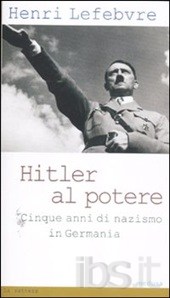
One of Lefebvre’s earliest books – very hard to find these days – was a short study of the first five years of Hitler’s dictatorship in Germany. Hitler au pouvoir, les enseignements de cinq années de fascisme en Allemagne, Paris: Bureau d’Éditions, 1938. It is the only book of Lefebvre’s I don’t own, and Worldcat suggests only 13 libraries worldwide have copies. As I understand it wasn’t printed in great numbers and was on the list of prescribed books that went on the bonfires after the invasion. (So did his book on Nietzsche, but I have a copy of that, and there is a new French edition.) I eventually read the copy of Hitler au pouvoir in the New York Public Library when I was working at Columbia University on the Norbert Guterman archive.

So I was rather surprised to have just discovered that an Italian translation appeared earlier this year – Hitler al potere. Cinque anni di nazismo in Germania. I know nothing about the publisher, and searching online doesn’t bring up much. I’m curious about this – I find it hard to believe this is an authorised edition/translation given the complexities around the rights to Lefebvre’s work. I’ve ordered a copy but if anyone reading can shed any light I’d be grateful.

Posted in Henri Lefebvre, Publishing | 1 Comment

Michael Watts – Silent Violence reissue forthcoming

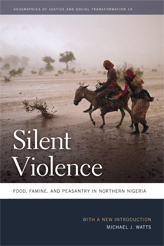
Michael Watts’s classic Silent Violence: Food, Famine, and Peasantry in Northern Nigeria is coming out in early 2013 with University of Georgia Press in their excellent Geographies of Justice and Social Transformation series.

As well as some really good new books, and some forthcoming ones, this series has been reissuing a number of classics, including Neil Smith’s Uneven Development, William Bunge’s Fitzgerald and David Harvey’s Social Justice and the City.

Posted in David Harvey, Neil Smith | Leave a comment