Haruki Murakami on writing and running

Thanks to Oliver Belcher for the link – a piece about novelist Haruki Murakami’s views on writing and running. What does a novelist/writer need? For Murakami, it’s three things – talent, focus and endurance.

Fortunately, these two disciplines—focus and endurance—are different from talent, since they can be acquired and sharpened through training. You’ll naturally learn both concentration and endurance when you sit down every day at your desk and train yourself to focus on one point. This is a lot like the training of muscles I wrote of a moment ago. You have to continually transmit the object of your focus to your entire body, and make sure it thoroughly assimilates the information necessary for you to write every single day and concentrate on the work at hand. And gradually you’ll expand the limits of what you’re able to do. Almost imperceptibly you’ll make the bar rise. This involves the same process as jogging every day to strengthen your muscles and develop a runner’s physique. Add a stimulus and keep it up. And repeat. Patience is a must in this process, but I guarantee results will come.

The views are an excerpt from his short memoir What I Talk About When I Talk About Running, which I bought on the strength of this. A really interesting and illuminating discussion. I don’t think you need to be a runner to appreciate it – I could simply replace many of his running examples with cycling, for instance… (He does talk about cycling a bit in relation to triathlons).

Posted in Cycling, Writing | Tagged | 1 Comment

Thomas Meyer’s Beowulf

The latest book from Punctum is Thomas Meyer’s translation of Beowulf. No ordinary translation – typographically and linguistically this is very different and this is a beautifully produced edition. It’s available free online or for a small price. You can read more about it on the Punctum Books blog.

Beowulf is a fascinating text and I’m looking forward to reading this version. There is a brief discussion of Beowulf in my forthcoming The Birth of Territory, which draws on a longer piece I wrote on this – “Place Symbolism and Land Politics in Beowulf“. Cultural Geographies. 2009;16:447-463. The link takes you to a freely available version.

Posted in Medieval Studies, My Publications, The Birth of Territory | Tagged , | Leave a comment

Peter Suber on Open Access Publishing

Good discussion at Berfrois from Peter Suber of the Harvard Open Access Project.

Posted in Publishing | Leave a comment

Another set of comments to Ben Anderson’s ‘Rapid Response’ piece – this time in relation to aid and the British Department for International Development.

Posted in Uncategorized | Leave a comment

Urban Geopolitics

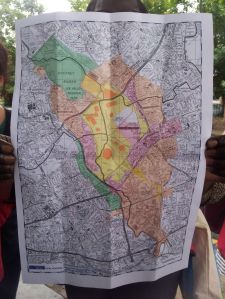
At the Antipode blog, Marijn Nieuwenhuis has an interesting post on Urban Geopolitics in the wake of the London Olympics. He mentions the Territorial Support Group’s ‘Total Policing’ map I linked to a few weeks back. Marijn discusses Foucault and Stephen Graham among others.

A subsequent piece at the Antipode blog provides some additional reading suggestions.

Posted in Michel Foucault, Politics, Stephen Graham, Territory, urban/urbanisation | 2 Comments

Ben Anderson on ‘rapid response’

Ben Anderson has a piece on ‘Rapid Response’ at the Berfrois website, which begins with the shooting at the cinema in Aurora, but draws out more general issues about states of emergency. Phil Steinberg and Derek Gregory have both written some comments on this on their blogs. Derek notes two of Ben’s other pieces on this topic, both co-written with Peter Adey – for a full publication list, see his Durham website.

Phil mentions the collection of (freely available) short responses Society and Space published on the 2011 Breivik murders in Norway – while he notes that they don’t discuss the police response, Breivik’s recent conviction perhaps gives a reason to look at them.

Posted in Derek Gregory, Politics | Leave a comment

Peter Gratton – Spinoza and the Biopolitical Roots of Modernity audio available

The audio recording of Peter Gratton’s talk ‘Spinoza and the Biopolitical Roots of Modernity’ at UWS is now available (from here, via’s Peter’s blog).

Peter Graton Presenting His Paper

Abstract: Much has been written about bio-political sovereignty in the wake of Giorgio Agamben’s work, which relies, at least in the first volume of Homo Sacer, on Carl Schmitt’s transcendental account of sovereignty. I will argue, however, that Foucault and Arendt rightly identify what Derrida once called the “changing shape and place of sovereignty” in modernity, which for them is horizontal and disseminated within a presupposed nation. For this reason, we will look to the source of modern philosophical immanentism, Spinoza, to show that he is not extrinsic to this modern bio-politics, and demonstrates how the sovereign exception and its nationalized version work hand-in-glove in the era of which he was a part. In this way, we argue that it is Spinoza’s political theology, not Schmitt’s, that is the better pass-key to what Foucault and Arendt identify as biopolitical. By doing so, I put in tension two trends in recent Continental philosophy–philosophical vitalism and the critique of biopolitics–while raising questions about the use of political, if not ontological, forms of immanence.

Bio: Peter Gratton is a professor of Philosophy at the Memorial University of Newfoundland. He has published widely in political, Continental, and intercultural philosophy and is the author of The State of Sovereignty: Lessons from the Political Fictions of Modernity (SUNY Press, 2012) and Speculative Realism (Continuum, forthcoming). Co-Editor of the influential interdisciplinary journal Society and Space, executive board member of the North American Sartre Society and other national philosophical societies, and area editor for Africana philosophy for the Internet Encyclopedia of Philosophy, Peter has also edited Traversing the Imaginary (Northwestern University Press, 2007), co-edited with John Mannousakis, and Jean-Luc Nancy and Plural Thinking: Expositions of World, Politics, Art, and Sense (SUNY Press, 2012), co-edited with Marie-Eve Morin. Peter is currently a Research Fellow in the Humanities Centre at Australia National University.

Posted in Baruch Spinoza, Carl Schmitt, Conferences, Giorgio Agamben, Hannah Arendt, Jacques Derrida, Michel Foucault, Society and Space | 2 Comments

Leiden Journal of International Law theme section on Foucault – currently free online.

Clare O'Farrell's avatarFoucault News

Leiden Journal of International Law, Volume 25, Issue 03, September 2012

Special section on Foucault. For a limited period to mark the 29th anniversary of the journal this issue is available free online

On the Uses of Foucault for International Law
TANJA AALBERTS and BEN GOLDER
pp 603-608

In Praise of Description
ANNE ORFORD
pp 609-625

On Foucault and Wolff or from Law to Political Economy
MATT CRAVEN
pp 627-645

‘The Life of Individuals as well as of Nations’: International Law and the League of Nations’ Anti-Trafficking Governmentalities
STEPHEN LEGG
pp 647-664

Targeted Killing and Its Law: On a Mutually Constitutive Relationship
SUSANNE KRASMANN
pp 665-682

View original post

Posted in Uncategorized | Leave a comment

Journal of Urban Cultural Studies – website and call for papers

The Journal of Urban Cultural Studies will be published by Intellect, and has a website here. The subscription price is low, and authors can opt for open access at a price – but one that is considerably lower than many of the big publishers. The journal has a linked blog, and this is the call for papers:

The Journal of Urban Cultural Studies is a new peer-reviewed publication cutting across both the humanities and the social sciences in order to better understand the culture(s) of cities. The journal is open to studies that deal with culture, urban spaces and forms of urbanized consciousness the world over.

Although we embrace a broad definition of urban cultural studies, we are particularly interested in submissions that give equal weight to: a) one or more aspects of urban studies (everyday life, built environment, architecture, city planning, identity formation, transportation…) and b) analysis of one or more specific forms of cultural/textual production (literature, film, graphic novels, music, art, graffiti, videogames, online or virtual space…) in relation to a given urban space or spaces.

Essays of 7,000-10,000 words (including works cited and notes) should be sent by attachment to the Editor at urbanculturalstudies@gmail.com. JUCS is also open to proposals of special issues by guest editors working individually or in teams of two. All citations in other languages should be translated into English for the journal’s international reading public, in addition to including the original text.

While the journal does not publish book reviews, we do publish review essays—which should discuss 3-5 recent books on a shared topic or theme (or place) and run from 2,500 to 4,000 words. Review essays of urban-themed installations or other works of art are also welcome. These essays will be reviewed in house. Given our visual focus, we are interested in original, unpublished artwork on the topic of cities and in publishing articles accompanied by images where appropriate.

We encourage a variety of approaches to the urban phenomenon—the strengths of the editorial board run from urban geography to literature and film, photography and videogames, gender and sexuality, creative economy, popular music, Marxist approaches, fashion, urban planning, anthropology, sociology, Deaf culture, built environment, philosophy, architecture, detective fiction and noir, and more…

Posted in Journal of Urban Cultural Studies, Publishing | Leave a comment

Eyal Weizman ‘Forensic Architecture’. Video of the Society and Space 30th anniversary lecture now available.

Posted in Uncategorized | Leave a comment