The Public Intellectual in Classical Athens and Today

Video of a discussion on ‘The Public Intellectual in Classical Athens and Today’, organised by the Durham University Institute of Advanced Study, chaired by Barbara Graziosi:

This panel event organised by Durham University took place on 28th June 2012 and examined the influence of ancient Athens on democracy today. The all-female panel featured TV presenter and historian Bettany Hughes, Guardian chief arts and culture writer Charlotte Higgins and ancient drama and democracy expert Professor Edith Hall

Posted in Institute of Advanced Study | Tagged , , , | Leave a comment

Łukasz Stanek – Henri Lefebvre on Space

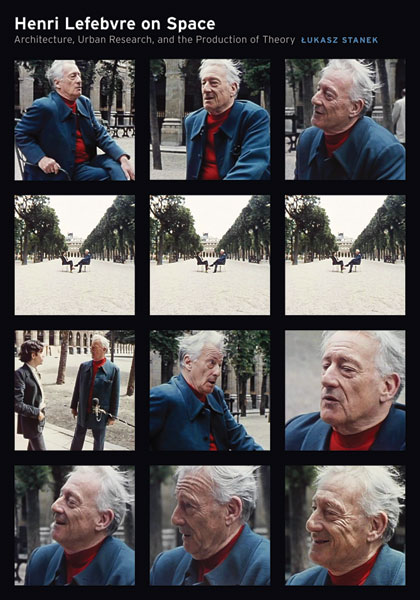
I finally got round to reading Łukasz Stanek, Henri Lefebvre on Space: Architecture, Urban Research, and the Production of Theory, which has been out for a little while. The book is extremely well researched, and filled with interesting discoveries from archives and through interviews. The key addition the book provides is to ground Lefebvre’s work on space and the urban in the empirical work he was involved with in architecture and urban planning. This adds a valuable counterbalance to work that seeks to understand Lefebvre’s theories on space in their conceptual and historical context. I don’t agree with the claim on the backcover of the book that the “prevailing view… reduces Lefebvre’s theory of space to a projection of his philosophical position”. My sense is that the attempt to see his theory of space as philosophically grounded – something I attempted in my Understanding Henri Lefebvre – is far from dominant and not discussed nearly as much as it should. I think much work on Lefebvre sees his claims as operating without any context – historical, political, empirical or conceptual. In my book I tried to show how the work on space developed out of two key strands – his work on the urban and the rural (the latter largely neglected in anglophone debates, though Nick Entrikin has done some interesting work on this); and his philosophical work. Stanek provides a major contribution to the understanding of the first of these, but I see them as complementary, rather than opposed, contextualisations.

One of the most interesting bits of the book is in the closing few pages, when Stanek discusses a manuscript Lefebvre wrote entitled Vers une architecture de la jouissance in 1973 – immediately before The Production of Space. Stanek is editing this manuscript for publication, and it is likely to be a really important addition to what we know of Lefebvre’s work in this field.

Posted in Henri Lefebvre | 3 Comments

Heidegger and Schmitt correspondence (again)

Twenty-five years after they first published it, Telos are again highlighting the letter Martin Heidegger sent to Carl Schmitt in August 1933. The point of the letter was to thank Schmitt for sending a copy of The Concept of the Political. After praising the reading of Heraclitus, Heidegger signifies he doesn’t have time to further comment on the text, making the quip that “But now I myself am in the middle of polémios [war] and all literary projects must take second place”.

In the 25th anniversary commentary on this piece, Juan Carlos Donado discusses the piece, and makes something of the notion of ‘war’. Given the year, that Heidegger was then Chancellor of Freiburg, a political post, and had recently joined the Nazi party, this is significant – he is describing his political actions as ‘war’. Or so we would be led to believe.

Except Heidegger doesn’t say ‘war’ – that’s the translator’s additional gloss. And he actually says pólemos and not polémios.

The term Schmitt uses as the Greek notion of enemy is polémios – is this the reason for the translator error? Heidegger says pólemos. Given what Schmitt makes of this notion there appears to be a relation at stake.

Donado says the fuller discussion of the fragment can be found in the 1934-35 course on Hölderlin. There is a discussion there, as there is in multiple courses, but the key discussion of the notion of polemos, in this fragment of Heraclitus, actually comes in an earlier course from 1933-34 – contemporaneous with the letter and the political involvement. [This has been published as Sein und Wahrheit (GA36/37), recently translated by Gregory Fried and Richard Polt as part of the Being and Truth volume – German pages 90-1; English 72-73.]

Heidegger says that the standard rendering of polemos is as “Krieg, Kampf [war, struggle]”, but then goes on to clarify what he thinks it means: “This does not mean the outward occurrence of war and the celebration of what is ‘military’, but rather what is decisive: standing against the enemy. We have translated this word with ‘Kampf [struggle]'”. Heidegger goes on to clarify how he means this to be understood – not as competitive, friendly, struggle – agon; “but rather the struggle of polemos, war”. So he brings ‘war’ back in, but only to clarify what he understands by Kampf. He links it to his notion of an Auseinandersetzung – a setting-apart-from-another – and notes it is directed against an enemy, though his enemy is not named.

Indeed, Heidegger more commonly sees polemos as Kampf, struggle.  He translates it that way in the 1934-35 course on Hölderlin (GA39, 125) and in the 1935 course An Introduction to Metaphysics understands polemos as Kampf, as Streit [strife], and says it is “not war in the human sense” (GA40, 47, etc.).

Obviously, enemies, struggle etc. link to some deeply unpleasant connotations – Schmitt with the first; Hitler with the second. It remains crucial to think through and work through Heidegger’s politics. But being critical of his political involvement requires more careful reading than this poorly researched piece. Fortunately the original Telos publication is bilingual, with the German text in a note, so we can see what Heidegger actually wrote, although I suspect relatively few would check.

[This draws on the discussion in my Speaking Against Number, pp. 84-85, updated in relation to the publication of Being and Truth]

Posted in Carl Schmitt, Martin Heidegger, Speaking Against Number | 2 Comments

Environment and Planning A theme issue on Future Geographies

Posted in Uncategorized | Leave a comment

Mark Purcell on Lefebvre’s spatial revolution

Mark Purcell's avatarPath to the Possible

Another excerpt from my book, which is now “in press,” on Henri Lefebvre’s understanding of revolution…

For Lefebvre the political project of autogestion and democracy is always also a project to transform the way we produce and use space.  He imagines politics to always be spatial, as for example when he imagines a transition from the industrial city to urban society.  In The Production of Space he sets out the more general project of moving from “abstract space” to “differential space” (see also The Urban Revolution, pp. 37, 125-127)  The former is a space “determined economically by capital, dominated socially by the bourgeoisie, and ruled politically by the state” (Production of Space, p. 227).  It is a space of domination that has been expropriated and alienated from users and is controlled by a heteronomous elite.  Abstract space reduces space to its economic function as either a means…

View original post 397 more words

Posted in Uncategorized | Leave a comment

Staple City

By Peter Root, via Urban Cultural Studies

Posted in Uncategorized | Leave a comment

More books received

The Pluto ones are for review work, and a couple of others are review copies. More interesting reading here.

Posted in Books, Boundaries, Politics, Territory, Tristan Garcia, William Shakespeare | Leave a comment

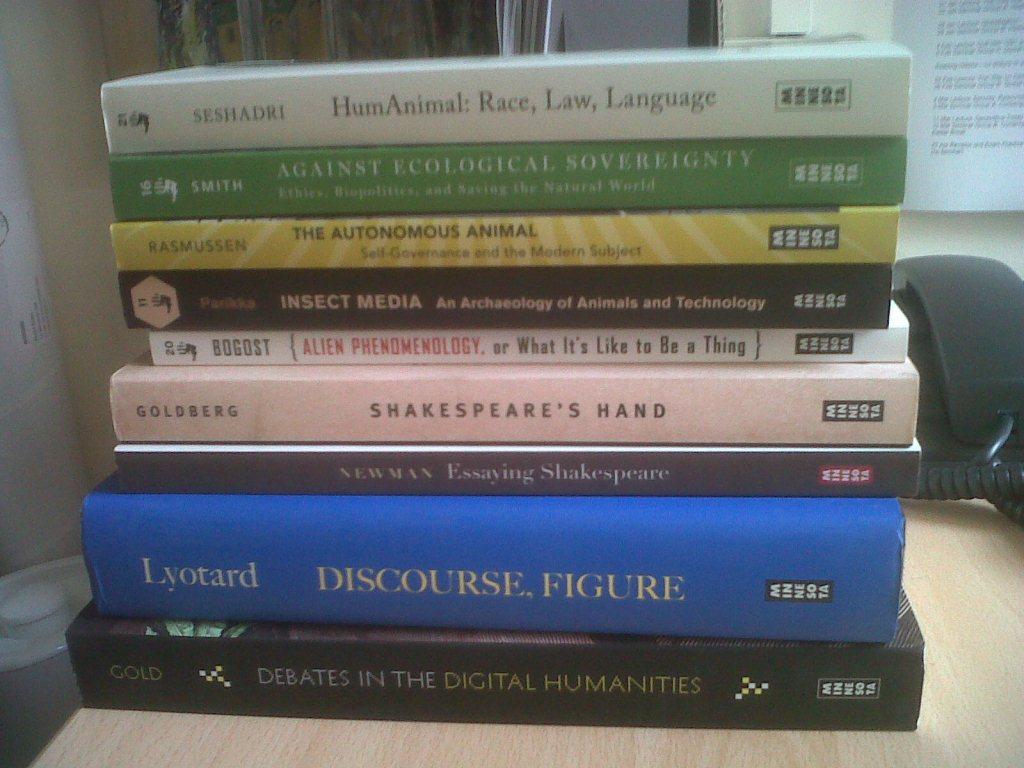
University of Minnesota Press books received

I did some review work for University of Minnesota Press – lots of nice new books received in recompense (plus two on order).

Posted in Books, William Shakespeare | 1 Comment

Lecturer in Urban/Political Geography at Durham University

The Department of Geography is seeking to appoint a full-time Lecturer in Urban/Political Geography for a fixed-term of 3 years from 1 October 2012. The person appointed will undertake high quality research, provide excellent teaching across a range of modules and contribute to the administration of the Department.

Further details here. Please contact my colleague Ben Anderson if you have any questions.

Posted in Uncategorized | Leave a comment

Alec Murphy on ‘Territory’s Continuing Allure’

Also in the Annals of the AAG (requires subscription) Alec Murphy has an interesting piece about questions of territory today.

The role of the territorial state has changed in recent decades in the wake of the communications revolution; the explosion of transnational social, political, and economic formations; accelerated mobility across international boundaries; and the inability of states to address pressing socioeconomic and environmental issues. Yet in the rush to document and assess the networks, flows, and relational spaces that are part of this shift, it is important not to overlook the continuing hold of modernist territorial ideas on the geographical imagination. Geographical writings on territoriality, spatial socialization, state-driven knowledge production, and regimes of territorial legitimation provide tools for understanding the power and inertia of modernist territorial ideas, which continue to influence patterns of identity and state practice in wide-ranging and significant ways. Contemporary interpretations of the doctrine of self-determination and its application in the Western Sahara case demonstrate that modernist ideas about territory continue to have far-reaching political and social consequences. It follows that any balanced assessment of the contemporary political–geographic order should not ignore the ways in which the continuing allure of territory articulates with the material and functional shifts that are challenging traditional political–territorial arrangements.
Posted in Alexander B. Murphy, Territory | Leave a comment