Emilia Angelova reviews Reading Kant’s Geography

Emilia Angelova, “Kant’s Physical Geography“, Comparative and Continental Philosophy, Vol 4, No 1, 2012 (requires subscription)

This review of an edited collection, Reading Kant’s Geography, discusses a series of critical essays on Kant’s physical geography, a topic to which he devoted many years of intellectual energy. The volume is the first of its kind for it appears in anticipation of the first ever publication into English of Kant’s own lectures on physical geography, which lectures he held for over forty years, alternating with lectures on anthropology. This volume together with the publication of the lectures thus constitute an important event in the English language reception of Kant.
Posted in Eduardo Mendieta, Immanuel Kant | Leave a comment

Mitchell Dean reviews Agamben, The Kingdom and the Glory

Mitchell Dean, “Governmentality Meets Theology: ‘The King Reigns, but He Does Not Govern’”, Theory, Culture & Society, May 2012 vol. 29 no. 3 145-158 (requires subscription; via Foucault News). A detailed review with some close discussion of the relation of the book to Foucault’s work on governmentality – Dean is the author of one of the key texts on this period of Foucault’s work (Governmentality: Power and Rule in Modern Society) – and to Carl Schmitt. Here’s the abstract:

While this ‘extraordinary’ book appears as an intermezzo within the Homo Sacer series (Negri, 2008), it supports two fundamental theses with its own philological, epigraphic, liturgical and religious-historical research, and a close reading of figures such as Ernst Kantorowicz and Marcel Mauss. These theses concern political power first as an articulation of sovereign reign and economic government and, secondly, as constituted by acclamations and glorification. These can be approached theoretically through its author’s engagement with Michel Foucault’s genealogy of governmentality and with the Erik Peterson/Carl Schmitt debate on the closure of political theology. Agamben’s reformulation of power and his derivation of liberal governmentality from the theological oikonomia prove convincing. A renewed analytics of power and politics of resistance should be possible, however, without recourse to a project seeking to deactivate all profane powers including those of public bureaucracies.

Posted in Carl Schmitt, Giorgio Agamben, Michel Foucault | Leave a comment

Žižek on Melancholia

via Thinking with Shakespeare

Posted in Slavoj Zizek | Leave a comment

Phil Steinberg interview at Exploring Geopolitics

Political Geographer Phil Steinberg is interviewed at Exploring Geopolitics. It’s part of that site’s ‘Geopolitical Passport’ series – lots of other interesting interviews there.

Posted in Uncategorized | Leave a comment

Work (for free) with Figure/Ground.

Posted in Uncategorized | Leave a comment

Difficult Books

Publishers Weekly has a list of ten of the most difficult books to read. Heidegger and Hegel make the list, but it is dominated by fiction. Worth it, for me at least, because it links to the original list and discussion at The Millions. Some good suggestions for interesting novels there – and given the number I’ve read this year I’m definitely on the look-out for those.

Posted in Books, Georg Wilhelm Friedrich Hegel, Martin Heidegger | Leave a comment

Verso’s Olympic reading list

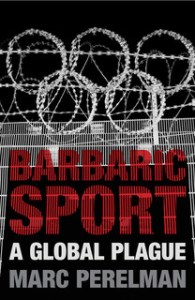
Some of these are a bit of a stretch, but many good books here. Marc Perelman’s recent Barbaric Sport: A Global Plague looks intriguingly polemical.

Posted in Books, Politics | Leave a comment

Slavoj Žižek – Signs from the Future

Žižek has another new book coming out this autumn. There is an excerpt available here. Compared to Less than Nothing it’s a mere pamphlet at 128 pages. Entitled The Year of Dreaming Dangerously, it’s published by Verso.

Posted in Politics, Slavoj Zizek | 3 Comments

Owen Hatherley on The Olympian Landscape

Owen Hatherley is author of the very good A Guide to the New Ruins of Great Britain. Verso have an excerpt from his forthcoming book,  A New Kind of Bleak: Journeys Through Urban Britain, here. A small taste:

What of the Olympic site itself? Everything is dominated by the ArcelorMittal Orbit, a shocking pink entrail laterally curved around an observation tower, famously commissioned by Boris Johnson in the toilets of a fundraising dinner from steel magnate Lakshmi Mittal, who provided the metal in return for the monument being named after him. There’s a faintly sick irony in this ex-industrial zone being overlooked by an edifice dedicated to a prolific downsizer and asset-stripper of factories, but that aside, there are buildings to enjoy, if you can keep from your mind the town-planning abortion that has been wreaked upon Stratford.

Posted in Politics | 3 Comments

Review of Pierre Macherey, Hegel or Spinoza at NDPR – plus links to online material in Society and Space.

Posted in Uncategorized | Leave a comment