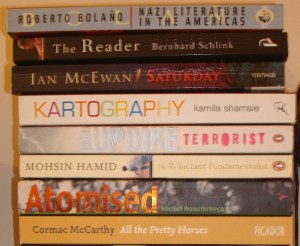
Novels read in 2012 (so far)

As with last year (part one, part two), these are the novels or ‘non-fiction but close’ books I’ve read – basically things I read as a break of sorts from work… Many of these were inspired by comments on posts about reading and rereading novels. Thanks.

  1. China Miéville, Embassytown
  2. Keith Thomas, Religion and the Decline of Magic (not a novel, but a classic of historical writing I’d never got round to reading)
  3. John Irving, Last Night at Twisted River
  4. Sebastian Faulks, The Girl at the Lion d’Or
  5. Michel Houllebecq, The Map and the Territory
  6. Alan Moore and David Lloyd, V for Vendetta
  7. Sebastian Faulks, A Week in December
  8. Kamila Shamsie, Burnt Shadows
  9. Edward Bond, Bingo: Scenes of Money and Death
  10. James Shapiro, 1599: A Year in the Life of William Shakespeare (non-fiction)
  11. David Byrne, The Bicycle Diaries (non-fiction)
  12. John Fowles, The Collector
  13. Ernest Shackleton, South: The Story of Shackleton’s 1914–17 Expedition (true story!)
  14. Joseph Conrad, Heart of Darkness (again)
  15. Mary Shelley, Frankenstein (again)
  16. J.M. Coetzee, Elizabeth Costello
  17. Herta Müller, The Passport
  18. Julie Otsuka, When the Emperor was Divine
  19. W.G. Sebald, The Emigrants
  20. Bernard Schlink, The Reader
  21. Roberto Bolaño, Nazi Literature in the Americas
  22. Mohsin Hamed, The Reluctant Fundamentalist
  23. John Updike, Terrorist
  24. Teju Cole, Everyday is for the Thief
  25. Roberto Bolaño, The Savage Detectives
  26. Ian McEwan, Saturday
  27. Cormac McCarthy, All the Pretty Horses
  28. Rob Kitchin, The Rule Book
  29. Julian Barnes, The Sense of an Ending
  30. Kamila Shamsie, Kartography
  31. Michel Houllebecq, Atomised
  32. Sebastian Faulks (writing as Ian Fleming), Devil May Care
  33. Barbara Kingsolver, The Bean Trees
  34. Gabriel Tarde, Underground Man (yes, that Tarde. This is more of a novella than a full novel.)
  35. Bill Martin, Avant Rock: Experimental Music from the Beatles to Björk
  36. Alice Sebold, The Lovely Bones
  37. Hari Kunzru, My Revolutions
  38. Georges Perec, Species of Spaces and Other Pieces (non-fiction, but really unclassifiable)
  39. Malcolm Bradbury, Doctor Criminale
  40. Paul Auster, The New York Trilogy (City of Glass – Ghosts – The Locked Room)

and a lot of Shakespeare…

Posted in Books, Novels read | 8 Comments

David Harvey in Ankara

via here

Posted in Uncategorized | Leave a comment

An argument for Open Access publishing

From Jo van Every here. Here’s a brief excerpt:

If you (individually or as a committee) only care about whether other white guys at prestigious universities in Europe and the US cite the work, then that should be explicit. If that statement makes you, individually or collectively, uncomfortable, then figure out what to do about it.

Posted in Publishing | Leave a comment

Steve Mentz on a one-man Chinese King Lear

Review here.

Posted in William Shakespeare | Leave a comment

Julian Barnes on being a bibliophile

In The Guardian:

I have lived in books, for books, by and with books; in recent years, I have been fortunate enough to be able to live from books. And it was through books that I first realised there were other worlds beyond my own; first imagined what it might be like to be another person; first encountered that deeply intimate bond made when a writer’s voice gets inside a reader’s head. I was perhaps lucky that for the first 10 years of my life there was no competition from television; and when one finally arrived in the household, it was under the strict control of my parents. They were both schoolteachers, so respect for the book and what it contained were implicit. We didn’t go to church, but we did go to the library. [continues]

Posted in Books | Leave a comment

Political Geography looking for a new review editor – chance to work with a great journal and editorial team.

Posted in Uncategorized | Leave a comment

Klaus Dodds on the Falklands/Malvinas situation

In the journal International Affairs (open access).

Posted in Politics | Leave a comment

Self-publishing articles

Graham Harman has an interesting series of posts on self-publishing articles (or open-access publishing). Initial thoughts here; a second-thought here; and a response and his thoughts on that. Part of this is, as he acknowledges, the security that being a full-professor gives.

I agree with the general sentiment and parts of this – and, in part, this is due to my own career position. With some publications I just don’t see the benefit in publishing behind a paywall – book reviews are the most obvious example, but commentaries are another. We have moved all single book reviews to the Society and Space open site, for instance, and are trying to get more commentaries up there too. The readership for these is much greater than in the print journal. The last couple of book reviews I’ve written have been for open access sites.

I’m not so sure about full articles. Part of this is that Geography is more of a journal-discipline than Continental Philosophy, for example. Part of this is a different regime in the UK. The research assessment system (now called REF) means that whatever you’ve achieved in the past, in one important way you are only as good as your work in the current assessment period. So the current period ends at the end of 2013. All the work anyone has done up to that point is ineligible for the next assessment – it will be based on work published in 2014-20?? (we don’t know the next end date, nor the rules of assessment). And while the guidance this time says that outlet is not important but content is, I think we all know that a piece in a peer-reviewed, prestigious journal is going to stand a substantially better chance of being selected, and then graded more highly, than a piece self-posted online. An open access online journal is another matter, but I sense here too attitudes are only changing slowly. I fully expect my next submission will be dominated by books, as the current one is and the previous one was, but articles still matter.

Where I am unsure is about unpublished papers. I have a few that I’ve given as talks that are either forthcoming, under review, need revision/resubmission after review (one instance each), or need me to turn a talk into a potential article (a few more). Should I post those online? I’d like to, but I open up all sorts of issues about what I can then do with them. My tactic with this site has been to get them published in the usual way, and then to post the pdf up here (see the archive here). I’ve also been posting audio and/or video of talks when possible, though recognise that this does restrict where else I might be able to give that talk (some thoughts on that question here). Publishing is changing fast, and both as an author and editor of a commercial journal – albeit one with a small, independent publisher; and with small but increasing amounts of material online and open access – I am watching these developments with interest.

Posted in Graham Harman, My Publications, Publishing | 6 Comments

Interview with Foucault’s colleague Arlette Farge, in French, on archives, the subject of history and writing history.

Clare O'Farrell's avatarFoucault News

Entretien avec Arlette Farge

Arlette Farge worked with Foucault on Le Désordre des familles, lettres de cachet des Archives de la Bastille, Paris, Gallimard Julliard, 1982. See the Portail Michel Foucault for info and documents on this book

Rares sont les chercheurs auxquels il arrive de rencontrer des “fans” ; rares sont les auteurs de non-fiction dont on dévore les livres, tous les livres. Historienne du “peuple”, du “subalterne” et de tout ce que le XVIIIe siècle compte de dominés, Arlette Farge fait partie de ceux-là s’il en est. Depuis leur émergence des archives judiciaires jusqu’alors oubliées sous la poussière, sa plume et sa voix sont devenues familières aux habitués des librairies et aux auditeurs de France Culture. Poursuivant un parcours entamé par l’étude de la petite délinquance et de la vie fragile avant d’entreprendre plus récemment l’exploration des sons et des voix ouvrières de la capitale, Arlette Farge…

View original post 114 more words

Posted in Uncategorized | Leave a comment

The Funambulist on Foucault

The Funambulist blog has been running a sequence of posts on Foucault around the body, architecture, cartography and power.

Episode 1: Michel Foucault’s Architectural Underestimation

Episode 2: Do not Become Enamored of Power

Episode 3: “Mon Corps, Topie Impitoyable”

Episode 4: The cartography of power

Episode 5: The political technology of the body

Episode 6: Architecture and Discipline: The Hospital

Episode 7: Questioning the Heterotopology

Posted in Michel Foucault | 10 Comments