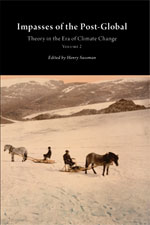
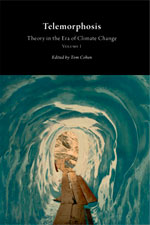
Critical Climate Change

Intriguing new series of books from Open Humanities Press. Details here.

Open Humanities Press is pleased to launch a new series in literary and cultural theory published in conjunction with the University of Michigan Library’s Scholarly Publishing Office. Each Critical Climate Change book will be freely available as an electronic book (open access) and as reasonably priced paperbacks.

The era of climate change involves the mutation of systems beyond 20th century anthropomorphic models and has stood, until recently, outside representation or address. Understood in a broad and critical sense, climate change concerns material agencies that impact on biomass and energy, erased borders and microbial invention, geological and nanographic time, and extinction events. The possibility of extinction has always been a latent figure in textual production and archives; but the current sense of depletion, decay, mutation and exhaustion calls for new modes of address, new styles of publishing and authoring, and new formats and speeds of distribution. As the pressures and re-alignments of this re-arrangement occur, so must the critical languages and conceptual templates, political premises and definitions of ‘life.’ There is a particular need to publish in timely fashion experimental monographs that redefine the boundaries of disciplinary fields, rhetorical invasions, the interface of conceptual and scientific languages, and geomorphic and geopolitical interventions. Critical Climate Change is oriented, in this general manner, toward the epistemo-political mutations that correspond to the temporalities of terrestrial mutation.

Posted in Books, Politics, Publishing | Leave a comment

Derek Gregory – Supplying war in Afghanistan: the frictions of distance

At the Open Democracy website.

Pakistan has said NATO’s supply convoys can cross the Afghan border so long as America’s drones do not. Though the expanded use of cyberwarfare, covert special forces and drones is designed to overcome the frictional problems of waging war from a distance, logistics still matter. The world is not flat – even for the US military.

Posted in Derek Gregory, Politics | Leave a comment

Žižek’s suggested books on Hegel

Before, after or alongside reading Slavoj Žižek book on Hegel, these are the books he suggests we read on Hegel. And the picture chosen to illustrate the Verso post brought back some old childhood memories…

Posted in Georg Wilhelm Friedrich Hegel, Slavoj Zizek | Leave a comment

Toscano and Kotsko on Agamben’s The Kingdom and the Glory

In a 2011 paper for Angelaki Alberto Toscano offers some critical remarks on Agamben’s The Kingdom and the Glory; Adam Kotsko responds. The latter is part of a symposium on the book at the Equinox Political Theology blog.

Posted in Alberto Toscano, Giorgio Agamben | Leave a comment

Bruno Latour to give the Gifford lectures in Edinburgh

In February 2013 – some details here, but says more info to come in December. Thanks to Graham Harman for the link.

Posted in Bruno Latour, Conferences | Leave a comment

Foucault – Du gouvernement des vivants

Amazon.fr has a page up for his 1979-80 course, due in October 2012. I can’t find a publisher page. Thanks to Chathan Vemuri for the link.

Posted in Michel Foucault | Leave a comment

Slavoj Žižek interview in The Guardian

Here. Too much information at times. Also disappointing that he avoids talking about his new book, especially when he has made the claim that he is tired of the jokes and wants his Hegel book to be the serious focus. See my comments on a talk of his in London in 2010.

Posted in Georg Wilhelm Friedrich Hegel, Slavoj Zizek | 1 Comment

Books on reading and writing

Posts on writing always seem to get a lot of interest here. Here are nine suggestions for books to read on this topic at Brain Pickings (via Chasing Dragons).

Posted in Uncategorized | 1 Comment

Glacken on the History of Ideas

A historian of ideas must go where his nose leads him, and it often leads him into chilly but not inhospitable regions whose borders are patrolled by men who know every square foot of it. Although I can lay no claim to being a specialist in a particular century or in the classical or medieval periods, my own specialization in the history of geographic thought has forced me to study many periods because their contributions are so great they cannot be ignored. Problems like this must be faced by anyone who wishes to go beyond the narrowest limits. A historian of geographic ideas (especially in the earlier periods) who stays within the limits of his discipline sips a thin gruel because these ideas almost invariably are derived from broader inquiries like the origin and nature of life, the nature of man, the physical and biological characteristics of the earth. Of necessity they are spread widely over many areas of thought.

Clarence J. Glacken, Traces on the Rhodian Shore: Nature and Culture from Ancient Times to the End of the Eighteenth Century, Berkeley: University of California Press, 1967, p. xiii.


Posted in Clarence J. Glacken | 1 Comment

Queer Space – new Society and Space virtual theme issue

Put together by Natalie Oswin, a theme issue on ‘Queer Space‘ with 11 papers from the archive available open access for three months.

Posted in Society and Space | 1 Comment