Audio recordings

A couple of people have asked how I make the audio recordings I have uploaded here. It’s actually a very low-tech and low-price setup. I make the recording on my iPad, with an app called Audio Memos. I think I bought the pro version, but it was not expensive. You can use this on an iPhone too. You then need to get the file, which will be large, onto a computer – I upload it through dropbox as it’s too big to email, but there are other ways (I guess you could do the next steps on an iPad as well). The file will be a .wav file, and it’s easy to get software that will convert it into .mp3 which is smaller, and for voice recordings is probably fine. I use the free Audacity program to do this – you can edit the audio with this too. I do that to clean up the beginning so it starts at the right place, and to tidy up the end. Applause, even from a small audience, is much louder so you can normalise the volume for that too, fade it, etc. With the discussion after the King Lear paper, the questions from the audience were very quiet, so you can amplify the volume, get rid of excess noise when there is no speaking, tidy up the bits where my over-active listening (‘yes’, ‘right’, ‘um’, etc.) drowns out the question itself – I’m of course much closer to the internal mic.

It doesn’t take long at all to do this, especially if the initial recording – for one voice or a conversation between two people close by – is of decent quality. I’ll see if I can record the AAG papers and put them up here too. Although I post the links whenever I upload something, I also keep a permanent list on the ‘Free Downloads’ page.

Posted in Uncategorized | Leave a comment

Anachronic Shakespeare

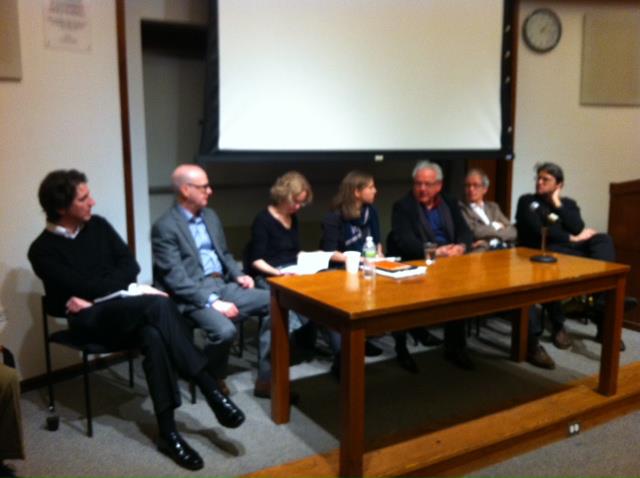
The Anachronic Shakespeare conference was excellent – a really interesting set of papers, engagingly delivered and with some really good discussion. John Archer gave a talk on sonnets 50 and 51 on the relation between human and animal, which he related to discussions in Heidegger, Derrida and Agamben. Vike Plock discussed the three-way relation between Joyce, Goethe and Hamlet. Jacques Lezra discussed theories of translation generally and in relation to A Midsummer Night’s Dream. Samuel Weber talked about Hamlet in relation to Carl Schmitt and Walter Benjamin. Julia Lupton responded to that paper, drawing in themes from the whole day, and then on the second day discussed Shakespeare and design, and what she called ‘softscapes’ with special reference to Macbeth. Anselm Haverkamp also talked about the sonnets, with a focus on life, detensed time, and reference to Whitehead, Foucault, Canguilhem and others.

I’ve come away with lots of ideas, inspiration to keep working on these topics, some uncertainties, a small reading list and some new friends. I plan to post more on my ‘Shakespearean Territories’ project soon – the enthusiasm that my paper received, and the suggestions, questions and suggestive questions, make me think this is worth pursuing. The question of succession, which had been brewing as one possible angle of approach but hadn’t quite crystalised before, is probably the thing I will be adding into the mix as a direct result of this conference. But the discussions here will likely have an impact throughout. It was an excellent event. Many thanks to Martin Harries, Daniel Hoffman-Schwartz, Elizabeth Bonapfel, Anselm Haverkamp and Susan Protheroe for organising this and inviting me to take part.

[photo L to R: Elden, Archer, Lupton, Plock, Weber, Haverkamp, Lezra]

Posted in Carl Schmitt, Conferences, Georges Canguilhem, Giorgio Agamben, Jacques Derrida, Martin Heidegger, Michel Foucault, Walter Benjamin, William Shakespeare | Leave a comment

What are Universities for?

Stefan Collini has a book out with that title, with an excerpt in The Guardian. Looks essential. It’s a shame academics are unable to set compulsory reading for their managers as well as their students.

Universities are not just good places in which to undertake such fundamental questioning; they also embody an alternative set of values in their very rationale. If we are only trustees for our generation of the peculiar cultural achievement that is the university, then those of us whose lives have been shaped by the immeasurable privilege of teaching and working in a university are not entitled to give up on the attempt to make the case for its best purposes and to make that case tell in the public domain, however discouraging the immediate circumstances. After all, no previous generation entirely surrendered this ideal of the university to those fantasists who think they represent the real world. Asking ourselves “What are universities for?” may help remind us, amid distracting circumstances, that we – all of us, inside universities or out – are indeed merely custodians for the present generation of a complex intellectual inheritance which we did not create, and which is not ours to destroy.

Posted in Politics, Universities | Leave a comment

The Geopolitics of King Lear: Territory, Land, Earth – audio

This is the audio recording of my lecture at the Anachronic Shakespeare conference. The accompanying Powerpoint slides are here. Thanks to Daniel Hoffman-Schwartz for the introduction. There was a good, challenging but helpful, discussion afterwards. The recording for that didn’t come out well, but I may try to clean up the audio and improve the volume levels. [Update: now available as an audio file]

Posted in Conferences, William Shakespeare | 2 Comments

New Perspectives on Bentham’s Panopticon

New book from Ashgate – Beyond Foucault: New Perspectives on Bentham’s Panopticon. Looks interesting, and especially for the largely Francophone contributors – shame about the prohibitive price. Clare O’Farrell wrote a preface. The intro is freely available here. (thanks to Foucault News for the alert)

Posted in Jeremy Bentham, Michel Foucault | Leave a comment

Breakfast Geopolitics

Overheard at breakfast this morning:

Waiter: Good morning

Young woman: Good morning. (Then in Spanish – making a big assumption) Is the orange juice fresh?

Waiter: (in English) no, it is not freshly squeezed.

Young woman: Okay. Where are you from?

Waiter: Bangladesh

Young woman: Ah! India!

Waiter: No, not India. Bangladesh. India is Hindu. I am a Muslim.

Young Woman: You’re from Pakistan!

Waiter: No.

You could run a seminar on it…

Posted in Uncategorized | 2 Comments

Rancière’s books

Thanks to Nicholas Dahmann for sending this – a visual response to my photo from yesterday. I wonder how many of these would fit in that over-sized box?

Posted in Uncategorized | Leave a comment

Gerry Pratt lecture at Queen Mary, London

Gerry Pratt is giving a public lecture at Queen Mary, University of London

“Temporary foreign workers and their children: (neo)liberal compromises and the violence of inclusion”.

Thursday 15 March 2012 at 6.00pm in the David Sizer Lecture Theatre, Francis Bancroft Building, followed by a wine reception. RSVP: a.tan@qmul.ac.uk

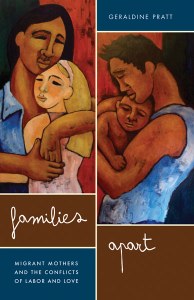
Gerry’s book Families Apart: Migrant Mothers and the Conflicts of Labor and Love has recently been published by University of Minnesota Press.

Posted in Conferences, Uncategorized | Leave a comment

Borders of Justice

Borders of Justice – new book edited by Étienne Balibar, Sandro Mezzadra and Ranabir Samaddar. You can read the introduction here.

Posted in Boundaries, Etienne Balibar | Leave a comment

New York talks

Off to New York, probably my favourite city. Three talks over the next few days…

24-25 February 2012 – “The Geopolitics of King Lear: Territory, Land, Earth”, Anachronic Shakespeare conference, Poetics and Theory program, New York University

27 February 2012 – Translator-meets-Critics session on Pierre Macherey, Hegel or Spinoza, translated by Susan M. Ruddick, Association of American Geographers

28 February 2012, 4pm – “Another Leibniz”, Association of American Geographers (part of a session on German Philosophy and Geography)

Posted in Baruch Spinoza, Conferences, Georg Wilhelm Friedrich Hegel, Gottfried Leibniz, Pierre Macherey, William Shakespeare | Leave a comment