

Polity now have a more detailed page up for this book, with blurb and table of contents. The book is on schedule for publication in December.
Polity now have a more detailed page up for this book, with blurb and table of contents. The book is on schedule for publication in December.
Even though there was an audio recording, I decided to type up my handwritten comments from which I improvised my response to Daniel Defert; Colin Gordon; Peter Fitzpatrick and Maria Carolina Olarte. There is some material here that was cut due to the time – there were three long papers and it was already after 7pm when I spoke, so this is record of both what I said and would have said. This is very much a pièce d’occasion, rather than the basis for anything more, though some of the themes relate to previous concerns, or will become part of future work. [The audio of the entire event can be found here.]
Thank you for the opportunity to say a few words.
I saw Colin Gordon’s paper before, and a version of Peter Fitzpatrick and Maria Carolina Olarte’s. While I didn’t see Daniel Defert’s paper I have read the lectures he was discussing and read his excellent ‘Situation du cours’.
I will confine my comments to four registers.
One of the things that the newly available materials by Foucault complicate is any sense of a straight-forward periodisation of Foucault’s work. Daniel Defert mentioned the complications of the ‘dernier Foucault’, but I think that the material challenges any sense of an early, mid or late Foucault.
This works in a number of ways:-
Twenty years ago Colin Gordon talked of Histoire de la folie as an “unknown book of Michel Foucault’s”. One of the things that the full text provided for me, when I read it in the mid 1990s early in my PhD, was a sense of how many of Foucault’s later concerns were anticipated in that book. We now of course have a full English translation as History of Madness.
Dits et écrits in 1994 was perhaps the first really serious challenge, and I’ll say more about that in a moment.
The lectures at the Collège de France especially complicate these ideas. One thing that is striking is the way that issues in The Order of Things are returned to, with a more explicitly political focus, in lectures. I’m thinking of the discussion of mathesis in ‘Society Must Be Defended’; or the return to the ideas of life/labour/language and political economy in The Birth of Biopolitics, as mentioned by Colin Gordon. Or the return to the last parts of History of Madness in Psychiatric Power, but with the new ‘power’ language and conceptual apparatus of the 1970s.
Leçons sur la volonté de savoir, as Daniel Defert explained, is an important transition text in Foucault’s work, and there is lots of material that is entirely new. Coming from 1970-71 it develops themes of power/knowledge, and in proposing a genealogy of knowledge alongside an archaeology of knowledge – instead of replacing one with the other – complicates a shift from archaeology to genealogy. It also proposes a genealogy of an ethic of truth, and the relation of truth to subjectivity. So, as well as anticipating Foucault’s work up to the mid 1970s – Discipline and Punish and the first volume of The History of Sexuality, with which it shared a title – this course opens up themes that would occupy Foucault for the rest of his life. In its focus on the Greeks it shares a subject matter with the 1980s; but in its concern with money, agriculture and juridical and political practice it also links to the late 1970s work on governmentality.
So, while there are certainly very many developments in Foucault’s work; there are not the radical breaks that are sometimes suggested.
We have, perhaps, tended to see the peaks – the books – and not the valleys that lie between them – the lectures and other materials. The wider availability of the lectures has filled in much of that detail.
This raises the question of how we read Foucault, or perhaps what Foucault do we read? Peter Fitzpatrick and Carolina Olarte briefly raised this question in their paper.
There is, of course, a distinction between lecture courses and other material delivered orally, and what Foucault chose to publish himself. Even Dits et écrits included a lot of material that had previously existed only in languages other than French or English, such as Spanish, Portuguese or Japanese, and translated back into French for that collection. These were materials Foucault did not intend to have in French, often written or spoken for a very difference audience.
(Let me note in passing how unfortunate and limited The Essential Foucault is compared to Dits et écrits, and lament how fragmented existing English collections are. The thematic, not chronological, arrangement does much to perpetuate the problems of periodisation just mentioned.)
Daniel Defert mentioned Foucault’s relation to Nietzsche, which is of course primarily in terms of content and approach. But there is a long running debate in terms of Nietzsche’s writings, of distinctions that should be drawn between Nietzsche’s books and his notebooks, edited initially as the pseudo-collection The Will to Power and more recently in proper critical editions. A key question for both Foucault and Nietzsche is whether any word committed to paper is the same as any other? For Foucault we can add: is any word spoken in a lecture to be taken the same as those in print?
There is also a question of who we read Foucault in relation to. Daniel Defert mentioned Foucault in relation to Heidegger and Deleuze, of which there is much discussion in his critical apparatus to Leçons sur la volonté de savoir, but I was also intrigued by his link of Foucault to Eugen Fink, especially Spiel als Weltsymbol, which has been influential in my own work.
Colin Gordon mentioned a few other links, some of whom are familiar such as Quentin Skinner, J.G.A. Pocock and Stephen Greenblatt; and Donald Kelley. There is also the German tradition of Begriffsgeschichte. And a French tradition of writers that worked alongside Foucault but are much less known – people like François Furet whose book on the French Revolution Colin Gordon mentioned; or Blandine Kriegel, whose L’Histoire de l’âge classique can be related to some of Foucault’s concerns about the political uses of history.
Comparisons between Foucauldian genealogy, the Cambridge School of contextual history, and Begriffsgeschichte are sometimes overdrawn, though there are certainly tensions to be discussed. I found all three approaches very valuable in my own work tracing the history of the concept of territory.
This opens up my third theme, that of using Foucault, of putting him to work. This is what Colin Gordon nicely calls ‘histories of later presents’. In this session, Peter Fitzpatrick and Carolina Olarte’s paper on thinking the death penalty was the most explicit use of Foucault, but the papers in the second day address this more fully.
One of the key things Colin Gordon called for was the need to finish Foucault’s projects – those he planned but did not live to write. But there are of course many themes that he would never have anticipated working on himself but on which others have found inspiration for their work in his. Many of the essays in The Foucault Effect of course did this themselves. Colin Gordon discussed this book in terms of themes within Foucault’s work that were discussed and not developed subsequently, but also in terms of what The Foucault Effect itself neglected.
But there is also the work Foucault left unfinished, but not unwritten. I am referring of course to Les aveux de la chair, a manuscript that Daniel Defert described at a conference at the LSE a few years ago as looking like a manuscript of Proust. The implication was that it was unreadable or at least unpublishable.
But there are people, many of whom are here at this conference, who could do this work. An edition with one page reproducing the manuscript in facsimile, and one page providing a working text from that; or a proper critical edition should be possible. Of course, the Mal faire, dire vrai lectures from Louvain in 1981, and Du gouvernement des vivants course from the Collège de France, both of which are forthcoming, will give us some insight into this theme. Yet given how central confession is to both the original thematic plan of the History of Sexuality and the historical plan Foucault was working on at his death, Les aveux de la chair is of crucial importance.
Given that the ‘no posthumous publications’ request is now (rightly) being interpreted in a more relaxed way, this would be a really important development.
Finally, I want to explicitly recognise that kind of work; the labours of editing and translating Foucault, but also generally.
Daniel Defert discussed this in terms of practices, but I want to mention it in terms of indebtedness. We simply would not be having these conversations were it not for the work of intellectual service or labour conducted by people, some of whom are here today.
Colin Gordon with Power/Knowledge and the Power volume.
Daniel Defert with Dits et écrits.
Daniel again for the recent Leçons sur la volonté de savoir, and others for the courses at the Collège de France more generally; Bernard Harcourt and Fabienne Brion for the Mal faire, dire vrai lectures.
Graham Burchell for his labours in translating Foucault’s lectures.
Yet these are all works of a single author. In terms of multi-authored, edited books, I find it hard to think of one in fields I work in that has had the same kind of impact (in a non-REF sense), or been more influential, than The Foucault Effect.
But this kind of academic labour – editing, translating, introducing and especially editing collections – is really undervalued, perhaps especially in the British system. This too is a particular kind of government rationality, of calculability.
As the line goes, if Foucault was writing a study of our academic research evaluation, it would be called Discipline and Publish…
So I will end with a hope: that this way of operating is entirely disregarded, and that the papers from this conference do not go their separate ways, or end up in journal special issues, but form the basis for something like The Foucault Effect II.
Those who have enjoyed the lectures on Capital Vol I will be pleased to see the news here.
update: Fredric Jameson’s book on Capital Vol I is reviewed here.
Reactions at The Disorder of Things; another news report in The Guardian, which among other things suggests Dawkins has little to do with it, Singer will give a single lecture, and Oxford don’t like the name. Brian Leiter also hosts an odd poll, noting that reactions in the US are considerably more favourable than those in the UK. [update: results and some discussion here.]
Among other things he talks about his love of sports and future directions for his work. Find it here.
Posted on behalf of Gavin Bridge from crit-geog-forum – please direct informal inquiries to him (gavin.bridge@manchester.ac.uk).
Geoforum (published by Elsevier) is looking for a new editor to join Gavin Bridge(Editor-in-Chief), Scott Prudham and Michael Samers in the management of the journal. Geoforum – www.elsevier.com/locate/geoforum – is a leading international journal publishing innovative research and commentary in human geography and related fields. Geoforum publishes research articles that are conceptually-led and empirically-grounded, critical reviews of recent research, and editorial interventions. It also features a highly-regarded ‘themed issue’ format that enables a focused exploration of emergent and/or significant areas of inquiry: recent examples include themed issues on New Feminist Political Ecologies, Transparency and Social Action in Ethical Commodity Networks, Mobilizing Policy, and Organisational Geographies of Power.
The editor will replace Katie Willis who is stepping down from the journal after serving as Editor and then as Editor in Chief for 6 years. Our preference is for someone with thematic expertise in issues of social geography and/development in order to handle submissions in this area. The editor can be based in any part of the world. Expressions of interest, including a CV and a short cover letter, should be sent to Geoforum’s editorial assistant, Hilary Backhouse, at geoforum@rhul.ac.uk by Monday June 20th 2011.
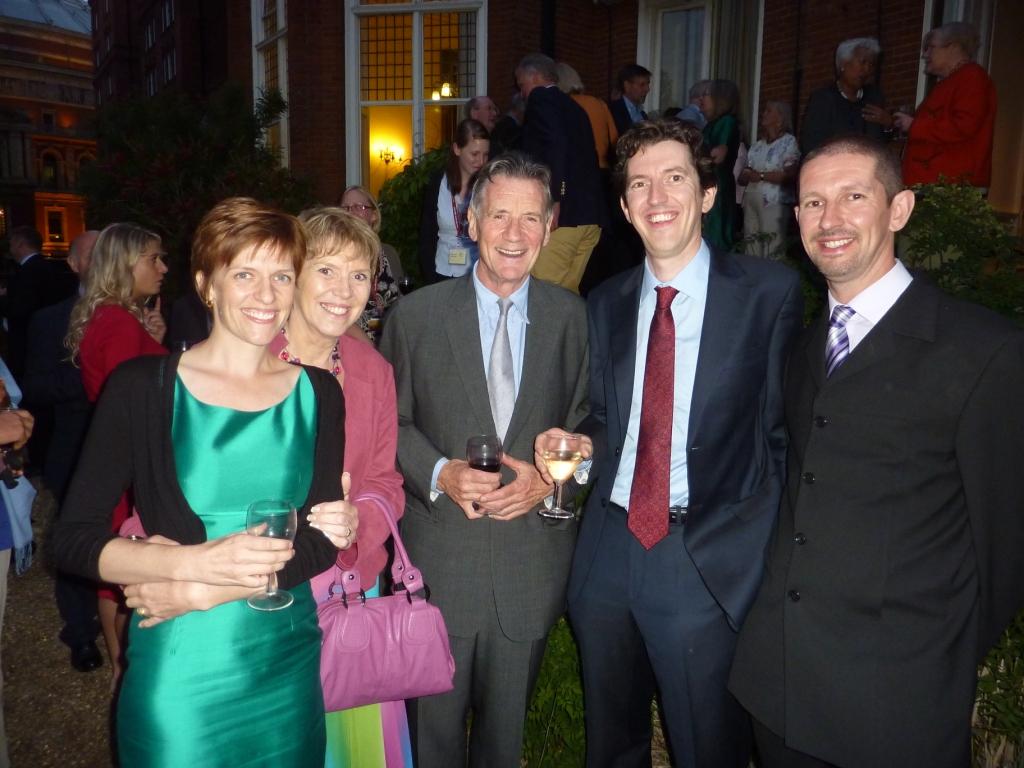
Monday evening was spent at the Royal Geographical Society, for the awards ceremony. The official list and photos are here.
Susan, my Mum and my brother Ian were able to join me, which was great. The RGS hosted a very good event, with a lunch reception, then a talk about some of the historical artefacts they possess, followed by the more formal events. They have some remarkable things in their collection, including the hats that Livingstone and Stanley were wearing when they met at Lake Tanganyika and remnants of the last meal Scott and his colleagues had in the Antarctic.
The awards ceremony was hosted by RGS president Michael Palin, who came across as having a genuine interest in geography. As the recipient of the Murchison award, for publications (mainly Terror and Territory), I had the unenviable task of giving a speech of thanks on behalf of a large group of the award winners. The recipients of the medals gave their own speeches, but I had to find a way to link some very disparate people together in my five-minute speech. Those people who kindly came to talk to me afterwards seemed to think I had done the best possible given the challenge.
I have very little recollection of what Palin said in my commendation – I’d been sent all the others in order to prepare my words, but not of course my own – as I was getting ready to give a speech which I was more than a little nervous about. Fortunately all the speeches were recorded and will appear in The Geographical Journal in the autumn.
Heidegger’s lectures collected in volume 36/37 of the Gesamtausgabe have been translated as Being and Truth. There is some unpleasant stuff here – these are the lectures delivered at the time Heidegger was rector of Freiburg. Miguel de Beistegui provides a review here.
Jeffrey Jerome Cohen talks about things that help get work done and self-imposed deadlines here and here.
Graham Harman offers some thoughts on productive bloggers here.
Of course, one way to maximise time is not to have (or answer) email. See the story of how to contact Terry Eagleton…
Birkbeck have issued a press release saying Grayling has resigned and that they are not providing facilities; Terry Eagleton calls it odious; the college is accused of copying syllabuses (shouldn’t that be syllabi?); in the same report we hear that Boris Johnston hopes it will succeed (the kiss of death?); and Lenin’s Tomb offers an incisive analysis.
More generally China Miéville elaborates a dystopian future based on current coalition policies.

