Territory: Conceptual, Political, Historical

I’ll be giving a talk at the Hong Kong Baptist University on 18th May. Because the audience will be mixed between faculty and students, I’ve been asked to be more general and so this will give me a chance to revisit some of the more contemporary political themes of my territory work. I may try to offer some thoughts on Libya and the death of Osama bin Laden. There will be a bit on The Birth of Territory but not so much focus on that as in other recent talks.

This talk outlines the work I have been doing on territory over the past several years. It discusses how territory needs to be taken much more seriously as a concept, which cannot be straight-forwardly understood as a ‘bounded space’ or as an outcome of ‘territoriality’. Instead, territory needs to be understood as a political question, but political in a broad sense: as economic, strategic, legal and technical. The bulk of the paper concentrates on the contemporary political situation of the ongoing ‘war on terror’, as outlined in the book Terror and Territory: The Spatial Extent of Sovereignty, and also makes some claims concerning the broader conceptual and historical themes of my ongoing work.
Posted in Conferences, Territory, Terror and Territory, The Birth of Territory | Leave a comment

New at the Society and Space blog

Over at the Society and Space blog, a couple of new things

Review editors Christian Abrahamsson and Mary Thomas explain a forthcoming selection of pieces on fiction.

A mini-interview with Pion publishing editor Amye Kenall on what happens after a piece is accepted.

Posted in Publishing, Society and Space | Leave a comment

Spatial Justice workshop videos

The videos from the Spatial Justice workshop at the University of Westminster last year are available here. Chaired by Chantal Mouffe, it includes talks by David Harvey, Doreen Massey, Engin Isin, Mustafa Dikeç and others. (Thanks to Rory for the link.)

Posted in Conferences, David Harvey, Engin Isin | Leave a comment

Higher Education in North America

Very interesting piece in The Nation.

Posted in Politics, Universities | Leave a comment

Noel Castree on the Future of Geography in English Universities

Depressing but important reading in The Geographical Journal.

Posted in Politics, Publishing, Universities | Leave a comment

British Intellectuals?

The Guardian has published a list of its top 300 British intellectuals here. Some commentary here and thoughts from 10 ‘intellectuals’ here.

I’m less interested in who is included (and who not) than the categories into which they are put. ‘Academics’ doesn’t include philosophers, scientists, classicists, historians etc. so is presumably a category to scoop up who’s left over. Lots of novelists included, and lots of ‘critics’, and an awful lot of journalists some of whom could have been included elsewhere. Few scientists. I’d be interested to hear how they are distinguishing between ‘political theorists’ and ‘political philosophers’; and what is ‘social scientists’ doing here given other categories? All a bit erratic and something of a strange exercise.

Posted in Uncategorized | 2 Comments

Moretti on Hamlet

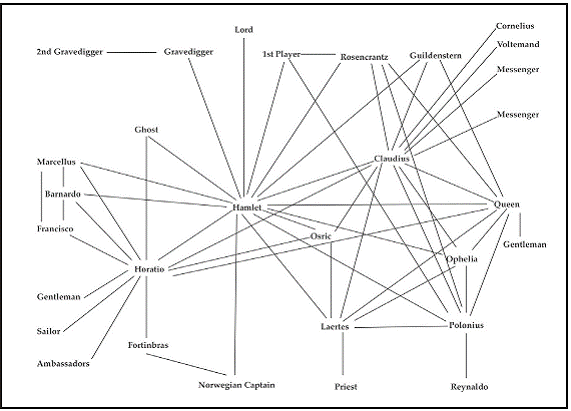
Franco Moretti has a piece on Hamlet in New Left Review. It’s available here, though that may require subscription, or free access in a variant form here.

This is an illustration of how Moretti’s approach of not reading novels as much as mapping, graphing and diagramming them works. It shows both the benefits and limitations of the analysis. It generates stuff like this:


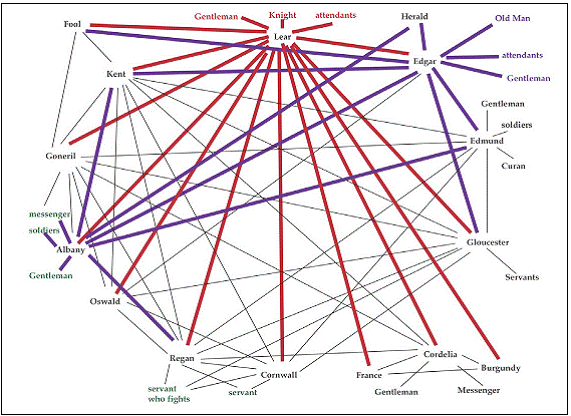
Some of the later material on sovereignty and legitimacy is interesting, visually depicting the claim that “Shakespeare’s major tragedies are reflections on the nature of sovereignty, in which an initial figure of legitimacy is ousted by a usurper, who is in his turn defeated by a second figure of legitimacy” (p. 88). This leads to some thoughts on King Lear. 

There is also the later the claim that geography replaces genealogy as the “hidden dimension of fate”: “Genealogy, vertical, rooted in myth; geography, horizontal, in something like the nascent European state system” (p. 92).

Thanks to Crooked Timber for the link, in a piece with the inspired title of ‘Six Degrees of Danish Bacon’.

Posted in Franco Moretti, William Shakespeare | 1 Comment

Call for Papers: The Royal Body

Call for Papers
Centre for the Study of Bodies and Material Culture, Royal Holloway, University of London
2-5 April 2012

‘For the King has in him two bodies . a Body natural and a Body politic.’

The idea of the king’s two bodies, the body natural and the body politic, founded on the distinction between the personal and mortal king and the perpetual and corporate crown, has long been of interest to scholars of medieval and early modern kingship. In later centuries the natural body of the monarch remained a contested site, with the life, health, sexuality, fertility and death of the king or queen continuing to be an important part of politics. Now royal sex and scandal is the very stuff that sells newspapers, and royal christening, weddings and funerals continue to capture the popular imagination. Indeed the ‘royal touch’ of Aids victims or sick children remains a potent image. So what is the significance of the natural body of the monarch to their subjects now and the importance of it for the concept, and survival, of monarchy?

This conference will explore the bodies of monarchs across Europe ranging from the medieval period to the present. By considering how the monarch’s body has been washed, dressed, used, anointed, hidden, attacked and put on display, it will investigate how ideas of king/queenship have developed over time.

Abstracts of 300 words, for papers of approximately 20 minutes, should be submitted by 15 September 2011 to Dr Anna Whitelock, Department of History, RHUL, anna.whitelock@rhul.ac.uk

The conference will take place at Royal Holloway, Egham, Surrey, on 2-5 April 2012.

Topics might include:

.       Body service – dining, dressing, washing
.       Rituals and ceremony
.       Bodyservants and bodyguards
.       Royal sleep -dreams and nightmares
.       Assassination attempts
.       Age, health and pregnancy
.       Deformity and disability
.       Royal births and deaths
.       Regicide 
.       Royal touch
.       Divine bodies
.       Christenings, coronations, weddings and funerals
.       Sexuality
.       Fertility, chastity, virility
.       Royal doctors
.       Effigies and monuments
.       Royal Dress
.       Sex and Scandal
.       Historiography                 
.       Iconography and representation
.       Drama and literature
.       Political theory

Posted in Conferences, Medieval Studies | 1 Comment

Lee Braver interview

Figure/Ground’s latest interview is with Lee Braver – Department Chair and Associate Professor of Philosophy at Hiram College, where he teaches advanced seminars on Being and Time, Wittgenstein, Kierkegaard, Foucault, Later Heidegger, Being & Nothingness, Postmodernism,  Phenomenology and Derrida. He specializes in nineteenth and twentieth century continental philosophy, history of philosophy, the connections between analytic and continental philosophy, Wittgenstein, Heidegger and Foucault. He is the author of A Thing of This World: A History of Continental Anti-Realism (Northwestern University Press, 2007) and Heidegger’s Later Writings: A Reader’s Guide (Continuum Books, 2009)

The interview can be found here. There are lots of others on this site here.

Posted in Lee Braver, Martin Heidegger | Leave a comment

The Foucault Effect 1991-2011 conference

More details about this interesting looking conference are available here.

Posted in Conferences, Michel Foucault | Leave a comment