

I posted the call for papers before, but now there is a poster and a provisional conference programme. Unfortunately I get to Hong Kong the day after this ends…
I posted the call for papers before, but now there is a poster and a provisional conference programme. Unfortunately I get to Hong Kong the day after this ends…
Over at his Place Hacking site, Bradley L. Garrett tells the story of accessing the ‘Mail Rail’ underground railway in London. Great photos and writing. See also the account at ‘Silent UK‘ which has more photos and some background. Very interesting.
Alongside the stuff on fossils I’ve been reading, I’ve also been accumulating a few notes and references to things that seem closer to what Meillassoux means by an arche-fossil. The work of Lord Kelvin on the cooling of the earth, using physical laws rather than observation of natural phenomena is important, but also Lord Rutherford’s work on radioactive decay, and the development of this by Marie and Pierre Curie. The Age of the Earth by G. Brent Dalrymple is helpful as an introductory guide (though a little dated); but Pascal Richet, A Natural History of Time is a much better book.
On Meillassoux, these two recent posts are worth a look – from An und für sich; and from Graham Harman. The first suggests that the argument concerning the arche-fossil is ‘terrible’ but its real point is to raise the question of temporality. I wouldn’t describe it as a terrible argument but it does seem to me to be most interesting in terms of time. Graham’s post works as another trailer for his forthcoming book on Meillassoux. I’m hoping to get back to my ‘Fossils’ paper soon, but there are a number of other demands on my time at the moment.
A few days away over Easter with family visiting the Blue Mountains, Sydney, Bateman’s Bay and the nature reserve at Tidbinbilla. Now back in Canberra for a few days and then an unexpected short trip to the US at the end of the month. Then back here again before I leave on 15 May, to Hong Kong and Macau and then back to England.
Around this I’ve been trying to keep up on work, especially editing the journal, but also some reading. Hopefully will get to more of that on all those flights…
Another useful resource from Sean Sturm here.
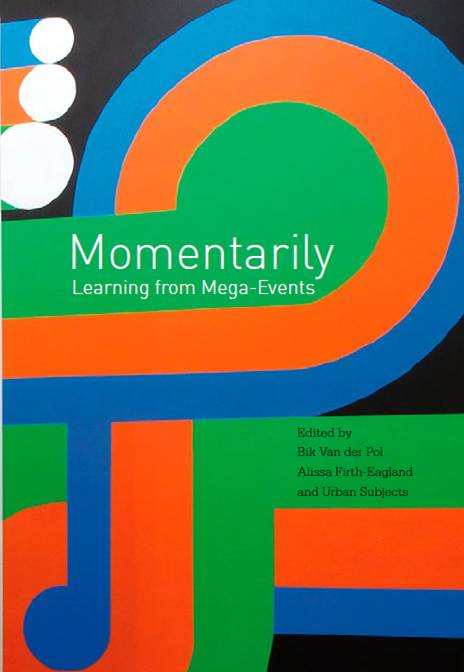
Free e-book – Momentarily: Learning From Mega Events, available here.
Strategic, simplified, spotless, homogenizing representations require a pluralistic response which engages the visual tactically. Unlike the image of Vancouver, the project’s category-defying qualities are not clear-cut nor easily pinned down. This project exists within several forms each increasingly visible: a residency, an exhibition that commissioned two new works, a symposium with more than thirty speakers, and now this publication.
A research process that has unfolded since 2009, Momentarily: Learning from Mega-Events began with a shared interest in the impacts of the 2010 Olympic Games on Vancouver, at a time when this city has been noted as especially livable. Through multiple textual forms – from semi-fiction to interview to theoretical historical examination – this publication explodes first doubts and curiosities.
More details, from the book’s launch, here. There is a short text by me on Henri Lefebvre’s theory of moments in the book.
Radical Foucault: An International Conference
September 8th – 9th, University of East London (Docklands Campus)
Centre for Cultural Studies Research, University of East London
http://culturalstudiesresearch.org/?p=591
Following the superb international response to our initial call for papers, we have decided to expand the event into a two-day conference. This has opened up a very limited amount of space for further contributions. Abstracts of no more than 350 words are invited, to arrive no later than Sunday May 8th 2011.
The publication of Michel Foucault’s Lectures at the Collège de France, 1983-84 in English will be complete in April 2011 and his first Collège de France lecture course, La Volonté de Savoir will be published for the first time in February. The Centre for Cultural Studies Research at the University of East London is holding a an international conference which will re-assess Foucault’s contribution to radical thought and the application of his ideas to contemporary politics. What does it mean to draw on Foucault as a resource for radical politics, and how are we to understand the politics which implicitly informs his work?
Many commentators today would seem to claim Foucault as the theorist of a politics which eschews all utopian ambition in favour of a certain governmental pragmatism, while others would claim him for a rigorous but ultimately rather simple libertarianism: can either of these positions ever be adequate to the radicalism of Foucault’s analyses? Does it matter?
What is the significance of Foucault’s ideas of ‘governmentality’ and ‘biopolitics’ in understanding his later oeuvre and its implications; do either of these terms deserve to carry the weight attributed to them by some commentators? What is the ongoing relevance of Foucault’s account of disciplinarity: is, it, as Lazzarato has claimed, a historical category no longer fully applicable to contemporary forms of power?
How can Foucauldian ideas be brought bear on the analysis of austerity politics? Is there a role for Foucault’s ideas in formulating effective resistance to the increasing erosion of civil liberties that operates both within countries and across state boundaries? Can the notion of bio-power account for contemporary forms of racism? How can Foucauldian epistemology enable an understanding of the biopolitics of contemporary scientific discourse?
Confirmed Keynotes:
Stuart Elden, Professor of Political Geography, Durham University.
Mark Kelly, Lecturer in Philosophy, Middlesex University.Subjects may include, but are not limited to:
Foucauldian thought and contemporary subjectivation
Foucault and other thinkers
Governmentality and everyday life
Strategic discourses of war and terror
New technologies of the self
Foucault and new forms of resistance
Heterotopias now and in the future
Foucault and the erosion of the state
Disciplinary society and the society of control
Foucault, British politics and the ‘big society’
Foucault, post-Fordism and post-democracyEmail abstracts to Jeremy Gilbert (j.gilbert@uel.ac.uk) and Debra Benita Shaw (d.shaw@uel.ac.uk)
Registration will cost £110.00 per delegate (including lunch, not including accommodation or dinner) for both days. A day-rate of 65.00 will be available, but delegates will be strongly encouraged to attend on both days, and the organisers cannot promise to accommodate requests to present on a particular day.
In comments to an earlier post, Robert Mayhew offers some useful thoughts. Robert rightly points to his own work. Much is already available, but on his website he points to two fascinating sounding future projects:
At present, I am engaged actively in work in two main arenas. First, I am writing a book length study of geography’s interactions with the humanities tradition of scholarship over the period from ancient times to 1945. This project is an attempt both to extend the chronological range we normally think about as geographers and to redirect attention to the extent to which geography was a scholarly enterprise entwined with the main trunk of the European humanistic tradition. Secondly, my long held and entirely unhealthy obsession with footnotes has broadened into an increasing interest in seeing geography as a textual tradition where we need to analyse the relations between authors, publishers and readers to understand the genealogy of this form of inquiry.
Both these sound great, and the idea of broadening the historical range of geography’s engagements and one that works on the resolutely textual alongside other concerns both fit with many of my own interests.
While I’m on this topic, worth a plug for the historical geography series Robert edits for I.B. Tauris.
New issue of Foucault Studies out – largely a theme issue on Foucault and Pragmatism, including papers by Paul Rabinow and Todd May.

