Working on the proofs of the critical edition of Georges Dumézil, Mitra-Varuna – forthcoming in December 2024 with HAU books

It has taken a long time to get to this stage, but I’m now working on the proofs of the critical edition of Georges Dumézil, Mitra-Varuna: An Essay on Two Indo-European Representations of Sovereignty – forthcoming in December 2024 with HAU books.

The new edition uses the translation by Derek Coltman as the basis, but also has notes with all the first edition variants, updated, completed and sometimes corrected notes, a new Introduction by me and an Afterword by Veena Das.

A photo of the proofs of the new, critical edition, the 1988 original English translation, and the French second edition of 1948
Posted in Georges Dumézil, Mapping Indo-European Thought in Twentieth Century France | Leave a comment

Books received – The Anti-Security Collective, Barthes, de Beistegui, Duchesne-Guillemin, Nabokov, JHI, Barua, Dumézil

A pile of recently bought or sent books including The Anti-Security Collective, The Security Abolition Manifesto, Miguel de Beistegui, Lacan: A Genealogy, Jacques Duchesne-Guillemin, Zoroastre, Vladimir Nabokov’s translation of The Song of Igor’s Campaign, the most recent issue of the Journal of the History of Ideas, Maan Barua, Plantation Worlds, and a somewhat battered first edition of Georges Dumézil’s La Religion romaine archaïque.

One of the collective sent the manifesto, and Barthes and de Beistegui were in recompense for review work. Duke University Press kindly sent the copy of Plantation Worlds. I have an essay in the journal –  “Foucault and Dumézil on Antiquity” – and the first edition of Dumézil’s text will be useful as I continue working through his books in detail (I already have the second, revised edition and translation). The article is behind a paywall, but email me if you don’t have institutional access and would like to see a copy.

Posted in Georges Dumézil, Jacques Lacan, Mapping Indo-European Thought in Twentieth Century France, Michel Foucault, Roland Barthes, Uncategorized | Leave a comment

Tamara Caraus, Militant Cosmopolitics: Another World Horizon – Edinburgh University Press, May 2024 (paperback)

now in paperback – Tamara Caraus, Militant Cosmopolitics: Another World Horizon – Edinburgh University Press, May 2024

Maps the radical cosmopolitan dimension of global protests and social movements from recent decades

  • Rethinks the foundations, practices and institutions of cosmopolitanism from a radical perspective
  • Reads the first cosmopolitan stance of the Ancient Cynics as a militant cosmopolitics 
  • Argues for conceiving the idea of World Republic as the institution of critique
  • Formulates a sustained critique of political philosophy’s reluctance to view human beings as citizens of the world
  • Works across the disciplines of political theory, critical theory, continental philosophy, poststructuralism and deconstruction

This book explores cosmopolitanism’s radical dynamic as expressed in the struggles from below, all over the world, against exclusion and domination, pointing to the horizon of another world that appears possible. It shows that cosmopolitanism emerges negatively through disaffiliation from the given forms of belonging and by questioning of the existing meanings and unjust practices. Through a radical critique, cosmopolitanism goes to the roots of the existing world order based on the nation-state, exposes its exclusionary structure, and brings instead the idea of a World Republic where No One Is Illegal and where all are equal citizens of the world.

Posted in Uncategorized | Leave a comment

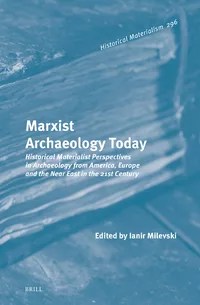
Ianir Milevski (ed.), Marxist Archaeology Today – Historical Materialist Perspectives in Archaeology from America, Europe and the Near East in the 21st Century – Brill, September 2023

Ianir Milevski (ed.), Marxist Archaeology Today – Historical Materialist Perspectives in Archaeology from America, Europe and the Near East in the 21st Century – Brill, September 2023

With this series, usually paperbacks follow 12 months after publication with Haymarket.

This volume gathers papers written by archaeologists utilising the methods of historical materialism, attesting not only to what Marxism has contributed to archaeology, but also to what archaeology has contributed, and can contribute, to Marxism as a method for interpreting the history of humanity. The book’s contributors consider the question of what archaeology can contribute to a historical perspective on the overcoming of present-day capitalism, synthesising developments in world archaeology, and supplying concrete case studies of the archaeology of the Americas, Europe and the Near East.

Contributors are: Guillermo Acosta Ochoa, Marcus Bajema, Bernardo Gandulla, Alex Gonzales-Panta, Pablo Jaruf, Vicente Lull, Savas Michael-Matsas, Rafael Micó, Ianir Milevski, Patricia Pérez Martínez, Cristina Rihuete Herrada, Roberto Risch, Steve Roskams, Henry Tantaleán, Marcelo Vitores, and LouAnn Wurst.

Posted in Uncategorized | Leave a comment

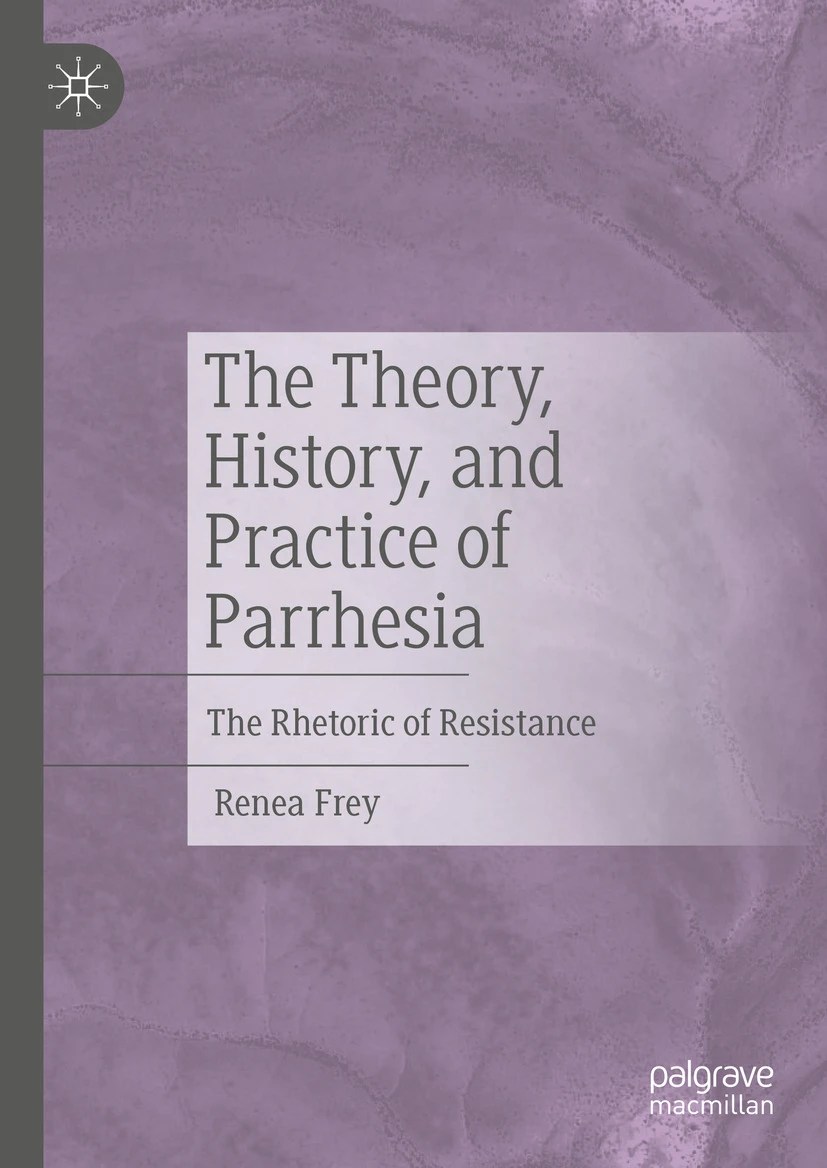
Renea Frey, The Theory, History, and Practice of Parrhesia: The Rhetoric of Resistance – Palgrave, September 2024

Renea Frey, The Theory, History, and Practice of Parrhesia: The Rhetoric of Resistance – Palgrave, September 2024

This book examines the theory, history, and practice of parrhesia—the act of speaking truth to power, when doing so is risky for the rhetor—and argues for a networked rhetorical approach to parrhesia that has not been considered previously by any other theorist. The goal of this book is to offer a reader-friendly explanation of this networked rhetorical approach to parrhesia, provide a genealogical account of the origins of parrhesia in the Classical age, and to show how parrhesia manifests today. This book is meant to give readers a functional manual for understanding, recognizing, analyzing, articulating, and using parrhesia.


Posted in Uncategorized | 1 Comment

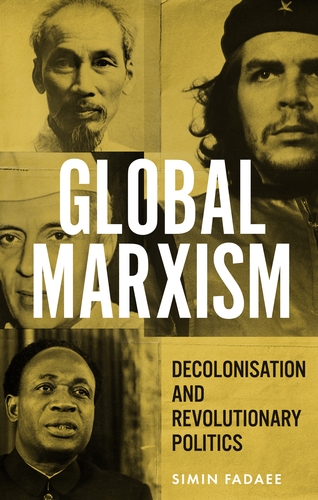
Simin Fadaee, Global Marxism: Decolonisation and revolutionary politics – Manchester University Press, September 2024

Simin Fadaee, Global Marxism: Decolonisation and revolutionary politics – Manchester University Press, September 2024

A cutting-edge exploration of how Marx’s ideas have been adopted and adapted by revolutionary thinkers in the Global South.

For much of the twentieth century, the ideas of Karl Marx provided the backbone for social justice around the world. But today the legacy of Marxism is contested, with some seeing it as Eurocentric and irrelevant to the wider global struggle.

In Global Marxism, Simin Fadaee argues that Marxism remains a living tradition and the cornerstone of revolutionary theory and practice in the Global South. She explores the lives, ideas and legacies of a group of revolutionaries who played an exceptional role in contributing to counter-hegemonic change. Figures such as Ho Chi Minh, Kwame Nkrumah, Ali Shariati and Subcomandante Marcos did not simply accept the version of Marxism that was given to them – they adapted it to local conditions and contexts. In doing this they demonstrated that Marxism is not a rigid set of propositions but an evolving force whose transformative potential remains enormous.

This global Marxism has much to teach us in the never-ending task of grasping the changing historical conditions of capitalism and the complex world in which we live.

Posted in Uncategorized | Leave a comment

Daniel G. König (ed.), Entangled Worlds: 600-1350 — Harvard University Press, March 2025

Daniel G. König (ed.), Entangled Worlds: 600-1350 — Harvard University Press, March 2025

The period between the seventh and fourteenth centuries is hardly thought of as an era of globalization. Entire societies in the Americas, Australia, and Oceania developed in relative isolation from other parts of the world. Even on the interconnected landmass of Eurafrasia, many people had little to do with processes of transregional exchange.

Yet the period 600–1350 CE in fact witnessed an explosion of connectivity amid the consolidation of sophisticated approaches to human organization. Flows of people, goods, and ideas across regional boundaries intensified, changing lives at all social levels, from rulers to the enslaved. In the Americas, large cities and north-south trade networks took shape. The Arabic-Islamic conquests of the seventh and eighth centuries, along with the Mongol expansion of the thirteenth, tied together diverse polities from southeast Asia to sub-Saharan Africa. Regions also became more culturally and politically integrated: Latin-Christian models of social organization spread across Europe; the Sinitic written language drew eastern Eurasia into a common elite culture; and the accumulation of significant agricultural surpluses in the Indian subcontinent supported the emergence of a settled political order.

Entangled Worlds sees the completion of the magisterial six-volume set History of the World, offering an authoritative introduction to a vibrant era of global history. The distinguished contributors make clear that there never was a stagnant “Middle Ages” wedged between Antiquity and Modernity but instead a period defined by decisive strides toward global connection, urbanization, and the cultural and political formations we live with today.

Posted in Uncategorized | Leave a comment

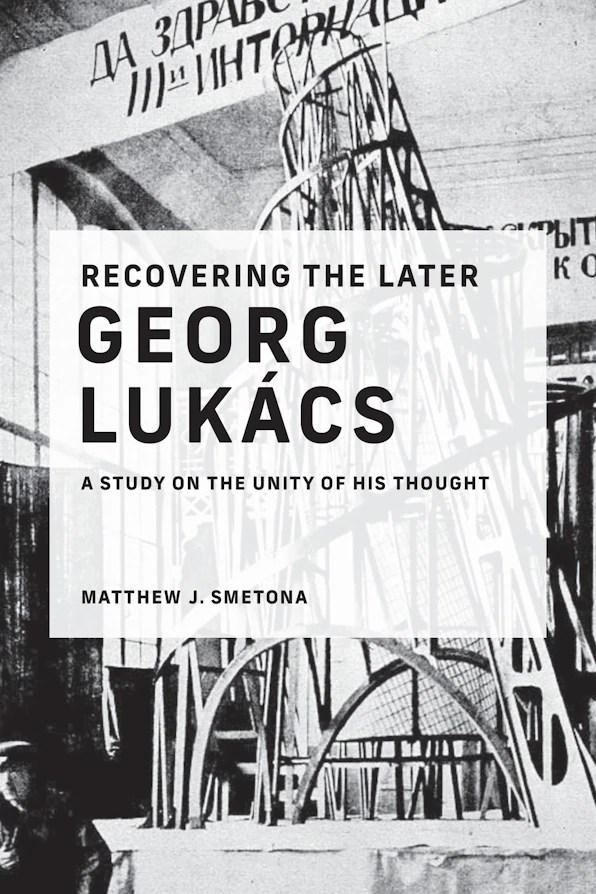
Matthew J. Smetona, Recovering the Later Georg Lukács: A Study on the Unity of His Thought – MIT Press, April 2023

Matthew J. Smetona, Recovering the Later Georg Lukács: A Study on the Unity of His Thought – MIT Press, April 2023

New resources for the critique of capitalism in culture from the late writings of Georg Lukács, one of the first authors in the tradition of Western Marxism.

The Hungarian literary critic, philosopher, and Marxist social theorist Georg Lukács is best known for his 1923 History and Class Consciousness, in which he offered an influential critique of reification from the standpoint of a dialectical conception of totality. While Lukács’s early works have been central to the study of Marxist thought, his later works have often been dismissed as political accommodations to Stalinism. In this new study, Matthew Smetona argues for a revisionist interpretation of Lukács’s later writings on topics as diverse as aesthetics, politics, and ontology. 

Smetona demonstrates that these writings reveal a methodological unity that follows directly from History and Class Consciousness, in which realism, in both literary and extraliterary senses, becomes the basis for the critique of reification. As Lukács had demonstrated, reification is that process by which the social relations between persons seem to take on the character of a thing. Rooted in Marx’s concept of commodity fetishism, the critique of reification proved, in Lukács’s hands, to be a flexible tool capable of clarifying all manner of obfuscations that arise within the social relations that capitalism produces. To recover the later work of Lukács is to open up new horizons for Marxist cultural criticism.

Posted in Georg Lukács | Leave a comment

Valentina Antoniol and Stefano Marino (eds.), Foucault’s Aesthetics of Existence and Shusterman’s Somaesthetics – Bloomsbury, August 2024

Valentina Antoniol and Stefano Marino (eds.), Foucault’s Aesthetics of Existence and Shusterman’s Somaesthetics – Bloomsbury, August 2024

Bringing together Michel Foucault’s aesthetics of existence and Richard Shusterman’s somaesthetics, this volume provides a critical comparison of two of the most influential philosophical theories of the late 20th and early 21st centuries.

Introduced by a comprehensive overview of both concepts by editors Stefano Marino and Valentina Antoniol, the ensuing chapters interrogate the affinities and variances between Foucault’s and Shusterman’s philosophies. Building on the interdisciplinary character of somaesthetics and aesthetics of existence, international scholars explore these ideas through a wide range of topics ranging from care of the self and of the social self to the ethical and political challenges posed by themes as white ignorance, construction of resistances, and production of subjectivities. Given the central role played by the body in both concepts, this volume also affords particular attention to the philosophy of sexuality.

Demonstrating the value of reading these two thinkers together through the adoption of radical interpretive perspectives, Foucault’s Aesthetics of Existence and Shusterman’s Somaesthetics highlights the potentialities and the relevance of Foucault’s and Shusterman’s theories, even with respect to our actualité.

Posted in Uncategorized | Leave a comment

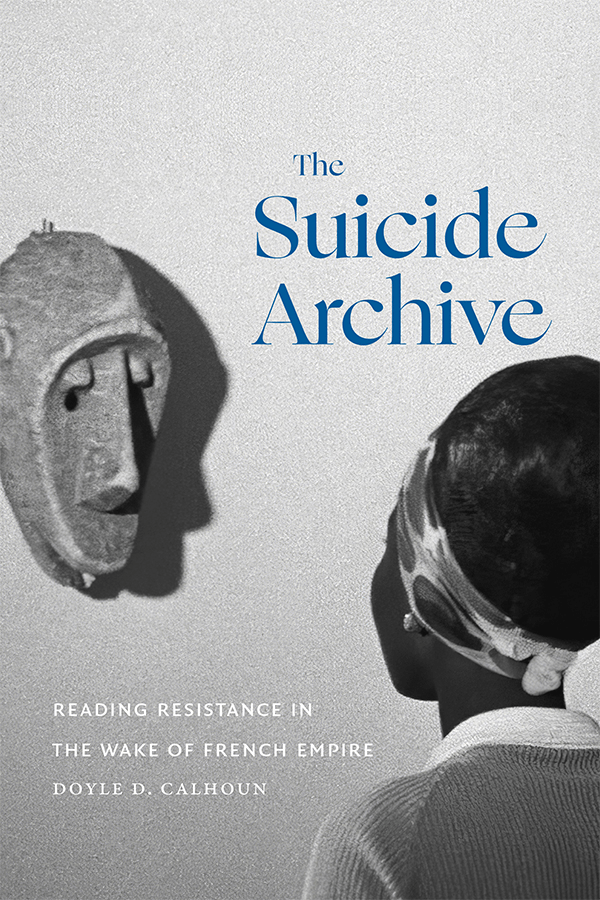
Doyle D. Calhoun, The Suicide Archive: Reading Resistance in the Wake of French Empire – Duke University Press, October 2024, with open access introduction available now

Doyle D. Calhoun, The Suicide Archive: Reading Resistance in the Wake of French Empire – Duke University Press, October 2024

The open access introduction is available now.

Throughout the French empire, from the Atlantic and the Caribbean to West and North Africa, men, women, and children responded to enslavement, colonization, and oppression through acts of suicide. In The Suicide Archive, Doyle D. Calhoun charts a long history of suicidal resistance to French colonialism and neocolonialism from the time of slavery to the Algerian War for Independence to the “Arab Spring.” Noting that suicide was either obscured in or occluded from French colonial archives, Calhoun turns to literature and film to show how aesthetic forms and narrative accounts can keep alive the silenced histories of suicide as a political language. Drawing on scientific texts, police files, and legal proceedings alongside contemporary African and Afro-Caribbean novels, film, and Senegalese oral history, Calhoun outlines how such aesthetic works rewrite histories of resistance and loss. In so doing, Calhoun offers a new way of writing about suicide, slavery, and coloniality in relation to literary history.

Posted in Uncategorized | Leave a comment