Translations

Graham replies to my post on intellectual generosity here, and his slight disagreement with me is well taken. I suppose translation of the sort Graham has done, or I’ve done with Lefebvre (or to a much lesser extent with Foucault) is perhaps closer to intellectual service than generosity.

I like Graham’s followup about the ‘person in question should be of a level comparable to that which they translate’. That’s quite a challenge to think of examples. Foucault translated Kant’s Anthropology, and Lefebvre and colleague Norbert Guterman translated some Marx, Lenin and Hegel, but these were early in career. Lacan translated one of Heidegger’s essays – the ‘Logos’ one if I remember correctly. The relative standings of Foucault and Kant; Lefebvre and Marx; Lacan and Heidegger seem to me fairly clear, but they are obviously all serious figures. Beyond that? There were the translators of Aristotle – William of Moerbeke, Hermann the German and Albertus Magnus – whose work enabled so much that Aquinas did, but they clearly realised they were not of the same calibre as Aquinas, and so again it was closer to service work. Hobbes translated Thucydides and Aristotle, but I can’t think of many other examples. But it’s an interesting thing to reflect on.

Posted in Georg Wilhelm Friedrich Hegel, Henri Lefebvre, Karl Marx, Martin Heidegger, Michel Foucault, Thomas Hobbes | Leave a comment

Communist Manifesto illustrated

Red Quill books have produced an illustrated version of The Communist Manifesto. Chapter 1 initially but more to follow. Details here and there is a promo video too.

Posted in Karl Marx, Uncategorized | Leave a comment

Intellectual Generosity

Graham Harman asks:-

What are the great acts of generosity in intellectual history? I’m not saying that generosity has to be free of all selfish motive; in fact, far from it. By “generosity” I mean the decision that someone is worthy of our pouring much of our own scarce energy into furthering their cause (even if it furthers our own as well).

Here are some of the examples that jump immediately to mind:

1. Baudelaire translating the complete tales of Poe. The remarkable thing here is that Baudelaire wasn’t an especially self-disciplined person, and was in fact a bit of a self-indulgent overspender running up debts for frivolities. But it’s remarkable to read the testimony of his friends, who would drop by and find Baudelaire so engrossed in his translation work that he would ignore them and continue. It was as if a sort of demon had possessed Baudelaire. The result is already known: Poe now belongs to French literature perhaps even more than to the American. In fact, this sort of hijacking of the foreign seems to be quite typical of generosity, as you can see from my next example…

2. Averroes (Ibn Rushd) agreeing to write commentaries on all the works of Aristotle. Yes, he was asked to do so by the powerful caliph in Cordoba. But he possibly could have said no, and even once agreeing there was no one who could force him to pour so much energy into it. And here too, the result is well known: Aristotle for a time belonged much more to Islamic philosophy than to European Christian thought.

Good examples, certainly. To be honest, most academic translation work fits the description of intellectual generosity, because academic translation is poorly paid and making a living from it must be very difficult. Translation isn’t well regarded as a publication choice either.

Historically, I’d suggest that Boethius and Isidore of Seville are examples closer to what Graham is thinking of. Without their labours of translation into Latin in the case of Boethius, and compilation in the case of Isidore, the medieval knowledge of the classical world would have been immeasurably poorer. And that means our knowledge of the classical world too, although much was later retrieved directly from the Greek (mediated through the Arabic in some cases). Boethius in particular fits the bill, because he tried to translate all the works of Plato and Aristotle into Latin. He did several, but not all. So there is also an interesting counterfactual history. Had he completed his task, what would have been different? Works which were effectively lost to the Latin West for several centuries would not then have had the impact they did have when rediscovered.

The second example is the work of Tribonian, employed by the Byzantine emperor Justinian to codify classical Roman law. This was the Corpus Juris Civilis, the body of civil law. It included laws and a compilation of the best legal opinions. The Digest and the Codex are major sources of what the Romans did with the law. Because they were copied after Tribonian’s time, and the source laws much less frequently, these works preserve much that might otherwise have been lost. Though of course it was partly because they existed that the other works were less copied. And the impact Roman law had and continues to have is enormous. Now this doesn’t quite fit Graham’s criteria, as Tribonian was furthering a more diverse body of work than that of a single author, but it is close. And Tribonian is much less known than Justinian, and Tribonian certainly furthered his cause.

Posted in Medieval Studies | 1 Comment

Revista Urban calls for papers

The Spanish journal Revista Urban has calls for papers for two new themes here. One of them in particular is interesting

Specters of Lefebvre
Henri Lefebvre continues to cast a long shadow. Under the sign of a ‘spatial turn’, the social theories of the 21st century have incessantly recovered the thoughts of a life that spanned the whole of the 20th century. His first texts were contemporary with those of Poëte, Lavedan, Lenin, Benjamin, Heidegger, Mumford, Eluard, Tzara, with the u/dys/topias of Le Corbusier and the institutionalisation of town planning, the birth of mass consumption and the formation of Totalitarianism, the proliferation of working-class movements, the films of Chaplin and the Paris that sleeps of René Clair. His late work co-exists alongside that of Harvey, Soja, Negri, Jameson, Bourdieu, Sennett, the unromantic city of the global suburbs and the defence of the lived-in city of historic centres, the consolidation of modern neo-liberal regimes, the decline of welfare societies and the constriction of everyday life in compulsive consumer networks.

All kinds of syndromes and (almost) a century have existed until his death in 1991. And then, le déluge; a torrent of resurrections, re-editions, appropriations, approaches, translations and betrayals… The Specters of Lefebvre haunt the cartographies of critical urbanism, human geography, cultural studies and political thought.

The twentieth anniversary of his death takes place next summer: 20 years without Lefebvre, 20 years filled with Lefebvre. In the next issue of URBAN we call for the preparation of critical studies to re-interpret his work, his idea of the city and urbanism, everyday life, history, philosophy, politics; the spatialisations of Lefebvre, his Marxisms and sociologies, his visions of the connection between urbanism and social reproduction, his heterodoxies, shadows and errors, his sources and legacies; we invite you, in short, to textually re-live his maxim, that of reflecting on the city and changing it, as a necessary moment in the transformation of life and society.

The first issue of the new series should be out shortly.

Posted in Henri Lefebvre, Publishing | Leave a comment

Foucault and Agamben

Foucault Studies 10, a theme issue on Foucault and Agamben is now available, open access, here.

Posted in Giorgio Agamben, Michel Foucault | Leave a comment

Book Bloc

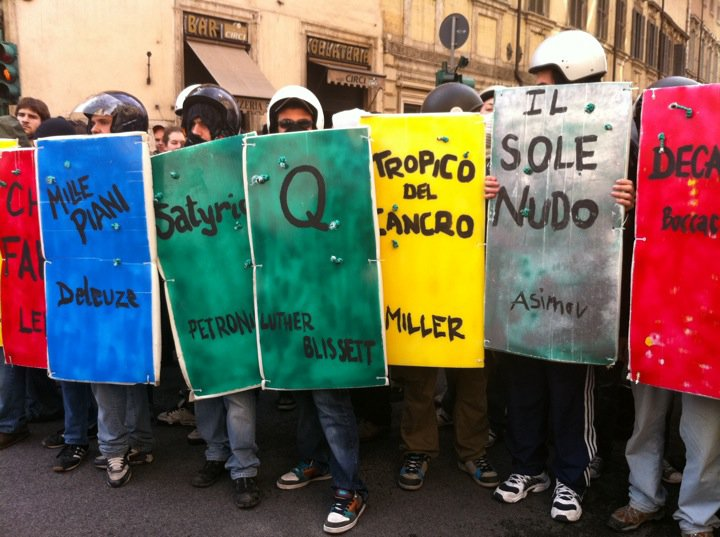
The ‘book bloc’ has been one of the most interesting things in the recent student protests. There is a genealogy of the term here. This is a guide to making your own:-

All these links are courtesy of Wu Ming Foundation, who claim the origin of the term here.

Posted in Politics, Universities, Wu Ming | 1 Comment

Post-Christmas Roundup

Now that I’m back, there is lots to catch up on…

New biography of Claude Lévi-Strauss – details here

The Speculative Turn is now out. Details here – either order as a print volume or download a free pdf. Edited by Levi Bryant, Nick Srnicek and Graham Harman, this is a major statement of new and potential new directions in philosophy. Apparently the volume of downloads slowed down the site dramatically, but it is working again now.

Interesting looking conference on time and revolution with Peter Gratton as keynote – call for papers here.

Some new books from Urbanomic, including Collapse VII, here.

Urbanomic also have an interview with Quentin Meillassoux, by Robin Mackay and Florian Hecker, here

There is a video of a David Harvey interview here

Terry Eagleton in the death of British universities, in The Guardian here

And a very useful post of links here…

Happy New Year

Posted in Conferences, David Harvey, Graham Harman, Peter Gratton, Quentin Meillassoux, Universities | Leave a comment

Holiday delayed

Along with a very large number of other people my travel plans were stopped by the weather. we were actually on the plane on Saturday, delayed for non-weather reasons, when the snow started falling at Heathrow. Flight was cancelled and bags unable to be retrieved. After long delays in getting through to BMI staff I rebooked my own flight. I’m due to fly in just over an hour, still without my bag. It could have been much worse for me – I have a very good friend who lives very close to Heathrow, so stayed with him for the days in-between. The snow did come down very quickly and no complaints that the flight was cancelled. That said, BMI and BAA are absolutely useless.

Posted in Uncategorized | Leave a comment

Holiday

Off on holiday for a couple of weeks with Susan, spending Christmas and New Year in Egypt. A few days in Cairo and then onto Sharm el Sheikh and Dahab.

The plan is to have a proper holiday – no email or work. We shall see.

Many thanks to everyone who has read this blog in the eight months since I started it. I’m really quite surprised and very grateful for the number of people who subscribe and visit the site. More in 2011…

Posted in Travel | 2 Comments

2011 publications preview

2011 should see both the Kant and Sloterdijk edited books out, in June and November respectively.

In addition the Environment and Planning collection (five volumes) with Sage should be out late in the year.

I have chapters in these books coming out next year – Stephen Legg (ed.), Spatiality, Sovereignty and Carl Schmitt: Geographies of the Nomos; J.A. Agnew and J.S. Duncan (eds.), The Wiley-Blackwell Companion to Human Geography; and Leonard Lawlor and John Nale (eds.), The Cambridge Foucault Lexicon. There should be a few shorter pieces too – the exchange with Antonsich; a response to a piece by John Allen; and a discussion between me, Álvaro Sevilla Buitrago and Derek Gregory.

Posted in Carl Schmitt, Derek Gregory, Immanuel Kant, My Publications, Peter Sloterdijk, Territory | Leave a comment