Walter Benjamin on writing

This is wonderful – Walter Benjamin’s writing rules, taken from Sean Sturm’s blog. I’ve read this before, but only now does it really resonate. I may say more about why in a bit.

I. Anyone intending to embark on a major work should be lenient with themselves and, having completed a stint, deny themselves nothing that will not prejudice the next.

II. Talk about what you have written, by all means, but do not read from it while the work is in progress. Every gratification procured in this way will slacken your tempo. If this régime is followed, the growing desire to communicate will become in the end a motor for completion.

III. In your working conditions avoid everyday mediocrity. Semi-relaxation, to a background of insipid sounds, is degrading. On the other hand, accompaniment by an etude or a cacophony of voices can become as significant for work as the perceptible silence of the night. If the latter sharpens the inner ear, the former acts as a touchstone for a diction ample enough to bury even the most wayward sounds.

IV. Avoid haphazard writing materials. A pedantic adherence to certain papers, pens, inks is beneficial. No luxury, but an abundance of these utensils is indispensable.

V. Let no thought pass incognito, and keep your notebook as strictly as the authorities keep their register of aliens.

VI. Keep your pen aloof from inspiration, which it will then attract with magnetic power. The more circumspectly you delay writing down an idea, the more maturely developed it will be on surrendering itself. Speech conquers thought, but writing commands it.

VII. Never stop writing because you have run out of ideas. Literary honour requires that one break off only at an appointed moment (a mealtime, a meeting) or at the end of the work.

VIII. Fill the lacunae of inspiration by tidily copying out what is already written. Intuition will awaken in the process.

IX. Nulla dies sine linea [“no day without a line” (Apelles ex Pliny)] — but there may well be weeks.

X. Consider no work perfect over which you have not once sat from evening to broad daylight.

XI. Do not write the conclusion of a work in your familiar study. You would not find the necessary courage there.

XII. Stages of composition: idea — style — writing. The value of the fair copy is that in producing it you confine attention to calligraphy. The idea kills inspiration, style fetters the idea, writing pays off style.

XIII. The work is the death mask of its conception.

From “One-Way Street” (1955; slightly ed.), Reflections:Essays, Aphorisms, Autobiographical Writings, ed. Peter Demetz, trans. Edmund Jephcott (New York: Schocken, 1978) 80-81.

Posted in Publishing, Walter Benjamin, Writing | 3 Comments

Reading Kant’s Geography – cover and endorsement

It’s been a busy few days with the Reading Kant’s Geography book. Eduardo and I have been working on the copy-edited text, we have the cover design and a very generous endorsement from Chris Philo:

This volume of impeccable scholarship and sustained critical inquiry performs an invaluable service. It is a major contribution to writings on the history of geography, but it also shows that Kant’s geography was far from incidental to the whole outworking of his philosophy, nor to what he claimed about the potentialities and pitfalls in shared human occupation of the planet. As such, this volume needs to be read by anyone concerned with Enlightenment, modernity, and issues such as cosmopolitanism and transnationalism.

Posted in Eduardo Mendieta, Immanuel Kant, My Publications | Leave a comment

Sloterdijk in English

I get lots of requests for what of Sloterdijk’s work is available in English. This is a really helpful resource for this – http://seansturm.wordpress.com/2010/01/01/sloterdijk-in-english/

I knew of most of these, but worth especially noting that Semiotext(e) have a translation of his dialogues with Hans-Jürgen Heinrichs, Neither Sun Nor Death, coming out next month. And his next  book in German – Die nehmende Hand und die gebende Seite– is already listed on Amazon.de. That’s going to really stir things up. The title would translate as something like ‘The hand that takes and the side that gives’ – it looks like a development of the arguments he had recently with Axel Honneth.

Posted in Peter Sloterdijk | 1 Comment

Harman and Bryant cover images

Speaking of cover images, Levi Bryant posts some wonderful artwork that will be used for his and Graham Harman’s new books here.

Posted in Graham Harman, Levi Bryant | Leave a comment

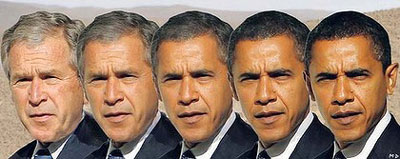
Bush-Obama

Tariq Ali has written a short piece on the continuities between Bush and Obama’s foreign policies for The Age. (Via the Verso blog.)

It’s to plug his new book The Obama Syndrome: Surrender at Home, War Abroad – details here. That book has an okay cover, though not nearly as good as the previous one done for his The Clash of Fundamentalisms.

But this one, done by Matt Davidson for The Age, is probably the best of all…


Posted in Politics, Tariq Ali | Leave a comment

Larval Subjects on Spatio-Temporal Cartographies

Levi Bryant gives a hint of where his work might go next here. From the post it’s clear his book The Democracy of Objects is just about done, and he’s now thinking about space and time. He mentions a few geographers he’s been reading, and clearly there is a lot of overlap in terms of interest. The session at the 2011 Association of American Geographers I publicised last week is a good example of this. You should read Levi’s whole post, but here’s a taster…

Insofar as OOO is committed to the thesis that at its most basic level being is composed of substances, it follows that time and space can no longer be conceived as milieus or containers in which objects exist, but rather that time and space, or spatio-temporality must be seen as arising from relations between and among objects. Second, insofar as all objects are operationally closed such that they only possess selective relations to the world, it follows that what we ordinary think of as a spatial relation– for example a relation of proximity –is not sufficient to establish that there is, indeed, a spatio-temporal relation between two entities. In other words, two entities might appear to share a spatio-temporal relation to one another, but it is not evident that there truly is a spatial relation between these two entities.

While the first is close to where some of the work in critical/theoretical geography has been for a while; the second is, I think, the more significant challenge. That – to me – is not yet worked through in the post; rather the examples reinforce the first claim. My sense is that the plural, relational notions of spatial-temporal connections work, but the doubt that “there truly is a spatial relation” in some cases remains to be demonstrated. It seems that the relation may be complicated, remote, not what we thought, etc. but that doesn’t mean that its not there in some form. I should also stress that on the first, the relational notion of time is particularly interesting. Levi says there are early thoughts and I’m curious where this will go.

Posted in Levi Bryant | Leave a comment

New French Thought

Very interesting set of seminars at The Public School in New York later this month. They focus on new French thought – that is outside of the 1960s/70s generation – and the thinkers covered are Catherine Malabou, Bernard Stiegler, Mehdi Belhaj Kacem, Quentin Meillassoux and François Laruelle. Of these, Stiegler and Meillassoux are probably the best known; Laruelle and Malabou are beginning to be translated, but Kacem is probably the unknown quantity. I’ve not read any of his work, but his L’esprit du nihilisme: Une ontologique de l’Histoire has been sitting in the Amazon.fr basket for a while…

You can find the official details here; thanks to Speculative Heresy for the info.

Update 2nd November: audio for the lectures here.

Posted in Bernard Stiegler, Mehdi Belhaj Kacem, Quentin Meillassoux | 1 Comment

Middlesex Philosophy Seminars

Despite CRMEP being moved to Kingston, and the closure of the undergraduate programme for new entrants, Middlesex philosophy has some very impressive people coming to give seminars next year. Christian Kerslake posts the details here.

Posted in Conferences | Leave a comment

Chapter Nine

I’ve been trying to concentrate on writing this week. My plan was to have a complete draft of all the chapters to take with me to Seattle, and that’s only about two weeks away and Chapter Nine needed some serious work. So I packed up the laptop, some books and the road bike, and headed to a country hotel. The weather has been rotten, so I’ve not done nearly as much cycling as planned, but it’s been good for the writing.

Some of this was simply making decisions and working with them. I have so much material and I could go in several different directions. Sometimes it’s simply a case of choosing one and making it work. I save every file with a different name every day, and anything I cut out goes into a discards file so no choice is ever irreversible but this has really helped me move on.

The final section of the chapter now begins with Theodor Reinking’s proposal of a hierarchical model of power with majesty held by the Holy Roman Empire and delegated ius territorii to the rulers within it. That proposal, in the 1619 Tractatus de regimine saeculari et ecclesiastico is near simultaneous with the beginning of the Thirty Years War. I then have a brief discussion of the revisionist narratives about Westphalia – mainly through Teschke but some reference to Krasner, Beaulac and Osiander. My conclusion is that while these approaches are valuable, they risk missing what was interesting about Westphalia. It was not nearly as central as the traditional accounts suggest; but it was not as unimportant as the revisionists would have us believe.

I’ve then used the discussion of von Chemnitz to set up a discussion of the treaties themselves, with emphasis on the words used in the different languages of the negotiators—Latin, French and German all matter. It’s interesting what you can discover: for instance the phrase most commonly associated with the 1555 Diet of Augsburg—cuius regio, eius religio, to whom the region the religion—does not actually appear in the text of the compact, but rather dates from debates about it some thirty years earlier. I was alerted to this by Wilson, Europe’s Tragedy, which is a terrific comprehensive study of the Thirty Years War. I can’t resist quoting Pope Innocent X’s view of the Westphalia treaties: “null and void, invalid, iniquitous, unjust, damnable, condemned, rejected, reprobate, inane, without force or effect, and no one is to observe them, even when they be ratified by oath”. I then move to a discussion of Pufendorf and Leibniz who are, in part, trying to make sense of where this left the Empire and the polities within it. This joins the political discussion of Leibniz much neater into the overall account.

I’ve shunted all the stuff on the impact of these treaties into the conclusion, which is partly deferral, but also gives me a good sense of how that might be structured.

I also finally worked out what I was doing with Nicholas of Cusa in terms of his position in the book, which is as a coda to the section entitled ‘Rex Imperator in Regno Suo’ in Chapter Seven. In retrospect it seems obvious, but it has taken me ages to work out what to do with him and how to make the link work. I first read him and took notes about eighteen months ago.

Now if I could just work out what I want to say about Vitoria, Grotius and Selden…

Posted in Bogislaw Philipp von Chemnitz, Gottfried Leibniz, Nicholas of Cusa, Samuel Pufendorf, Territory, The Birth of Territory, Theodor Reinking | 2 Comments

Meillassoux in Society and Space

Some new forthcoming essays in Society and Space are available online here (subscription required). They include a piece by Quentin Meillassoux for a theme issue on mathematics, which should also include a piece by Michel Serres.

Posted in Quentin Meillassoux, Society and Space | Leave a comment