Chapter Nine

I’ve been trying to concentrate on writing this week. My plan was to have a complete draft of all the chapters to take with me to Seattle, and that’s only about two weeks away and Chapter Nine needed some serious work. So I packed up the laptop, some books and the road bike, and headed to a country hotel. The weather has been rotten, so I’ve not done nearly as much cycling as planned, but it’s been good for the writing.

Some of this was simply making decisions and working with them. I have so much material and I could go in several different directions. Sometimes it’s simply a case of choosing one and making it work. I save every file with a different name every day, and anything I cut out goes into a discards file so no choice is ever irreversible but this has really helped me move on.

The final section of the chapter now begins with Theodor Reinking’s proposal of a hierarchical model of power with majesty held by the Holy Roman Empire and delegated ius territorii to the rulers within it. That proposal, in the 1619 Tractatus de regimine saeculari et ecclesiastico is near simultaneous with the beginning of the Thirty Years War. I then have a brief discussion of the revisionist narratives about Westphalia – mainly through Teschke but some reference to Krasner, Beaulac and Osiander. My conclusion is that while these approaches are valuable, they risk missing what was interesting about Westphalia. It was not nearly as central as the traditional accounts suggest; but it was not as unimportant as the revisionists would have us believe.

I’ve then used the discussion of von Chemnitz to set up a discussion of the treaties themselves, with emphasis on the words used in the different languages of the negotiators—Latin, French and German all matter. It’s interesting what you can discover: for instance the phrase most commonly associated with the 1555 Diet of Augsburg—cuius regio, eius religio, to whom the region the religion—does not actually appear in the text of the compact, but rather dates from debates about it some thirty years earlier. I was alerted to this by Wilson, Europe’s Tragedy, which is a terrific comprehensive study of the Thirty Years War. I can’t resist quoting Pope Innocent X’s view of the Westphalia treaties: “null and void, invalid, iniquitous, unjust, damnable, condemned, rejected, reprobate, inane, without force or effect, and no one is to observe them, even when they be ratified by oath”. I then move to a discussion of Pufendorf and Leibniz who are, in part, trying to make sense of where this left the Empire and the polities within it. This joins the political discussion of Leibniz much neater into the overall account.

I’ve shunted all the stuff on the impact of these treaties into the conclusion, which is partly deferral, but also gives me a good sense of how that might be structured.

I also finally worked out what I was doing with Nicholas of Cusa in terms of his position in the book, which is as a coda to the section entitled ‘Rex Imperator in Regno Suo’ in Chapter Seven. In retrospect it seems obvious, but it has taken me ages to work out what to do with him and how to make the link work. I first read him and took notes about eighteen months ago.

Now if I could just work out what I want to say about Vitoria, Grotius and Selden…
Posted in Bogislaw Philipp von Chemnitz, Gottfried Leibniz, Nicholas of Cusa, Samuel Pufendorf, Territory, The Birth of Territory, Theodor Reinking | 2 Comments

Meillassoux in Society and Space

Some new forthcoming essays in Society and Space are available online here (subscription required). They include a piece by Quentin Meillassoux for a theme issue on mathematics, which should also include a piece by Michel Serres.

Posted in Quentin Meillassoux, Society and Space | Leave a comment

Ennis, Post-Continental Voices

Paul Ennis’s collection of interviews Post-Continental Voices is now searchable on Amazon. You can read most of the interview with me there. Thanks to Graham Harman (also in the book) for the alert. Of course, you can buy the book too…

Posted in Graham Harman, My Publications | Leave a comment

Geography and Object-Orientated Philosophy

(reposted from Crit-Geog-Forum)

Call for Papers: The Difference of Things

Association of American Geographers Annual Meeting, 12-16th April 2011, Seattle, USA.

Session organised by Deborah Dixon, JP Jones, Sallie Marston and Keith Woodward

 
If difference in the world is not a remainder from or a bad copy of Identity, Ideas or Essences, but is rather the immanent force characterizing all materialities, including words and meanings, affects and perceptions, things and thoughts, then how do we go forth in the world to think and speak in terms of things and their qualities?

In this session we wish to bring together those interested in working though what is being loosely termed ‘object-oriented philosophy,’ or ‘object-oriented ontology’, in emerging areas such as ‘speculative realism.’ Whilst geographers have long sought to ‘ground’ their objects of inquiry in the validating power of the Subject-perceiver-expert, recent years have seen a concerted effort to ask object-orientated questions in ways that neither presuppose such a subject nor presume that ‘things’ conform to the conditions or constraints of human perception or understanding. In the process, such reflections have engendered sympathetic but also at times difficult relations with, for example, Badiou’s subjectless objects, Deleuze and Guattari’s assemblages (agencements), Serres’ Angels and quasi-objects, Simondon’s pre-individual fields and singularities, Harman’s Object-Oriented Philosophy and Bryant’s ‘onticology’, Latour’s ‘democracy of things’, Bennett’s ‘vibrant matter’, Heidegger’s tools, and things ‘in-themselves’ existing before, beyond or beside the metaphysical solipsism of Kant’s ‘Copernican Turn.’

We are especially interested in how geographic terms such as space, place, distance, proximity, differentiation, localization, mobility, and stillness might be re-imagined in this work. What are the implications for technical objects, objets d’art, and ‘assemblages’? How do we attend to and account for the difference of ‘natural’ objects or things-in-themselves? What do notions such as ‘ecology’ mean for object-oriented approaches? What is the refined role of the senses and/or cognition in an approach that seeks to comprehend the mind-independent status of objects? And, how does such an enquiry change or challenge the stakes for theories of emergence?

Thematic objects may include, but are not limited to:

The arche-fossil
Vicarious causation
The democracy of objects
Distinctions between Objects and Things-in-themselves
The changing statuses of the commodity and the money form
Techné
Bios
Ontography
New treatments of phenomena and understanding
The return of the transcendental

Abstracts should be sent to both Deborah Dixon (dxd@aber.ac.uk) and Keith Woodward (kwoodward@wisc.ed) by October 15, 2010.

For conference information see: http://www.aag.org/cs/annualmeeting

Posted in Conferences | 4 Comments

Wu Ming on Robespierre

Interesting (contentious, probably wrong) piece here. I briefly discussed Robespierre on terror, using the recent Verso book introduced by Zizek, in Terror and Territory. He’s worth reading.

Posted in Maximilien Robespierre, Slavoj Zizek, Wu Ming | Leave a comment

Society and Space issue 5

Environment and Planning D: Society and Space volume 28 issue 5 has now been published online and is available here. 

Among other pieces, it includes essays by Gary Okihiro, Nicola Ansell, Graham Harman and Trevor Paglen.

Posted in Graham Harman, Society and Space | Leave a comment

Sloterdijk Now blurb

Here’s the publicity blurb for the Sloterdijk Now edited collection I am doing for Polity, due out next year.

Peter Sloterdijk is one of the most challenging and contentious thinkers currently working within the European tradition. This is the first collection devoted to his work for English-language audiences and will act as an introduction to his work, set an agenda for engagement with his ideas, and relate his writings to a range of political, theoretical and practical contexts.

Since his philosophical bestseller Critique of Cynical Reason (1983), Sloterdijk has exercised an important influence over German and other European thought and recently interest in his diverse oeuvre has grown considerably.  The past few years have seen a number of his books translated into English, with many more to come. The book seeks to do justice to the breadth of Sloterdijk’s work throughout his career, orientated around the central topics of cynicism, ressentiment, the posthuman, space and world, art and literature, language, social science and his role as a public intellectual. Contributors include Babette Babich, Sjoerd van Tuinen, Eduardo Mendieta, Marie-Eve Morin, Efrain Kristol, Wieland Hoban, Nigel Thrift, Jean-Pierre Couture, and Sloterdijk himself.

An explicitly interdisciplinary project, Sloterdijk Now is a crucial introduction to the work of this central thinker, in its complexity, variety and notoriety. It is set to spark debate amongst students and scholars across the humanities and social sciences.

Posted in Eduardo Mendieta, Marie-Eve Morin, Nigel Thrift, Peter Sloterdijk | Leave a comment

Boulainviller/Boulainvilliers

Peter Gratton uses my last post to say something about his own work on Boulainviller/Boulainvilliers (the spelling is disputed) here. As I said in that last post, I’ve not read much of him so far, but he looks interesting. For a good introduction to his work you could do a lot worse than to read the two long footnotes from Peter’s forthcoming The State of Sovereignty that are included in his post. Peter has kindly send me the introduction to that book and it promises to be a really important contribution. We’re clearly working on very closely related projects, and a lot of the twentieth-century/contemporary writers he’s been reading – Schmitt, Kantorowicz, Foucault, Agamben, Derrida et. al. – are ones I have been looking at too. The same goes for the more historical figures – Gregory of Tours, Bodin, Rousseau, etc. But since we are asking different questions we’re coming up with very different readings.

Posted in Carl Schmitt, Giorgio Agamben, Henri de Boulainviller, Jacques Derrida, Jean Jacques Rousseau, Michel Foucault, Peter Gratton | Leave a comment

Territory book progress

I’ve been making slow but steady progress on chapter nine of my territory book. A lot of this has been checking minor details in libraries, including original language sources such as the Latin for a few quotes from Newton’s Principia Mathematica. I’ve been doing some work on Samuel Pufendorf, mainly as a foil for Leibniz, and Bogislaw Philipp von Chemnitz, who wrote an interesting book in 1640 entitled Dissertatio de ratione status in imperio nostro Romano-Germanico under the pseudonym of Hippolithus à Lapide. Strangely, given its focus, there is an 18th century French translation. (Foucault discusses this work briefly in Security, Territory, Population). Chemnitz is said to have influenced the discussions at Westphalia, and provides something of a challenge to Bodin (along the lines of Knichen I think) around the relation between sovereignty and majesty.

I’ve also had a look at some of Henri de Boulainviller’s philosophical works, which are much influenced by Spinoza, but I think it’s his historical-political works that I really need to look at (of course Foucault discusses them too in ‘Society Must Be Defended’). I also read James Harrington’s Oceana, which is a very strange work that doesn’t seem to fit the chronologies I’ve been suggesting, partly because it takes land issues pretty seriously but uses ‘territory’ indiscriminately to describe ancient Rome, the Middle Ages and the present. He seems to use the term in a familiar way without any need to describe or challenge it. This seems to be in distinction to writers on the continent: such as Knichen, Althusius, Leibniz and, a little later, Johannes Hertius, who I have also been looking at.

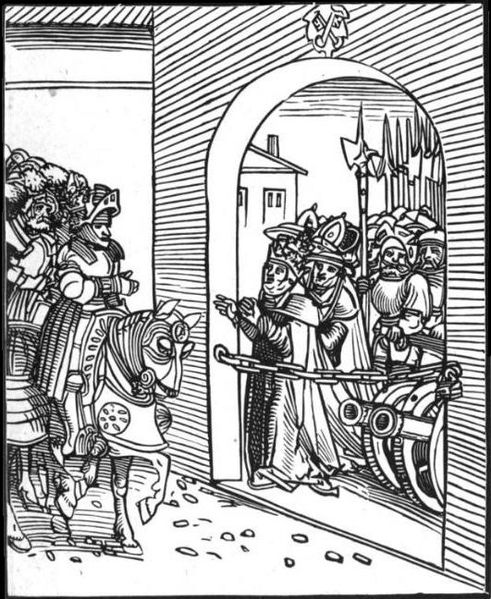
Finally, and out of sequence, I had a look at an original of the Passional Christi und Antichristi. The British Library has what appears to be a first edition of 1521. You can see the text in a scanned form here. It’s a fairly well-known text of Lucas Cranach woodcuts, of images of Christ and the Antichrist (depicted as the Pope) on facing pages. The left-hand page has a quotation from scripture; the right-hand page a description of the contemporary parlous state of the church which is going directly against this. The opening pair, for instance, juxtaposes Christ refusing the crown as an earthly king and the Pope behind a gate with cannons and armed soldiers defending himself from an armoured figure on horseback.

A later one shows Jesus washing feet and the Pope having his kissed by admirers. The writer of the German text was probably Philipp Melanchthon, a collaborator of Luther. The scripture is in German too. Though this predates the publication of Luther’s Bible translation, it was contemporaneous with the work on the New Testament.

Then, following up on a reference Melanchthon makes to Bartolus in a completely different source I came across a remarkable image that I want to find out more about. That’s the first task for tomorrow.

Posted in Andreas Knichen, Bartolus of Sassoferrato, Bogislaw Philipp von Chemnitz, Gottfried Leibniz, Henri de Boulainviller, Isaac Newton, James Harrington, Jean Bodin, Johannes Althusius, Johannes Hertius, Martin Luther, Michel Foucault, Philipp Melanchthon, Samuel Pufendorf, Territory, The Birth of Territory | 3 Comments

More on articles

Clare replies to my reply, here.

My remarks were of course provocative. As a former journal editor myself I agree very strongly that it matters a great deal who reads the articles and my statement: ‘who cares who reads the articles’ was perhaps too ambiguously ironic. It was intended to criticise certain institutional interests in quantity at the expense of any interest in the actual content of what is being written.

What worries me is academic writing that is published but not read. In this case one could argue that this work is not serving its social function and that forms of quasi censorship are in operation by requiring too hermetic a form. Some forms of journal article writing can close down the impact of academic work, rather than opening it up In this sense they operate like a closed club – or in Foucault’s terms ‘a society of discourse’ whose rules are only accessible to a very restricted few.

Of course one needs specialist discussion to advance knowledge – but if this is not being read even by other specialists then there is a problem.

Editors certainly care who reads material, because no-one wants to be the editor of a journal that no-one reads. But how can we tell? We try to keep an eye on what measures we have that can give an indication of that. Two of these are the number of times articles are downloaded, and the number of citations they receive. Neither of course is an indication that they have actually been read, though you’d hope they had been in the last case at least. But I think that the same argument about how editors try to gauge how much stuff is read is more broadly shared. For promotion and hiring decisions, citation rates can actually play quite a big role. Numbers of articles does matter, but not (I think) at the expense of what is in them. Where they are published is much more important. This is often driven by the impact factor of journals, itself a product of citation rates. (There are problems with this of course, but they are rather different from those Clare raises.)

There has been a struggle in the British system, certainly in the humanities and social sciences, not to move to a wholly metric driven system for evaluation of research outputs. The last Research Assessment Exercise panels put quite an emphasis on the reading of the submitted material before its grading. This is surely the right way to continue – rather than grading on the basis of where it was published, citation rates etc. For those outside the UK, the RAE – now replaced by the REF (Research Excellence Framework) – is basically the means by which research funding, other than grants for specific projects, is determined. What this is requires is that over a specific period (the last one ran from 2001-07) all submitted academics have to list the four pieces they have produced in that time that they/their department think represent their best work. Those pieces can be books, articles or chapters. Now, I’m not defending every aspect of this system, but four pieces in that time period puts the emphasis squarely on quality, not quantity. The model of splitting the research into more and more pieces and thereby spreading it thin to increase the volume actually counts against the academic and their department.

Posted in Publishing | 3 Comments