Middlesex escalation – staff and students suspended

http://savemdxphil.com/2010/05/21/philosophy-students-and-staff-suspended/

Unbelievable – it just keeps getting worse. Various reactions from Etienne Balibar, Bruno Bostells, Alberto Toscano (in comments), John Protevi… (I’ve taken some of these links from Graham Harman‘s blog and Infinite Thought – thanks).

There is now talk of some kind of academic boycott, which seems inevitable. I’ll be writing to Dean Esche and the board of governors to add my voice to the outrage.

[update 12noon – you can find my letter here; Graham Harman’s letter here]

Posted in Universities | 1 Comment

Latest from Middlesex

http://savemdxphil.com/2010/05/21/the-library-sit-in-is-over-the-campaign-continues/

Interesting quick way to sustain interest in the case; to broaden the disciplinary appeal; and ensure people realise this is about intellectual life more generally. It will be interesting to see what transpires from here on. If you haven’t written to the board of governors and senior management, signed the petition and added yourself to the facebook group, then the http://savemdxphil.com site tells you how.

Posted in Universities | Leave a comment

New occupation at Middlesex

This evening around 50 students and staff from half a dozen different programmes at Middlesex University’s School of Arts and Education occupied the library at Trent Park campus.

This building is full of books on philosophy, literature, art criticism, music and culture. These books – and the courses and departments associated with them – are severely endangered by management cuts. We are determined to preserve them.

The Campaign to Save Philosophy at Middlesex
Thursday 20 May 2010, 7:30pm

http://savemdxphil.com/2010/05/20/a-new-occupation-at-trent-park/

Seems they are not going to give up, or go quietly. Good luck to them.

Posted in Universities | Leave a comment

Porcupine Tree – Anesthetize premiere

I was lucky enough to get a ticket for the premiere of the new Porcupine Tree concert film – shown at the Prince Charles Cinema in Leicester Square last night.

The band all attended, as did the director Laisse Hoile. This was filmed at the end of the Fear of a Blank Planet tour in 2008. I saw a couple of the shows earlier on this tour – in Los Angeles and New York. Since this tour, the band have released a new album, The Incident, which pushed back the release of this film.

It is now also available on DVD.

A trailer is available

The band came out at the end to talk and sign stuff – they were all really friendly and good to meet them.


Posted in Music | Leave a comment

Westminster – Inauguration of the Security and International Relations Programme

Another conference at University of Westminster – I will be speaking very briefly on the second day

Department of Politics and International Relations

University of Westminster

 Inauguration of the Security and International Relations Programme

9-10 June 2010

Wednesday 9 June – Opening Lecture

 “From Global to Primal: the Devolution of Security Studies”

 James Der Derian, Watson Institute for International Studies, Brown University

 5.00-6.30 Pavilion Lecture Room, University of Westminster, 115 New Cavendish Street, London, W1W 6UW followed by reception and book launch

 Thursday 10 June

 Panels dedicated to research undertaken within the Security and International Relations programme

 Room 358, 309 Regent Street, University of Westminster

 9.30-11.0                  Intervention and State-Building

Aidan Hehir and David Chandler with intervention from Tony Lang, University of St Andrews

 11.30-13.00    Borders and Identities

Dibyesh Anand and Patricia Hogwood with intervention from Stuart Elden, University of Durham

 13.00-14.00     Lunch

 14.00-15.30        Energy, Security and International Relations

Roland Dannreuther and Wojciech Ostrowksi with intervention from Gavin Bridge, University of Manchester

 16.00-17.30        Securities and Their Subjects

Roundtable with David Chandler, Tom Moore and Tara McCormack, University of Leicester and Julian Reid, King’s College London and University of Lapland

 Please RSVP to Suzy Robson – s.robson@westminster.ac.uk

 For more information please contact Roland Dannreuther – r.dannreuther@westminster.ac.uk

Posted in Conferences | 2 Comments

China-India Border Dispute conference

Held at the University of Westminster on 2-3 June 2010. Details here – summary below

A Conference on ‘REVISITING THE CHINA-INDIA BORDER DISPUTE’

2-3 June 2010, University of Westminster, London. 

http://chinaindiaborderdispute.wordpress.com and http://www.westminster.ac.uk/schools/humanities/politics-and-international-relations 

 Organiser: Dr Dibyesh Anand (www.dibyesh.com), Reader (Associate Professor), Department of Politics and International Relations (DPIR), University of Westminster, London, UK. Email: D.Anand@wmin.ac.uk

Sponsors: DPIR (University of Westminster), Nirman Foundation and the Universities’ China Committee in London. 

Attendance is free and open to all but requires pre-registration. Attendees should send the following information to <chinaindiaconference@gmail.com>:

Full name, Email, Affiliation (if relevant), Days attending: 2 June, 3 June, Both 2 and 3 June.

Media enquiries should be directed to Dr Anand by email D.Anand@wmin.ac.uk and/or phone 44-7940806894. 

 BACKGROUND

A disputed Himalayan border is a primary obstacle in closer cooperation between India and China. The conference will revisit various facets of this dispute, including the boundary disagreement, border conflict, tense geopolitics of the region, the legacy of British imperialist re-ordering of the Himalayas, Great Power politics, strategic triangles (China-India-USA or China-India-Pakistan), the disappearance of traditional Tibetan state, the future of the Dalai Lama, and the impact of these tensions on the people living in the borderlands. This two-day event, held in the heart of central London, will bring together relevant international experts and provide an invaluable opportunity to scholars, students, diplomats, media persons, and interested members of the public, to further their understanding of the relationship between China and India. 

 China and India are rapidly emerging as key global players in the twenty-first century. Leaders around the world including President Obama, military strategists, security thinkers, businesspersons, media commentators, academics, and human rights activists have turned their attention to the challenges and opportunities offered by the rise of two Asian countries that share between them more than 37% of world’s population, 20% of world energy use, 10-17% of world economy (depending on the measure), 8-10% of military spending, 9% of world’s land, and are projected to significantly increase their stamp on the global politico-economic landscape. This fluid scenario demands greater understanding of the politics and international relations of both China and India, especially of Sino-Indian relations.

 China-India relations have witnessed major swings since the heyday of close cooperation in the early 1950s and the nadir of the 1962 border war. Though both countries profess a desire to work closely to resolve disagreements, have rapidly expanding economic relations, and often strike strategic cooperation in several arenas (such as at the Copenhagen Climate Conference), their bilateral relationship is, by most accounts, fragile. Some of the factors that contribute to the testy China-India relations are: mutual suspicion of each others’ intentions, the bitter memories of 1962 war (especially in India), the presence in India of Tibetan exiles led by the Dalai Lama, Indian discomfort at China’s close relations with Pakistan, China’s increasing clout in other South Asian states, Chinese mistrust of warmer Indo-US relations. The key issue that prevents the two countries from establishing a stable relationship is the border dispute. 

 China and India have a territorial disagreement and accuse each other of illegal occupation. The border dispute, emerging from a boundary disagreement and centering on Aksai Chin/South Xinjiang area in the Western Himalayas (under Chinese control) and Arunachal Pradesh/South Tibet (under Indian control) in the Eastern Himalayas, has already led to a war in 1962, several military clashes, political posturing, and more recently, military buildup, media wars, diplomatic squabbles, and blame-games.

 This conference brings together world’s leading experts to discuss and debate various facets of the Sino-Indian border dispute. The aim is to identify and assess various perceptions of Sino-Indian rivalry as exemplified in the border dispute. 

 An edited collection based on the papers presented at the conference along with a few additional chapters is planned for 2010-2011. The conference website http://chinaindiaborderdispute.wordpress.com/ will also act as a research archive for sources on the border dispute.

Posted in Conferences, Territory | Leave a comment

Jane Bennett – Vibrant Matter, a Medieval review

Jane Bennett‘s new book Vibrant Matter has been receiving a lot of attention recently. There are plans afoot for a reading group run across a number of blogs. You can find details here; and a preparatory interview here.

Here’s a review from Jeffery Jerome Cohen – a very interesting medieval scholar. (I’d particularly mention his Medieval Identity Machines). I’ve not seen this linked from other blogs.

I received Jane’s book in the post yesterday, not entirely coincidently along with a new edition of Chaucer’s Canterbury Tales… could be an interesting juxtaposition.

One thing Cohen mentions is worth a link on its own – a conference on Speculative Medievalisms in January 2011 which looks fascinating.

Posted in Events, Medieval Studies | Leave a comment

Labour leadership election

Miliband, Miliband, Balls… and no Cruddas… very disappointing and representing a tiny part of the political spectrum within the party. John McDonnell wants to stand, but the Labour party electoral system means he has to get 34 MPs to nominate him, in the period May 24th-27th in order that Union members or party members actually get a chance to vote for him. Labour only has 258 MPs; many are newly elected; most won’t have a chance to make up their minds.

Whether people want McDonnell as leader or not, it is a high hurdle. You might remember McDonnell stood against Brown in 2007, but because he didn’t get enough nominations he wasn’t allowed to contest it, and Brown was ‘elected’ unopposed. Who now thinks that was a good idea – surely Brown would have been better off having facing some opposition then, even if he’d subsequently won?

I’ve received the following today, and was happy to sign.

Dear friend, 

As you may have heard, John McDonnell has announced his intention to stand for leader. In order to stand, candidates need to be nominated by 32 MPs. However, we only have until 24TH MAY to get the number required. If you want a geuine leadership debate with a broad range of candidates, please support the letter below which will be published in the Guardian on Monday.

Please email me [john4leader@gmail.com] your name, your CLP and/or trade union (if applicable), and any relevant positions as soon as you read the letter if you are in support.

Please also get in touch with your local Labour MP or any Labour MP you think is sympathetic and ask them to nominate John to allow a debate, however they then decide to vote. Nearly every MP has a generic email surnameinitial@parliament.uk, e.g. Gordon Brown would be browng@parliament.uk

Please circulate this email widely. You can help to make this happen!

As a range of Labour party members, councillors, NEC members, trade unionists, activists, community workers and campaigners, we are asking Labour MPs to nominate John McDonnell in order to allow a genuine debate about the future direction of our party.

We are concerned that a contest between candidates with broadly the same views will fail to deliver the wide-ranging policy debate Labour urgently needs following our defeat at the polls.

We welcome John McDonnell’s commitment to a leadership debate based on the policies, not the personalities. We note John McDonnell’s long-standing support for workers’ rights, a peaceful foreign policy, publicly owned services, progressive taxation, an emergency council housing programme, a living wage, and civil liberties. We also welcome his determination that working people must not be made to pay for a crisis that is not of their making, and his opposition to the Con-Dem cuts agenda that will devastate our communities. We want these policies to be given a platform in the leadership campaign.

That is why we ask MPs to nominate John McDonnell, regardless of how they will subsequently vote, in order to allow an inspirational, comradely debate about the future direction of our party and our country.

Michael Crick of Newsnight has an interesting post on this here

I met McDonnell in the early 1990s when I was a student at Brunel. He contested the Hayes & Harlington seat in 1992 and lost by something like 50 votes; winning it in 1997. It’s now a safe seat. I met him again in 2007 to interview him when I was working on the Iraq war – he was one of the ‘rebels’ who consistently opposed the war. It would be really good for the Labour party to have a proper debate about its future direction and how to be an effective opposition.

Posted in Politics | Leave a comment

Tordesillas, Territory, Topology

A few days ago I wrote about the struggles I was having with chapter eight of my ‘history of territory’ book.

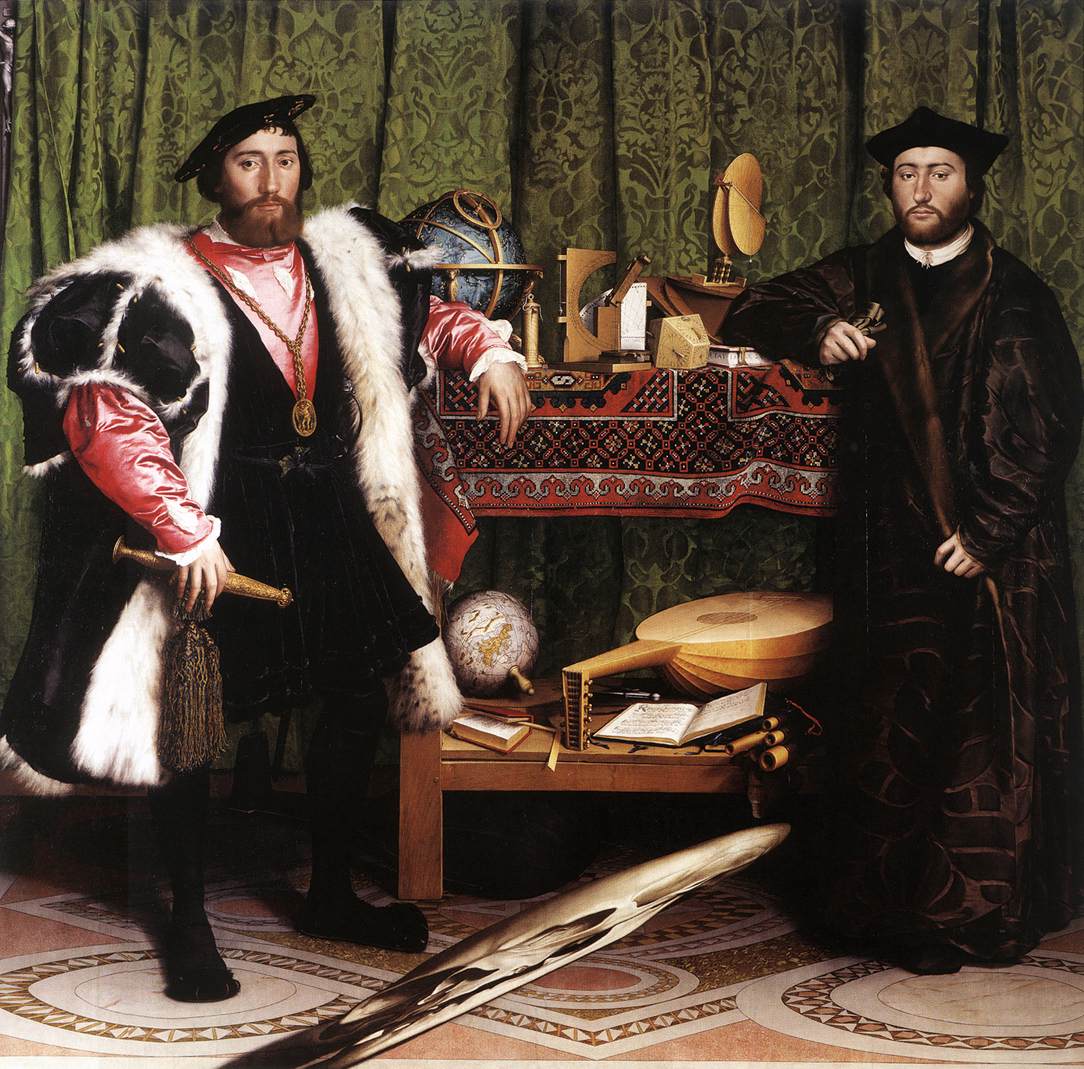
I have sections on ‘The Politics of the Reformation’ and on the New World which need further work before being slotted in. The former has a discussion of Thomas More, Erasmus, Holbein’s The Ambassadors, and a bit on Henry VIII, but needs more on Luther and possibly Calvin. The latter I’m much less sure about, partly because I think there is little I can say that hasn’t already been said. (While the other things are also widely written on, I think I’m at least asking different questions.) But the discovery, mapping and territorial division of the new world seems too important to the story to leave out, so I’m struggling a bit there. I think I also need to work a reading of Richard Hooker into this chapter somehow, and part of me is wondering if I could use a reading of Shakespeare’s The Tempest (perhaps instead of the one of King Lear) as a way into the colonial questions.

I’m still not sure that I have a good way through these problems, but the more I read the more I realise that on the specifics of new world conquest, cartography and division I will have little to add to work already out there. I’m thinking of works like Jerry Brotton, Trading Territories: Mapping the Early Modern World; and Frank Lestringant, Mapping the Renaissance World: The Geographical Imagination in the Age of Discovery, as well as many others. I reread The Tempest too, but again, not sure that there is much for me to say there.

I’m toying with the idea of beginning the chapter with a discussion of the Treaty of Tordesillas and then quickly moving to the discussions of the European thinkers but with this as a context pre-established. Tordesillas is really interesting because of the calculative nature of the division, abstract space superimposed over unknown seas and lands.

John Allen is giving a talk at UCL this afternoon, talking about topologies of power as better or more adequate ways to think about current political/geographical issues than territory. I’ve read some of his work on this and it should be interesting to hear him. I’m giving a seminar at UCL on the territory project in a couple of weeks time. Maybe John will spark some useful thoughts.

Posted in Conferences, My Publications, Territory, The Birth of Territory, William Shakespeare | 1 Comment

South Atlantic claims

My colleagues in the International Boundaries Research Unit at Durham have produced some remarkable maps showing the rival UK and Argentine claims in the South Atlantic, which include but exceed the Falklands/Malvinas…

You can find a briefing and the maps here  There is also a press release here

My sometime co-author Klaus Dodds has written a commentary on the new oil issues in the South Atlantic for Society and Space, which should be out in issue 4 this year. That issue will also include a piece entitled ‘The Territory is not the Map’ written by Valerie November and Bruno Latour.

Issue 3 of the journal should be out soon – I’ll post a link when it’s online.

Posted in Politics, Society and Space, Territory | Leave a comment