Maps in London

Free exhibition at the British Library – http://www.bl.uk/magnificentmaps/

And a series of linked talks – http://www.bl.uk/magnificentmaps/events1.html

Then another exhbition at the Royal Geographical Society – http://www.rgs.org/WhatsOn/Exhibitions/Exhibition.htm

Posted in Uncategorized | Leave a comment

London Political Geography Network

Anyone based in London will find this a useful source of information for what’s going on

http://lpgn.wordpress.com/

They often arrange social events after talks, exhibitions or screenings in London.

Posted in Events, Politics | Leave a comment

The Guardian on Middlesex

The story is now getting more mainstream media coverage

http://www.guardian.co.uk/education/2010/may/07/philosophy-cuts-closures-middlesex-university

The most alarming part of this is the way the university can pocket money earned by philosophy’s previous research success long after the department is gone.

Also worth noting that – so far – the comments on The Guardian page are generally thoughtful, even when there is disagreement, and have not yet descended as they so often do.

Posted in Universities | Leave a comment

Durham conference

The Durham conference was a success. Really good papers and some interesting topics being discussed. My talk seemed to go well – good questions again. It was the first time I’d used Prezi instead of Powerpoint – it will not be the last. I really like the way you can work with graphics. There were some maps in the slides and I was able to zoom in and out really easily. Also good for focusing on details and then pulling back in a slide with lots of detail (i.e. the table of contents of the book). I made a decision to keep out some of the more flash bits, rotation, excessive movement, etc, since I didn’t want to distract too much. People seemed to like it – several comments of ‘how do you do that?’ It’s also terrific for not working in a linear way, with the plotting of the path, although of course you could always paste slides in repeat times in powerpoint which made them not look quite so linear.

Posted in Conferences, Territory | Leave a comment

Middlesex update

The occupation continues….

http://savemdxphil.com/2010/05/07/405/

see also the photos and all the links at Infinite Thought

A letter with a terrific array of top names at The Times Higher – just picking a few it would include Badiou, Butler, Zizek, Negri, Ranciere and Sloterdijk… Chomsky has also sent a letter. Excellent that so many people are publicly supporting this campaign.

[and a video report here]

Posted in Universities | Leave a comment

Radical Philosophy

A new issue of Radical Philosophy is out… and I have a piece in it. I’m very pleased to finally have a full article in a journal that has been really important to my work since I began my PhD. I had a few reviews and the interview with Kostas Axelos in it before, but this is the first full piece.

The piece is a critical reading of Carl Schmitt, and particularly the recent interest in his work on international politics. You can find the issue here.

Posted in Carl Schmitt, My Publications | 1 Comment

Kostas Axelos

The Greek-French thinker Kostas Axelos died earlier this year. He wasn’t very well known in the English speaking world, but in his adoptive home of France he was a major thinker and enabler of intellectual life. He was, for example, Heidegger’s interpreter at the Cerisy-la-salle conference where he gave the lecture ‘What is Philosophy?’ and facilitated the discussions with Lacan. He edited the journal Arguments and founded the book series of that name with Les Editions de Minuit, which published a range of important French thinkers and translations. His 1969 book Le jeu du monde is, for my money, one of the best books on the notion of the ‘world’ and a corrective to lazy thinking of globalisation. I’ve written a few pieces on Axelos, who was a friend and interlocutor with – among others – Lefebvre.

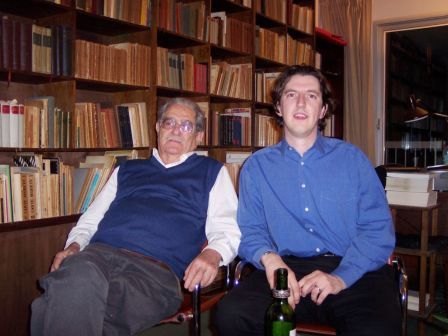
I met him only once, in 2004. I’d sent him a piece I’d written on his work and he sent me a very kind note, inviting me for dinner if I was in Paris. We arranged that I would interview him for the journal Radical Philosophy, but we spent most of the evening talking in a mixture of French and English about everyone he knew, what of their work was translated and lots of good stories.

We ended up doing the interview by correspondence. You can find it here.

The reason I’m writing this now is that in my post at Durham was a handwritten note from his partner, Katherina. I’d written her a letter when I knew that Axelos had died. He will be missed but hopefully some more of his really interesting work can be translated. Only one of his books and a few shorter pieces are to date.

Update: there is a bibliography of his work available in English here.

Posted in Kostas Axelos, My Publications, Society and Space | 1 Comment

Speaking as performance

On the way to give another talk, I’m thinking about what it means to speak in public. There are so few really good academic speakers – strange given the element of performance that must be part of the motivation.

Derek Gregory has an interesting point on his webpage where he talks of the choice between acting and being an academic, and he chose academia because he could write his own scripts (and mark the audience). Derek is a terrific speaker, perhaps in part because of his acting ability. But most important he seems to exemplify some things that we would all do well in following. I’ve tried to distil a few thoughts

– Be interested in your material. Some speakers seem bored by themselves. And you can make even unpromising material engaging if it is clear you are interested in it yourself. If you’re not, why not?

– Prepare carefully. If you’re using powerpoint or similar, check it carefully. Make time to run it through on the laptop or equipment you will be using – get there early, skip the previous coffee break, etc. Have a backup plan – a way to give the lecture if the power fails etc.

– Practice. I always run the talk through live before I give it in public. This is often in hotel rooms. It helps massively with working out its timing, and how it sounds.

– If you must read, at least work on the text so it reads well. Some people read as if they are surprised by the text. Some ways of writing do not work well when spoken. It can make a big difference to switch from formulations like ‘To be sure…’ to ‘Of course…’ Break sentences up; try to have at least a few bits where you can talk rather than read. Some people give dreadfully stilted talks and then come alive when the questions come, speaking in perfectly formed sentences in response.

– Keep to time. You can’t accomplish the same in 20 minutes as 50 minutes, so don’t try. Don’t try to read a paper, give a talk. That might summarise some key themes, or focus on one section, or be a provocation, or… Cut the speech according to the time, the brief, the audience. Your audience doesn’t have to be there.

– Accept and use your nerves. I am always nervous when speaking. It’s never gone away, and now I don’t want it to. I take it as a sign that I am taking the event seriously. So it’s the same kind of adrenaline as going on stage as an actor or musician.

There are loads of other things to consider of course, but these might be of interest. I’m not claiming that I’m a good speaker, but I’ve got better, and I’d be surprised if people thought I didn’t prepare carefully or take the audience seriously.

Posted in Conferences, Derek Gregory, Universities | 2 Comments

Class and Politics

I’m currently doing something I’ve never done – sitting in First Class having paid for the privilege. I have had a couple of upgrades before on flights (once to first, once to business), and remember one time sitting in first class without the right ticket in protest simply because the commuter train turned up with half the normal number of carriages and it was horribly overcrowded. I wasn’t alone.

Today I’m travelling from London to Durham, and the standard off-peak return is £105. £105! I could drive for half the price, which is just crazy. But the time I need to leave is before off-peak, and booking two single tickets was actually cheaper in first class than standard. I guess they must sell-out of ‘discounted’ seat allocations. Anyway, it’s a good place to get some work done.

In an old British tv show, ‘A Very British Coup’, a truly progressive prime minister was asked if he wanted to abolish ‘first class’. He said something to the effect that actually he wanted to abolish second class, because he thought everyone was first class. Didn’t the questioner?

Something to think about on election day. Wouldn’t a much more aggressive inheritence tax – rather than parties falling over themselves to make allowances – be a way of ridding the system of the in-built politics of privilege? It’s all very well Cameron saying it’s to do with the middle classes being able to hand over their homes to their children, instead of the state, but that seems a convenient way of disguising the real goal.

Posted in Politics, Travel | 2 Comments

Durham conference

The next speaking engagement is on Thursday, at Durham. This is an interesting event, in that it is a meeting of the Aberystwyth-Lancaster Graduate Colloquium, but being held in Durham. The last one was held in Manchester, so it is clearly breaking out of any narrow sense of its geography. It’s also being held in the Geography department, and I think has always previously been hosted by politics departments. One of our Durham postgraduates, Emily Jackson, has organised it, and she asked me, my colleague Ben Anderson and long-standing friend of the department Mick Dillon to speak. Mick was my PhD external examiner in 1999 and he’s one of the people that never ceases to inspire me when I see him.

Of course, the main event and key purpose is the postgraduate presentations, and there are several really interesting looking papers. I’ve met some of the presenters before at various events and of course know some from Durham.

Posted in Conferences | 1 Comment