I’ve written about Marie-Louise Sjoestedt (1900-1940), an important scholar of Celtic languages and mythology, briefly before in this series. From various accounts, there are two pieces of information about her.
- After the death of her first husband Michel Jonval in 1935, Sjoestedt married the Sanskrit scholar Louis Renou (see here).
- One of the reasons for Sjoestedt’s suicide in December 1940 was the arrest of her second husband by the German occupying forces (see here).
If both are true, then Renou (1896-1966) was arrested in 1940. But I’ve found no explicit mention that he was. It’s the sort of thing which would have important in his own biography. Why was he arrested and when was he released? We do know that Renou survived the war and remarried. Renou and Louis Robert were able to save some of Benveniste’s library when his flat was occupied and ransacked during the Occupation, when he was first in a POW camp and then a refugee.
Renou and Sjoestedt certainly knew each other, as part of the remarkable group of students taught by Antoine Meillet, Jules Bloch and Joseph Vendryes, among others, between the wars. The group also included Émile Benveniste, Pierre Chantraine, René Fohalle and Jerzy Kuryłowicz. There are a couple of photographs of the group with Meillet in 1928. Renou and Benveniste wrote a book together in 1934, and Benveniste travelled with Sjoestedt’s sister, the painter Yvonne. Georges Redard gives some information about all this in his biographical notes included in Benveniste’s Last Lectures.
So, the idea of a marriage between Sjoestedt and Renou is entirely plausible.
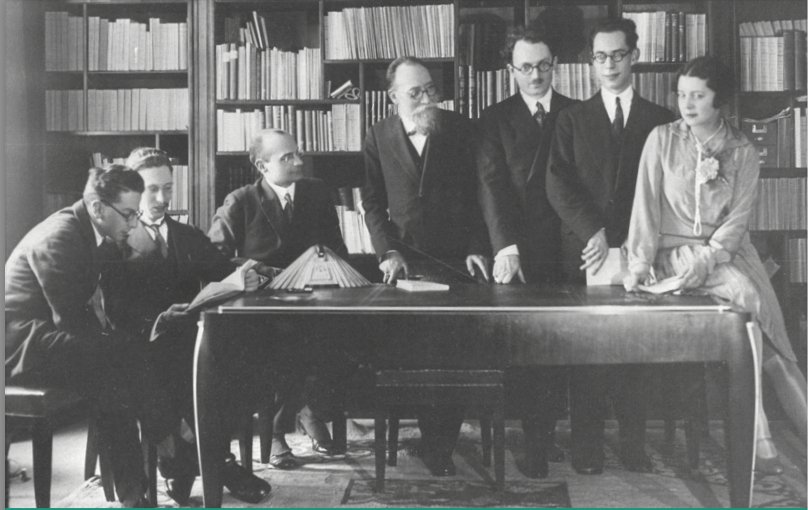
The original is in Benveniste’s archives at the Collège de France; and it is reproduced on the cover of Didier Samain and Pierre-Yves Testenoire (eds.), La Linguistique et ses forms historiques d’organisation et de production: Actes du colloque de la Société d’histoire et d’épistémologie des sciences du langage et du laboratoire Histoire des théories linguistiques Paris, 24-26 janvier 2019, Paris: SHESL, 2022.
Renou wrote a biographical note for the Marie-Louise Sjoestedt (1900–1940): In Memoriam collection, which also included tributes by Benveniste and Georges Dumézil. In his “Notice biographique”, Renou talks of her first marriage, and says that she remarried “a man who loved her and who she loved”. He also says a bit about the previous suicide attempts and how the final time she was not saved in time (p. 11).
In his discussion of Sjoestedt’s life and work, Seán Ó Lúing says of this note that “The name of her second husband is not given and the details of the tragedy have been shaded and softened. In reality she was a victim of the war” (p. 92). As I said in the earlier piece on Sjoestedt, Dumézil also acknowledged her death in the second edition of his Mitra-Varuna in a somewhat guarded way: “she was not to survive France’s first misfortunes” (p. 16/xxxvii). As well her as attending his classes, he had learned Welsh and Irish from her.
Renou’s major work was his multi-volume Études védiques et paninéennes. He was author of the book on Hinduism in the Que sais-je? series, and editor of an English collection of its sacred texts. Renou gave the inaugural series of Jordan lectures in Comparative Religion at SOAS in London in 1951, published as Religions of Ancient India. Benveniste wrote an obituary for his friend in 1966. A massive 800-page book of essays was published in 1968 – it was originally planned for his 70th birthday but because of his death became a tribute. A collection of Renou’s shorter texts was compiled in a two-volume study in 1997, which also reprints Benveniste’s obituary.
But I’m drawing a blank for information on Renou’s possible arrest.
References
Marie-Louise Sjoestedt (1900–1940). In Memoriam, suivi de Essai sur une littérature nationale, la littérature irlandaise contemporaine, Paris: E. Droz, 1941.
Mélanges d’indianisme à la mémoire de Louis Renou, Paris: Boccard, 1968.
Émile Benveniste, Notice sur la vie et les travaux de M. Louis Renou, Institut de France, 1966.
Émile Benveniste and Louis Renou, Vrtra et Vrθragna: Étude de Mythologie Indo-Iranienne, Paris: Imprimerie Nationale, 1934.
Georges Dumézil, Mitra-Varuna: Essai sur deux représentations indo-européennes de la souveraineté, revised second edition, Gallimard, 1948 [1940]; Mitra-Varuna: An Essay on Two Indo-European Representations of Sovereignty, trans. Derek Coltman, ed. Stuart Elden, Chicago: Hau, 2024.
Klaus Karttunen, “Renou, Louis”, Person of Indian Studies, https://whowaswho-indology.info/5176/renou-louis-marie-joseph/
Pierre-Yves Lambert, “Sjoestedt (-Jonval), Marie-Louise”, Dictionary of Irish Biography, https://www.dib.ie/biography/sjoestedt-jonval-marie-louise-a8102
Seán Ó Lúing, “Marie-Louise Sjoestedt, Celtic Scholar (1900-1940)”, Journal of the Kerry Archaeological and Historical Society 20, 1987, 79-93.
Georges Redard, “Bio-bibliographie”, Émile Benveniste, Dernières Leçons: Collège de France 1968 et 1969, ed. Jean-Claude Coquet and Irène Fenoglio, EHESS/Gallimard/Seuil, 2012, 149-76; “Bio-Bibliography of Émile Benveniste”, Last Lectures: Collège de France 1968 and 1969, trans. John E. Joseph, Edinburgh University Press, 2019, 128-56.
Louis Renou, “Notice biographique”, in Marie-Louise Sjoestedt (1900–1940). In Memoriam, 3-11.
Louis Renou, Études védiques et paninéennes, Collège de France Institut de Civilisation Indienne, seventeen volumes, 1955-69.
Louis Renou, Hinduism, Prentice-Hall, 1961.
Louis Renou, Religions of Ancient India, trans. Sheila M. Fynn, New York: Schocken, 1968.
Louis Renou, L’hindouisme, PUF, 1983 [1951].
Louis Renou, Choix d’études indiennes, eds. Nalini Balbir & Georges-Jean Pinault, Paris: École française d’Extrême-Orient, two volumes, 1997.
Joseph Vendryes, “Nécrologie: Marie-Louise Sjoestedt”, Études Celtiques 4 (2), 1948, 428-33.
Thanks to Rebecca Rogers for some information on the group with Benveniste, Renou and Sjoestedt.
This is the 82nd post of a weekly series, posted every Sunday throughout 2025, and continuing into a second year. The posts are short essays with indications of further reading and sources. They are not as formal as something I’d try to publish more conventionally, but are hopefully worthwhile as short sketches of histories and ideas. They are usually tangential to my main writing focus, a home for spare parts, asides, dead-ends and possible futures. I hope there is some interest in them. They are provisional and suggestions are welcome. A few, usually shorter, pieces in a similar style have been posted mid-week. I’m not sure I’ll keep to a weekly rhythm throughout 2026, but there will be at least a few more pieces.
The full chronological list of ‘Sunday histories’ is here, with a thematic ordering here.
Discover more from Progressive Geographies
Subscribe to get the latest posts sent to your email.


Pingback: Marie-Louise Sjoestedt (1900-1940): an important scholar of Celtic languages and mythology | Progressive Geographies