
Daniele Lorenzini ed. The Foucauldian Mind – Routledge, July 2026
Now published – a major, and very expensive, reference work, though the e-book is less. I say a bit about my chapter, on Foucault and structuralism, here.
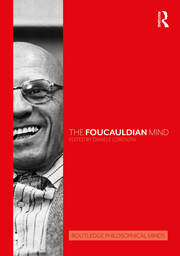
Michel Foucault is one of the most influential, and controversial, thinkers of the twentieth century. His work has had a transformative effect on the study of the humanities and social sciences. His engagement with topics such as truth, power and language continues to exert significant influence on a huge range of disciplines, from philosophy, sociology and anthropology to history, politics, law, literature, religion and many others. Yet, paradoxically, Foucault’s work is rarely discussed systematically within philosophy in the Anglophone world.
The Foucauldian Mind is an outstanding exploration and assessment of Foucault’s thought, demonstrating its coherence, insight and continuing relevance to current debates in a multiplicity of fields within philosophy, and beyond. Comprising over forty chapters authored by an international team of expert contributors, it addresses the following topics and more:
- the formation of Foucault’s thought and his most important writings, from History of Madness and The Order of Things to Discipline and Punish, the History of Sexuality, and his later works on governmentality and the aesthetics of existence
- Foucault’s theoretical and methodological engagements, including with phenomenology, existentialism, structuralism, Marxism, psychoanalysis, critical theory, pragmatism and feminism
- Foucault’s contributions to ethics, political philosophy and law
- Foucault’s often misunderstood engagements with science, race and gender
- the legacy of Foucault’s thought, including for environmental studies, biopolitics, migration studies and philosophy of disability.
With its comprehensive analysis of Foucault’s work and its original discussion of both traditional and new topics, The Foucauldian Mind is a superb resource for anyone studying Foucault’s thought from a broadly philosophical standpoint.
Discover more from Progressive Geographies
Subscribe to get the latest posts sent to your email.


always appreciate your awareness of, and concern for, exclusionary pricing, I was hoping that all of the political/economic attacks on universities might help folks to see how they are desperately in need of public support would move people (in ways that apparently some sense of solidarity/outreach, and or hoping to be relevant to , make a difference in, the broader society hasn’t) to share their work with us but alas the pull of more of the same carries the day. It’s all a bit tragic.
Some pricing choices are indefensible. Books like this are intended for library markets, and the best way to get chapters is to request them directly from authors. I am always happy to share what I can that way. I expect the vast majority of academic authors want their work to be read and will do the same.
yes thanks, you in particular have always been very gracious about sharing your work. I know all too well the dynamics around academic and publishing (not sure about libraries at UK Unis but here in the US once you get past the coffee bars and group “study” rooms to the hidden away shelves the books sit largely uncracked. I mean how many people are reading these materials? I know some people are under the pressures of publish or perish but for folks with tenure we also know there are other ways to go public like Open Humanities and Punctum that offer well edited works.
https://podcasts.apple.com/lc/podcast/friendship-and-other-ways-of-producing-knowledge/id1890533097?i=1000764231532