
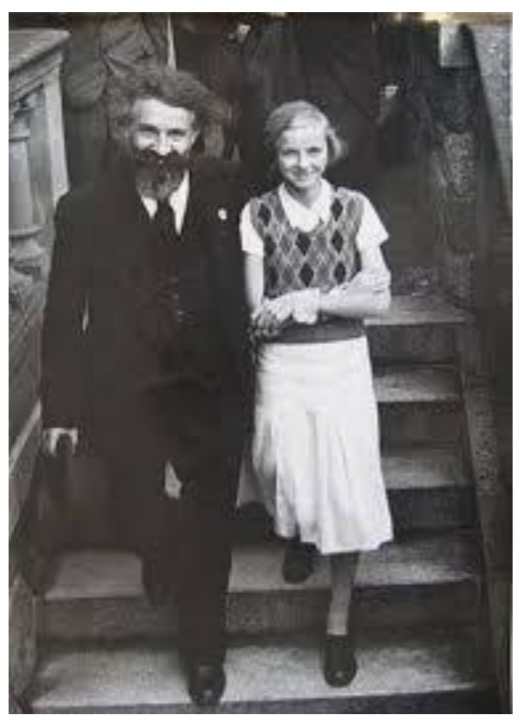
Suzanne Bachelard (18 October 1919-3 November 2007) was the daughter of Gaston Bachelard. Her mother died in June 1920 when she was still an infant, and she was brought up by her father. She would sit in on his teaching from a young age, and attend philosophy conferences with him, and it is not surprising she became a philosopher herself. Her training was in both philosophy and mathematics, initially studying with Jean Cavaillès, who was shot by the occupying Nazis in 1944. Steven Connor’s recent Gaston Bachelard: An Intellectual Biography gives some useful detail on her early childhood, and the life she shared with her father until his 1962 death.
She is probably best known for her work on Edmund Husserl’s Logique formelle et logique transcendantale, which she translated into French and on which she also wrote a long commentary, La Logique de Husserl, both published in 1957. The commentary was translated by Lester E. Embree as A Study of Husserl’s Formal and Transcendental Logic in 1968. Husserl’s book was published in English in 1969, translated by Dorion Cairns. The translation of Bachelard’s commentary was made to fit with Cairns’s choices on terminology. This means that both English and French readers had a translation of Husserl’s text made available alongside Bachelard’s commentary, terminologically consistent and a guide to this difficult work.
I am particularly interested in her situation within a French tradition of the history and philosophy of the sciences, a lineage which includes some aspects of the work of her father, Cavaillès, Alexandre Koyré, Georges Canguilhem, and Michel Foucault. Her major work in this field was La Conscience de rationalité: Étude phénoménologique sur la physique mathématique, published in 1958. The first two chapters are included in Joseph J. Kockelmans and Theodore Kisiel’s collection Phenomenology and the Natural Sciences, but the work as a whole is not translated.
La Conscience de rationalité was her primary thesis for the doctorate, with the translation of Husserl’s Logic and the commentary together being the secondary thesis. Expectations for a doctorate in this period were extensive, in extent as well as quality. Foucault’s History of Madness was his primary thesis, and his translation and introduction to Kant’s Anthropology the secondary one. Bachelard’s submission was of a similar scale. Ties Van Gemert says that the formidable jury was “composed of the philosophers René Poirier, Jean Hyppolite, and Canguilhem, assisted by the Germanist Robert Minder and the mathematician André Lichnerowicz” (p. 315).
After this astonishing beginning to her publishing career, she seems to have concentrated on teaching, including in Lille and Paris. She did not publish much more, and she never completed another book-length study. Her later publications are mainly book chapters or contributions to conference proceedings. Two lectures were also published as standalone texts. “Les Polémiques concernant le principe de moindre action au XVIIIe siècle” was on the Maupertuis principle and the dispute between Pierre Louis Maupertuis and Johann Koenig over the work of Gottfried Leibniz, and whether Leibniz had formulated the principle years before. The other was “La représentation géométrique des quantités imaginaires, au début du XIXe siècle”. An important report “Épistémologie et histoire des sciences” was presented to the twelfth International Congress for the History of Sciences, held in Paris in 1968. The report appears in Volume 1A of the Congress proceedings, with her shorter spoken presentation and the following discussion in Volume 1B.
She attended the very interesting 1970 interdisciplinary conference on structuralism held in Saclay which I’ve written about before in this series, but André Malan’s report seems to indicate she did not give a paper. Lichnerowicz was one of the conference organisers, which brought together people from a wide range of disciplines. She was part of the memorial event for Jean Hyppolite at the École Normale Supérieure on 19 January 1969, and contributed to the 1971 tribute volume to him, Hommage à Jean Hyppolite. Foucault wrote its short preface and contributed his important essay “Nietzsche, Genealogy, History”; Bachelard’s chapter was entitled “Forme et contenu”. It is a discussion of the development of algebra, particularly focusing on George Peacock, Duncan Gregory and George Boole.
Hyppolite succeeded Martial Gueroult to the Collège de France’s chair in the history of philosophy. After Hyppolite’s death, this was the chair to which Foucault was later elected. On Hyppolite’s courses there, see this piece. Gueroult’s chair had the title History and Technology of Philosophical Systems’; Hyppolite changed it to History of Philosophical Thought. Foucault would retitle the chair the History of Systems of Thought. Hyppolite’s inaugural lecture was included in Figures de la pensée philosophique – a two volume posthumous collection edited by Dina Dreyfus in 1971.
She succeeded Canguilhem as director of the University of Paris’s Institut d’histoire des sciences et des techniques in 1971, and as chair of history and philosophy of the sciences at the Sorbonne, both posts which had been previously held by her father. Her assistants included Jacques Bouveresse and Michel Fichant (on whose later work with Althusser, see here). The young Jacques Derrida had also been her assistant, and his work on Husserl, especially his translation and introduction to Origin of Geometry can be seen in this light. His diploma thesis on Husserl was written before Bachelard’s theses were published, but her work was significant in his other early engagements. Edward Baring’s The Young Derrida and French Philosophy, 1945-1968 is good on this importance, especially in Chapter 5. As he says of the Origin of Geometry introduction, “beyond works by Husserl, Derrida cited Suzanne Bachelard more than any other author” (p. 160). Bachelard’s translation of the Logique, her commentary, Derrida’s translation and introduction to Origin of Geometry, Figures de la pensée philosophique and the Hommage à Jean Hyppolite all appeared in the Epiméthée series at Presses Universitaires de France, founded by Hyppolite. (Epiméthée is the French name for Epimetheus, one of the titans, whose name means afterthought.)
Suzanne Bachelard was unusual in occupying such a senior post at the time. As I’ve mentioned before the first female professor at the Collège de France was elected in 1973; the second not until a decade later. Perhaps one indication of the male attitude towards her position in academia can be found in the English translation of A Study of Husserl’s Formal and Transcendental Logic. Despite the book being part of her doctoral work, the translator persistently calls her “Miss Bachelard”, even though when Cairns is mentioned in the preface he is “Dr” or “Professor”.
She collaborated with Canguilhem and others on the Introduction à l’histoire des sciences book, in a series Canguilhem edited on Textes et documents philosophiques. Intended for students, it comprised a series of excerpts from classic texts. I discuss this book and the series in Canguilhem (pp. 126-28).
In January 1983 she organised a seminar on logic and grammar, with the proceedings published in Histoire Épistémologie Langage in 1984, brought together by Luce Giard. Bachelard did not contribute a paper to the proceedings, which included Jacques Brunschwig, Bouveresse, who succeeded her to the posts previously held by her father and Canguilhem, Irène Rosier, and Giard.
She also edited Gaston Bachelard’s Fragments d’une poétique du feu in 1988, the completed parts of his planned study which he was working on at the time of his death. The book discusses the phoenix, Prometheus and Empedocles. Connor’s biography of Gaston Bachelard says that the delay was because there were plans for a collected works, in which unpublished material could appear, but that the range of publishers Gaston Bachelard had worked with made this too difficult. It was only when this plan was abandoned that Suzanne Bachelard agreed to edit the surviving material separately (pp. 162-63). Her preface “Un livre vécu” is interesting about his way of working, with books always ‘en chantier’, in the workshop or under construction, books becoming other works, possible ideas branching off in different directions. The book had the working title “Le Feu vécu”, living or experienced fire, before becoming La poétique du feu. She also notes the constraints on a planned Œuvres complètes, but also her father’s stipulation that there should be no publication on texts originally delivered verbally – in his courses or radio interviews (pp. 20-21).
A “Homage to the ‘Hommage à Jean Hyppolite’” was published in the new journal Philosophy, Politics and Critique in 2024, including an introduction by Joe Hughes, and articles by Christopher O’Neill, Lachlan Wells and Alice Nilsson. The contribution by Alice Nilsson uses Suzanne Bachelard’s article “as an entry point to sketch out the possibility (or impossibility) of a dialectic of mathemata following the work of Jean Cavaillès and Jean Hyppolite” (p. 373).
Recently, Ties van Gemert has edited and translated the “Epistemology and the History of Sciences” report. As far as I can tell, beyond the book on Husserl, and the excerpts from La Conscience de rationalité in Phenomenology and the Natural Sciences, this is the only other work by her available in English. He does not include the shorter presentation at the conference or the discussion which followed it. He introduces and contextualises her work well, and this is certainly the most comprehensive study in English. He describes her work as “untimely”, given the prevailing trends of French philosophy and its interest in existentialism and Marxism. “Bachelard’s attempt to integrate the history and philosophy of mathematical physics with Husserl’s transcendental phenomenology was novel and ambitious. It most likely struck many of her contemporaries as idiosyncratic” (p. 316).
Van Gemert says that the “archives of Suzanne and Gaston Bachelard were brought to the Sorbonne during spring 2024 and are currently being catalogued. At the time of writing, they were not yet open to the public” (p. 315 n. 5). As far as I’m aware, that is still the situation. While her father’s papers are likely to have wider interest, van Gemert says Suzanne Bachelard’s archive includes unpublished works “including a book on the history of modern algebra” (p. 315).
[Update 24 August 2026: Ties van Gemert has told me that there is a preliminary inventory of the Archives Gaston and Suzanne Bachelard online. This indicates that there is a lot of work ahead before the collection is fully itemised and available to researchers. But they do indicate that people with expertise in the area should contact them to assist in this task. There are 188 boxes, so the scale is clearly extensive, though it also includes their libraries.]
References
Hommage à Jean Hyppolite, Paris: PUF, 1971.
Gaston Bachelard, Fragments d’une poétique du feu, ed. Suzanne Bachelard, Paris: Presses Universitaires de France, 1988.
Suzanne Bachelard, La Logique de Husserl: Étude sur Logique formelle et logique transcendantale, Paris, PUF, 1957; A Study of Husserl’s Formal and Transcendental Logic, trans. Lester E. Embree, Evanston: Northwestern University Press, 1968.
Suzanne Bachelard, La Conscience de rationalité: Étude phénoménologique sur la physique mathématique, Paris: PUF, 1958.
Suzanne Bachelard, Les Polémiques concernant le principe de moindre action au XVIIIe siècle, etc. Paris: Palais de la découverte, 1961.
Suzanne Bachelard, La représentation géométrique des quantités imaginaires, au début du XIXe siècle, Paris: Palais de la découverte, 1966.
Suzanne Bachelard, “Épistémologie et Histoire des Sciences”, Actes du XIIe congrès international d’histoire des sciences, 1. A: Colloques, textes des rapports, Paris: Albert Blanchard, 1970, 39–51; “Epistemology and the History of the Sciences”, trans. Ties van Gemert in “Suzanne Bachelard’s Historical Phenomenology: Recursivity in the History of the Sciences”, HOPOS: The Journal of the International Society for the History of Philosophy of Science 15 (2), 2025, 322-34.
Suzanne Bachelard, “Épistémologie et Histoire des Sciences”, Actes du XIIe congrès international d’histoire des sciences, 1. B: Discussion des Rapports, Paris: Albert Blanchard, 1970, 74-82.
Suzanne Bachelard, “Phenomenology and Mathematical Physics”, trans. Joseph J. Kockelmans, in Joseph J. Kockelmans and Theodore Kisiel eds. Phenomenology and the Natural Sciences, Evanston: Northwestern University Press, 1970, 413-25.
Suzanne Bachelard, “The Specificity of Mathematical Physics”, trans. Joseph J. Kockelmans, in Joseph J. Kockelmans and Theodore Kisiel eds. Phenomenology and the Natural Sciences, Evanston: Northwestern University Press, 1970, 426-40.
Suzanne Bachelard, “Forme et contenu”, in Hommage à Jean Hyppolite, Paris: Presses Universitaires de France, 1971, 217-29.
Suzanne Bachelard, “Quelques aspects historiques des notions de modèle et de justification des modèles”, in Pierre Delattre and Michel Thellier eds., Élaboration et justification des modèles: Application en Biologie, Paris: Maloine, two volumes, 1979, Vol I, 3-19.
S. Bachelard, J.C. Cadiuex, G. Canguilhem et. al. Introduction à l’histoire des sciences, Paris: Hachette, two volumes, 1970-71.
Suzanne Bachelard ed. “Logique et grammaire”, Histoire Épistémologie Langage 6 (1), 1984, https://www.persee.fr/issue/hel_0750-8069_1984_num_6_1
Suzanne Bachelard, “Avant-Propos: Un livre vécu” in Gaston Bachelard, Fragments d’une poétique du feu, ed. Suzanne Bachelard, Paris: Presses Universitaires de France, 1988, 5-24.
Edward Baring, The Young Derrida and French Philosophy, 1945-1968, Cambridge University Press, 2011.
Steven Connor, Gaston Bachelard: An Intellectual Biography, London: Reaktion, 2025.
Jacques Derrida, Edmund Husserl’s Origin of Geometry: An Introduction, trans. John P. Leavey, Jr., Lincoln: University of Nebraska Press, 1978.
Stuart Elden, Canguilhem, Cambridge: Polity, 2019.
Edmund Husserl, Logique formelle et logique transcendantale, trans. Suzanne Bachelard, Paris: Presses Universitaires de France, 1957.
Edmund Husserl, L’Origine de la géométrie, trans. Jacques Derrida, Paris: Presses Universitaires de France, 1962.
Edmund Husserl, Formale und transzendentale Logik: Versuch einer Kritik der logischen Vernunft, Tübingen: Max Niemeyer, 1981 [1929]; Formal and Transcendental Logic, trans. Dorion Cairns, The Hague: Martinus Nijhoff, 1969.
Jean Hyppolite, Figures de la pensée philosophique, ed. Dina Dreyfus, Paris: Presses Universitaires de France, two volumes, 1971.
André Malan, “Colloque de Saclay”, in Structure et dynamique des systèmes, ed. A. Lichnerowicz, F. Perroux and G. Gadoffre, Paris: Maloine, 1976, 165-90.
Jean Mosconi, “Éloge de Suzanne Bachelard (18 octobre 1919-3 novembre 2007)”, Comité national français d’histoire et de philosophie des sciences, https://www.cnfhpst.org/sites/default/files/documents/eloge_Suzanne_Bachelard.pdf
Alice Nilsson, “Dialectics, Mathematics and the Cavaillès-Hyppolite Encounter”, Philosophy, Politics, Critique 1 (3), 2024, 373-82.
Ties van Gemert, “Suzanne Bachelard’s Historical Phenomenology: Recursivity in the History of the Sciences”, HOPOS: The Journal of the International Society for the History of Philosophy of Science 15 (2), 2025, 312-53.
This is the 85th post of a weekly series, posted every Sunday throughout 2025, and continuing into a second year. The posts are short essays with indications of further reading and sources. The pieces are not as formal as something I’d try to publish more conventionally, but are hopefully worthwhile as short sketches of histories and ideas. They are usually tangential to my main writing focus, a home for spare parts, asides, dead-ends and possible futures. I hope there is some interest in them. They are provisional and suggestions are welcome. A few, usually shorter, pieces in a similar style have been posted mid-week. I wasn’t sure I’d keep to a weekly rhythm throughout 2026, but have ideas for at least a few more pieces.
The full chronological list of ‘Sunday histories’ is here, with a thematic ordering here.
Discover more from Progressive Geographies
Subscribe to get the latest posts sent to your email.


