
In an interview with Maria Lúcia G. Pallares-Burke in October 1998, published in The New History: Confessions and Conversations, Carlo Ginzburg mentions the critical attitude he has to some of his earlier works. One was his 1970 book Il nicodemismo: Simulazione e dissimulazione religiosa nell’Europa del Cinquecento [Nicodemism: Religious pretence and dissimulation in sixteenth-century Europe]:
I don’t like it because it is perhaps the most academic book I ever wrote… I wouldn’t like to repudiate the book completely (there being something in its research strategy that I still feel close to), although I have always refused permission for republication, since that would require a long introduction explaining what is wrong with some of its chapters (pp. 198-99).
This book remains untranslated into English, one of only a few of Ginzburg’s books not available in that language. (The original Italian is out of print, but available on archive.org) He also mentions a collaborative work:
Another book that seems strange today is Giochi de Pazienza, which I wrote with my friend Adriano Prosperi, telling the story of our joint research on sixteenth-century religious tracts. I never really understood why Einaudi decided to reprint it. It is in a deliberate way a rather unreadable book. But its research core was quite sound, as Adriano Prosperi will show in the book he has been working on for years on Giorgio Siculo, a sixteenth-century Benedictine monk put to death as a heretic. But Giochi di Pazienza was also a sort of methodological manifesto. I developed some of its themes in my essay on clues (The New History, p. 199).
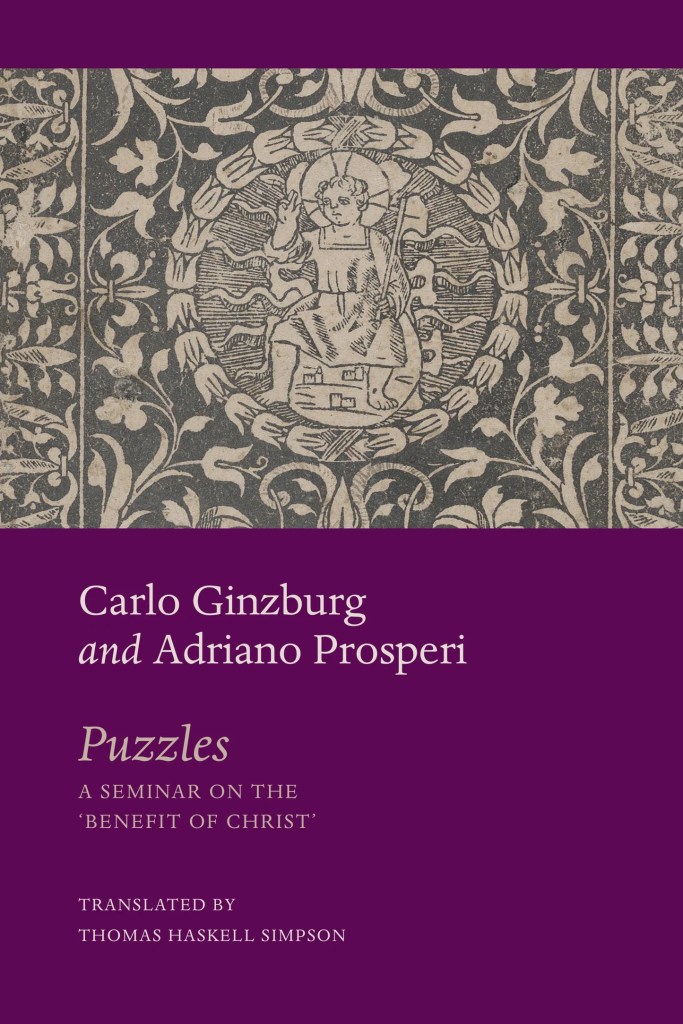
Giochi de Pazienza might translate as ‘games of patience’, a play on the card game sometimes known as solitaire. First published in 1975, and reissued in 2020, the book was finally translated into English in 2026 as Puzzles: A Seminar on the ‘Benefit of Christ’, just a few months before Ginzburg died. The second edition and its translation has two reflective essays by Ginzburg and Prosperi. It is part of the Italian List at Seagull, edited by Alberto Toscano. That series has been so valuable in making work available in English for those of us who can’t read more than a little Italian.
I wrote about the ‘Clues’ essay in an earlier piece in this series, about Ginzburg’s approach of the historian as a detective. I also outlined the different versions of that text which exist. I should have noted there that Italo Calvino’s short essay on that text is included in his The Written World and the Unwritten World collection. The Adriano Prosperi reference given by Ginzburg in the interview quotation is L’eresia del Libro Grande: Storia di Giorgio Siculo e della sua setta [The Heresy of the Great Book: The History of Giorgio Siculo and his sect], which was published in 2000.
Puzzles is a very interesting book. I can’t pretend to have been able to follow all of the details of the text and the issues about its dating and provenance, but I found the narration of the process of research fascinating. Christopher Smith has a very interesting piece about Puzzles, and what it shows about reading, at “Clio reads a book” on his Anatomies of Power site. As he says there:
1968, Bologna. Two young professors look for a new way of teaching as the clouds of revolution swirl. What is history? How to do it? What are the rules and what is the endpoint, and who are the historians? They take up a text, the Beneficio di Cristo, and let the students pick it apart. They followed the clues, hunted in the libraries in a way that is familiar to my generation, but increasingly unfamiliar as catalogues and texts are digitised. They had to rely on chance, and on memory (“I’ve read that somewhere before!”). And then they did something even more radical – they jointly published a book of their intellectual journey, its missteps and mistakes, the backtracking, disagreements, the recognition of their own preconceptions.
In his tribute in Pittsburgh Review of Books, Reading Vertically and Horizontally with Carlo Ginzburg, Nitzan Lebovic says that when he arrived at UCLA he asked for guidance: “When I asked my friends what I should study with Carlo, their advice was simple: It doesn’t matter. Take whatever he’s teaching — it’s always an intellectual whirlwind”. You get a sense from Puzzles why that might be, though you should look at Lebovic’s piece to read his anecdote of being initiated into historical research by Ginzburg.
Here’s one passage I particularly liked from Puzzles:
There comes a moment (not always) in the course of research when, as in a jigsaw puzzle, all the pieces begin to fall into place. But unlike a jigsaw puzzle, where all the pieces are to hand and there is only one picture to be formed (so that the correctness of each move can be checked at once), in research only some of the pieces are available, and the pictures that can be composed are, in theory, more than one. There is always the risk, in fact, of using the jigsaw pieces, consciously or not, as building blocks. The fact that everything appears to fit is therefore an ambiguous sign: either one is completely right or one is completely wrong. In the latter case, what is taken for external verification is in reality the selection and prodding (more or less deliberate) of the evidence, manipulated to confirm the (more or less explicit) presuppositions of the research. The dog thinks it is gnawing the bone, and instead it is chewing its own tail (p. 102).
In his 2020 “Afterword”, Ginzburg adds that “a group of young Bolognese writers, concealed behind the pseudonym Luther Blissett, [wrote] a historical novel inspired by the characters and events at the centre of Puzzles (Q, 1999; one of the chapters is entitled ‘Il Beneficio di Cristo’)” (p. 254). It’s been many years since I read Q, and I hadn’t made the connection until I read this “Afterword”. The collective ‘Luther Blissett’ was named after a former football player, and some of the group later went on to found the group ‘Wu Ming’, who have authored many novels. Wu Ming have a tribute to Ginzburg on their website. This connection promises to be explored in Andrea Brondino’s forthcoming book Narrative and History in the Works of Umberto Eco, Carlo Ginzburg, and Wu Ming: Untangling the Strands.
At least four collections of essays have been dedicated to Prosperi, a three-volume study in 2011 and another in 2019. Most, but not all, of the essays in these are in Italian. Ginzburg contributed an essay on Machiavelli and antiquarians, later reprinted in his Nevertheless: Machiavelli, Pascal. In contrast to Ginzburg, only some of Prosperi’s work has been translated, including Infanticide, Secular Justice, and Religious Debate in Early Modern Europe, Justice Blindfolded: The Historical Course of an Image and Crime and Forgiveness: Christianizing Execution in Medieval Europe.
Justice Blindfolded examines how ‘justice’ is often portrayed as a woman with bandaged eyes, how this relates to the crucified Christ, and ideas of justice as fairness, as impartiality. It is an extraordinary study, historically wide-ranging and strikingly illustrated, moving between religious and legal history, with analysis of artworks and texts. It moves from the Bible to Bentham and Rousseau to Rawls, and deserves to be better-known by political theorists as much as historians.
I don’t think there is an English translation of Prosperi’s L’eresia del Libro Grande, the book which Ginzburg suggests demonstrates the soundness of the “research core” of Puzzles. Like Ginzburg’s book on Nicodemism, it is out of reach for non-Italian readers… Maybe two others for ‘The Italian List’.
References
Luther Blissett, Q, trans. Shaun Whiteside, London: Heinemann, 2003.
Andrea Brondino, Narrative and History in the Works of Umberto Eco, Carlo Ginzburg, and Wu Ming: Untangling the Strands, London:Bloomsbury, forthcoming December 2026.
Italo Calvino, The Written World and the Unwritten World: Collected Non-Fiction, trans. Ann Goldstein, London: Penguin, 2023.
Guido Dall’Olio, Adelisa Malena and Pierroberto Scaramella eds. La Fede degli italiani: Per Adriano Prosperi vol. I, Pisa: Edizioni della Normale, 2011.
Wietse de Boer, Vincenzo Lavenia and Giuseppe Marcocci eds. La Ghianda e la quercia: Saggi per Adriano Prosperi, Roma: Viella, 2019.
Massimo Donattini, Giuseppe Marcocci and Stefania Pastore eds. L’Europa divisa e I nuovi mondi: Per Adriano Prosperi vol. II, Pisa: Edizioni della Normale, three volumes, 2011.
Carlo Ginzburg, Il nicodemismo: Simulazione e dissimulazione religiosa nell’Europa del Cinquecento, Torino, Einaudi, 1970.
Carlo Ginzburg, Nevertheless: Machiavelli, Pascal, London: Verso, 2022.
Carlo Ginzburg and Adriano Prosperi, Giochi di Pazienza: Un Seminario sul «Beneficio di Cristo», Torino: Einaudi, 1975, second edition, Macerata: Quodlibet, 2020; Puzzles: A Seminar on the ‘Benefit of Christ’ – trans. Thomas Haskell Simpson, Calcutta: Seagull, 2026.
Vincenzo Lavenia and Giovanna Paolin eds. Riti di passaggio, storie di giustizia: Per Adriano Prosperi vol. III, Pisa: Edizioni della Normale, three volumes, 2011.
Nitzan Lebovic, “Reading Vertically and Horizontally with Carlo Ginzburg”, Pittsburgh Review of Books, 29 June 2026, https://pghrev.com/reading-vertically-and-horizontally-with-carlo-ginzburg/
Maria Lúcia G. Pallares-Burke, The New History: Confessions and Conversations, Cambridge: Polity, 2002.
Adriano Prosperi, L’eresia del Libro Grande: Storia di Giorgio Siculo e della sua setta, Milan: Feltrinelli, 2000.
Adriano Prosperi, Infanticide, Secular Justice, and Religious Debate in Early Modern Europe, Turnhout: Brepols, 2016.
Adriano Prosperi, Justice Blindfolded: The Historical Course of an Image, trans. John Tedeschi and Anne C. Tedeschi, Leiden: Brill, 2018.
Adriano Prosperi, Crime and Forgiveness: Christianizing Execution in Medieval Europe, trans. Jeremy Carden, Harvard University Press, 2020.
Wu Ming, “Carlo Ginzburg nel momento del pericolo. Un saluto al maestro (1939 – 2026)”, June 2026, https://www.wumingfoundation.com/giap/2026/06/carlo-ginzburg/
This is the 87th post of a weekly series, posted every Sunday throughout 2025, and continuing into a second year. The posts are short essays with indications of further reading and sources. The pieces are not as formal as something I’d try to publish more conventionally, but are hopefully worthwhile as short sketches of histories and ideas. They are usually tangential to my main writing focus, a home for spare parts, asides, dead-ends and possible futures. I hope there is some interest in them. They are provisional and suggestions are welcome. A few, usually shorter, pieces in a similar style have been posted mid-week.
The full chronological list of ‘Sunday histories’ is here, with a thematic ordering here.
Discover more from Progressive Geographies
Subscribe to get the latest posts sent to your email.


Pingback: The Historian as Detective – Carlo Ginzburg and the Search for ‘Clues’ | Progressive Geographies
Pingback: Carlo Ginzburg and Adriano Prosperi, Puzzles: A Seminar on the ‘Benefit of Christ’ – trans. Thomas Haskell Simpson, Seagull, March 2026 | Progressive Geographies
https://newbooksnetwork.com/unfree-workers
Pingback: Books received – Eco, Lefebvre, Mandrou, Moore and Fedorowich, Nerlich, Coletti, Deutsch, Prosperi | Progressive Geographies
Pingback: Books received – Bagnato, Mandrou, Ginzburg, Puaud, Favret-Saada, Wilson | Progressive Geographies
Pingback: Books received – Bagnato, Mandrou, Ginzburg, Puaud, Favret-Saada, Wilson - Som2ny Network