
In a previous piece on The Friendship between Hannah Arendt, Alexandre Koyré and Horace Kallen, I mentioned how Kallen and Arendt were both involved with the Commission on European Jewish Cultural Reconstruction after World War II. The Commission was set up to track down books, archives and other materials looted by the Nazis, restore those that could be to their owners, and to distribute those for which no heir could be identified. Kallen was one of the founders of the Commission. The Commission is mentioned briefly in biographies of Arendt (i.e., Young-Bruehl, Hannah Arendt: For Love of the World, pp. 187-88; Rose Hill, Hannah Arendt, p. 118), but the story of Arendt’s involvement is interesting and perhaps deserves more attention.
While countless Jewish books were burned, and religious objects melted down by the Nazis, many artworks were stolen and some books kept as part of pseudo-academic racist research. There was therefore both a deliberate attempt to destroy Jewish heritage in Europe, and to use some materials to provide a basis for anti-Semitism. In particular, the philosopher and Nazi administrator Alfred Rosenberg headed the Institut zur Erforschung der Judenfrage [Institute for the Research of the Jewish Question] which compiled its own library of stolen books (see Leff, The Archival Thief, pp. 85-86). After the end of the War, many of the recovered items were transferred to the Offenbach Archival Depot in the American sector of occupied Germany. (A brief history with a photograph of one storeroom is here.) This depot held well over two million books, and many other items. Robert G. Waite, “Returning Jewish Cultural Property” is good on this story generally. Elizabeth Simpson’s collection The Spoils of War – World War II and Its Aftermath gives a sense of the scale of restitution required.
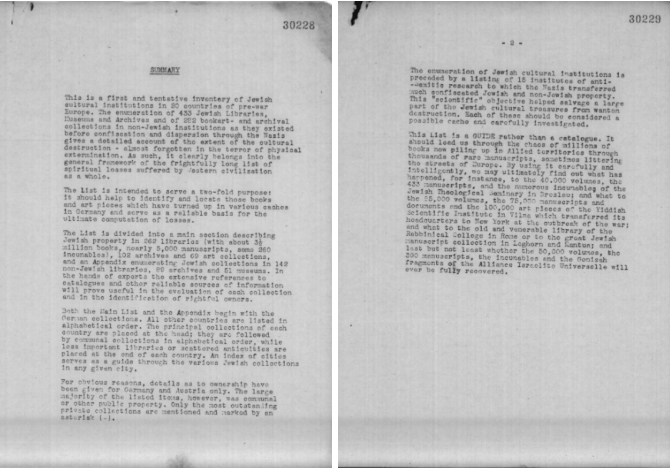
In one of Arendt’s letters to Kallen she includes a two-page typescript describing the work of the Commission (YIVO RG 317 box 35, folder 605, pp. 23-24). This summary introduces the report “Tentative List of Jewish Cultural Treasures in Axis-Occupied Countries”, which was published as a supplement to Jewish Social Studies in 1946. Arendt’s summary is not in the published version which instead has an opening statement by the historian Salo W. Baron. Arendt led the research which produced this list – in the report she is described as “in charge of the entire project and especially of the West-European area” (p. 8).
Arendt also led a second report, “Tentative List of Jewish Educational Institutions in Axis-Occupied Countries”, also published as a supplement to Jewish Social Studies, with addenda in subsequent issues including lists of Jewish publishers and periodicals. In the second report, Baron says that Arendt had “submitted two preliminary surveys of the facts and trends in Jewish education in postwar Europe. We hope that before long this information will be sufficiently complete to warrant publication for the use of wider circles” (p. 8). It is not clear to me whether this happened. In “Tentative List of Jewish Periodicals in Axis-Occupied Countries” Arendt is again credited as leading the team which prepared the list (p. 7).
Natan Sznaider says these reports are “usually not included in the Arendt canon, but they are among her important publications on Jewish matters and should be considered as such” (Jewish Memory and the Cosmopolitan Order, p. 55). At the time she was writing these reports, Arendt was combining this work with an editorial role at Schocken Books. Schocken Verlag had been a Jewish publisher based in Berlin which was closed by the Nazis, and reestablished in Tel Aviv. Salman Schocken founded Schocken Books in New York in 1945, and hired Arendt as an editor. (On the history, see here.) Some of Arendt’s books, including The Origins of Totalitarianism were published by Schocken, now part of Penguin Random House.
As these “tentative lists” indicate, much of the initial work of the Commission was cataloguing and beginning to trace heirs. In 1947 the Commission set up Jewish Cultural Reconstruction Inc. (JCR) which was responsible for transferring the remaining items to libraries. It has been described as an:
organization established in 1947 to deal with the collection and redistribution of heirless Jewish cultural property in the American Zone of Germany, centered in Offenbach and later in Wiesbaden. Its headquarters were in New York and its logistical and financial support came from the Jewish Restitution Successor Organization (JRSO). Its leadership was comprised of some of the foremost Jewish intellectuals of the day: Salo Baron was its executive director; Joshua Starr and later Hannah Arendt served as executive secretaries. Gershom Scholem, Shlomo Shunami, Bernard Heller, Mordechai Narkiss, and E.G. Lowenthal were among those working in conjunction with JCR in Europe. Under the American Restitution Law (no. 59), JCR functioned as a trustee for those Jewish cultural items whose owners or heirs could not be located. By the end of its operations in 1951–52, JCR had redistributed hundreds of thousands of books and thousands of Torah scrolls and other ritual objects to major libraries and museums, including the Library of Congress and Bezalel [the Academy of Arts and Design] in Jerusalem, as well as to institutions of higher learning such as the Jewish Theological Seminary in New York. A total of 85% of the cultural property was sent to Israel and the United States; 8% was allocated to Western European countries (with half going to Britain) and the remaining 7% was distributed to South Africa, Argentina, Brazil, Australia, Canada, and West Germany. Although it had no international standing, the organization encouraged the establishment of similar bodies in the British and French Zones of Occupation (Jewish Virtual Library).
US Military Government Law 59 was a November 1947 regulation on “Restitution of Identifiable Property” – its text is available here or here. Michael Kurtz provides a detailed discussion of the JCR, making use of the papers of Salo W. Baron, which are at Stanford University, and archives in Israel. He quotes from some of Arendt’s administrative letters for the Commission.
Hannah Arendt based her efforts during a trip to Germany on “the assumption that Nazi-confiscated Jewish cultural property must have found its way into German libraries, museums and archives and that it could be discovered only through active cooperation of the German personnel in charge of such institutions.” Arendt worked assiduously to gain the cooperation of German officials, particularly in light of the fact that the reporting requirement for looted Jewish cultural property (Article 73) in Military Government Law No. 59 remained basically a dead letter.
Arendt met with German library officials and persuaded the president of the German Library Association, Dr. Gustav Hofmann, to issue an appeal to all libraries to search their collections for confiscated Jewish material and report it to the JCR. Arendt did not mention restitution because the law differed in each of the western zones, with no effort possible in the Soviet Zone. To Arendt, the “centralization of information is a first and the most important step.” Unfortunately, no reports came in, partly because of Germany’s reluctance to comply and partly because many collections were still crated from wartime storage (Kurtz, “Resolving a Dilemma”, pp. 652-53; citing Hannah Arendt, “Report of My Mission to Germany”, 12 April 1950 [in The Correspondence of Hannah Arendt and Gershom Scholem, pp. 255-56]).
Kurtz explains how the situation of restitution in the other occupied zones of Germany was different – the British and French wanted to delegate the work to German administrators; the Soviets were uninterested in the work, and like the French were more concerned with reparations for their own war-time losses (“Resolving a Dilemma”, p. 638). He also discusses how the JCR decided to distribute the allocations to Israel, mainly the Jewish National and University Library, based at the Hebrew University of Jerusalem; the United States, both the Library of Congress and Jewish schools, seminaries and other libraries; and the rest to Britain, South Africa and elsewhere, roughly along the proportions indicated above. His source here is a letter from Arendt, crucially involved in these decisions (p. 643). This means that these items taken from Europe became part of an intellectual diaspora, like many Jewish people. (Kurtz developed this research into Chapter 8 of his book America and the Return of Nazi Contraband: The Recovery of Europe’s Cultural Treasures, itself an updated version of his much earlier book Nazi Contraband: American Policy on the Return of European Cultural Treasures, 1945-1955, but the book does not add much detail about Arendt’s specific role beyond what is in the article. The earlier book only mentions Arendt briefly.)
Theodor Gaster – academic and at the time head of the Hebraic section of the Library of Congress, and one of the founders of JCR – put it starkly in 1945:
It is erroneously supposed (even by national organizations that should know better) that the task which confronts us is one of restoring prewar or pre-Nazi conditions, of putting libraries, museums, schools, seminaries, and academies back on their feet, as they were in 1939 or before Hitler rose to power. Our problem is, however, not one of renovation or repair but of laying new foundations. So far as the Jews of Europe are concerned, there are no ruins to rebuild; we have to start from scratch (“Foundations of Jewish Cultural Reconstruction in Europe”, pp. 257-58).
Arendt spent about four months in Germany doing research for the JCR. She published an article about her visit in 1950, “The Aftermath of Nazi Rule. Report from Germany” (reprinted in Essays in Understanding). But her four field reports and a final report back to the JCR have a lot more detail. They are included as an appendix to her correspondence with Gershom Scholem. The reports were written in English, and are reproduced in that form in the German edition (pp. 485-533) with a translation (pp. 555-607), and the originals are included in the English translation of the correspondence (pp. 225-61). I had thought that I’d be unable to look at the originals of Arendt’s reports to the JCR without a trip to the United States, but there is a microfilm copy at the Wiener Holocaust Library in London. The microfilm reel has been digitised and so I was able to spend an afternoon there. The file includes Arendt’s reports, but also the ones by Bernard Heller, E.G. Lowenthal, Schlomo Shunami and others, some summarised in English from Hebrew or Yiddish originals, and minutes of meetings and other documents. The fourth report from Hamburg is also available online, with a presentation by Elisabeth Gallas.
Arendt’s 10 February 1950 report gives an indication of how much travel she did for this research. After a week each in London and Paris in January, between 16 January and 10 February she passed through Wiesbaden, Mainz, Frankfurt, Munich, Stuttgart, Tübingen, Heidelberg, Karlsruhe, Worms, Landau, Basel, Freiburg, Baden-Baden, Rastatt and finally back to Wiesbaden (report of 10 February, p. 1; see in The Correspondence of Hannah Arendt and Gershom Scholem, p. 241). Her other reports were sent reporting from Berlin, Munich and Hamburg and neighbouring areas: with the exception of the Soviet zone, she covered most of the country.
There are some small variations between the reports published in the correspondence with Scholem and the ones in the Wiener Holocaust Library file. The itinerary, for example prefaces the report in the file, but is in a postscript to the one in the correspondence. While none of the changes seemed to me to be especially significant, they do indicate that different versions of these typed reports exist. There are a lot of other documents in the file, including minutes of the meetings, for which Arendt often acted as secretary. Arendt indicates the challenges of the field visits:
Conditions in Germany are uncertain, chaotic and full of surprises; the same, unfortunately, holds true for conditions in the German Jewish communities. Throughout my stay in Germany, I have been trying to find a central body that enjoys enough authority to be able to enter into generally binding agreements. When this failed, I tried to come at least to agreements with the Landesverbände in order to avoid to have to negotiate with every single community…
Unfortunately, I must admit that only negotiations carried out on a local level with the community leaders in a given city seem to have any chance to achieve results at the present moment. Promises made by larger bodies are not taken seriously, no matter how solemnly they are being pronounced (final report of 12 April 1950, p. 5; in The Correspondence of Hannah Arendt and Gershom Scholem, p. 260).
As well as Kurtz’s accounts, the story of this work and Arendt’s role has been told more fully in, for example, Chapter 3 of Natan Sznaider, Jewish Memory and the Cosmopolitan Order: Hannah Arendt and the Jewish Condition; Dov Schidorsky, “Hannah Arendtʼs Dedication to Salvaging Jewish Culture”; and Elisabeth Gallas, A Mortuary of Books: The Rescue of Jewish Culture after the Holocaust. Gallas co-edited a collection of essays with Anna Holzer-Kawalko, Caroline Jessen and Yfaat Weiss, entitled Contested Heritage: Jewish Cultural Property after 1945. That book is available open access and is richly illustrated. Some of the essays there, which came from a 2016 conference at the Hebrew University of Jerusalem, mention Arendt’s work. In the German edition of the Arendt-Scholem correspondence there is an essay by David Heredia on the history of JCR, but this is not translated in the English edition. There is a wide literature on the broader question of looted artworks and the political questions around their repatriation, of which Jelena Subotić, The Art of Status: Looted Treasures and the Global Politics of Restitution is a recent valuable guide.
Another, partly-related story about Jewish cultural heritage is told by Lisa Moses Leff. This is “the murky business” of Yehoshua “Szajko” Frydman, who wrote under the pseudonym of Zosa Szajkowski. Szajkowski initially was involved with getting material out of Europe, saving documents and other resources. But he continued this long after the War had ended, stealing documents from French archives which he used for his own research, and which later were sold to collections in the United States and Israel. Leff explores his story in articles and in her very interesting book The Archive Thief: The Man who Salvaged French Jewish History in the Wake of the Holocaust. She explores what he did across the historical moments in which they happened, and indicates that his actions are ambiguous – initially salvaging material in wartime, but later stealing it, “a rescuer who certainly became a thief”.
In one of her articles, Leff says that:
For Arendt especially, Judaica no longer belonged in Europe, where Jewish history had come to an end; now, the remnants of the Jewish past needed to be in the places where Jews lived and Jewish historians could make use of them (“Rescue or Theft”, p. 16; see The Archival Thief, pp. 137-39).
Her reference here is to one of the JCR field reports Arendt sent back from Europe (No 18, February 15 to March 10, 1950). Of course, this claim is problematic because there were Jewish people who did remain in Europe, but whose cultural heritage ended up in the United States and Israel, among other places. The argument seems to have been that as the people were displaced, it made sense for the heritage to be moved too, in order to ensure Jewish control and to provide access to as many people as possible. Leff’s work is good on the provenance on some of those materials removed from Europe.
Archives
Jewish Cultural Reconstruction Inc.: Records, Wiener Holocaust Library, https://wiener.soutron.net/Portal/Default/en-GB/RecordView/Index/70531
Papers of Horace Meyer Kallen (1882-1974) 1902-1970 RG 317, YIVO Institute for Jewish Research, Center for Jewish History, https://archives.cjh.org/repositories/7/resources/525
References
Hannah Arendt, “The Aftermath of Nazi Rule. Report from Germany”, Commentary 10 1950, 342-53; reprinted in Essays in Understanding 1930-1954, ed. Jerome Kohn, New York: Harcourt, Brace & Company, 1994, 248-69.
Hannah Arendt, The Origins of Totalitarianism, New York: Schocken, 1951; enlarged edition 1958; numerous reeditions.
Hannah Arendt and Gershom Scholem, Der Briefwechsel, ed. Marie Luise Knott, Berlin: Jüdischer Verlag, 2010; The Correspondence of Hannah Arendt and Gershom Scholem, trans. Anthony David, Chicago: University of Chicago Press, 2017.
Commission on European Jewish Cultural Reconstruction, “Tentative List of Jewish Cultural Treasures in Axis-Occupied Countries”, Jewish Social Studies VIII (1), 1946, supplement.
Commission on European Jewish Cultural Reconstruction, “Tentative List of Jewish Educational Institutions in Axis-Occupied Countries”, Jewish Social Studies VIII (3), 1946, supplement.
Commission on European Jewish Cultural Reconstruction, “Tentative List of Jewish Periodicals in Axis-Occupied Countries”, Jewish Social Studies IX (3), 1947, supplement.
Commission on European Jewish Cultural Reconstruction, “Addenda and Corrigenda to Tentative List of Jewish Cultural Treasures in Axis-Occupied Countries”, Jewish Social Studies VIII (1), 1946, supplement.
Commission on European Jewish Cultural Reconstruction, “Tentative List of Jewish Publishers of Judaica and Hebraica in Axis-Occupied Countries”, Jewish Social Studies X (2), 1948, supplement.
Elisabeth Gallas, “Jewish Cultural Assets in the Postwar Period: Hannah Arendt’s Report on the Situation in Hamburg”, trans. Insa Kummer, in Key Documents of German-Jewish History, January 30, 2017, https://dx.doi.org/10.23691/jgo:article-89.en.v1
Elisabeth Gallas, A Mortuary of Books: The Rescue of Jewish Culture After the Holocaust, trans. Alex Skinner, New York: NYU Press, 2019.
Elisabeth Gallas, Anna Holzer-Kawalko, Caroline Jessen and Yfaat Weiss eds. Contested Heritage: Jewish Cultural Property after 1945, Göttingen: Vandenhoeck & Ruprecht, 2020.
Theodor H. Gaster, “Foundations of Jewish Cultural Reconstruction in Europe”, The Journal of Educational Sociology 18 (5), 1945, 267-70.
David Heredia, “Zur Geschichte von Jewish Cultural Reconstruction, Inc.” in Hannah Arendt and Gershom Scholem, Der Briefwechsel, ed. Marie Luise Knott, Berlin: Jüdischer Verlag, 2010, 534-52.
Michael J. Kurtz, Nazi Contraband: American Policy on the Return of European Cultural Treasures, 1945-1955, New York: Garland, 1985.
Michael J. Kurtz, “Resolving a Dilemma: The Inheritance of Jewish Property”, Cardozo Law Review 20 (2), 1998–99, 625-55.
Michael J. Kurtz, America and the Return of Nazi Contraband: The Recovery of Europe’s Cultural Treasures, Cambridge: Cambridge University Press, 2006.
Lisa Moses Leff, “Rescue or Theft?: Zosa Szajkowski and the Salvaging of French Jewish History after World War II”, Jewish Social Studies 18 (2), 2012, 1-39.
Lisa Moses Leff, The Archive Thief: The Man who Salvaged French Jewish History in the Wake of the Holocaust, Oxford University Press, 2015.
Lisa Moses Leff, “A Murky Business: Doing Jewish History in France, 1961”, The Jewish Quarterly Review113 (1), 2023, 5-9.
Samantha Rose-Hill, Hannah Arendt, London: Reaktion, 2021.
Dov Schidorsky, “Hannah Arendtʼs Dedication to Salvaging Jewish Culture”, The Leo Baeck Institute Yearbook 59 (1), 2014, 181–95.
Elizabeth Simpson ed. The Spoils of War – World War II and Its Aftermath: The Loss, Reappearance, and Recovery of Cultural Property, New York: Harry N. Abrams, Inc./The Bard Graduate Center for Studies in the Decorative Arts, 1997.
Jelena Subotić, The Art of Status: Looted Treasures and the Global Politics of Restitution, Oxford: Oxford University Press, 2025.
Natan Sznaider, Jewish Memory and the Cosmopolitan Order: Hannah Arendt and the Jewish Condition, Cambridge: Polity, 2011.
Robert G. Waite, “Returning Jewish Cultural Property: The Handling of Books Looted by the Nazis in the American Zone of Occupation, 1945 to 1952”, Libraries & Culture 37 (3), 2002, 213-28.
Elisabeth Young-Bruehl, Hannah Arendt: For Love of the World, New Haven: Yale University Press, 1982.
This is the 98th post of a weekly series, posted every Sunday throughout 2025, and so far through 2026. The posts are short essays with indications of further reading and sources. They are not as formal and developed as something I’d try to publish more conventionally, but are hopefully worthwhile as short sketches of histories and ideas. They are usually tangential to my main writing focus, a home for spare parts, asides, dead-ends and possible futures. I hope there is some interest in them. They are provisional and suggestions are welcome. A few, usually shorter, pieces in a similar style have been posted mid-week.
I discuss what I am doing in this series in “Writing the ‘Sunday histories’ – an experiment in sharing short pieces on a blog”, my contribution to the Northern Ireland Legal Quarterly “Reflections on Writing” Series – all pieces are open access.
The full chronological list of ‘Sunday histories’ is here, with a thematic ordering here.


