Giorgio Agamben’s The Use of Bodies was published in English translation in 2015, after an Italian publication in 2014. It was the final volume of the Homo Sacer series, which had been inaugurated by the book of that title in 1995, translated in 1998. In the preface to The Use of Bodies Agamben says that the series, “like every work of poetry and thought, cannot be concluded but only abandoned (and perhaps continued by others)” (p. xiii). I thought at the time that this meant he’d just run out of steam, and was trying to rationalise this. The Use of Bodies ends with an “Epilogue”, which does pull together some strands from the series, and makes some clarifications, but it did feel a bit unfinished and unsatisfying.
Adam Kotsko outlines the final order of the books in the Homo Sacer series here, noting also how this reworked the order from what had previously been announced. In the final plan, Stasis: Civil War as a Political Paradigm became II.2 and The Kingdom and the Glory was moved from that position to II.4. The Omnibus Homo Sacer brings all the books together in a single volume. I didn’t read much of Agamben’s work after this, and lost track of his publications and the new translations. Agamben’s writings on the pandemic gave me another reason not to keep up on his work.
I taught Agamben this week, for the first time in several years. While my focus was on the first volume of Homo Sacer and The State of Exception, I did briefly comment on the pandemic writings. Aphelis has a useful listing of these; many of which were collected in the A che punto siamo? L’epidemia come politica collection, translated as Where are we Now? The Epidemic as Politics. There is a second edition of that translation with a few later pieces, based on a later Italian text, but I’ve not seen that. (To make room for a discussion of the pandemic texts, I dropped the part of the lecture where I discussed Stasis.) In preparation for the lecture, I also looked at a few of the more recent translations. Only then did I realise just how many had come out in the 2020s. The Italian List at Seagull books in particular has translated fourteen of his more recent works, and there are a couple with Polity.
Adam Kotsko listed the books Agamben had produced by 2016 in A chronological list of Agamben’s publications, with reflections thereon, where he already noted that “One thing that stands out to me is how slow his early publication schedule is compared to the 2000s and especially the 2010s”. I think that’s even more the case in the decade since that post, with more than twenty new books, though many of these are very slender, some simply lectures in book-form. I haven’t even begun to scratch the surface of those later publications. At the age of 84 he does not appear to be slowing down.
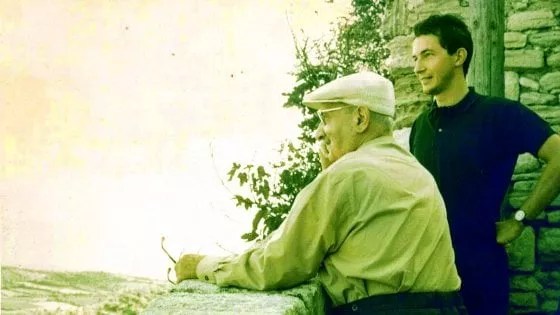
But he has become more autobiographical, taking stock of his life’s work. Next year a translation of The Time of Thinking: The Le Thor Seminars with Heidegger (1966 and 1968) is due to be published, which includes his notes from those seminars in Provence. There is a striking photograph of the young Agamben standing next to Heidegger from that time. A couple of years ago Agamben published Self-Portrait in the Studio, which is an interesting conceit – narrating something of his career through reflections on paintings, objects, and photographs which surrounded him in places he has worked, or photographs of those places.
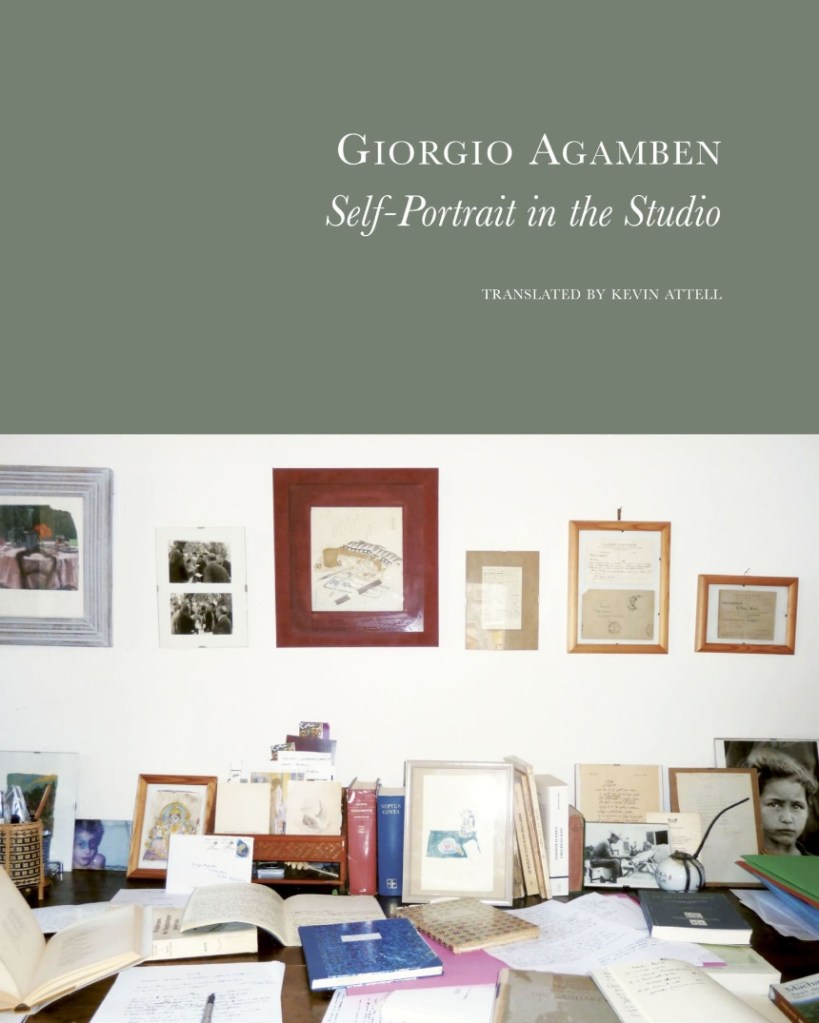
There is a lot going in this book, which connects up people, places and reflections on the writing of his work. The book had to be illustrated to work, and it is a visual feast. Among the parts which particularly struck me was his discussion of the photograph with Heidegger, recalling the seminar and the countryside near Le Thor.
What did the meeting with Heidegger in Provence mean to me? I certainly cannot separate it from the place where it happened—his face at once gentle and stern, intense and uncompromising eyes that I have never seen elsewhere save in a dream (p. 10).
There are some other photographs of Heidegger at the seminar or nearby, which I’d not seen before – a group walking, with Heidegger next to René Char; a group where Heidegger is talking to Agamben and Jean Beaufret; Heidegger and the group watching people playing pétanque. There are also images of some postcards sent to Agamben by Heidegger.
Agamben says that at the second seminar he talked to Heidegger about Hannah Arendt, and asked for her address in New York (p. 22). He wrote an English letter to her in 1970 (available here), expressing admiration for her work, and sending her an essay about violence, which he says she “had the generosity to cite it in a note included in the German edition of her book On Violence” (p. 23).
Later in the book, Agamben talks about his own writing practices, again spurred by an old photograph:
On the right-hand side of the desk in Vicolo del Giglio you can see eight similar notebooks bound in different colours. They are notebooks in which I write down thoughts, observations, reading notes, citations—on rare occasions dreams, meetings or particular events. They are an essential part of my research laboratory and they often contain the first germ or the materials of a future book or one that I am in the process of writing (p. 73).
He says that there are now thirty notebooks, begun in 1979 and filling a shelf on a bookcase. The notebooks are being published in Italian – with the first volume covering some early notes and the first two notebooks from1979 to 1981. Four volumes have been published so far – the first three volumes chronologically and the one relating to the pandemic years. I’m sure for people more invested in Agamben than me they will be invaluable in reconstructing the trajectory of his thought. In Self-Portrait he goes on:
To be sure, compared to my finished books, these notebooks, with their hurried and ragged handwriting, are a more faithful image of potentiality, which keeps intact the possibility to be and not to be, or to be otherwise. In this sense, these notebooks are my studio. This is why I prefer them to my published books and at times wish I had not carried them across the threshold towards final publication. I have many times thought about writing a book that was only the proem or postlude of a missing book. Perhaps the books that I have published are something of this sort—not books but preludes or epilogues (p. 73).
But this passage about the notebooks and the books ends with a remarkable sentence: “A writer’s secret lies entirely in the blank space that separates the notebooks from the book” (p. 73).
I’m not sure what’s in the notebooks, but for my more recent interests, I was struck by a discussion of an unrealised project:
While discussing our plans for a journal with Claudio [Rugafiori], I was taking notes for a series of portraits of the great representatives of the general science of the human, which I thought I could glimpse, as in a dream, in our conversations. Aby Warburg’s was the only one of these portraits I brought to completion; of the unfinished others, I one I cared about most was to be devoted to Émile Benveniste, the linguist whose work has never ceased to accompany me since I first read it at the beginning of the seventies (p. 157).
He goes on to say a little about Benveniste, and some people will know he wrote a preface to the 2016 re-edition of Benveniste’s masterwork, translated as the Dictionary of Indo-European Concepts and Society. But an earlier portrait sounds intriguing, and I hope something of it will be revealed in the published notebooks.
As these comments indicate, I enjoyed Self-Portrait in the Studio and will certainly get a copy of The Time of Thinking. I suspect that some other more recent books will be interesting, but equally frustrating. I remember once making the comment that Agamben was more persuasive the less you knew about who or what he was writing about. I’m not sure that’s entirely fair, but there might be something in it. Derrida, for me, in contrast, is an example of someone who is often more interesting than the object of his analysis. An earlier piece in this series, Huguette Fugier’s study of the vocabulary of the sacred in Latin, and Giorgio Agamben’s other sources for the notion of the homo sacer, tracked the references in his work back to earlier sources, and other discussions of the notion.
There is a lot more in Self-Portrait in the Studio which interested me, about his reading of Walter Benjamin and meeting Gershom Scholem, for example. Agamben also speaks of Friedrich Hölderlin, and Giorgio Colli’s edition of Friedrich Hölderlin’s Scritti sulla poesia e frammenti as “a book that has continuously accompanied me” (p. 41). Colli is better known to me as the editor of Nietzsche, along with Mazzino Montinari. My first academic journal article was on Heidegger’s reading of Hölderlin, a part of my PhD which was reworked into my first book. Agamben’s Hölderlin’s Madness: Chronicle of a Dwelling Life, 1806-1843 will probably be the next of his books I read.
References
Giorgio Agamben, The Use of Bodies: Homo Sacer IV, 2, trans. Adam Kotsko, Stanford: Stanford University Press, 2015.
Giorgio Agamben, The Omnibus Homo Sacer, trans. various, Stanford: Stanford University Press, 2017.
Giorgio Agamben, Where Are We Now? The Epidemic as Politics, trans. Valeria Dani, London: Bloomsbury, 2021.
Giorgio Agamben, Hölderlin’s Madness: Chronicle of a Dwelling Life, 1806-1843, trans. Alta L. Price, London: Seagull, 2023.
Giorgio Agamben, Self-Portrait in the Studio, trans. Kevin Attell, London: Seagull, 2024.
Giorgio Agamben, The Time of Thinking: The Le Thor Seminars with Heidegger (1966 and 1968), trans. Francesco Guercio and Ian Alexander Moore, London: Seagull, forthcoming 2027.
Émile Benveniste, Dictionary of Indo-European Concepts and Society, trans. Elizabeth Palmer, foreword Giorgio Agamben, Chicago: Hau, 2016.
This is the 100th post of a weekly series, posted every Sunday throughout 2025 and 2026. I never imagined I’d keep up the weekly rhythm for this long. The posts are short essays with indications of further reading and sources. They are not as formal and developed as something I’d try to publish more conventionally, but are hopefully worthwhile as short sketches of histories and ideas. They are usually tangential to my main writing focus, a home for spare parts, asides, dead-ends and possible futures. I hope there is some interest in them. They are provisional and suggestions are welcome. A few, usually shorter, pieces in a similar style have been posted mid-week.
I discuss what I am doing in this series in “Writing the ‘Sunday histories’ – an experiment in sharing short pieces on a blog”, my contribution to the Northern Ireland Legal Quarterly “Reflections on Writing” Series – all pieces are open access.
The full chronological list of ‘Sunday histories’ is here, with a thematic ordering here.
Discover more from Progressive Geographies
Subscribe to get the latest posts sent to your email.


