The Editors of the Northern Ireland Legal Quarterly are excited to announce the launch of a new opinion-style series of pieces: ‘Reflections on Writing’ (2025 NILQ 76) and Reflections on Writing (2026 NILQ 77).
We are inviting authors to think about their own writing practices. To ask, for example, why do I write? How do I write? Where do I write? How do I carve out the time and space to write? How do I improve my writing? How has my approach to writing changed? Who has influenced my writing practices? What is the value of writing in the contemporary scholarly context?
These are among the questions many scholars ponder wherever they are on their scholarly journey, but seldom articulate to an audience, let alone publish, or even have an opportunity to publish. This new series seeks to develop dialogue around these and other related questions.
The Editors of the NILQ believe that such a dialogue is all the more pressing given the very many constraints put on colleagues in academia at different points in their careers. So, we have invited scholars to write up their thoughts on these — and other — questions. Authors have been given the freedom to select their leading question or prompt for reflection, and to express their thoughts however they wish within the broad remit of the series.
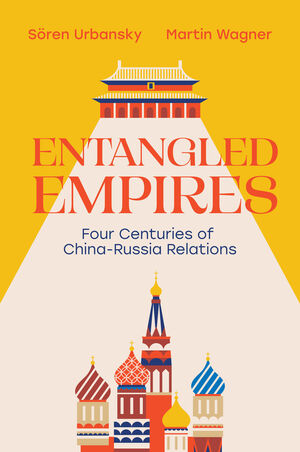
As expansionist empires, socialist superpowers and authoritarian regimes, China and Russia have much in common. While many in the West fear the formation of an authoritarian alliance between these two great powers, and while Vladimir Putin and Xi Jinping call themselves ‘good friends’, the geopolitical interests of Beijing and Moscow are often at odds with each other. They may be comrades, but they don’t always march to the same beat.
In order to gain a clear understanding of China–Russia relations in the twenty-first century, we need first to understand the long history that brought them to this point. In Entangled Empires, Sören Urbansky and Martin Wagner offer an introduction to the 400-year history of these two distant neighbours: from their first official contact in 1618 and the falling out of the two communist regimes under Khrushchev and Mao, through to China’s response to Russia’s full-scale invasion of Ukraine in 2022.
This expertly researched history of the relationship between these two nations will be essential reading for all students and scholars of Chinese and Russian history and politics, and for anyone interested in the changing balance of power in the world today.
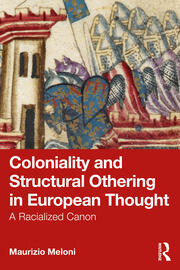
This book provides a historical and conceptual analysis of patterns of racialized otherness in European thought, traversing primary sources, historical periods, and national archives, to show that the longue durée of structural othering beyond individual disciplinary canons is essential to making sense of epistemic violence and structural coloniality in the European canon.
Through the analysis of published texts and personal letters, the book brings to light racializing tropes and patterns of othering in four canonical authors each representing a different Western European country: Italian father of humanism Francesco Petrarca (Petrarch), Charles Darwin, Norbert Elias and Michel Foucault. The chapters on Italian humanism begin by highlighting how one of the founding myths of European modernity was shaped by a protocolonial mentality and the violent excision of Arabic sources, whilst the chapter on Darwin analyses the importance of shooting and frontier wars in the Beagle voyage and the vicissitudes of the term ‘extermination’ in Darwin’s thought. Elias’s civilizing narrative is unpacked to highlight his omission of colonial violence in parallel to the development of court etiquette in the metropoles. Finally, Foucault’s belief in the uniqueness of the Greek experience goes in parallel with his deletion of Islamic presence in the genealogy of modern governmentality. The initial and final chapters offer an ethnography of forgotten ethnic violence and racialized monuments in Italy linked with the distinctive history of Italian colonialism and ‘eternal fascism’.
It will appeal to scholars, researchers and students with interests in social theory, sociology, political theory, cultural studies, history, history of science, and postcolonial and ethnic studies.
Michel Foucault is considered one of the most important philosophers of the 20th century. Marita Rainsborough examines the current relevance of his work with reference to the post- and decolonial theories of Achille Mbembe, Homi Bhabha and Walter D. Mignolo in a global context. She incorporates the philosophy of Judith Butler and Byung-Chul Han as well as New Realism into the critical reading of Foucault, and emphasises the philosophical references to Bloch and Kant that have so far been neglected in his reception. Considering the subject between knowledge, power, ethics and aesthetics, an overall review as well as new aspects for the philosophical discussion of this French classic are offered.
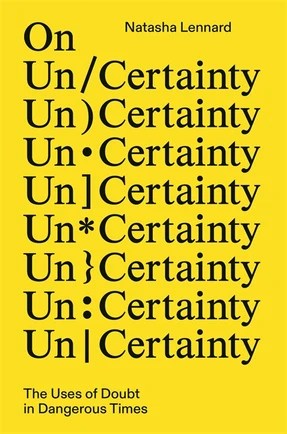
We live in uncertain times. But what does uncertainty mean for our ability to act?
While politicians, CEOs, and pundits reflexively invoke “uncertain times” to explain everything from pandemic responses to climate inaction, journalist and theorist Natasha Lennard offers a radical intervention. Lennard demonstrates how our obsession with uncertainty masks the violent certainties that dominate our fracturing world.
On Un/Certainty applies philosophical insight to political practice, offering readers not just analysis but hope—and conceptual tools with which to act. The book tackles contemporary flashpoints through an original philosophical lens, demystifying our constant talk of crisis, polycrisis, and omnicrisis. Lennard examines the way entrenched conceptions of gendered experience are weaponized to harass the most vulnerable. Dissecting the discourse around borders, she reveals their enforcement to be a site of paranoid vigilance and violent property logics, which threaten millions of lives. Lennard addresses head-on the limits to traditional forms of political persuasion and demands that we think anew about how to build more liberatory forms of life.
Drawing on the philosophy of Ludwig Wittgenstein and placing his work alongside thinkers rarely put into conversation, Lennard contends with the nature of certainty, identity, and ideology as we struggle into the future.
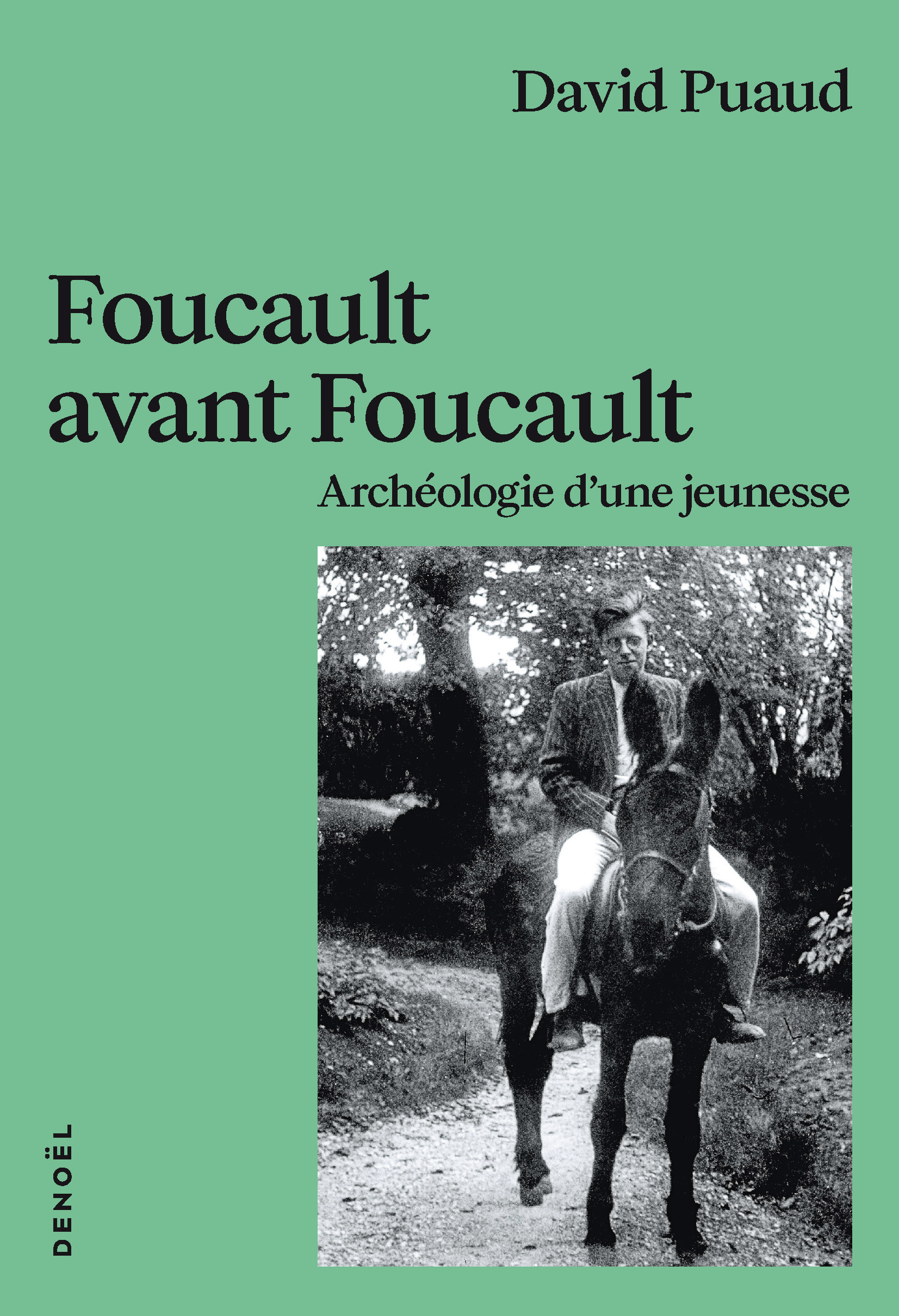
À l’occasion du centenaire de la naissance de Michel Foucault, première enquête sur la jeunesse de l’un des penseurs les plus influents du monde contemporain.
Raconter les années de formation de Michel Foucault, c’est comprendre comment une pensée prend forme. Il est étonnant de voir à quel point les thèmes qui jalonnent son œuvre – la psychiatrie, la religion, le système carcéral, le pouvoir arbitraire – sont inscrits dans les murs, les sols et l’histoire de sa ville natale, Poitiers. Avec le jeune Michel, nous entendons les murmures de la maison familiale rue Arthur-Ranc, nous arpentons les couloirs de la clinique de Pont-Achard où travaille son père, les salles feutrées de l’Institut Larnay, école pour enfants sourds-muets-aveugles, les pierres silencieuses de l’abbaye de Ligugé qui abrite un vaste réseau de Résistance. Ces lieux originels sont plus qu’un simple décor, ils contiennent en germe une pensée qui connaîtra un retentissement mondial. David Puaud marche dans les pas de Foucault et feuillette la ville comme un livre : institutions, rituels et rencontres, autant de traces et de fantômes qui éclairent la genèse d’une pensée appelée à irriguer durablement les sciences humaines et sociales.
It’s not the first book on these early years, as aside from the biographies, Michael C. Behrent, Becoming Foucault: The Poitiers Years came out with Penn Press in December 2023. But it sounds interesting.
Update: I should have noted that there is a short interview with Foucault’s brother, in English in Foucault Studies, about their childhood. Among other things it reveals that the name of the donkey in the above photograph was Cyrano.
Further details of this are now on the Gallimard site. It is edited by Fabienne Brion, Julien Cavagnis, Sajjad Lohi and Chowra Makarem, and a fuller description has been posted. This indicates that as well as the reports, most of which were collected in Dits et écrits, there are also some of the critical assessments of Foucault from the time, and draft material from his archives. At 400 pages, it’s a substantial volume.
À l’automne 1978, Michel Foucault se rend en Iran pour réaliser un « reportage d’idées » sur le soulèvement contre le régime du shah. Dix articles sont publiés par le Corriere della Sera, dans lesquels il tente de comprendre la révolte, sa forme singulière et ses aspirations. Un exercice à la croisée de la philosophie et du journalisme, « où l’analyse de ce que l’on pense [est] liée à celle de ce qui advient ». À l’époque, un seul de ces articles est aussi publié en français, dans Le Nouvel Observateur. Il est à l’origine d’une polémique qui a traversé les années : Michel Foucault, en Iran, aurait été séduit par l’élan révolutionnaire au point d’être aveugle à son potentiel autoritaire, bientôt manifesté par la République islamique de l’ayatollah Khomeyni. Pourtant, le reportage ne relève ni d’un soutien à un régime qui n’existe pas encore, ni d’une fascination pour l’islam politique, dont Foucault perçoit les ambiguïtés et les dangers. Il est le témoignage d’un des rares intellectuels français à s’être rendus sur place pour comprendre au nom de quoi les Iraniens et les Iraniennes ont pu risquer leur vie dans une révolte fédérant des classes sociales et des mouvements politiques et religieux si différents. Le présent ouvrage réunit pour la première fois l’ensemble des articles du reportage, les critiques parues dans la presse de l’époque, ainsi que les réponses et réflexions de Foucault à ce propos. On y trouve aussi une sélection d’archives inédites – notes prises sur le vif et premières ébauches d’une pensée, toujours actuelle, de « l’événement Iran ».
In an interview with Maria Lúcia G. Pallares-Burke in October 1998, published in The New History: Confessions and Conversations, Carlo Ginzburg mentions the critical attitude he has to some of his earlier works. One was his 1970 book Il nicodemismo: Simulazione e dissimulazione religiosa nell’Europa del Cinquecento [Nicodemism: Religious pretence and dissimulation in sixteenth-century Europe]:
I don’t like it because it is perhaps the most academic book I ever wrote… I wouldn’t like to repudiate the book completely (there being something in its research strategy that I still feel close to), although I have always refused permission for republication, since that would require a long introduction explaining what is wrong with some of its chapters (pp. 198-99).
This book remains untranslated into English, one of only a few of Ginzburg’s books not available in that language. (The original Italian is out of print, but available on archive.org) He also mentions a collaborative work:
Another book that seems strange today is Giochi de Pazienza, which I wrote with my friend Adriano Prosperi, telling the story of our joint research on sixteenth-century religious tracts. I never really understood why Einaudi decided to reprint it. It is in a deliberate way a rather unreadable book. But its research core was quite sound, as Adriano Prosperi will show in the book he has been working on for years on Giorgio Siculo, a sixteenth-century Benedictine monk put to death as a heretic. But Giochi di Pazienza was also a sort of methodological manifesto. I developed some of its themes in my essay on clues (The New History,p. 199).
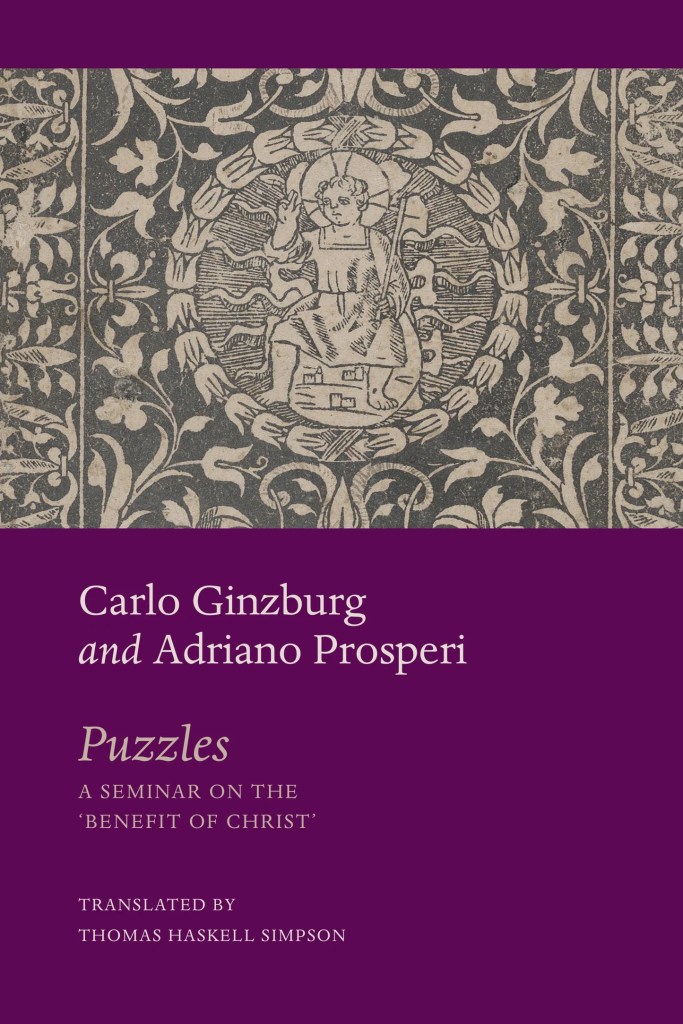
Giochi de Pazienza might translate as ‘games of patience’, a play on the card game sometimes known as solitaire. First published in 1975, and reissued in 2020, the book was finally translated into English in 2026 as Puzzles: A Seminar on the ‘Benefit of Christ’, just a few months before Ginzburg died. The second edition and its translation has two reflective essays by Ginzburg and Prosperi. It is part of the Italian List at Seagull, edited by Alberto Toscano. That series has been so valuable in making work available in English for those of us who can’t read more than a little Italian.
I wrote about the ‘Clues’ essay in an earlier piece in this series, about Ginzburg’s approach of the historian as a detective. I also outlined the different versions of that text which exist. I should have noted there that Italo Calvino’s short essay on that text is included in his The Written World and the Unwritten Worldcollection.The Adriano Prosperi reference given by Ginzburg in the interview quotation is L’eresia del Libro Grande: Storia di Giorgio Siculo e della sua setta[The Heresy of the Great Book: The History of Giorgio Siculo and his sect], which was published in 2000.
Puzzles is a very interesting book. I can’t pretend to have been able to follow all of the details of the text and the issues about its dating and provenance, but I found the narration of the process of research fascinating. Christopher Smith has a very interesting piece about Puzzles, and what it shows about reading, at “Clio reads a book” on his Anatomies of Power site. As he says there:
1968, Bologna. Two young professors look for a new way of teaching as the clouds of revolution swirl. What is history? How to do it? What are the rules and what is the endpoint, and who are the historians? They take up a text, the Beneficio di Cristo, and let the students pick it apart. They followed the clues, hunted in the libraries in a way that is familiar to my generation, but increasingly unfamiliar as catalogues and texts are digitised. They had to rely on chance, and on memory (“I’ve read that somewhere before!”). And then they did something even more radical – they jointly published a book of their intellectual journey, its missteps and mistakes, the backtracking, disagreements, the recognition of their own preconceptions.
In his tribute in Pittsburgh Review of Books, Reading Vertically and Horizontally with Carlo Ginzburg, Nitzan Lebovic says that when he arrived at UCLA he asked for guidance: “When I asked my friends what I should study with Carlo, their advice was simple: It doesn’t matter. Take whatever he’s teaching — it’s always an intellectual whirlwind”. You get a sense from Puzzles why that might be, though you should look at Lebovic’s piece to read his anecdote of being initiated into historical research by Ginzburg.
Here’s one passage I particularly liked from Puzzles:
There comes a moment (not always) in the course of research when, as in a jigsaw puzzle, all the pieces begin to fall into place. But unlike a jigsaw puzzle, where all the pieces are to hand and there is only one picture to be formed (so that the correctness of each move can be checked at once), in research only some of the pieces are available, and the pictures that can be composed are, in theory, more than one. There is always the risk, in fact, of using the jigsaw pieces, consciously or not, as building blocks. The fact that everything appears to fit is therefore an ambiguous sign: either one is completely right or one is completely wrong. In the latter case, what is taken for external verification is in reality the selection and prodding (more or less deliberate) of the evidence, manipulated to confirm the (more or less explicit) presuppositions of the research. The dog thinks it is gnawing the bone, and instead it is chewing its own tail (p. 102).
In his 2020 “Afterword”, Ginzburg adds that “a group of young Bolognese writers, concealed behind the pseudonym Luther Blissett, [wrote] a historical novel inspired by the characters and events at the centre of Puzzles (Q, 1999; one of the chapters is entitled ‘Il Beneficio di Cristo’)” (p. 254). It’s been many years since I read Q, and I hadn’t made the connection until I read this “Afterword”. The collective ‘Luther Blissett’ was named after a former football player, and some of the group later went on to found the group ‘Wu Ming’, who have authored many novels. Wu Ming have a tribute to Ginzburg on their website. This connection promises to be explored in Andrea Brondino’s forthcoming book Narrative and History in the Works of Umberto Eco, Carlo Ginzburg, and Wu Ming: Untangling the Strands.
Justice Blindfolded examines how ‘justice’ is often portrayed as a woman with bandaged eyes, how this relates to the crucified Christ, and ideas of justice as fairness, as impartiality. It is an extraordinary study, historically wide-ranging and strikingly illustrated, moving between religious and legal history, with analysis of artworks and texts. It moves from the Bible to Bentham and Rousseau to Rawls, and deserves to be better-known by political theorists as much as historians.
I don’t think there is an English translation of Prosperi’s L’eresia del Libro Grande, the book which Ginzburg suggests demonstrates the soundness of the “research core” of Puzzles. Like Ginzburg’s book on Nicodemism, it is out of reach for non-Italian readers… Maybe two others for ‘The Italian List’.
References
Luther Blissett, Q, trans. Shaun Whiteside, London: Heinemann, 2003.
Andrea Brondino, Narrative and History in the Works of Umberto Eco, Carlo Ginzburg, and Wu Ming: Untangling the Strands, London:Bloomsbury, forthcoming December 2026.
Italo Calvino, The Written World and the Unwritten World: Collected Non-Fiction, trans. Ann Goldstein, London: Penguin, 2023.
Guido Dall’Olio, Adelisa Malena and Pierroberto Scaramella eds. La Fede degli italiani: Per Adriano Prosperi vol. I, Pisa: Edizioni della Normale, 2011.
Wietse de Boer, Vincenzo Lavenia and Giuseppe Marcocci eds. La Ghianda e la quercia: Saggi per Adriano Prosperi, Roma: Viella, 2019.
Massimo Donattini, Giuseppe Marcocci and Stefania Pastore eds. L’Europa divisa e I nuovi mondi: Per Adriano Prosperi vol. II, Pisa: Edizioni della Normale, three volumes, 2011.
Carlo Ginzburg, Il nicodemismo: Simulazione e dissimulazione religiosa nell’Europa del Cinquecento, Torino, Einaudi, 1970.
Carlo Ginzburg, Nevertheless: Machiavelli, Pascal, London: Verso, 2022.
Carlo Ginzburg and Adriano Prosperi, Giochi di Pazienza: Un Seminario sul «Beneficio di Cristo», Torino: Einaudi, 1975, second edition, Macerata: Quodlibet, 2020; Puzzles: A Seminar on the ‘Benefit of Christ’ – trans. Thomas Haskell Simpson, Calcutta: Seagull, 2026.
Vincenzo Lavenia and Giovanna Paolin eds. Riti di passaggio, storie di giustizia: Per Adriano Prosperi vol. III, Pisa: Edizioni della Normale, three volumes, 2011.
This is the 87th post of a weekly series, posted every Sunday throughout 2025, and continuing into a second year. The posts are short essays with indications of further reading and sources. The pieces are not as formal as something I’d try to publish more conventionally, but are hopefully worthwhile as short sketches of histories and ideas. They are usually tangential to my main writing focus, a home for spare parts, asides, dead-ends and possible futures. I hope there is some interest in them. They are provisional and suggestions are welcome. A few, usually shorter, pieces in a similar style have been posted mid-week.
The full chronological list of ‘Sunday histories’ is here, with a thematic ordering here.
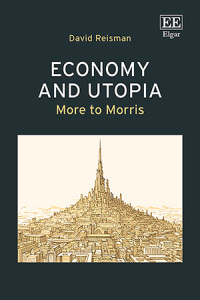
In this insightful book, David Reisman examines the various notions of a utopia that emerged in opposition to feudalism and capitalism between the publication of Thomas More’s Utopia in 1516 and William Morris’s News from Nowhere in 1890. The book adopts an interdisciplinary approach to analysing the concept of a utopia, its sources and roots and the spectrum of thought surrounding how it should be created.
Reisman evaluates the ideas of renowned and lesser-known authors such as Francis Bacon, Henri de Saint-Simon, Gerrard Winstanley, Étienne Cabet, James Harrington and Edward Bellamy, who imagined an earthly paradise to replace social division and economic underperformance. The book explores science, communism, cooperation, citizenship, the constitution and the dystopia of control. It shows how utopian ideals continue to challenge narrow individualism. Providing a unique depth of coverage in this field, Reisman assesses how market exchange, cut-throat competition and private property would yield to a new and more communitarian approach to life and work.
Economy and Utopia is a crucial resource for students and scholars of economics and finance, political theory, public policy and philosophy. Its focus on past efforts to improve society will also benefit researchers in history and sociology.
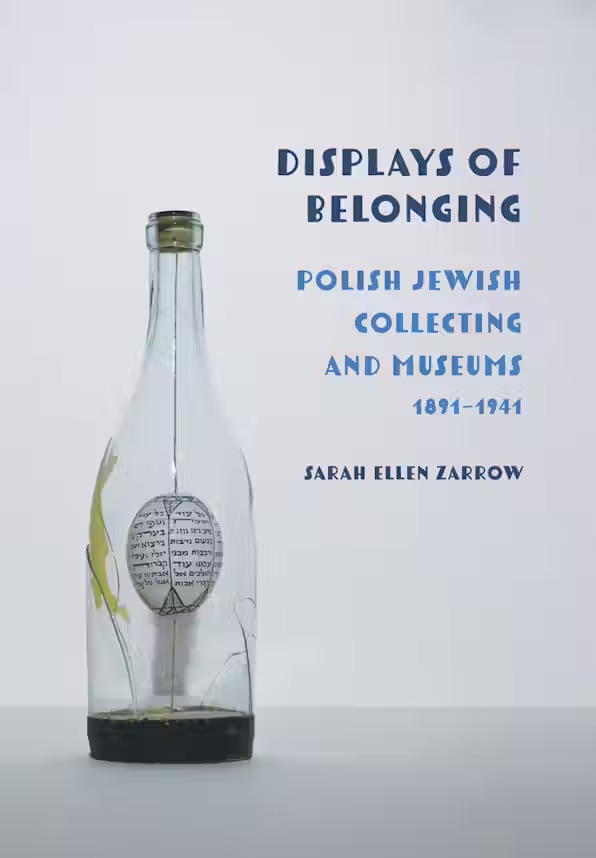
Displays of Belonging illuminates the lives and work of Polish Jewish collectors and museologists, who sought to preserve the treasures of the Jewish past while demonstrating Jewish belonging on Polish soil. As Jews comfortable in the Polish language and within Polish artistic and academic society, they saw themselves as intermediaries between less-integrated Jews and the Polish cultural elite.
At the turn of the century, Jewish ethnographers and museum creators staked their claim to belonging to the civic nation though the display of Jewish folk art, fine art, and Judaica. After the First World War, the nearly three million Jews in the Second Polish Republic were suddenly challenged with finding a place for themselves in a state that increasingly defined itself as a creation of the ethnic Polish nation, to which Jews, by many accounts, did not belong.
By tracing emergent documentation and display practices in partitioned Poland and in the interwar Second Polish Republic, Sarah Ellen Zarrow offers a better understanding of how integrated Jews identified with Polish culture and history and with non-Jewish Poles, and how they conceived of, negotiated, and argued their collective place within Poland. This is not a case of assimilation, nor of acculturation, but rather of displaying a parallel culture that was at once similar and yet distinctive.
Displays of Belonging offers a nuanced understanding of the multiplicity of ways in which Jews in Poland saw their present and dreamed of their future. It places Jewish ethnographic practice and art collection within a Polish context, and sheds light on ways in which ideas about belonging and national identity were negotiated in the space of museums.