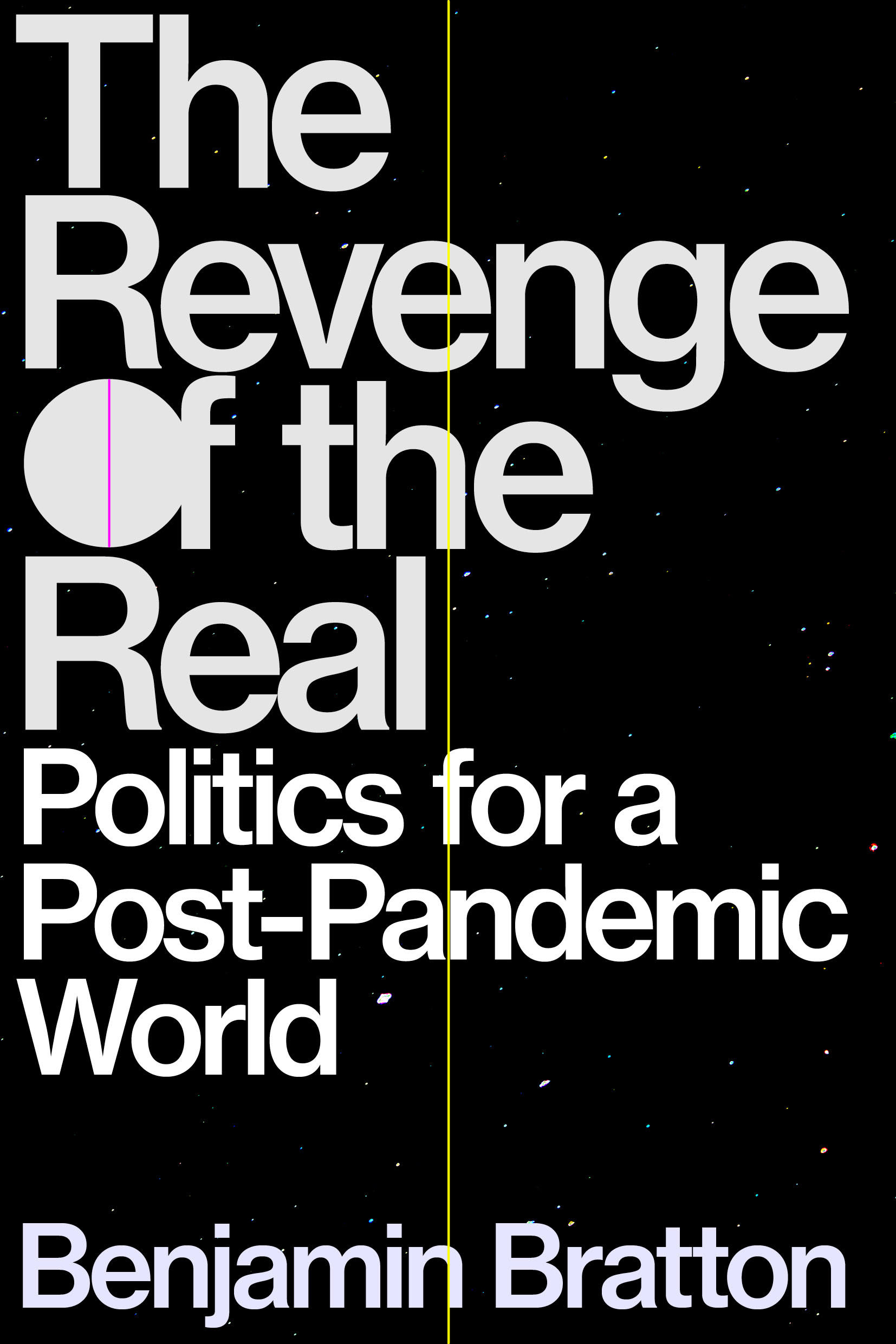
Benjamin Bratton, The Revenge of the Real: Post-Pandemic Politics – Verso, June 2021

Benjamin Bratton, The Revenge of the Real: Post-Pandemic Politics – Verso, June 2021

COVID-19 exposed the pre-existing conditions of the current global crisis. Many Western states failed to protect their populations, while others were able to suppress the virus only with sweeping social restrictions. In contrast, many Asian countries were able to make much more precise interventions. Everywhere, lockdown transformed everyday life, introducing an epidemiological view of society based on sensing, modeling, and filtering. What lessons are to be learned?

The Revenge of the Real envisions a new positive biopolitics that recognizes that governance is literally a matter of life and death. We are grappling with multiple interconnected dilemmas—climate change, pandemics, the tensions between the individual and society—all of which have to be addressed on a planetary scale. Even when separated, we are still enmeshed. Can the world govern itself differently? What models and philosophies are needed? Bratton argues that instead of thinking of biotechnologies as something imposed on society, we must see them as essential to a politics of infrastructure, knowledge, and direct intervention. In this way, we can build a society based on a new rationality of inclusion, care, and prevention.

Posted in Uncategorized | Leave a comment

Toposophia: thinking place/making space – relaunch of book series with Lexington books, edited by Jessica Dubow and Jeff Malpas

Toposophia: thinking place/making space – relaunch of book series with Lexington books, edited by Jessica Dubow (Sheffield) and Jeff Malpas (Tasmania).

Originally established by Robert Mugerauer and Brian Treanor, Toposophia is being continued in a new form under the editorial direction of Jessica Dubow and Jeff Malpas. Retaining the original focus on the combination of topos and sophia, and so on the reflective and critical engagement with issues of place and space, the series now has an expanded brief encompassing a wide range of disciplines from geography and environmental studies through to anthropology and politics, architecture and creative arts, history and philosophy. The aim is to make Toposophia the premier series for cutting edge explorations and investigations of the spatial and topological.

Peer-reviewed, and publishing in paper and hardback as well as electronically, the series includes monographs and edited collections. The editors encourage new proposals in keeping with the expanded brief. Proposals and inquiries should be addressed to Jana Hodges-Kluck (jhodges-kluck@rowman.com) or Jeff Malpas (jeff.malpas@utas.edu.au).

The series page is here, which gives the links to previously published volumes.

Posted in Uncategorized | Leave a comment

Foucault – Duby – Dumézil – Changeux – Thom : Cinq grands entretiens au Champ Freudien (2021)

A collection of interviews – the Foucault one is in Dits et écrits and translated as ‘The Confession of the Flesh’ in Power/Knowledge.

Clare O'Farrell's avatarFoucault News

Foucault – Duby – Dumézil – Changeux – Thom : Cinq grands entretiens au Champ Freudien, Navarin – Février 2021
Introduction par Christiane Alberti, Deborah Gutermann-Jacquet, France Jaigu

Lacan a toujours insisté pour que les psychanalystes ne s’isolent pas, mais s’ouvrent aux autres disciplines. Son enseignement porte la trace d’un intérêt constant pour les différents champs du savoir.
La psychanalyse a une affinité fondamentale avec la conversation. Ce volume invite à raviver les connexions.

Sont ici réunis cinq grands entretiens avec des figures de l’effervescence théorique d’une époque où la psychanalyse conversait à bâtons rompus avec les autres disciplines : Foucault, Dumézil, Duby, côté philosophie, anthropologie, histoire ; Changeux et Thom, côté biologie, épistémologie.

On y rencontre le scientifique aux prises avec son objet et ce qui résiste à sa saisie. On interroge, on ferraille. L’enquête est sérieuse, le ton enjoué. Les voix vibrent, l’énonciation est fulgurante. Échanges et…

View original post 70 more words

Posted in Uncategorized | Leave a comment

Martin Jay, Genesis and Validity: The Theory and Practice of Intellectual History – Penn Press, November 2021

Martin Jay, Genesis and Validity: The Theory and Practice of Intellectual History – Penn Press, November 2021

There is no more contentious and perennial issue in the history of modern Western thought than the vexed relationship between the genesis of an idea and its claim to validity beyond it. Can ideas or values transcend their temporal origins and overcome the sin of their original context, and in so doing earn abiding respect for their intrinsic merit? Or do they inevitably reflect them in ways that undermine their universal aspirations? Are discrete contexts so incommensurable and unique that the smooth passage of ideas from one to the other is impossible? Are we always trapped by the limits of our own cultural standpoints and partial perspectives, or can we somehow escape their constraints and enter into a fruitful dialogue with others?

These persistent questions are at the heart of the discipline known as intellectual history, which deals not only with ideas, but also with the men and women who generate, disseminate, and criticize them. The essays in this collection, by one of the most recognized figures in the field, address them through engagement with leading intellectual historians—Hans Blumenberg, Quentin Skinner, Hayden White, Isaiah Berlin, Frank Ankersmit—as well other giants of modern thought—Max Weber, Emile Durkheim, Georg Simmel, Walter Benjamin, Theodor Adorno, and Georg Lukács. They touch on a wide variety of related topics, ranging from the heroism of modern life to the ability of photographs to lie. In addition, they explore the fraught connections between philosophy and theory, the truth of history and the truthfulness of historians, and the weaponization of free speech for other purposes.

Martin Jay is Ehrman Professor of European History Emeritus at University of California, Berkeley. He is author of numerous books, including The Dialectical Imagination: A History of the Frankfurt School and the Institute of Social Research, 1923-50 and Reason After Its Eclipse: On Late Critical Theory.

Posted in Quentin Skinnner, Walter Benjamin | Leave a comment

Paul Gilroy and Ruth Wilson Gilmore – video discussion of Stuart Hall: Selected Writings on Race and Difference

Paul Gilroy and Ruth Wilson Gilmore – a really interesting video discussion of Stuart Hall, Selected Writings on Race and Difference (Duke University Press, 2021). Thanks to dmf for this link.

In this Theory from the Margins event, we discuss Stuart Hall: Selected Writings on Race and Difference, edited by Paul Gilroy and Ruth Wilson Gilmore. In Selected Writings on Race and Difference, editors Paul Gilroy and Ruth Wilson Gilmore gather more than twenty essays by Stuart Hall that highlight his extensive and groundbreaking engagement with race, representation, identity, difference, and diaspora. Spanning the whole of his career, this collection includes classic theoretical essays such as “The Whites of their Eyes” (1979) and “Race, the Floating Signifier” (1997). It also features public lectures, political articles, and popular pieces that circulated in periodicals and newspapers, which demonstrate the breadth and depth of Hall’s contribution to public discourses of race. Foregrounding how and why the analysis of race and difference should be concrete and not merely descriptive, this collection gives organizers and students of social theory ways to approach the interconnections of race with culture and consciousness, state and society, policing and freedom.

Paul Gilroy is one of the foremost theorists of race and racism working and teaching in the world today. Author of foundational and highly influential books such as There Ain’t No Black in the Union Jack (1987), The Black Atlantic: Modernity and Double Consciousness (1993), Against Race (2000), Postcolonial Melancholia (2005) and Darker Than Blue (2010) alongside numerous key articles, essays and critical interventions, Gilroy’s is a unique voice that speaks to the centrality and tenacity of racialized thought and representational practices in the modern world. He has transformed thinking across disciplines, from Ethnic Studies, British and American Literature, African American Studies, Black British Studies, Trans-Atlantic History and Critical Race Theory to Post-Colonial theory. He has contributed to and shaped thinking on Afro-Modernity, aesthetic practices, diasporic poetics and practices, sound and image worlds. He is Professor of the Humanities and Founding Director, Sarah Parker Remond Centre for the Study of Racism & Racialisation at University College London.

Ruth Wilson Gilmore is professor of Earth & Environmental Sciences, and American Studies, and the director of the Center for Place, Culture, and Politics. She also serves on the Executive Committee of the Institute for Research on the African Diaspora in the Americas and the Caribbean. Co-founder of many grassroots organizations including the California Prison Moratorium Project, Critical Resistance, and the Central California Environmental Justice Network, Gilmore is author of the prize-winning Golden Gulag: Prisons, Surplus, Crisis, and Opposition in Globalizing California (UC Press). Recent publications include “Beyond Bratton” (Policing the Planet, Camp and Heatherton, eds., Verso); “Abolition Geography and the Problem of Innocence” (Futures of Black Radicalism, Lubin and Johnson, eds., Verso); a foreword to Bobby M. Wilson’s Birmingham classic America’s Johannesburg (U Georgia Press); and a foreword to Cedric J. Robinson on Racial Capitalism, Black Internationalism, and Cultures of Resistance (HLT Quan, ed., Pluto). Forthcoming projects include Change Everything: Racial Capitalism and the Case for Abolition (Haymarket); Abolition Geography (Verso); plus a collection of Stuart Hall’s writing on race and difference (co-edited with Paul Gilroy, Duke UP).

Get the book: https://www.dukeupress.edu/selected-w…

Learn More: Theory from the Margins: http://theoryfromthemargins.com​​

CoFUTURES: http://cofutures.org​​

Mythopolitics: http://mythopolitics.mf.no

Posted in Stuart Hall | 1 Comment

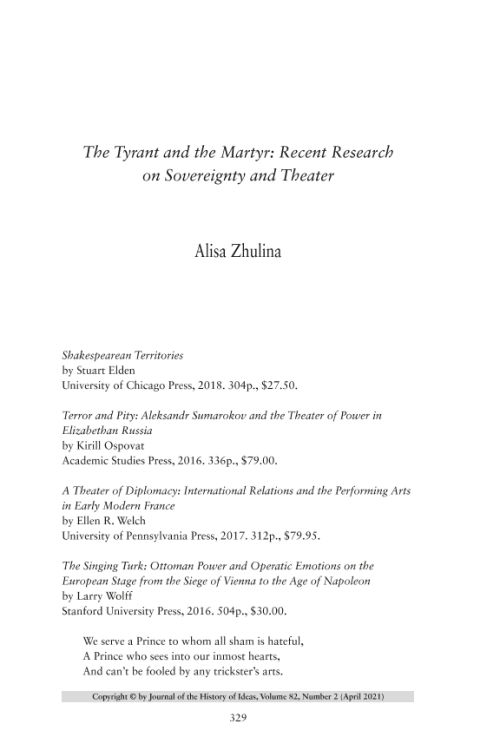
Alisa Zhulina, ‘The Tyrant and the Martyr: Recent Research on Sovereignty and Theater’ – review essay in Journal of the History of Ideas (including Shakespearean Territories)

Alisa Zhulina, ‘The Tyrant and the Martyr: Recent Research on Sovereignty and Theater‘ – review essay in Journal of the History of Ideas (requires subscription).

An interesting review essay, which includes discussion of my book Shakespearean Territories (University of Chicago Press, 2018).

Posted in Shakespearean Territories, Territory, William Shakespeare | 1 Comment

Rachael Squire, Undersea Geopolitics: Sealab, Science, and the Cold War – Rowman, July 2021

Rachael Squire, Undersea Geopolitics: Sealab, Science, and the Cold War – Rowman, July 2021

This book furthers academic scholarship in cutting-edge areas of geographical and geopolitical writing by drawing on a series of little-studied undersea living projects conducted by the US Navy during the Cold War (Project Genesis, Sealab I, II and III). Supported by an engaging and novel empirical setting, the central themes of the book revolve around the practice and construct of ‘territory’, ‘terrain’, the ‘elemental’ and the interrelationships between these material phenomenon and both human and non-human bodies. Furthermore, the book will point to future research trajectories in the form of ‘extreme geographies’ to better understand living practices in a world that is increasingly submerged and extreme.

Rachael Squire is a political geographer and lecturer in human geography at Royal Holloway, University of London. Her research engages with the concepts of territory, embodiment, and ‘volume’ with a particular focus on the space of the sea. 

Update: pleased to be one of the two people writing an endorsement of this book:

Extending critical geopolitical analysis to investigate an unlikely venue, Rachel Squire brilliantly shows how American cold war geopolitical culture was a combination of science, masculinity and exploration. This fascinating account of a nearly forgotten scientific project explores the underwater world of Sealab, its aquanauts, scientists and their dangerous experimental habitat, built in the quest to dominate the frontier space of the ocean.
— Simon Dalby, Balsillie School of International Affairs, Wilfrid Laurier University

A fascinating study of a little-known story in the Cold War. Using archival and other historical sources, Squire takes us beneath the surface to explore the world of Sealab with its multiple geographies. Engagingly written and conceptually innovative, this is an important contribution to political geography and wider debates about territory, volume and materiality.
— Stuart Elden, Professor of Political Theory and Geography, University of Warwick

Posted in Uncategorized | 1 Comment

Dante Fedele, The Medieval Foundations of International Law: Baldus de Ubaldis (1327–1400), Doctrine and Practice of the Ius Gentium – Brill 2021

Dante Fedele, The Medieval Foundations of International Law: Baldus de Ubaldis (1327–1400), Doctrine and Practice of the Ius Gentium – Brill 2021

This looks a really interesting study of Baldus, who was significant in the argument I make in The Birth of Territory. At over 700 pages, it’s clearly a major work, but unfortunately the book is only in hardback and prohibitively priced.

Dante Fedele’s new work of reference reveals the medieval foundations of international law through a comprehensive study of a key figure of late medieval legal scholarship: Baldus de Ubaldis (1327-1400). A student of Bartolus de Sassoferrato, Baldus wrote both extensive commentaries on Roman, canon and feudal law and thousands of consilia originating from particular cases. His writings dealt with numerous issues related to sovereignty, territorial jurisdiction, diplomacy and war, combining a rich conspectus of earlier scholarship with highly creative ideas that exercised a profound influence on later juristic thought. The detailed picture of the international law doctrines elaborated by a prominent medieval jurist offered in this study contributes to our understanding of the intellectual archaeology of international law. 

“Dr. Fedele’s monograph will no doubt become a necessary work of reference for any scholar interested in the history of international law. […] Beyond the specific doctrines on particular areas of international law, Dr. Fedele’s study of Baldus shows how in the area of international governance, jurists sought to marshal different expressions of normativity.” – Alain Wijffels, Foreword

Posted in Baldus de Ubaldis, Bartolus of Sassoferrato, Territory, The Birth of Territory | Leave a comment

Books received – Cavaillès, Eliade, Foucault, Hoffman, Derrida (with a note on the new Foucault editions)

The new translation of Jean Cavaillès, On Logic and the Theory of Science, some second-hand books by Eliade, a collective volume on Vincennes, the reedition of Foucault’s first two Collège de France courses, a special issue of the Carceral Notebooks on ‘Foucault and the Politics of Resistance in Brazil’, and Derrida’s Donner le temps II.

Carceral Notebooks 13: Foucault and the Politics of Resistance in Brazil was kindly sent to me by Marcelo Hoffman, who edited the volume. The essays are available open access here, though it’s nice to have a physical copy.

The Foucault lecture courses are the new editions. There is an interesting editorial note about this new edition, which notes that there is a difference in how the first courses published differ from the later ones. The initial courses (‘Society Must Be Defended’ and Abnormal, for instance) made limited use of the manuscripts, but largely transcribed the recordings. The courses published later made much more extensive use of written material. The series plans to re-edit courses with more attention to manuscripts, so the earliest published courses will have the most work. These two volumes, which were the first two courses delivered, were both later in the publication cycle, and also only used manuscripts as no recordings existed (or, at least, were known about). So there is probably relatively little that has changed here. But the potential changes will be greater in the courses to follow, since the recordings and manuscripts differ quite extensively – Foucault extemporised, cut material, etc. So there could be some interesting material to come.

Two other notes on this. Unfortunately the pagination between the original and these pocket editions differs. That’s going to make references start to differ as these editions supersede the initial ones. And I have no idea if Palgrave (or Penguin or Verso for the two earliest published) will do revised editions of the translations to take these revisions into account.

Posted in Jacques Derrida, Michel Foucault | 3 Comments

Books received – Hegel, Skinner, Pereltsvaig and Lewis, Kant (with a grumble about books in a series)

Some books received in recompense for review work for Cambridge University Press: The first four volumes of the Cambridge Hegel Translations, Quentin Skinner’s From Humanism to Hobbes: Studies in Rhetoric and Politics, The Indo-European Controversy, and Kant’s Lectures and Drafts on Political Philosophy.

The Kant volume is, I think, the only volume of this series I didn’t have before.

I’ve grumbled before about the appearance of books in a series, which is certainly the case with the way CUP have changed the format and size of these Kant texts. The red part on the spine seems to have been short-lived, etc. The Hegel ones all look the same, but then, it’s early in that series, and surprisingly, all of these books from CUP were print on demand.

Posted in Georg Wilhelm Friedrich Hegel, Immanuel Kant, Quentin Skinnner | Leave a comment